
What is RAG (Retrieval-Augmented Generation)? A Marketer's Guide
by Shai Belinsky9 Min.
Oct 01, 2026
A media buyer building a ChatGPT ads plan from audience data would start with the UK, the US and Australia. Those are the markets where the most ad-eligible users have seen an ad: 45.7%, 43.4% and 43.3% as of September 2026, according to Similarweb’s ChatGPT Ads panel. Click behavior tells a parallel story, with a different set of leaders. The US click-through rate (CTR) is 0.73% all-time, while Brazil sits at 1.91%, Mexico at 1.55% and Japan at 1.53%.
That gap is the clearest finding in the market data from The State of ChatGPT Ads, a report from Graphite built on Similarweb panel data. Brazil’s CTR is about 2.6 times the US figure, and Mexico’s and Japan’s are about 2.1 times. The five markets with the highest reach are also the five with the lowest CTR.
This article breaks down how many ad-eligible users see ChatGPT ads in each of the nine markets analyzed, then looks at which countries click the most, why reach and CTR point to different markets, and why the newest markets’ numbers need caution. It closes with Graphite’s 10-step playbook and what else to measure beyond CTR.
As of September 2026, between 27.8% (Mexico) and 45.7% (UK) of ad-eligible ChatGPT users had seen at least one ad, according to Similarweb’s ChatGPT Ads panel. What that range hides is more telling: in every market, including the US at 43.4%, most eligible users have not yet seen a ChatGPT ad. Exposure is still the minority experience, which fits the report’s description of advertisers as still in experimentation mode. Similarweb’s earlier analysis of ChatGPT ad stats showed how quickly the advertiser base was growing in June, driven by expansion to other markets, and this report adds click-through data by market.
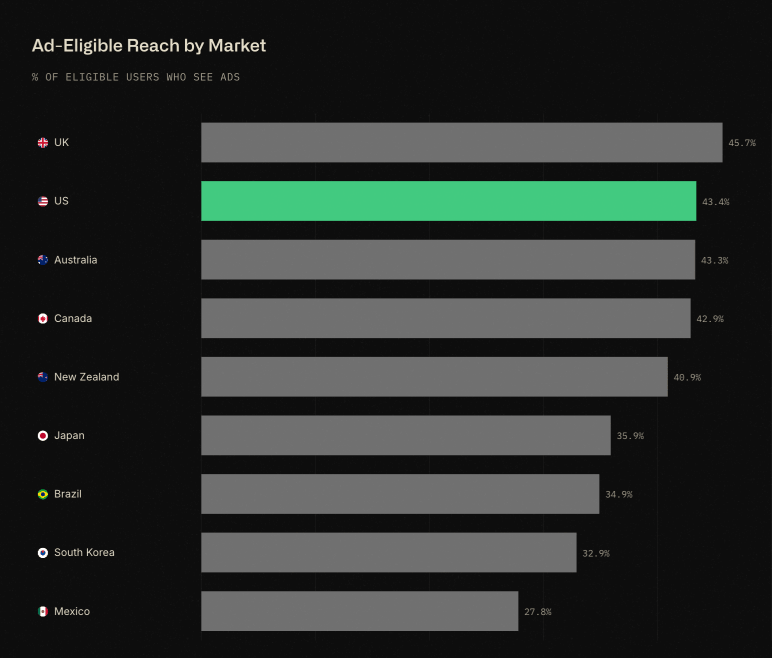
The pattern is as useful as the level. The five English-language markets sit within about five points of each other, while the four other markets trail the leader by roughly 10 to 18 points (Similarweb calculation from the report’s figures). Reach measures exposure, not response, though. A user who saw one ad counts the same as a user who saw many, so use reach to size how often an ad could be seen in a market, not to predict how often it will be clicked. As the sections below show, the markets with the lowest reach have the highest click-through rates.
Brazil, Mexico and Japan out-click the US by more than two times, and South Korea is not far behind, so the top four spots all belong to markets outside the English-speaking group. These are all-time CTRs through September 16, 2026, per Similarweb’s ChatGPT Ads panel. The split is between two groups, not a gradual slope: the five English-language markets sit within 0.15 percentage points of each other, a much narrower band than the gap between them and the other four. On this data, the English-language markets look alike on response, while the markets outside that group behave differently.
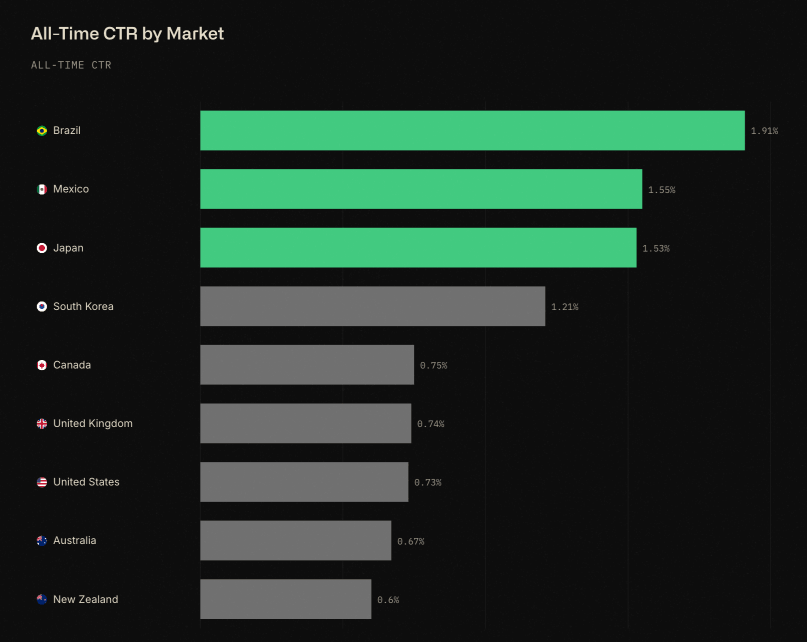
CTR is also moving. The report puts the worldwide increase at 112% since launch, so a market’s all-time figure blends early weeks with later ones. Treat each rate as a snapshot of a young channel, not a fixed benchmark.
No. The five markets with the highest reach (UK, US, Australia, Canada, New Zealand) are the same five with the lowest CTR. The four markets with the lowest reach (Japan, Brazil, South Korea, Mexico) have the four highest CTRs. Mexico has the lowest reach and the second-highest CTR.
The table below puts the two measures side by side. Reach comes from a September 2026 snapshot and CTR from an all-time window ending September 16, so the ranks and multiples are a Similarweb comparison of two report slides, not figures published in the report. Do not multiply reach by CTR to estimate clicks; the report does not support that.
| Market | Reach (Sep 2026) | Reach rank | All-time CTR | CTR rank | CTR vs US (derived) |
|---|---|---|---|---|---|
| Brazil | 34.9% | 7 | 1.91% | 1 | 2.6x |
| Mexico | 27.8% | 9 | 1.55% | 2 | 2.1x |
| Japan | 35.9% | 6 | 1.53% | 3 | 2.1x |
| South Korea | 32.9% | 8 | 1.21% | 4 | 1.7x |
| Canada | 42.9% | 4 | 0.75% | 5 | 1.0x |
| UK | 45.7% | 1 | 0.74% | 6 | 1.0x |
| US | 43.4% | 2 | 0.73% | 7 | 1.0x (baseline) |
| Australia | 43.3% | 3 | 0.67% | 8 | 0.9x |
| New Zealand | 40.9% | 5 | 0.60% | 9 | 0.8x |
Sources: Graphite and Similarweb, The State of ChatGPT Ads (reach and CTR). Ranks and multiples calculated by Similarweb.
A reach-first plan and a CTR-first plan would sort these nine markets in almost opposite order. Neither ordering is sufficient alone, because the report does not explain the inversion. Three explanations are testable: novelty effects in newly launched markets, lighter ad load where fewer advertisers have arrived, and a different advertiser mix. The data does not test any of them.
One caveat applies to every row in the table: the markets do not have the same history. OpenAI began testing ads in the US on February 9, 2026, and said on March 26 that pilots would follow in Canada, Australia and New Zealand. It said on May 7 that it planned to expand the pilot to the UK, Mexico, Brazil, Japan and South Korea, and confirmed on August 11 that ads had launched there. The four markets with the highest CTR all sit in that last group, so treat their lead over the US as an early signal, not a settled benchmark.
Graphite closes its report with a 10-step playbook for advertisers testing ChatGPT ads. Three of the rules map directly onto the market data above.
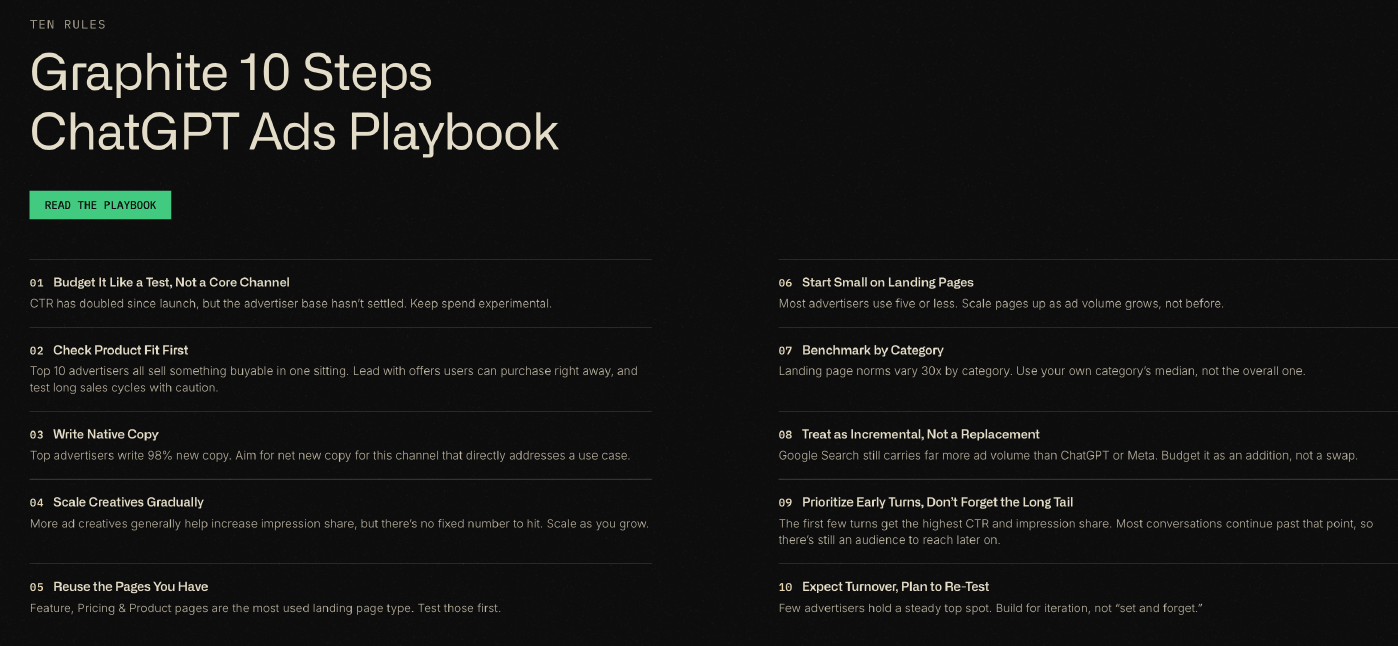
CTR has more than doubled since launch, up 112% in the report, but the advertiser base has not settled, so the playbook recommends keeping spend experimental. That fits the market table: the highest CTRs sit in the markets OpenAI added most recently, so treat them as early signals, not settled benchmarks.
Google Search still carries far more ad volume than ChatGPT or Meta, so Graphite advises budgeting ChatGPT as an addition to your existing channels, not a swap.
Few advertisers hold a steady top spot in the report’s data, so the playbook advises building for iteration, not “set and forget”. For markets, that means re-checking CTRs as the newer ones mature.
The other seven rules cover product fit, creative, landing pages and conversation turns, and they are in the full playbook.
The market data reframes a simple question. The countries where ChatGPT ads are seen most are not the countries where they are clicked most, and the four markets with the best click rates are also the ones OpenAI added most recently. Brazil, Mexico and Japan out-click the US by more than 2x so far, and the US, where ads have run since February 2026, remains the most reliable benchmark.
CTR is a useful success indicator, especially for comparing markets, but it is not the only one. The effect of ChatGPT ads can also show up outside the ad itself, for example as lifts in organic or branded traffic, so pair click data with those signals. The State of Brand covers how ChatGPT ads relate to organic traffic.
Reach shows where ChatGPT ads are seen, CTR shows where they are clicked, and organic and branded lifts show what follows.
To track which advertisers and creatives are running in each market, explore Similarweb’s ChatGPT Ads tool.
In Similarweb’s ChatGPT Ads panel, all-time CTR ranged from 0.60% (New Zealand) to 1.91% (Brazil) across nine markets through September 16, 2026, and the US figure is 0.73%. These are market-level rates across advertisers, so they are benchmarks, not a target for a single campaign.
Brazil, at 1.91% all-time through September 16, 2026. Mexico follows at 1.55%, Japan at 1.53% and South Korea at 1.21%. Newer markets have fewer weeks of data, so these rankings may shift as the markets mature.
Among ad-eligible users, 43.4% in the US had seen at least one ad as of September 2026, according to Similarweb. Reach ranged from 27.8% in Mexico to 45.7% in the UK. Eligibility is limited to Free and Go plan users, as OpenAI does not show ads on paid plans.
Logged-in adult users on the Free and Go plans. OpenAI states that Plus, Pro, Business, Enterprise and Education subscribers do not see ads, and that ads are not shown to accounts it identifies or predicts as under 18.
Treat any comparison with caution. The report says cross-channel CTR comparisons are limited to paid search, and that Similarweb does not yet have comparable CTR data for paid social, YouTube or display on this panel. Use these figures to compare countries, and benchmark your own campaigns against your own results.
OpenAI said on September 23, 2026 that ChatGPT Ads is available in more than 60 countries. The Graphite and Similarweb report analyzes nine of those markets.
Senior SEO Specialist at Similarweb
Maayan is a senior SEO specialist with 7+ years of experience in SEO. She loves complex research projects, creating SEO strategies and performing technical audits.
Give it a try or talk to our insights team — don’t worry, it’s free!