


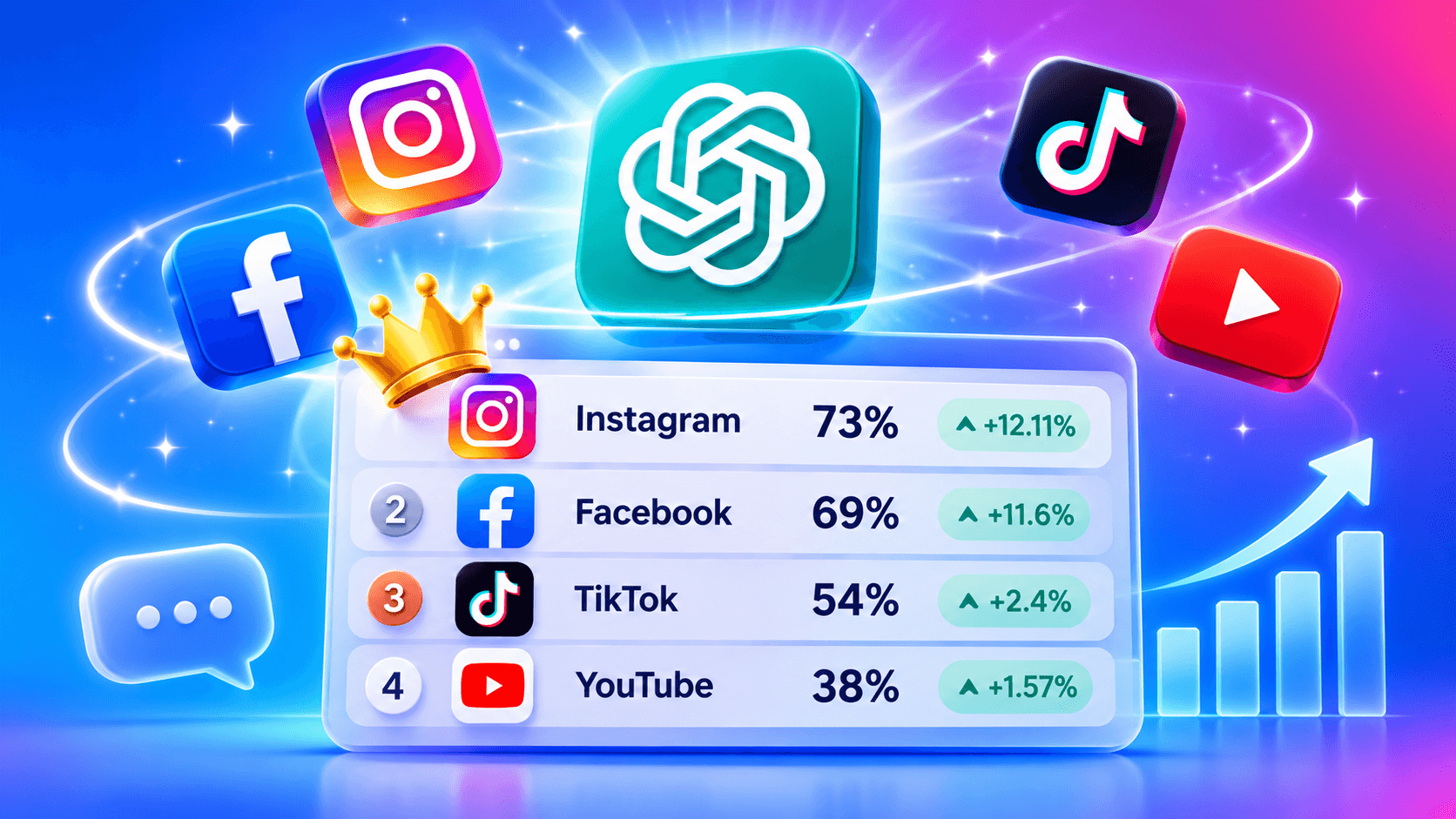
Most visible social media brands in ChatGPT: Instagram leads at 73% in October 2026
by Maayan Zohar Basteker5 Min.
Nov 17, 2026

The best AEO agency sets clear targets, shows how it measures AI visibility, and backs up its claims with evidence. That means a written baseline before work starts, a defined set of prompts tracked across AI engines, and clear reporting that connects to your business goals.
Every agency says it does AEO, and every pitch deck says it works. I spent many years inside a major agency, so I know how these pitches get built and what a client should expect from the other side of the table.
I also work with agencies for Similarweb. Our company operates in many markets, so my team optimizes in those markets too, and we sometimes outsource that work for better localization or efficiency.
If you ask me, the only thing that separates agencies is what you can check. Below is how I test any agency: a five-part scorecard, ten questions to ask, a paid pilot, and a reporting spec. I then apply it to five example agencies to simulate a real-life scenario.
An AEO (answer engine optimization) agency is a marketing agency that works to increase how often, and how accurately, AI answer engines cite and describe a brand. The same service is also sold as GEO (generative engine optimization) or AI SEO. It measures results in citations, mentions, and AI-referred visits, not just rankings.
In my experience, nearly every AEO agency is an SEO agency that added an AI search service, and pure AEO agencies are rare. Among the agencies that added it, some have built a real practice, with a method and tracking. Others have only added a line to their service list.
I trust pure AEO agencies less. In my experience, many come from PR or link building, or from SEOs with a few years of experience who saw an open niche. AI search is about four years old, and most of the work is SEO anyway. I would rather hire a team with 20 years of search experience that added AI than a team built around the new label. That is my bias, so judge any agency on the evidence it shows.
An AI search optimization service usually includes six things:
Prompt research and tracking are keyword research and tracking with prompts instead of keywords. Original data, named experts, and technical fixes have been SEO best practices since E-E-A-T. Community work, social support, and PR were already known ways to build entities.
What changed is the target and the data: digital PR now aims for listicles instead of traditional backlink articles, and citation building works like outreach, with a citation report instead of a backlink report. This is where an established SEO agency has the edge.
So the useful question is not whether an agency offers AEO. It is how deep the AI work goes: can it show a baseline method, or proven success?
An AEO agency is measured on whether AI engines cite and describe your brand, not on rankings and organic clicks. Most of the work is the same. What changes is the scoreboard, the measurement methods, and how much weight third-party mentions carry.
According to Google, AEO is not a separate discipline. Its guide to optimizing for generative AI features says that “optimizing for generative AI search is optimizing for the search experience, and thus still SEO.” Its “mythbusting” section tells site owners they can skip LLMs.txt files, content chunking, special schema, and chasing inauthentic mentions to appear in AI Overviews and AI Mode, because those features run on its core ranking systems.
Google’s team said the same from the stage: a slide at Search Central Live Bengaluru in October 2026 read “Don’t worry about what to call it. Good SEO is good GEO, AEO,” according to attendee reports, and the same speakers told the July 2025 Asia Pacific edition that AI Mode and AI Overviews are “just features of Search.”
The biggest counterclaim came from an AEO software vendor. Its CEO wrote in a September 2026 funding announcement that “AEO rhymes with SEO, but that’s pretty much where the similarities end.” An independent QueryBurst analysis reviewed all 33 recommendations the vendor made between April and September 2026 and found every one already existed in standard SEO or marketing practice.
Here’s what I think: most of the work is SEO, and what’s new is mainly about how you measure it.
Google says optimizing for its AI features is still SEO, but that only covers Google. Google also launched an AI Performance report covering AI Overviews and AI Mode, but it shows impressions only. AI engines don’t publish visibility advice, and ChatGPT only began offering businesses basic insights, such as mentions and website clicks, in a beta Business Hub in November 2026, so most measurement still happens through third-party platforms.
Agencies that sell AEO separately, as an add-on or as their only service, gain the most from calling it new, so don’t choose an agency based on the label it uses. Ask what it will change on your site, what it will measure, and how it will show the change worked.
Off-site work is where the confusion is greatest. A Seer Interactive study of 10,000 ChatGPT answers found that page-one Google rankings were the strongest correlate of brand mentions (about 0.65) and that backlink counts showed a weak or neutral link, though the evidence is correlational. A University of Toronto study of 143,249 AI answers in the US home internet market found that third-party sites earned 75.0% of citations and the studied brand’s own site 11.1%.
Some link-building vendors now sell the same placements under an AEO label: guest posts, link inserts, and sponsored listicles, which they report as “AI mentions.” Gaetano DiNardi, who has tested dozens of link-building services, calls this “AI mention building” and says it is “just link building 2.0”: the same work under a new name. His example is a cold email that asks for a mention instead of a backlink, then offers a link from a partner site in return.
A list of placements can pass for AEO work, so it is worth checking what an agency actually does. The FACTS scorecard and the ten questions later in this guide show how. The table below shows how an AI SEO agency differs from a traditional SEO agency.
| Dimension | SEO agency | AI SEO agency |
| Primary scoreboard | Rankings, organic sessions, conversions | Citation rate, mention rate, share of voice, AI referral sessions, conversions |
| Measurement method | Rank tracking, Search Console, analytics | Repeated prompt sampling across engines, plus analytics for AI referrals |
| Content focus | Pages that rank for keywords | Passages and pages that answer fan-out questions and earn citations |
| Authority work | Backlinks | Third-party mentions, community presence, digital PR |
| Technical focus | Crawl, indexation, speed | The same, plus bot access for AI crawlers |
Be wary of any agency promising a secret formula for Google’s AI features. I’ve sat through plenty of those pitches over the years. Google’s own guide lists several popular tactics it says you can ignore for Google Search.
Independent tests show no reliable lift on other engines either, so the real test is whether the agency says which engine a claim applies to and can show evidence. My AI search optimization best practices ranks 13 AISEO tactics by evidence.
| Claim an agency may make | What Google Search says | Question to ask the agency |
| “You need an llms.txt file” | Google Search does not use llms.txt. Keeping one for other services neither helps nor harms Google visibility. | Which engine reads it, and what is your evidence? |
| “AI search needs special schema” | No special schema.org markup is needed. Structured data still helps with rich results | What does the markup do for this page, and where is the proof? |
| “Break content into AI-sized chunks” | There is no requirement to chunk content for Google’s systems | Show me a before and after that isolates chunking |
| “Build mentions across the web” | Mentions and links help. Seeking inauthentic ones is not as helpful as it seems. | How do you earn mentions without buying them? |
The takeaway: a good agency says “Google does not need this, but Perplexity or ChatGPT may reward it, and here is how we will test it.” A bad agency says “Google requires this.” Google also states that third-party tools don’t have access to its internal ranking data, so any agency presenting its numbers as Google’s deserves a second look.
Choose an AEO or AI SEO agency by scoring five kinds of proof: Foundation, Authority, Content, Tracking, and Sales. Rate each from 1 to 5, demand evidence rather than claims, and run a 60- to 90-day paid pilot before signing a retainer.
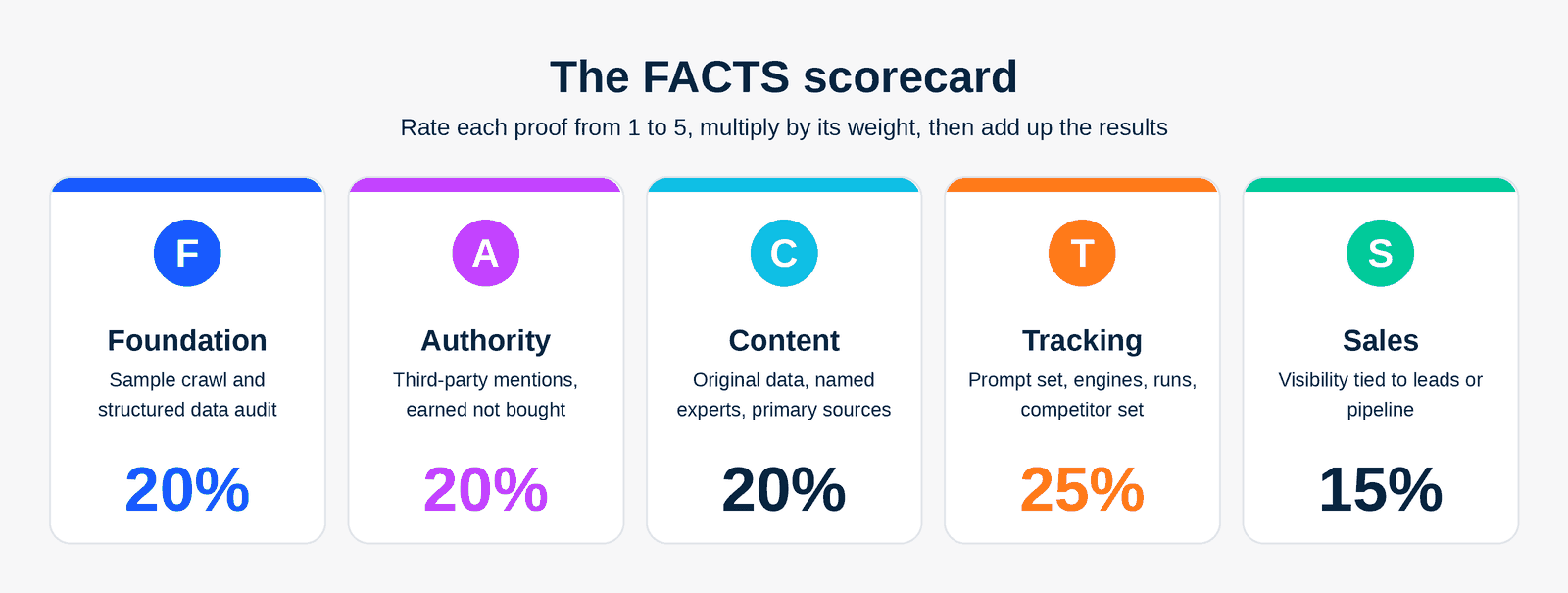
| Proof | What to ask for | Strong evidence | Weight |
| Foundation | A sample crawl and structured data audit | Before and after fixes tied to indexed pages, valid markup, and AI crawler access | 20% |
| Authority | How they earn third-party mentions without buying them | Live placements from digital PR and community work, with disclosure of how each was earned | 20% |
| Content | Two samples of non-commodity content with original data | Named experts, first-party data, tables, and primary sources | 20% |
| Tracking | The prompt set, engines, runs per prompt, and competitor set they will use | Reproducible weekly sampling plus analytics for AI referral traffic | 25% |
| Sales | A case study that connects visibility to leads or pipeline | Baseline, timeline, and conversion data, not screenshots of AI answers | 15% |
How to score: Multiply each 1-to-5 rating by its weight, then add them up.
Let’s say an agency scores 4 on Foundation, 3 on Authority, 5 on Content, 2 on Tracking, and 3 on Sales. That is (4 × 0.20) + (3 × 0.20) + (5 × 0.20) + (2 × 0.25) + (3 × 0.15) = 3.35 out of 5. The 5 on Content and the 2 on Tracking tell us the content is probably good, but the proof (measurement) is lacking.
Set a pass threshold before you meet anyone. I use a threshold of 4.0 or higher, so that agency would score below the threshold, but you can adjust the weights and thresholds to fit your gaps and business needs.
Start with your current SEO agency if it can show an AEO baseline, a set of relevant target prompts plus a valid tracking methodology, and examples of their work. If it cannot, I would consider switching to another SEO agency or to a specialist.
“AEO experience” can mean ten years of SEO plus six months of prompt tracking, so ask when the AEO practice started and how many clients it serves.
Send these in writing and score the answers against the FACTS table.
Five patterns come up again and again in the vendor buyer guides I reviewed, and all five are easy to test:
I would add one from my agency years: ask who will actually do the work, not just who will present it. The team that wins the pitch is not always the team you meet after you sign.
AEO pricing depends on scope. First Page Sage collected 1,146 GEO and AEO quotes from 214 agencies between July and October 2026. The typical (median) retainer was $6,850 a month, about 45% more than the $4,740 agencies quoted for traditional SEO.
By company size, the median ran from $2,950 a month for small businesses to $7,400 for mid-market, $14,600 for upper mid-market, and $31,500 for enterprise.
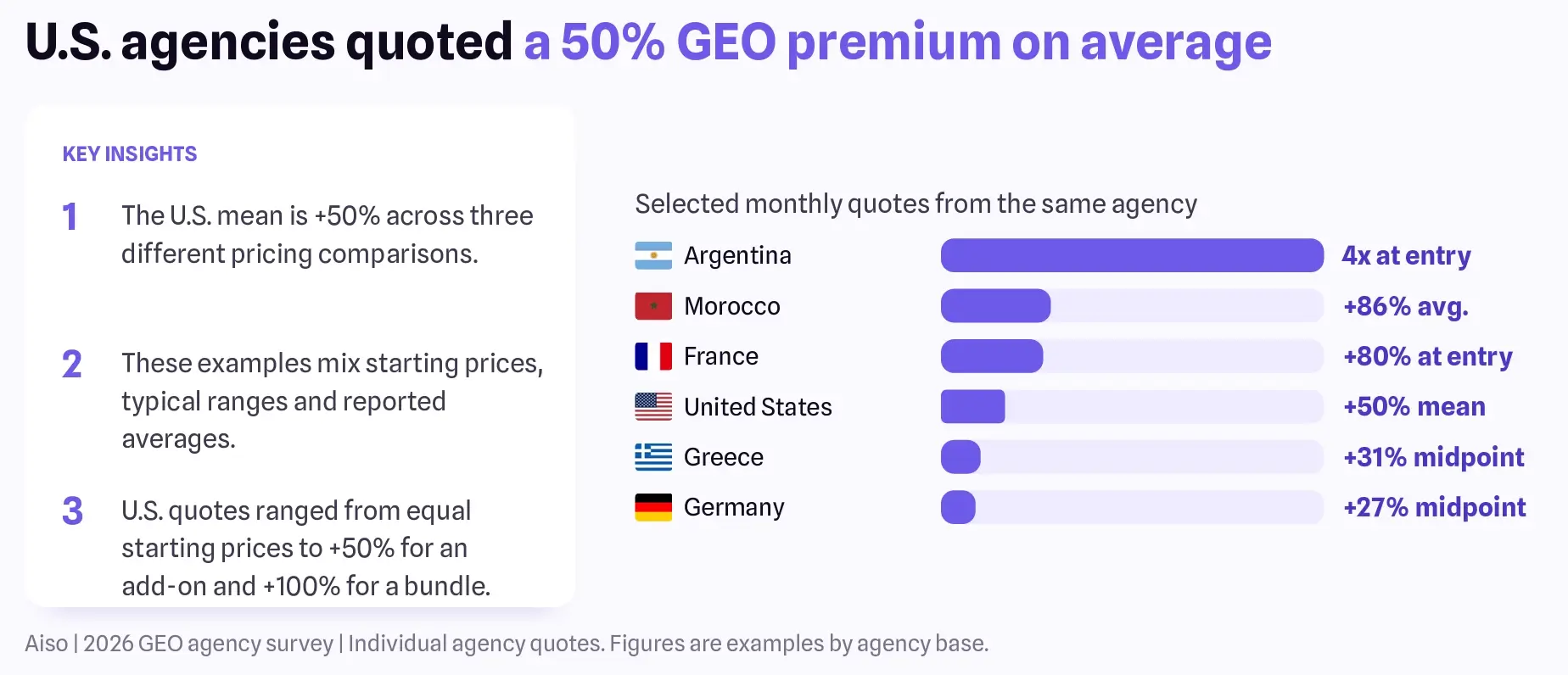
AISO’s survey of agency founders (November 2026) found similar trends in the countries where agencies price both services: AEO costs more than SEO, and in newer markets like Argentina, up to four times as much.
These numbers do not tell you what the fee covers, so ask what is included before anything else. In my experience, the scope line in a proposal is where the surprises hide.
Content production, technical work, and third-party coverage through digital PR might be priced separately, so ask in writing what is included. And since AEO often costs more than SEO, make sure the extra money buys proper measurement and adjustments, not the same work under a new label.
Most agencies include it in the SEO retainer. In Aiso’s survey, 54% of agencies reported bundling AEO into SEO, and 9% sell it as a separate add-on.
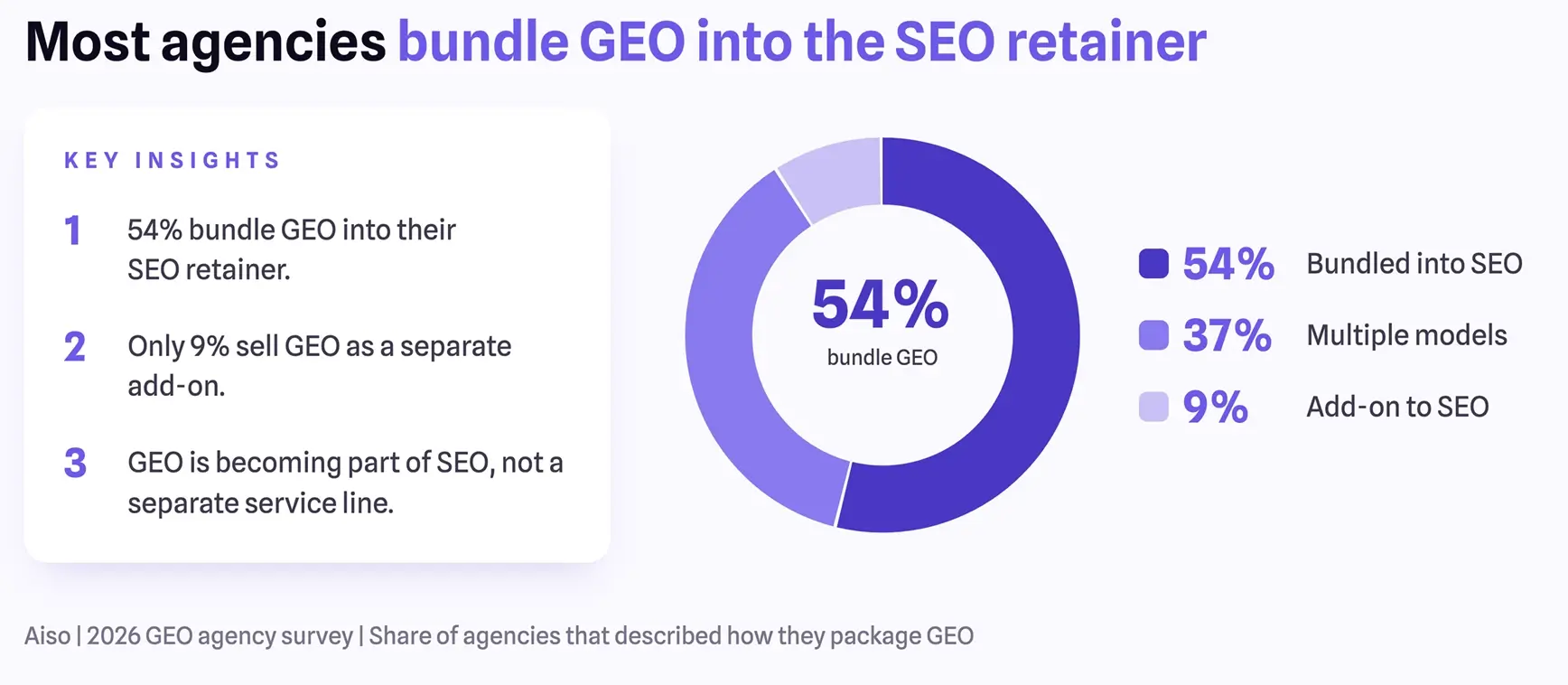
“Bundled” doesn’t mean “fully included.” Ask in writing whether AEO is in the retainer or costs extra. Then list what it covers: prompt tracking, content, technical fixes, and digital PR. A bundled line item can also mean very little time, so ask for the hours or deliverables behind it.
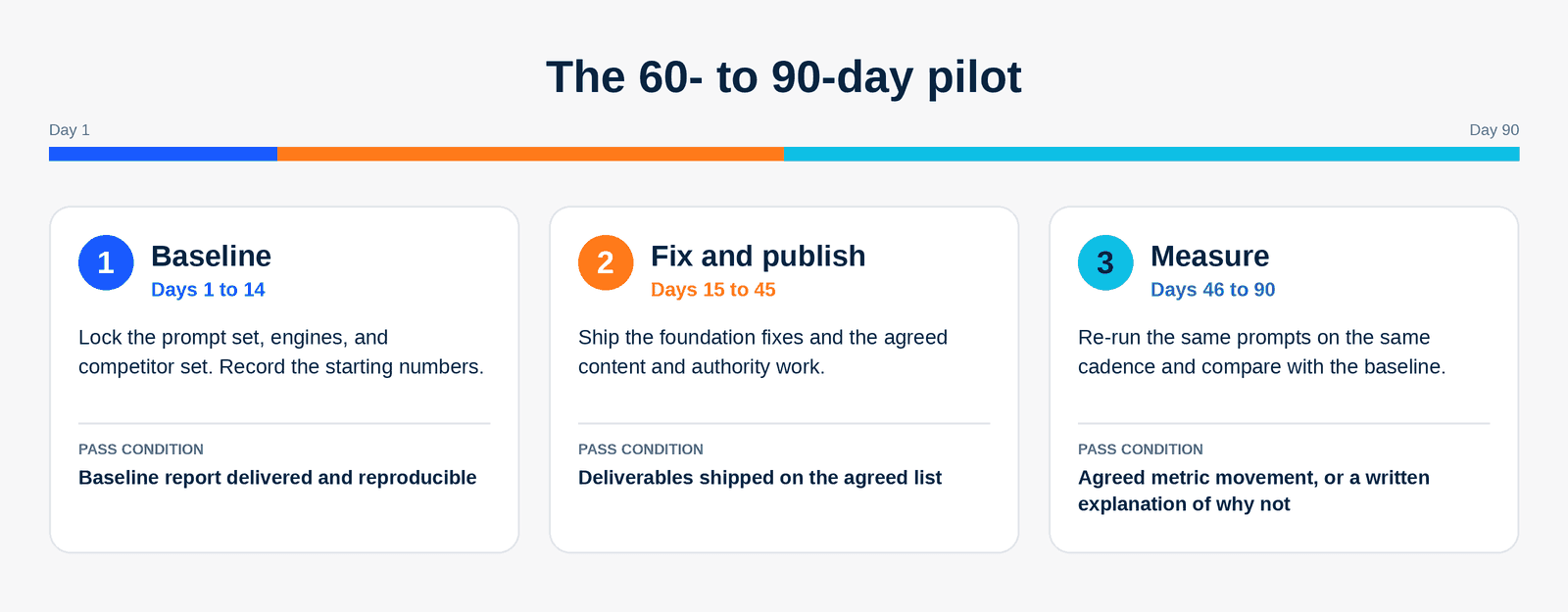
Pay for a defined pilot instead of a 12-month retainer. Agree on the metrics before day one and write the pass-or-fail line into the contract.
| Phase | Days | What happens | Pass condition |
| Baseline | 1 to 14 | Lock the prompt set, engines, and competitor set. Record starting citation rate, mention rate, and AI referral sessions | Baseline report delivered and reproducible |
| Fix and publish | 15 to 45 | Ship the foundation fixes and a defined set of content and authority work | Deliverables shipped on the agreed list |
| Measure | 46 to 90 | Re-run the same prompts on the same cadence and compare with the baseline | Agreed metric movement, or a written explanation of why not |
No single agency is best for every brand, so this list is ordered, not ranked. I ordered the five by how much each one publishes that you can check: its method, how it tracks, its pricing, and AEO case studies that show a baseline, a timeframe, and a method. That measures evidence shared, not results delivered, and I found no independent performance reviews for any of them.
The selection toolkit lets you run the same test on your own shortlist.
I only included agencies whose AEO, GEO, or AI SEO services were confirmed on their website. No agency paid to be included. Everything below is self-reported unless an awarding body is named.
Graphite is a research-driven growth agency focused on SEO and AEO, and it discloses the most about its measurement. Best for brands that want method transparency and research-led content.
Omniscient Digital is an organic growth agency for B2B software companies, and the only one of the five that publishes a price. Best for B2B software brands that want AEO tied to pipeline.
iPullRank is an AI search and content marketing agency built around its Relevance Engineering framework. Best for teams with technical and retrieval gaps.
Nectiv is an SEO and AEO agency for B2B and technology brands, founded in 2025 and based in the Philadelphia area. Best for B2B and SaaS teams that want AEO measured with a tracker the agency built itself.
Amsive is a performance marketing agency that added AEO to its SEO practice in June 2025. It sits last because it publishes no AI-search case studies, not because it is weaker. Best for enterprise technical SEO at scale.
One note: every case-study number above is the agency’s own. From the inside, I can tell you a published case study is a highlight reel: agencies show their best account, not their average one. So ask for references and the raw before-and-after data.
Match the agency to the gap you have, not the one in its pitch.
| Your biggest gap | Agency type to prioritize | Evidence to demand |
| AI crawlers or search engines cannot reach or parse your pages | Technical and retrieval-focused | A sample audit with fixes tied to indexed pages |
| You publish plenty of content, but none of it gets cited | Content and research-led | Two samples with original data and named experts |
| No third-party sites mention your brand | Digital PR and community | Live placements and how each was earned |
| You cannot tell whether anything is working | Measurement-led | The prompt set, engines, and run counts in writing |
| Your category is B2B software | Vertical specialist | Case studies from your category, with baselines |
AI search runs on SEO foundations, so a good agency can show both technical fixes and content that earns citations. Structured data is part of the technical work. It is a foundation, not a lever: Google says its AI features need no special schema.org markup, though valid markup still supports rich results.
Similarweb’s review of whether schema markup helps you get cited by AI found no evidence that it does: in an October 2025 searchVIU test, none of the five systems tested extracted a price placed only in JSON-LD.
Ask for the technical sample and the content sample in the same meeting. Agencies often show one and imply the other.
Google’s AI features guidance says a page must be indexed and eligible to appear in Search with a snippet to be a supporting link in AI Overviews or AI Mode, with no additional technical requirements. Google’s optimization guide adds that a site must be included in Search generative AI features in Search Console to be eligible for display, so ask any agency to confirm that setting.
Technical SEO is therefore the entry fee. A foundation audit that finds blocked crawlers, broken canonicals, or unrendered content is doing real AEO work, even if the deck never says “AEO.” Structured data sits in the same audit. It should produce valid, maintained markup that matches the visible text on the page, and the agency should prove each markup type against a specific outcome.
Use this checklist on any technical proposal that includes structured data:
On content, look for original work with real data and real expertise, not a rewrite of what everyone already says. Google calls the opposite “commodity” content. Research on generative engine optimization points the same way.
The GEO study by Aggarwal et al., published at KDD 2024, found that methods such as adding citations, quotations, and statistics boosted source visibility by up to 40% in a benchmark of generative engine responses. Results varied by query domain, and the study did not test every production engine.
An agency that cannot show original data in its own samples is unlikely to add it to yours.
A credible AEO report shows the prompt set, the engines tested, the number of runs per prompt, citation and mention rates against named competitors, AI referral sessions, and conversions. Reports that show only rankings or single screenshots can’t demonstrate AEO progress.
A good agency should agree to this spec before signing the contract. Send it along with your questions.
| Report section | Minimum content | Why it matters |
| Prompt set | Number of prompts, how they were chosen, and funnel stage mix | Defines what “visibility” means |
| Engines and modes | Each engine, and whether web search was on | Behavior differs across engines |
| Sampling | Runs per prompt and cadence | One answer is an anecdote |
| Citations and mentions | Citation rate and mention rate, reported separately | A mention is not a linked source |
| Competitor set | Named competitors, chosen with you | Share of voice needs a denominator |
| Sentiment | How the brand is described, with examples | Visibility can be negative |
| AI referral traffic | Sessions from AI sources in your analytics | Connects visibility to visits |
| Business outcome | Leads or pipeline tied to AI-referred sessions | The Sales proof |
| Actions and next steps | What shipped, what moved, what is next | Links effort to results |
In an agency, reporting is part of the job, and clients who ask for specific data usually get it. A full report covers the work and the performance (visibility, citations, AI referral traffic, and conversions against the baseline) in any format, from a file to a live dashboard to an export from another tool.
As the client, you decide which data it shows, so ask for the prompts, engines, and competitors you care about. The spec above lists what to ask for.
Your tracking doesn’t conflict with any of that. It is there when you need it. Any tracker that follows the spec will do. In Similarweb’s AI Search Intelligence, you set your own prompts, engines, and competitors and track mentions, citations, and sentiment (the same rows the spec asks the agency to report) so you can check its numbers between reports. Pair that with AI referral data in Similarweb and your GA4, and you can show leadership the ROI on AI visibility, not just visibility.
If an agency builds its client dashboards on Similarweb, you and the agency look at the same data, so ask whether yours does.
One Google caveat: third-party tools cannot see Google’s internal ranking data, so any metric presented as “from Google” should be traceable to Search Console, including the Generative AI performance report for Google’s AI features.
The best AI SEO agency is the one whose claims hold up when you check them. Pitches and lists will keep claiming the top spot, so your advantage is the test, not the list.
Run the FACTS scorecard, send the ten questions, and attach the reporting spec. Then pay for a 60- to 90-day pilot with a pass-or-fail line, and keep your own view of the data. A confident agency will welcome all four. One that pushes back on a baseline has already answered your question.
If you want your own view of the data, Similarweb’s AI Search Intelligence tracks brand visibility, prompts, citations, and sentiment, so you have a baseline before any agency starts.
The agency that wins is not the one with the best pitch. It is the one that lets you check.
An AEO agency audits how often AI engines cite your brand, builds a tracked prompt set, fixes technical barriers, publishes content built to be cited, earns third-party mentions, and reports citations, mentions, and AI referral traffic. Most are SEO agencies that added this service, so ask for a baseline, a prompt set, and shipped examples.
The median AEO retainer is $6,850 per month, against $4,740 for traditional SEO, based on First Page Sage’s review of 1,146 price quotes from 214 agencies. The median is $7,400 per month for mid-market companies and $31,500 for enterprise. Ask for a scoped pilot price before any retainer.
Score each candidate on the FACTS scorecard: Foundation, Authority, Content, Tracking, and Sales, with Tracking weighted highest at 25%. Require a written prompt set, engine list, and competitor set before work starts, then run a paid 60- to 90-day pilot with a pass-or-fail line. Walk away from any agency that cannot define a baseline.
A traditional SEO agency is measured mainly on rankings and organic traffic. An AEO agency is also measured on whether AI engines cite and describe your brand, using repeated prompt sampling. The work overlaps, since Google states that optimizing for generative AI search is still SEO, so many agencies sell both under different names.
No agency controls what an AI engine says, so treat guaranteed citations as a red flag. Google notes that indexing and serving are never guaranteed, and AI answers vary by engine and prompt. Credible agencies commit to inputs and measurement instead: a baseline, a defined prompt set, shipped deliverables, and agreed metrics reviewed at day 90.
Build in-house if one team already has technical SEO, content, and analytics skills. Hire an agency to fill specialist gaps such as digital PR or technical audits, or to move faster. Many companies split the work, keeping strategy in-house and outsourcing execution. The pilot design above lets you test the split before committing.
Expect months, not weeks, and treat any promised date with suspicion: no reliable benchmark exists for how long AI engines take to pick up changes. Ask any candidate to commit to a timeline and a metric in writing. A 60- to 90-day pilot tests direction and process, not the full effect.
Structured data helps with eligibility for rich results in Google Search. Google states that no special schema.org markup is required for its generative AI features, and it advises making sure markup matches the visible text on the page. Treat it as a foundation. Other AI engines may behave differently, so ask any agency claiming a benefit to show a measured before-and-after.
Director of SEO & AI Search at Similarweb
Limor brings 20 years of expertise in SEO and AI Search. She thrives on solving complex problems, creating scalable strategies, and building amazing dashboards.
Most visible social media brands in ChatGPT: Instagram leads at 73% in October 2026
Where Is My Customer? ChatGPT Ads and Google’s Universal Cart Split the Journey Across Platforms
The Lock-and-Refresh Method: How To Track AI Prompts by Funnel Stage
Give it a try or talk to our insights team — don’t worry, it’s free!