


How to Optimize Your Homepage for AI Traffic
by Limor Barenholtz15 Min.
Aug 09, 2026
Claude users are 25x more likely to visit university and college websites than the average Google searcher.
That single number, from Similarweb’s 2026 Generative AI Landscape report, should end the notion that “AI users” are a single audience. They are not. The browsing data behind the report’s new Website Affinity Index shows that ChatGPT, Claude, and Gemini have each attracted a measurably different type of person, with distinct interests, session behavior, and jobs to be done.
Here is the thesis of this article: AI platform choice is audience self-selection. If you plan content, media, or brand visibility around “AI” as a single channel, you are averaging three audiences that barely resemble each other, and your targeting will be wrong for all of them.
This article breaks down the AI chatbot user demographics behind each platform using datasets from the report: the Website Affinity Index (who each platform’s users are) and prompt behavior data (how they interact). It ends with a practical framework for matching your content strategy to each platform’s persona.
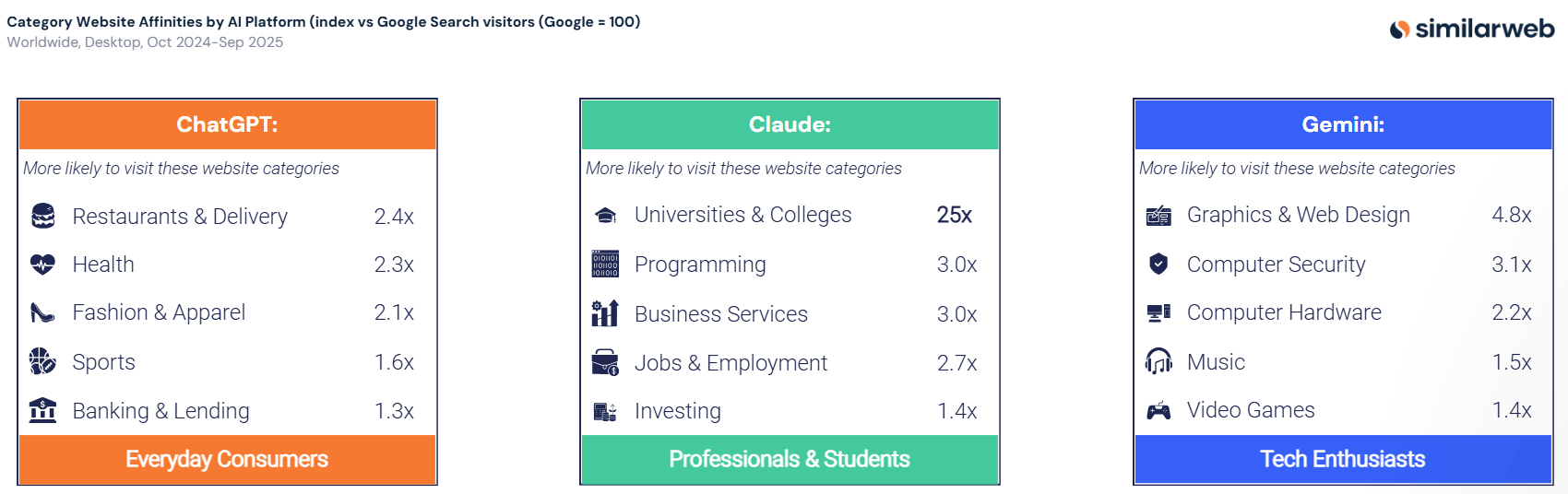
The Website Affinity Index compares the websites each AI platform’s users visit against the browsing behavior of the average Google searcher, indexed to 100. A score of 236 means a platform’s users are 2.4x more likely than the average Google searcher to visit that category of website. Based on worldwide desktop and mobile web behavior from June 2025 to May 2026, the table below sorts the three major platforms into three clean personas, summarized here alongside how each audience behaves:
| Platform | Persona | Defining affinity signal | Median prompt length | Prompts per session | What it signals |
| ChatGPT | Everyday Consumers | Restaurants & Delivery 2.4x | 13 words | 5.0 | Mainstream consumer life |
| Claude | Professionals & Students | Universities & Colleges 25x | 17 words | 5.6 | Work, study, and career |
| Gemini | Tech Enthusiasts | Graphics & Web Design 4.8x | 12 words | 2.2 | Technical and creative hobbies |
Three things stand out in the affinity data before we go platform by platform.
ChatGPT’s strongest affinity signals have nothing to do with technology. Per Similarweb’s Website Affinity Index (worldwide, June 2025 to May 2026), its users are 2.4x more likely than the average Google searcher to visit restaurant and delivery sites, 2.3x more likely to visit health sites, and 2.1x more likely to visit fashion and apparel sites, with sports (1.6x) and banking, credit, and lending (1.3x) close behind.
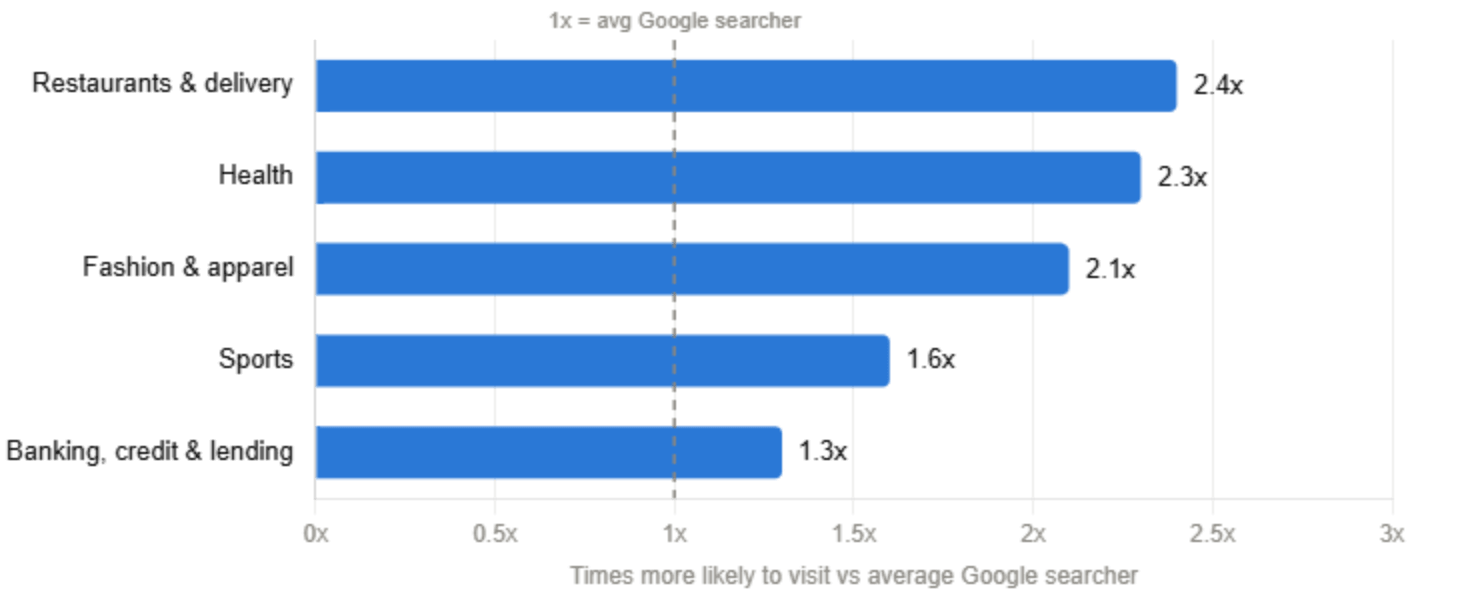
Look at what’s not on that list: no developer tools, no SaaS, no tech media. The categories where ChatGPT users over-index are the ones where everyone spends: dinner, health, wardrobe, the game, the bank account. Three years in, the platform’s audience no longer looks like the people who found it first. It looks like the market.
This is the most underappreciated finding in the persona data: ChatGPT has crossed the chasm. Its user base no longer skews toward any identifiable niche, because the niches have averaged out into the general population. The report labels this persona Everyday Consumers, and the affinity spread supports it. No single category dominates, instead, ChatGPT users show moderate, broad lifts across the categories that define normal consumer life.
The strategic consequence cuts both ways:
If you sell food delivery, healthcare services, apparel, or consumer banking, your buyers are disproportionately on ChatGPT, and the 2.1x to 2.4x lifts in exactly those categories mean the AI platform’s users are already active shoppers in your vertical.
A mainstream audience means your specialist content competes for attention against every consumer topic at once. Reach is high, but density of your specific buyer is lower than on the platform where your buyer concentrates.
Takeaway: treat ChatGPT the way you treat broad-reach consumer media. Prioritize it if your category appears on its high-affinity list, and measure your visibility there before assuming your audience is present.
Where ChatGPT’s affinities spread evenly across consumer life, Claude collapses into a single theme: career trajectory. Its users are 25x more likely than the average Google searcher to visit university and college sites, per the Website Affinity Index in Similarweb’s 2026 report. The supporting signals all point the same direction: business services (3.0x), programming and developer software (3.0x), jobs and employment (2.7x), investing (1.4x).
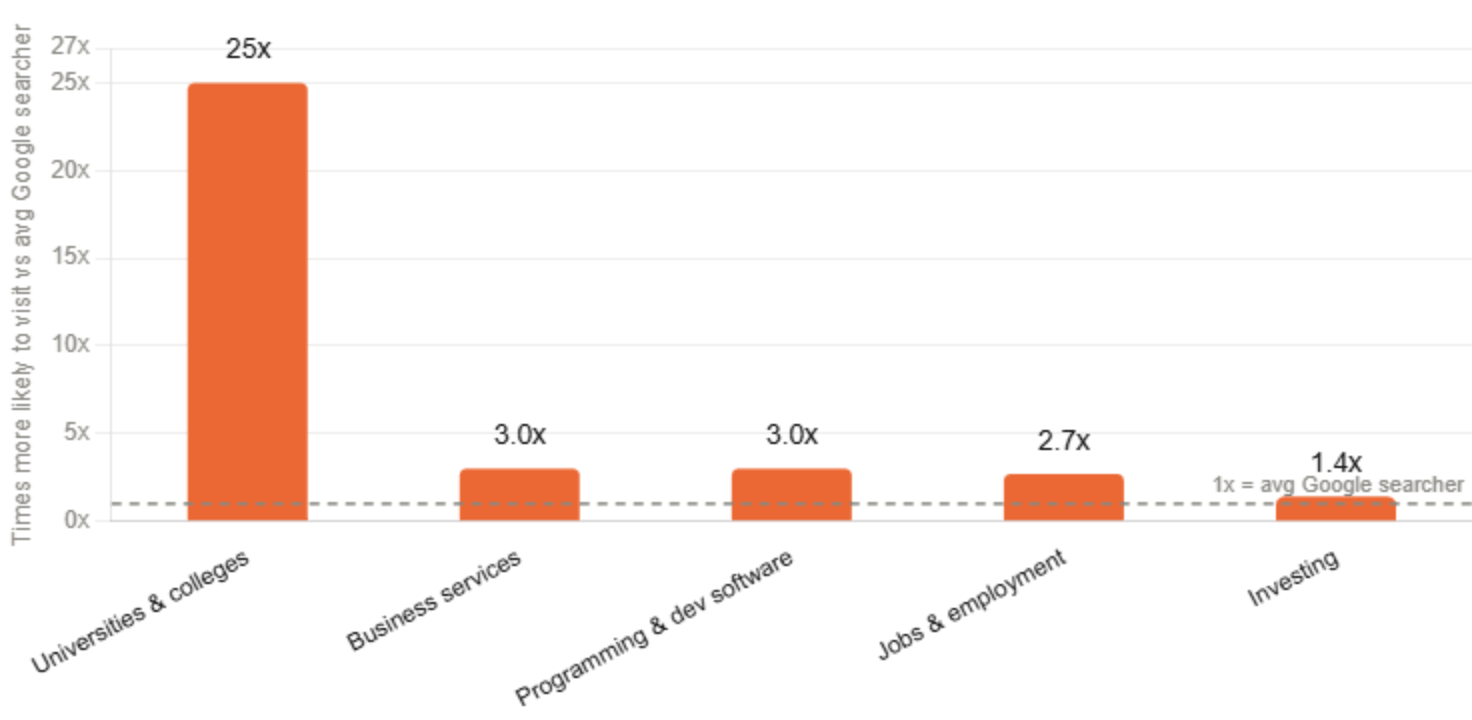
Claude hasn’t attracted a demographic so much as a mindset, people actively investing in their professional selves. That 25x number isn’t just a big lift, it’s audience concentration of a kind the other platforms don’t come close to, and concentration is what makes an audience targetable.
A 25x affinity score is a statistical anomaly worth dwelling on. Nothing else in the entire cross-platform dataset comes close, the next-strongest signal on any platform is Gemini’s 4.8x for graphics and web design. What produces a number like that is not casual usage. It is a user base where students, academics, and researchers are so overrepresented that university browsing becomes the defining behavioral marker of the platform.
Stack the rest of Claude’s affinity list on top and a coherent persona emerges, which the report names Professionals & Students. Every top category maps to a career stage: studying (universities), building skills (programming), working (business services), moving jobs (employment), and building wealth (investing). This is a life-arc of professional development expressed in browsing data.
The insight for marketers is about audience quality versus audience scale:
If your product touches education, developer tools, B2B services, recruiting, or personal finance for professionals, Claude offers the densest concentration of your buyer of any AI platform, even though its total traffic is smaller than ChatGPT’s.
Banking content over-indexes on ChatGPT (1.3x), while investing over-indexes on Claude (1.4x). Same industry, two platforms, two different customers: everyday account holders on one, active wealth-builders on the other. A bank marketing checking accounts and a brokerage marketing portfolios should not have the same AI platform priorities.
Takeaway: if your buyer is defined by what they do for a living or what they are studying, weight your AI visibility efforts toward Claude, and write for a reader in work mode.
Gemini presents the strangest result in the persona data: the platform with the most mainstream distribution on earth has attracted the least mainstream audience. Despite being wired into Google’s ecosystem, its users over-index on graphics and web design (4.8x vs. the average Google searcher), computer security (3.1x), and computer hardware (2.2x), per the Similarweb Website Affinity Index, with music (1.5x) and video games (1.4x) rounding out the profile.
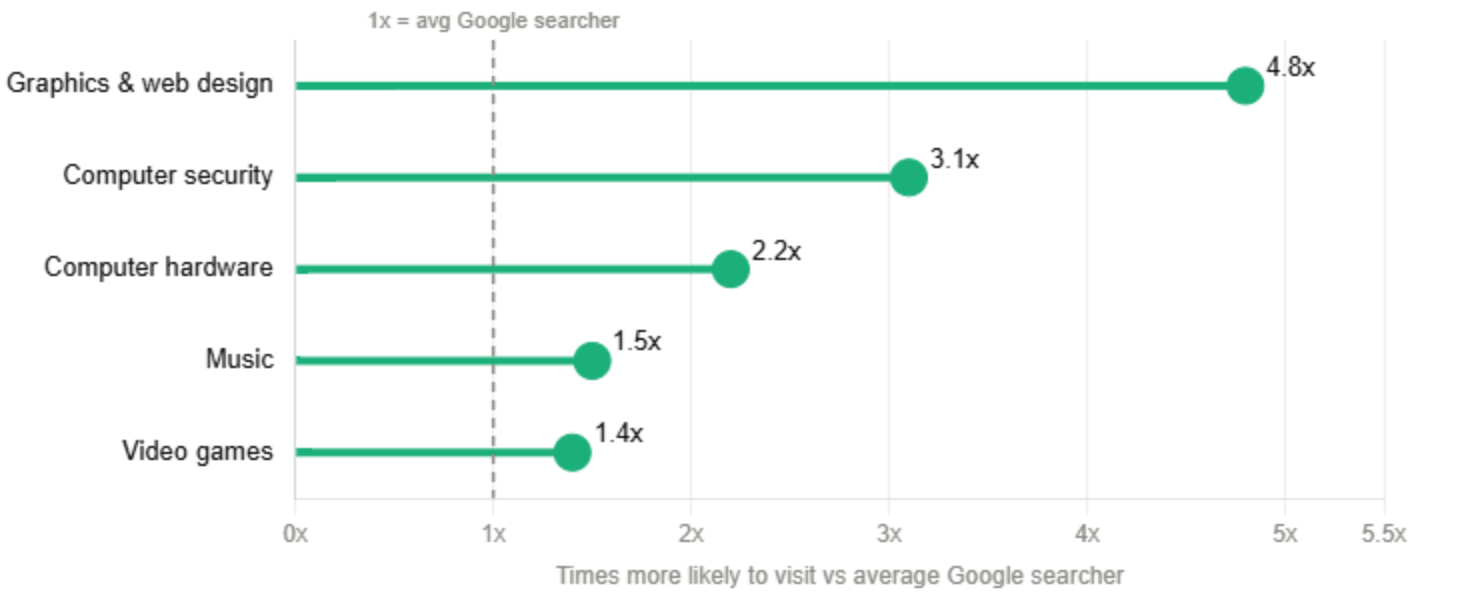
Notice what kind of interests these are: not professional obligations, but technical passions. Design tools, security, hardware, games, these are the categories of people who tinker, build, and optimize for the enjoyment of it. Where Claude’s audience is defined by career stage and ChatGPT’s by everyday consumption, Gemini’s is defined by enthusiasm. Distribution put Gemini in front of everyone, self-selection decided who stayed.
The report calls this persona Tech Enthusiasts, and the composition suggests self-selection at work. Access to Gemini is effectively universal for anyone in the Google ecosystem, yet the people who actually adopt the standalone chatbot skew toward those who care about technology as an interest, not just a utility.
Two implications follow:
Tutorials, tooling comparisons, hardware guides, design resources, and security content have a natural audience fit on Gemini that they do not have on ChatGPT, where those same categories index far lower.
The Gemini result is a caution against inferring audience from parent-company reach. Who a platform’s owner can reach and who actually shows up are different populations, and only behavioral data distinguishes them.
Takeaway: if your content lives in the maker, builder, or gamer space, Gemini’s audience over-indexes for you at 1.4x to 4.8x. Prioritize it above what its raw traffic share alone would suggest.
If the affinity data told us who uses each platform, the analysis of prompt behavior tells us why, and the two datasets agree with each other in a way that should make any analyst sit up. Independently measured, with no connection to the browsing data, the way people talk to each platform reproduces the same three personas.
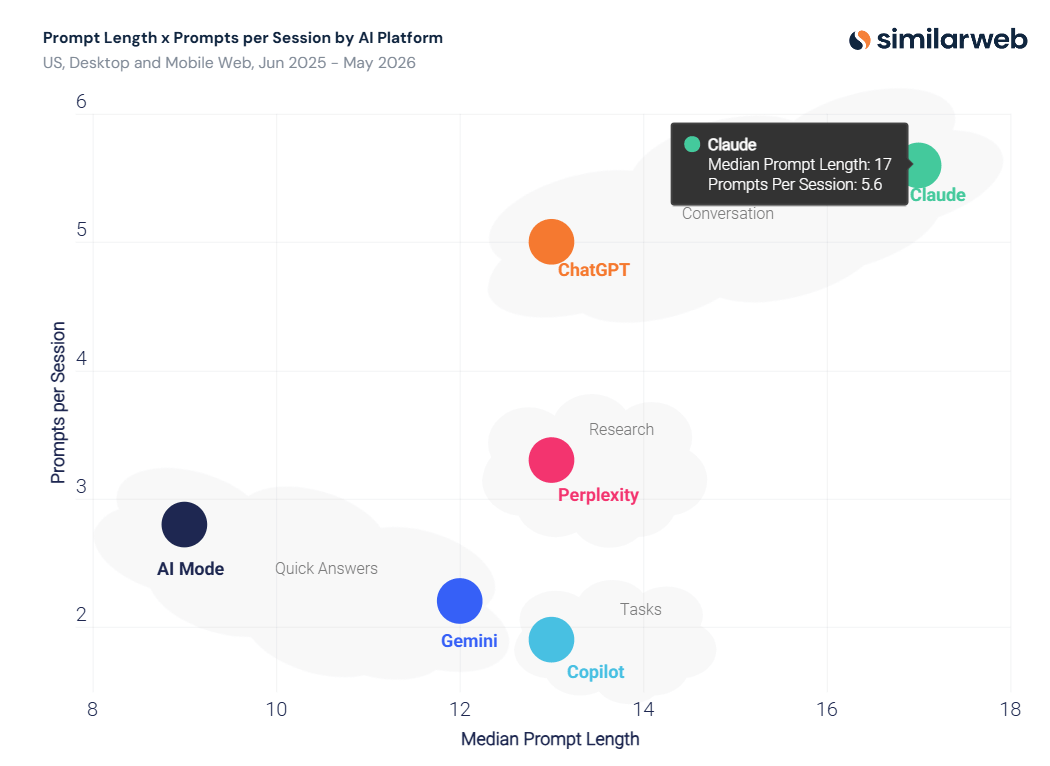
The chart above sorts the AI platforms into four modes of use, and the clusters are more revealing than any single number. Claude and ChatGPT sit alone in the upper right: long prompts, many turns, which is the signature of conversation: users thinking out loud, refining, going back and forth. Perplexity occupies the middle: moderately long prompts but fewer exchanges, the pattern of someone researching, getting an answer, and moving on. Gemini and Copilot cluster low despite decent prompt length: task-oriented, in-and-out usage, while AI Mode sits closest to old search behavior: short queries, quick answers, minimal dialogue.
Put differently, the same “AI prompt” means something different on every platform. The table below breaks down the numbers behind each cluster:
| Platform | Median prompt length (words) | Prompts per session |
| Claude | 17 | 5.6 |
| ChatGPT | 13 | 5.0 |
| Copilot | 13 | 1.9 |
| Perplexity | 13 | 3.3 |
| Gemini | 12 | 2.2 |
| Google AI Mode | 9 | 2.8 |
| Google Search | 3 | n/a |
Now overlay the personas from the affinity data, and the behavior explains itself:
Nearly six exchanges per session at 17 words each is the rhythm of iterative work, drafting, debugging, refining, following up. The platform with the most work-defined audience shows the most work-shaped behavior: internal consistency across two independent datasets.
The most technical audience produces the shortest chatbot sessions, sitting closer to AI Mode’s retrieval pattern than to Claude’s collaboration. That fits: an audience raised on Google-style search gets in, gets the answer, and gets out, even when the tool can do more.
Everyday consumers hold genuine conversations, nearly as long and deep as Claude’s working sessions, but across the full breadth of consumer life rather than concentrated on work.
The content implication is structural. Short-session platforms reward extractable, direct answers: the reader wants one thing and leaves, which is exactly the behavior answer engine optimization is built for. Long-session platforms reward depth: comprehensive resources that survive being interrogated across five or six follow-up prompts.
The datasets in this article combine into a repeatable targeting method. For any content or visibility initiative, run the persona check.
Check your vertical against the Website Affinity Index. Restaurants, health, fashion, sports, or consumer banking: ChatGPT (1.3x to 2.4x). Education, developer tools, B2B services, recruiting, or investing: Claude (1.4x to 25x). Design, security, hardware, music, or gaming: Gemini (1.4x to 4.8x). If your category over-indexes on one platform, that platform gets priority, regardless of overall traffic rankings.
Match format to prompt behavior. Targeting Gemini or AI Mode users (2.2 to 2.8 prompts per session): lead with direct, extractable answers, because you get one shot per session. Targeting Claude users (5.6 prompts, 17-word queries): build deep, layered resources that hold up under repeated follow-up questioning. Targeting ChatGPT (5.0 prompts): balance both, with a direct answer up top and depth beneath.
The phrase “AI users” now hides more than it reveals. The data in Similarweb’s 2026 Generative AI Landscape report describes three distinct populations: everyday consumers ordering food and managing their health on ChatGPT, professionals and students doing 25x-concentrated academic and career work on Claude, and tech enthusiasts pulling quick technical answers from Gemini. They browse different sites, write different prompts, hold different-length sessions, and bring different prompt intent.
For marketers, this is good news disguised as complexity. Undifferentiated channels force you to compete on volume. Differentiated channels let you compete on fit, and fit is winnable. A developer-tools brand does not need to outrank consumer giants across all of AI, it needs to be the answer on the one platform where its buyer is 3x concentrated.
The memorable version: nobody chooses an AI platform at random, so every platform choice is audience data. Read it that way, and your AI visibility strategy stops being one strategy and becomes three smaller, sharper ones.
What kind of people use ChatGPT vs Gemini vs Claude?
Similarweb’s 2026 Website Affinity Index identifies three personas: ChatGPT attracts everyday consumers (2.4x affinity for restaurant and delivery sites, 2.3x for health), Claude attracts professionals and students (25x affinity for university sites, 3.0x for programming), and Gemini attracts tech enthusiasts (4.8x affinity for graphics and web design, 3.1x for computer security).
Do professionals prefer Claude over ChatGPT?
Professional and academic users concentrate on Claude more than any other platform. Claude users are 25x more likely than the average Google searcher to visit university sites, 3.0x more likely to visit business services and programming sites, and 2.7x more likely to visit job sites, per Similarweb’s 2026 report. ChatGPT has more professionals in absolute terms, but Claude has the highest professional concentration.
Why does Gemini attract different users than ChatGPT?
Gemini’s audience self-selects around technical interests despite Google’s mainstream distribution. Its users over-index on graphics and web design (4.8x), computer security (3.1x), and computer hardware (2.2x) versus the average Google searcher, per Similarweb data, while ChatGPT’s users over-index on mainstream consumer categories like restaurants, health, and fashion instead.
How do prompt lengths differ across AI platforms?
Claude users write the longest prompts, with a 17-word median and 5.6 prompts per session, per Similarweb’s US desktop data (June 2025 to May 2026). ChatGPT follows at 13 words and 5.0 prompts per session, Gemini at 12 words and 2.2 prompts, Google’s AI Mode at 9 words, and traditional Google Search at just 3 words per query.
What age group uses AI chatbots most?
Users aged 18 to 34 make up 50% of generative AI users worldwide as of the June 2025 to May 2026 period, according to Similarweb’s 2026 Generative AI Landscape report. That share is down from 61% in May 2024, showing adoption spreading into older age groups as generative AI matures into a mainstream tool.
Senior SEO Specialist at Similarweb
Maayan is a senior SEO specialist with 7+ years of experience in SEO. She loves complex research projects, creating SEO strategies and performing technical audits.
How to Optimize Your Homepage for AI Traffic
Is AI Replacing Search? What The 2026 Numbers Actually Reveal
ChatGPT vs Claude vs Gemini vs Perplexity: what 2026 usage data actually shows
Give it a try or talk to our insights team — don’t worry, it’s free!