
Review Sites as AI Citation Sources: Why They Matter
by Maayan Zohar Basteker6 Min.
Nov 03, 2026

Google Search referrals to hundreds of publishers fell 40% between July 2025 and July 2026, twice the decline of the year before, according to Chartbeat data reported by the Reuters Institute for the Study of Journalism.
AI platforms are sending some visits back. AI referrals to news sites averaged 44.5 million visits a month worldwide between June 2025 and May 2026, up 115.6% year over year, according to Similarweb’s 2026 Generative AI Landscape report.
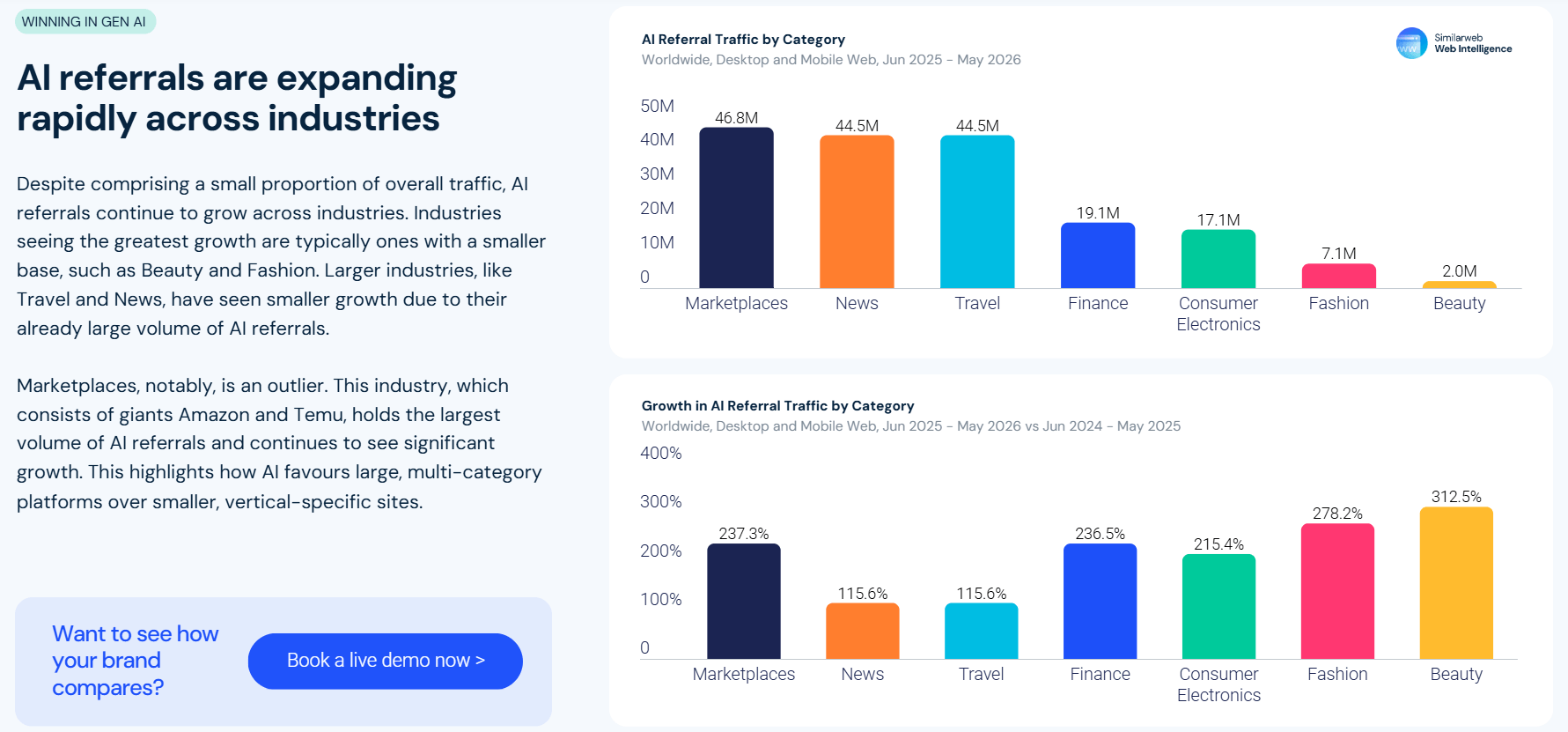
AI referral traffic by category (top) and growth versus the prior 12 months (bottom). Source: Similarweb 2026 Generative AI Landscape report, worldwide, desktop and mobile web, June 2025 to May 2026.
For scale, organic search sent US news and media sites more than 1 billion visits a month from October 2025 to September 2026, based on Similarweb market research data. AI referrals are growing fast from a much smaller base.
So why invest in AI visibility? Because AI answers are where many readers now first encounter your brand. A citation there can lead to a return visit, a newsletter sign-up, or a subscription later.
AI visibility in the context of news publishers is how often and how prominently a publisher’s articles are cited in answers from AI tools such as ChatGPT, Gemini, and Google AI Overviews. It differs from search ranking: an outlet can sit at the top of Google results and still be absent from the AI answer above them.
A citation is a link or named reference to your site inside an AI answer.
Publishers should care because AI answers now sit between readers and search results, and a citation there is the new first impression. Visibility builds brand recognition, can bring subscribers, and strengthens a publisher’s hand in licensing talks with AI companies, even when no click follows.
The audience is moving. Weekly use of generative AI in six countries rose from 18% to 34% between 2024 and 2025, according to the Reuters Institute’s Generative AI and news report 2025. Search traffic is falling at the same time. In the Reuters Institute’s January 2026 survey of 280 media leaders in 51 countries, executives expected search traffic to fall 43% over the next three years.
Newsroom leaders interviewed by the Reuters Institute gave three reasons to act:
Pew Research Center tracked 68,879 Google searches by 900 US adults in March 2025. When an AI summary appeared, people clicked a traditional result link in 8% of visits. Without a summary, they clicked in 15%.
Visitors clicked a link inside the AI summary itself in just 1% of visits to pages that showed one.
Google does not show AI Overviews on every news query. The Digital News Report 2026 says they are disabled for certain types of news queries, particularly breaking or developing news. More contextual searches related to the news can still trigger them.
That puts explainers, background pieces, and profiles closest to AI answers.
Chatbots reach a smaller audience for news than for other tasks. The Generative AI and news report 2025 found that weekly use of generative AI in six countries was 24% for getting information and 6% for getting news. The Digital News Report 2026 found that 10% of its global sample used AI chatbots for news weekly, up from 7% in 2025. Weekly use was 17% in the youngest age group and 5% in the oldest.
Data from Similarweb’s market research tool for the US News and Media industry shows 61.21 billion visits from October 2025 to September 2026, down 14.02% from the prior 12 months, while September unique visitors rose 3.3% year over year. Organic search traffic fell over the period, and Gen AI traffic grew through August before Similarweb reclassified Google AI Mode traffic.
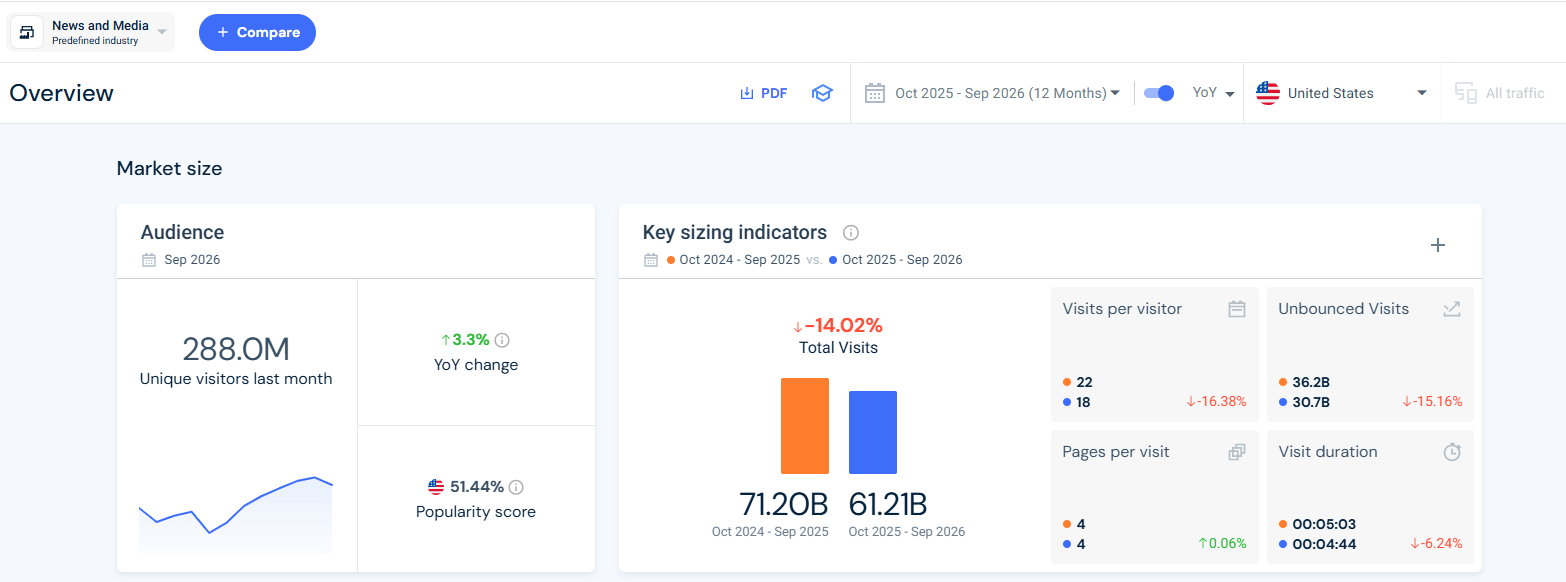
Market size overview for the News and Media industry in the US. Source: Similarweb market research tool, October 2025 to September 2026 versus the prior 12 months.
Let’s start with the big picture. Total visits to US news and media sites fell 14.02%, from 71.20 billion to 61.21 billion. The audience itself held up, though: 288.0 million unique visitors in September 2026, up 3.3% year over year.
So readers are still around. They just visit less often. Visits per visitor dropped from 22 to 18, a 16.38% decline.
When they do show up, they behave much the same. Pages per visit stayed at 4, and visit duration slipped 6.24%, from 5 minutes 3 seconds to 4 minutes 44 seconds. Unbounced visits fell 15.16%, from 36.2 billion to 30.7 billion.
Takeaway: Look at visits per visitor next to total visits. Total visits alone can hide the fact that your audience held steady.
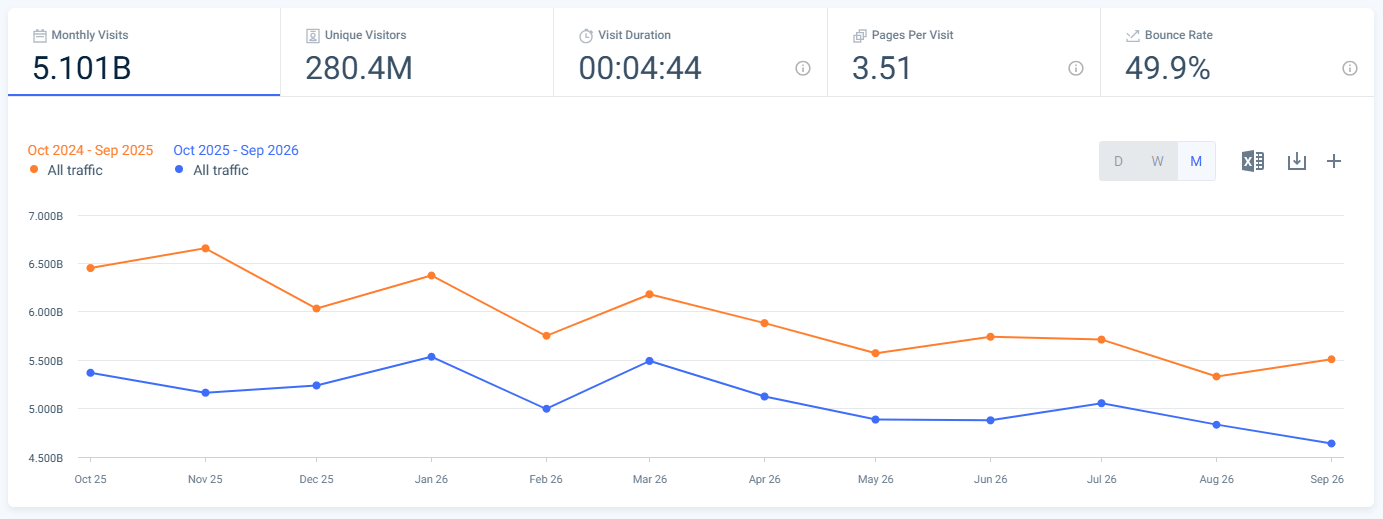
Monthly visits, current period (blue) versus prior period (orange). Source: Similarweb market research tool.
Across the 12 months, monthly visits averaged 5.101 billion. Unique visitors averaged 280.4 million a month, and the bounce rate came in at 49.9%.
Takeaway: Compare your own decline with the category’s. If your traffic fell 10% while the category fell 14%, you held up better than most.
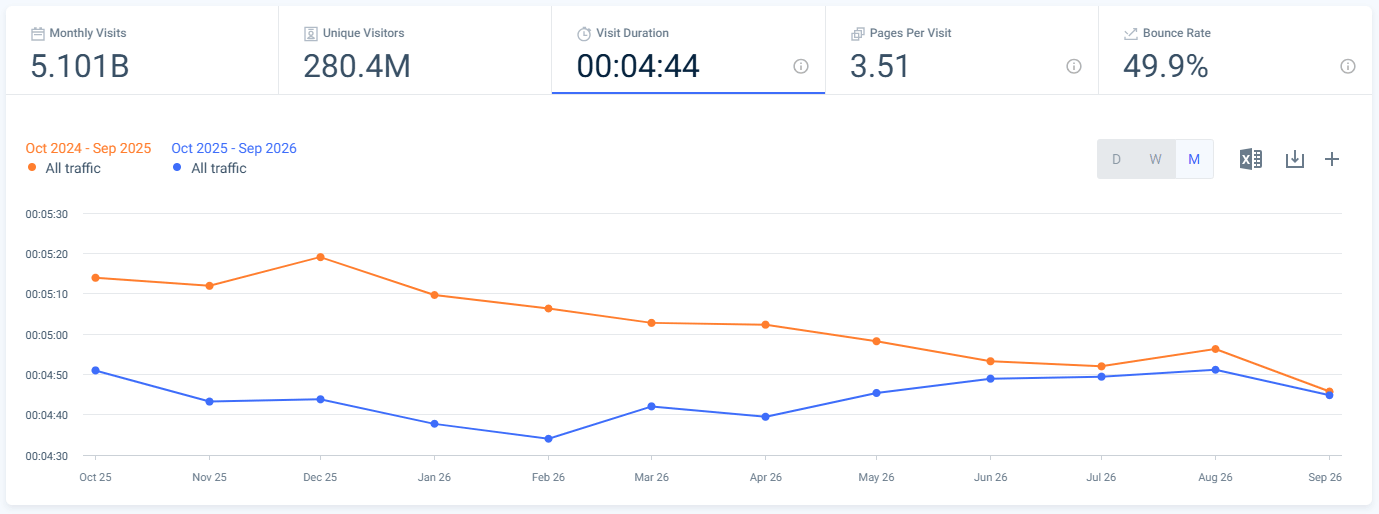
Visit duration by month, current period (blue) versus prior period (orange). Source: Similarweb market research tool.
Average visit duration was 4 minutes 44 seconds. Back in October 2025, visits ran about 4:51, compared with about 5:14 a year earlier. Over the following months, the two lines move toward each other and meet at about 4:45 in September 2026.
So time per visit steadied, even as the number of visits kept falling.
Takeaway: The readers who still arrive stay about as long as they did a year ago. There are fewer visits, but they’re about as deep as before.
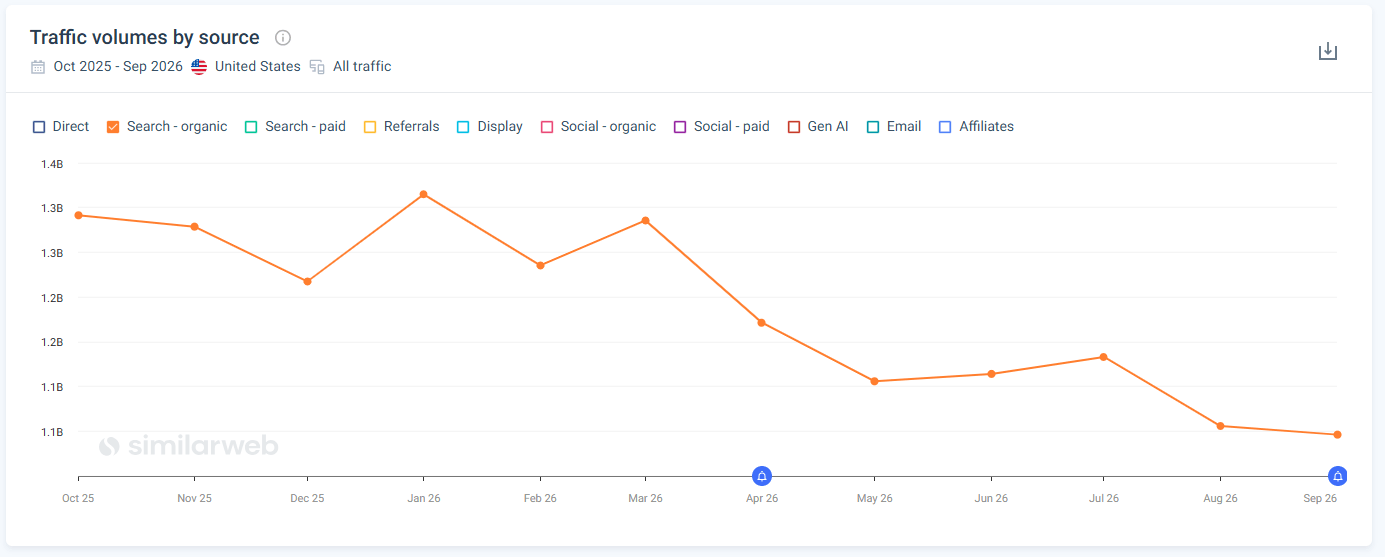
Traffic volumes by source, Search – organic selected. Source: Similarweb market research tool, US, all traffic.
Organic search sent US news and media sites about 1.3 billion visits in October 2025. It peaked around 1.32 billion in January 2026, then slid to about 1.05 billion by September 2026. That’s roughly 20% below the January peak.
Chartbeat’s numbers in the Trends and Predictions 2026 report point the same way. Google Search traffic to more than 2,500 news sites fell 38% in the US between November 2024 and November 2025.
One caution on September. Similarweb reclassified Google AI Mode traffic as organic search starting that month, so it isn’t a like-for-like comparison with earlier months. It’s still the lowest point on the chart, though.
Takeaway: Search is still the biggest source by far, and it’s shrinking. Build your AI visibility work on top of your SEO work.
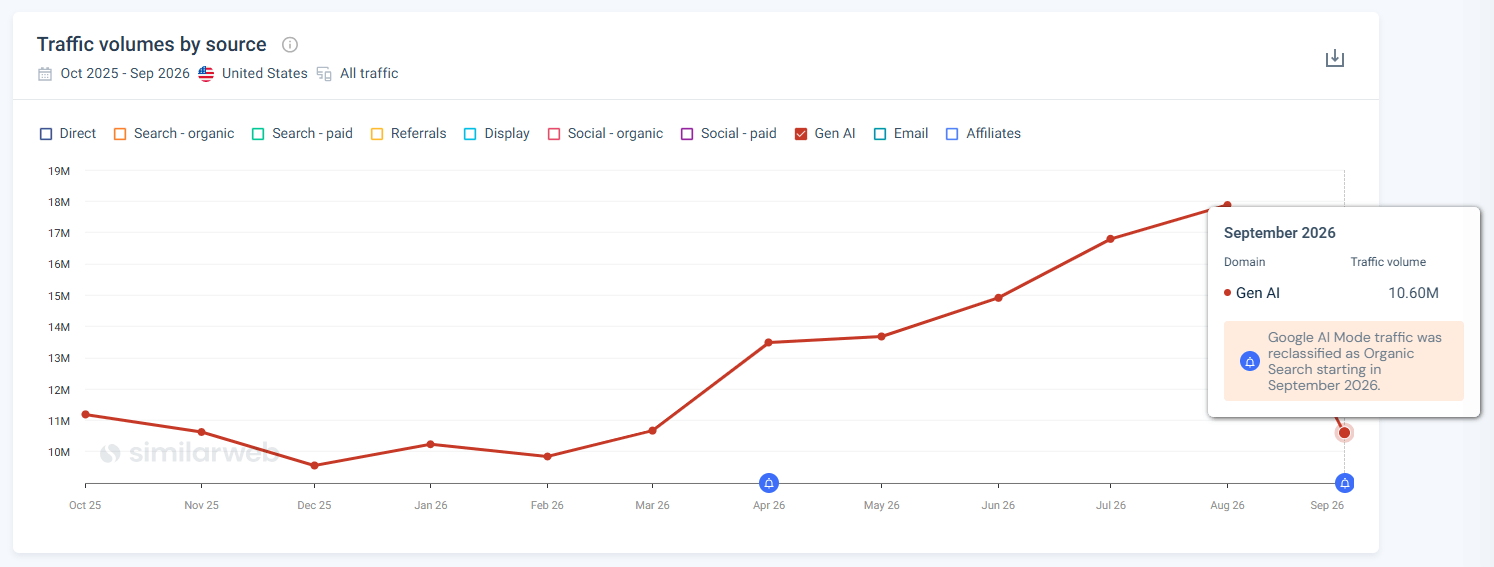
Traffic volumes by source, Gen AI selected, with the September 2026 tooltip. Source: Similarweb market research tool, US, all traffic.
Now for the newer channel. Visits from Gen AI platforms to US news and media sites ran at about 11 million in October 2025 and dipped to about 9.5 million in December. From there they climbed to about 13.5 million in April 2026 and peaked near 17.9 million in August.
September shows 10.60 million. Similarweb reclassified Google AI Mode traffic as organic search starting that month, so September is not comparable with earlier months.
To keep things in proportion, even at the August peak, Gen AI traffic was under 2% of the roughly 1.1 billion visits from organic search that month.
Takeaway: Gen AI is a small channel for news, but it nearly doubled between December 2025 and August 2026. Report it separately from search so you can watch the trend.
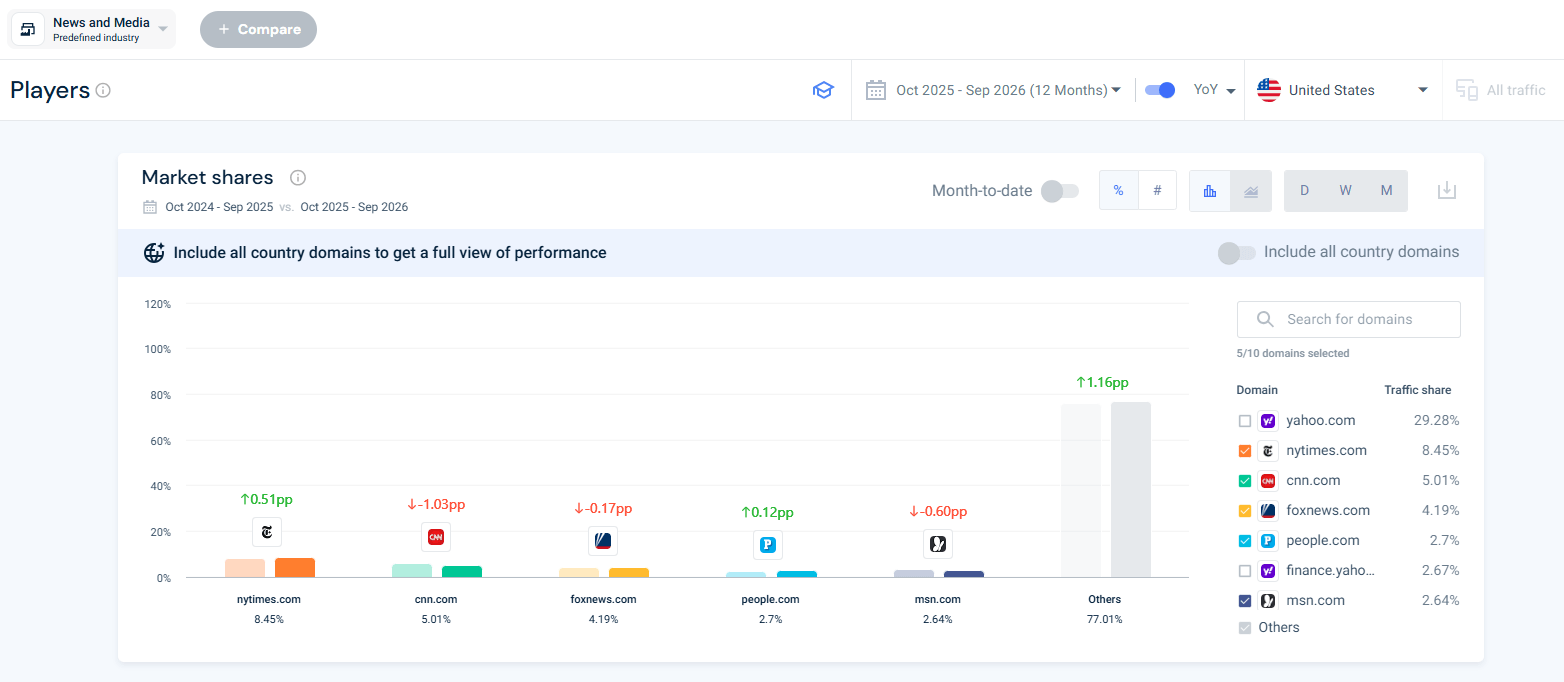
Market shares by domain, with change in percentage points versus the prior period. Source: Similarweb market research tool.
Now let’s see who’s winning share. The New York Times takes 8.45% of the category’s visits. CNN follows at 5.01%, then Fox News at 4.19%, People at 2.70%, and MSN at 2.64%.
Share moved in different directions over the year. The New York Times gained 0.51 percentage points, and People gained 0.12. Fox News lost 0.17, MSN lost 0.60, and CNN lost 1.03.
These 5 sites alone hold about 23% of visits to the category. All other domains in the category gained 1.16 points combined.
Takeaway: Share is moving between established brands, even as total visits in the category fell 14%.
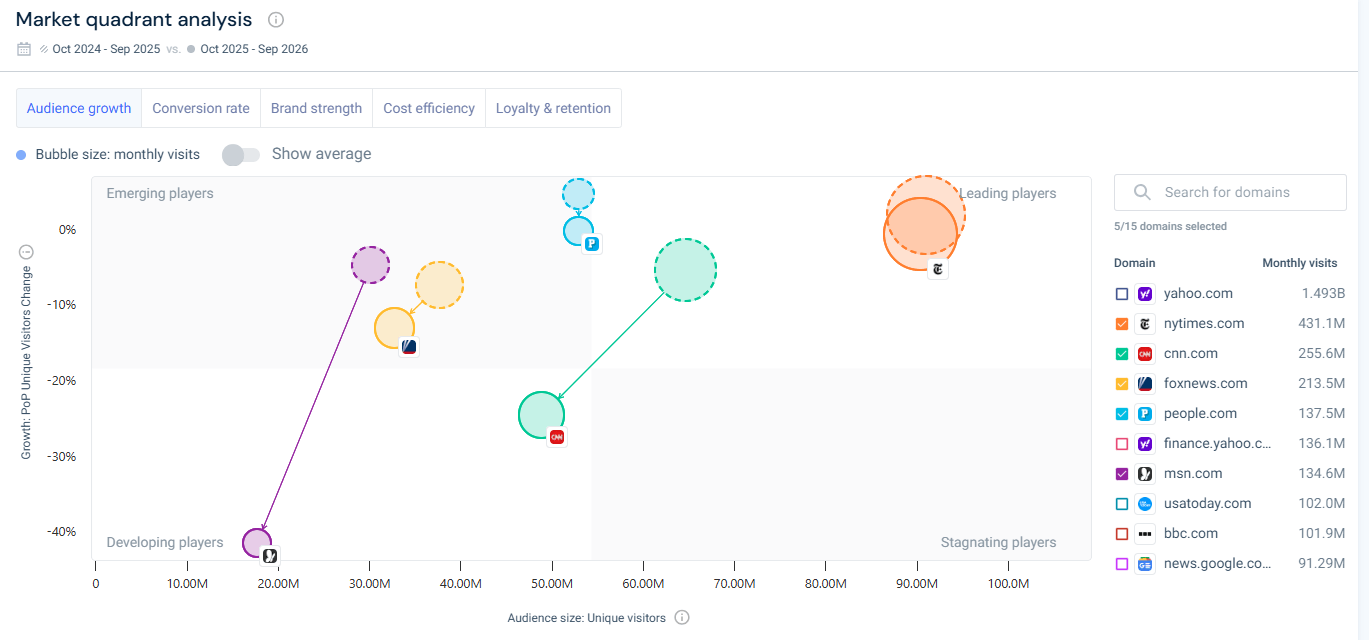
Market quadrant analysis, audience size versus change in unique visitors. Source: Similarweb market research tool.
This chart plots audience size against the change in unique visitors, and the picture is pretty clear. The New York Times sits among the leading players, with about 90 million unique visitors and a 0.55% decline. People held its audience too: 52.9 million unique visitors, down 0.10%.
Others lost a lot more. Fox News dropped 12.93%, to 32.8 million. CNN dropped 24.48%, to 48.9 million. MSN dropped 41.34%, to 17.7 million.
Five sites are a small sample, though, and this data can’t show cause and effect.
Takeaway: Audience loss is uneven. Brand strength is worth testing in your own data.
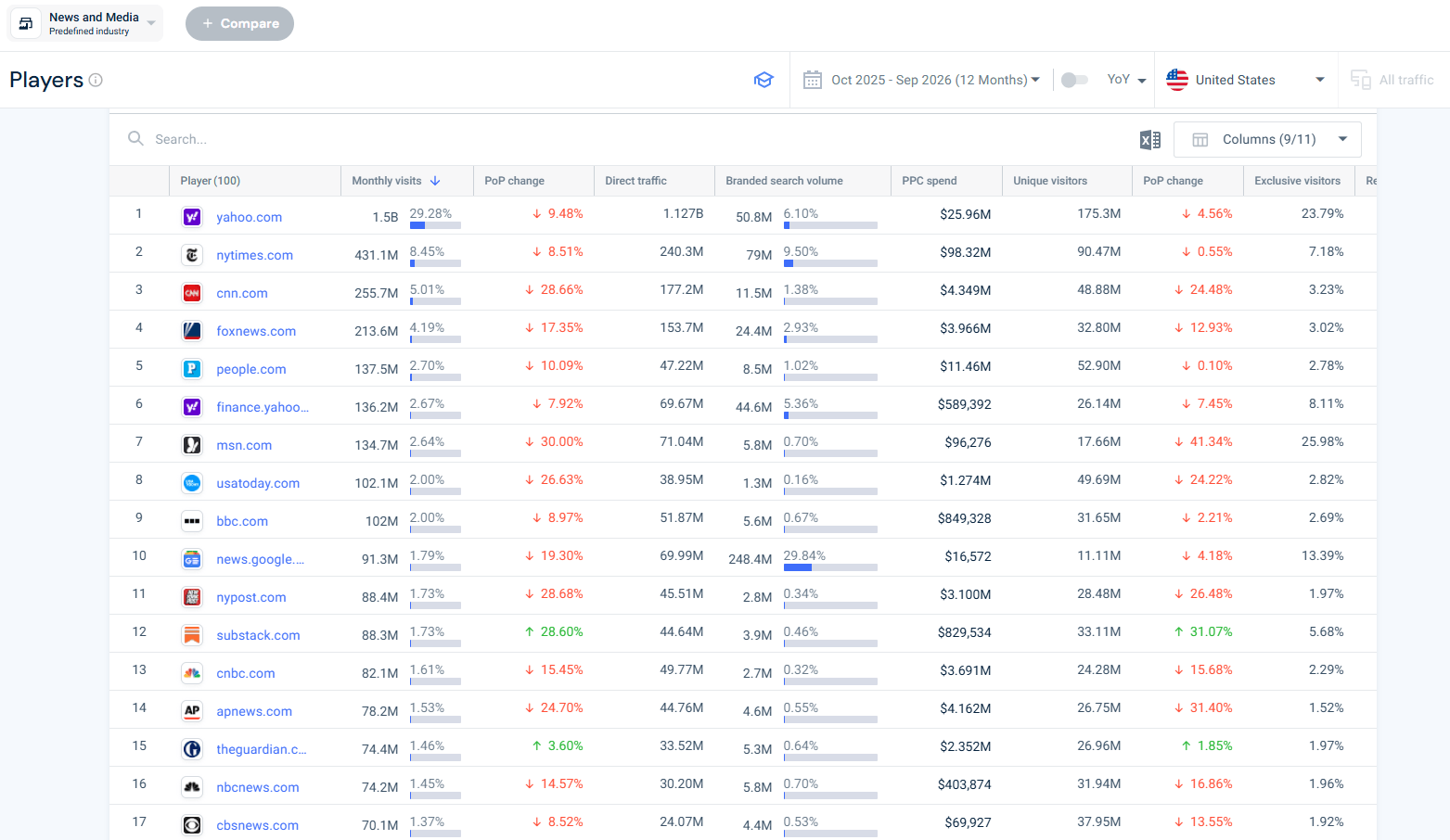
Players table for the News and Media industry, ranked by monthly visits. Source: Similarweb market research tool.
Of the top 17 sites that I could fit into the screenshot, 15 lost visits compared with the prior 12 months. Only Substack (up 28.60%) and The Guardian (up 3.60%) grew.
The steepest losses were at MSN (down 30.00%), the New York Post (28.68%), CNN (28.66%), USA Today (26.63%), and AP News (24.70%). The New York Times, at 431.1 million monthly visits, lost 8.51%.
Our data also reports direct traffic, branded search volume, PPC spend, unique visitors, and exclusive visitors for each site, so you can dig into how each audience is built.
The Guardian stands out. It’s the one major news brand in this top 17 with growing visits and unique visitors (up 1.85%). In a test of UK news queries published in January 2026, the think tank IPPR found the Guardian was ChatGPT’s top source, used in 58% of responses, and the most common source on Gemini, in 53% of answers. The two datasets cover different markets and measure different things, so treat the match as a lead worth testing.
Substack, a newsletter platform, also grew.
Takeaway: Pull your own Players table and look for the sites that are growing. Then see what they do differently.
AI tools cite a narrow set of news brands, and the set varies by platform and over time. IPPR’s test used 100 randomly generated UK news queries across ChatGPT, Gemini, Google AI Overviews, and Perplexity, and analyzed more than 2,500 links. On average, 34% of journalistic citations on each tool went to a single outlet, according to Press Gazette’s coverage of the report.
The BBC, which has sought to block AI companies from its content, was missing entirely from ChatGPT and Gemini. Google AI Overviews used it for 52.5% of news queries and Perplexity for 36%, IPPR found.
Our analysis of nearly 600,000 citation events in the US shows how little room news outlets have at the top. Reuters ranked seventh among ChatGPT’s most-cited domains, with 2.27% of citations, behind Wikipedia (13.15%) and Reddit (11.97%). No news outlet made Google AI Mode’s top 20. The data covers January and February 2026.
Citations also move. The sources cited for a given prompt change over time and differ by platform. This pattern is called citation volatility: how often the sources cited for a prompt change between scans.
Takeaway: Citation share is concentrated and unstable, so measure it over weeks, not days.
These tips cover your content, your site, and how you track results. Each one is rated for how confident we are that it works and how much effort it takes.
Confidence ratings work like this. Strong means published research or vendor documentation. Moderate means a single test or one analysis. Limited means a practitioner view, or a vendor stating the tactic is not required.
| # | Tip | Type | Confidence | Effort |
|---|---|---|---|---|
| 1 | Publish original data and named sourcing | Content | Strong | High |
| 2 | Lead with the answer | Content | Moderate | Low |
| 3 | Refresh evergreen explainers | Content | Moderate | Medium |
| 4 | Add a TL;DR to long analysis | Content | Limited | Low |
| 5 | Write sections that stand alone | Content | Limited | Medium |
| 6 | Put structured facts in tables | Content | Limited | Low |
| 7 | Add FAQ blocks to explainers | Content | Limited | Low |
| 8 | Set crawler access by bot type | Technical | Strong | Low |
| 9 | Confirm pages are indexed and snippet-eligible | Technical | Strong (Google features) | Low to medium |
| 10 | Keep key facts in visible text | Technical | Moderate | Low |
| 11 | Add Article schema with named authors | Technical | Limited | Low to medium |
| 12 | Track a fixed set of queries and test one change at a time | Measurement | Practical | Medium |
Seven content tips help AI systems extract and cite journalism: original data with named sources, answer-first ledes, refreshed explainers, TL;DRs on long analysis, self-contained sections, tables, and FAQ blocks. The research favors substance over format, since statistics and quotations raised citation visibility more consistently than formatting changes.
The Reuters Institute’s review of the research found that relevance, recency, and concrete, extractable details such as statistics and quotations help. Formatting effects are less consistent. The list below starts with the best-supported tip.
Put the number, the name, and the source in the same sentence. This is the best-supported content tip.
The Princeton GEO-Bench study tested content edits against a benchmark of 10,000 queries. Adding citations, quotations, and statistics raised visibility by more than 40% across queries. On Perplexity, the methods lifted visibility by up to 37%.
The benchmark covers diverse topics, so treat the percentages as a sign of direction. Google’s own guide to generative AI features points the same way. It says creating unique, useful content will likely influence a site’s presence in generative AI search more than any other suggestion in the guide.
Original reporting and your own data give AI systems something they cannot get elsewhere. Our guide to original data as a GEO moat shows how to package your numbers so they get cited.
Lead with the answer. This is called the BLUF approach, short for bottom line up front: the main fact comes first, then the context.
Keep the claim, the attribution, and the key number in one sentence. Here is an illustrative example. Riverton is a made-up city.
Do the same under each subhead. Put the direct answer in the first sentence of the section.
Yes, for explainers and background pages that readers keep searching for. Update the facts, add new data, and show the update date in the visible text.
Recency is one of the factors the research links to citation visibility. Start with the explainers that get the most traffic.
Add one to long analyses and explainers that make a central argument. Skip it on short news items. A TL;DR is a 40 to 100 word summary near the top that states the answer.
Placement matters. Kevin Indig’s analysis of 18,012 ChatGPT citations, published in his Growth Memo, found 44.2% came from the first 30% of the text. Our guide to TL;DR sections covers the finding. We have not seen a test showing that a TL;DR label by itself earns citations.
A summary on every article can train readers to skim the box and leave. Axios shows the useful version: its “Why it matters” note states the point first and still rewards the reader who continues.
Give each section a descriptive subhead, answer one question in it, and make sure it reads well on its own. Keep paragraphs to three or four sentences. Our content chunking guide covers the full checklist.
Google’s May 2026 guide says chunking is not required for its AI features. Write for readers first. Splitting a story into bite-sized pieces for machines can hurt the story.
Use a table when a story holds comparable facts: election results, game scores, polling, timelines, or prices. A table labels each value, so readers and retrieval systems both read it correctly.
Our TL;DR guide makes the same point about AI extraction, though we cite no test for it. Add a one-sentence takeaway above the table.
Add three to five questions at the end of explainers, profiles, and evergreen guides. Write them from real follow-up questions: search suggestions, reader emails, and the prompts you track.
Give each a direct answer in the first sentence. A TL;DR covers the main point, and an FAQ covers the side questions.
Four technical tips matter most for news sites: setting crawler access by bot type, keeping pages indexed and snippet-eligible, putting key facts in visible text, and adding Article schema with named authors and dates. Google says its AI features need no special markup, so treat schema as a low-cost clarity step.
These tips are about your site settings and page templates. Most take hours, not weeks.
| # | Tip | Where to check |
|---|---|---|
| 8 | Crawler access by bot type | Your robots.txt file and server logs |
| 9 | Indexed and snippet-eligible pages | Your search console index and snippet reports, and the generative AI setting |
| 10 | Key facts in visible text | A text-only view of the page, or the page source |
| 11 | Article schema | Your article page template, the page source, and a structured data validator |
Decide by bot type and by content tier. OpenAI documents three user agents. OAI-SearchBot surfaces sites in ChatGPT search results. GPTBot collects content that may be used for training. ChatGPT-User acts on a person’s request, and robots.txt rules may not apply to it.
OpenAI says each setting is independent. You can allow OAI-SearchBot and disallow GPTBot. Sites that opt out of OAI-SearchBot will not be shown in ChatGPT search answers.
Here is an example that allows search and blocks training:
User-agent: OAI-SearchBot
Allow: /
User-agent: GPTBot
Disallow: /
Two practical checks help here. First, look at your server logs. Our technical GEO guide recommends confirming which AI bots fetch your pages and whether they get a 200, 403, or 429 response. Second, review any SEO plugin or CDN setting that blocks AI bots in one click. Our robots.txt guide notes that some of these settings block retrieval bots along with training bots. It also covers the syntax and has a fuller example that includes Anthropic and Perplexity bots.
The BBC shows what blocking can cost. In October 2023, Deadline reported that the BBC blocked OpenAI’s crawler, saying it does not believe that scraping its content without permission to train generative AI models is in the public interest. IPPR found the BBC missing entirely from ChatGPT and Gemini, and noted that the BBC has sought to block AI companies from its content.
Google has a separate control for its own AI features. A Search Console toggle lets site owners opt out of AI Overviews and AI Mode. Google says sites that opt out get no traffic or impressions from those features, and the control is not used as a ranking signal for regular Search. Google began testing it in the UK on June 3, 2026, the day the UK’s Competition and Markets Authority imposed a conduct requirement on Google, and had rolled it out to all websites worldwide by August 31, 2026. For Gemini, our robots.txt guide says the Google-Extended token controls whether Google uses your content to train Gemini, and it is separate from Googlebot.
Bot strategy has no single right answer. One approach is to keep premium journalism protected while opening free content as an introduction to the brand. A publisher missing from AI summaries loses the chance to make that introduction.
This is a business decision. Match it to your audience and revenue strategy.
Check this first. Google’s guide describes optimizing for its AI features as still SEO. AI Overviews and AI Mode draw on Google’s core search systems, and a page must be indexed and eligible to be shown in Google Search with a snippet to appear. The guide also says a site must be included in Search generative AI features in Search Console, so check that setting too.
Treat GEO as a layer on top of SEO basics. Our guide to adapting your SEO strategy to increase AI visibility covers the general version.
Duplicates matter too. Our technical GEO guide says AI systems notice conflicting versions of the same page, so canonicalize properly and keep variants consistent. It also suggests keeping publish and modified dates accurate and adding lastmod to your XML sitemaps.
This guidance applies to Google’s AI features. It says little about ChatGPT or Perplexity.
Put bylines, dates, key figures, and corrections in the text on the page. Chatbots that fetch a page live read what a visitor sees.
Some AI crawlers fetch pages with simple HTTP requests and rely on the raw HTML. Our technical GEO guide suggests keeping the main content in clean, crawlable HTML, and using server-side rendering or pre-rendering if the article loads in the browser. To check, view the page source or turn off JavaScript and see whether the article text is still there.
In an October 2025 test, searchVIU placed a price only in JSON-LD on a test page. None of ChatGPT, Claude, Perplexity, Gemini, or Google AI Mode extracted it when fetching the page directly. Our schema markup guide covers the test. It is a single test, so we rate our confidence as moderate.
Add it if the cost is low, and expect no guaranteed lift. Google says no special schema is needed for its AI features. Our guide on schema markup and AI citations found no published test showing that any schema type earns AI citations. A Microsoft Bing product manager said in March 2025 that schema helps Microsoft’s LLMs understand content, but understanding a page is a different step from citing it.
For publishers, the types worth adding are Article with a named Person author, and Organization with sameAs links. You can use Article or its news subtype, NewsArticle. The markup states who wrote the page, when, and who published it, and sameAs links let AI systems connect the publisher and authors to official profiles. Match every value in visible text, as in tip 10.
Set it up once per template, and it applies to every page that uses the template. There is no need to add schema article by article. Build it into your article page template, and fill the headline, author, and dates from the same fields that fill the visible page. Put the JSON-LD directly in the page’s HTML instead of adding it later with a tag manager, so every crawler receives it.
Already have markup? Keep it if it is valid and matches the page. Remove only markup that is inaccurate, contradicts the page, or duplicates another block. To find out whether markup moves citations on your site, our guide shows how to test it with test and control pages.
It is optional, so it sits outside the 12 tips. llms.txt is a Markdown file at your domain root that lists a small set of your most important pages, each with a short description, written for AI systems. Our llms.txt guide compares three root files: robots.txt controls access, sitemap.xml lists what exists, and llms.txt curates which pages matter most. It blocks nothing, and it replaces neither of the other two.
Do not expect a lift. Google says Google Search ignores llms.txt files, so adding one neither helps nor harms your visibility there. Our guide reaches the same view for classic SEO and AI Overviews, and our technical GEO guide adds that major AI platforms have not officially adopted it.
Where does that leave a newsroom? Our guide ranks the file by site type. Sites still fixing crawlability, indexing, or content quality should skip it for now. Mature, content-rich sites with solid basics can treat it as a low-cost experiment. If you try it, keep the list to 5 to 15 pages, such as your About page, your standards and corrections policy, and your evergreen explainers. Review it a few times a year so it never points at outdated pages.
Match AI visibility work to your audience strategy. Visibility can be a first touch that leads to direct visits, newsletter sign-ups, and subscriptions. Smaller and local outlets have the clearest opening in specialized questions where only a handful of authoritative sources exist.
Smaller publishers can focus on questions only they can answer. If you are the only source with a very local answer, you can be found and cited.
IPPR found that AI tools concentrate on a narrow set of large brands. Competing on stories that hundreds of outlets cover is harder. List the questions only your newsroom can answer, such as local election results or council votes, and cover them well.
These are our recommendations, built from the sources above. They are not tested results.
| Publisher type | Start with | Why |
|---|---|---|
| Large national brand | 8, 12, 1 | Citations concentrate on established brands, and premium content needs a deliberate bot policy |
| Mid-size or ad-supported | 9, 2, 1 | These are the lowest-cost tips, and they help readers too |
| Small or local | 1, 3, 8 | Few sources cover local questions, so original local data and open free content give you an edge |
| Subscription-led | 8, 1, 12 | Protect premium content, introduce your brand through free content, and track the results |
Measure AI visibility with four numbers: citation share across a fixed set of topic queries, brand mention rate, AI referral sessions in your analytics, and AI crawler activity in your server logs. AI answers vary between runs, so compare trends over several weeks and treat any single result as one sample.
Track the four numbers above for each topic, such as politics or sports. Newsroom KPIs built on unique users and page views need to change, since a mention in an AI answer generates no click. LLMs can also give different answers to the same question, so test likely queries repeatedly.
For Google’s AI features, Search Console now has a Generative AI performance report. Google says it shows impressions, which pages appear in AI responses, and in which countries, and that it has rolled out to all websites worldwide.
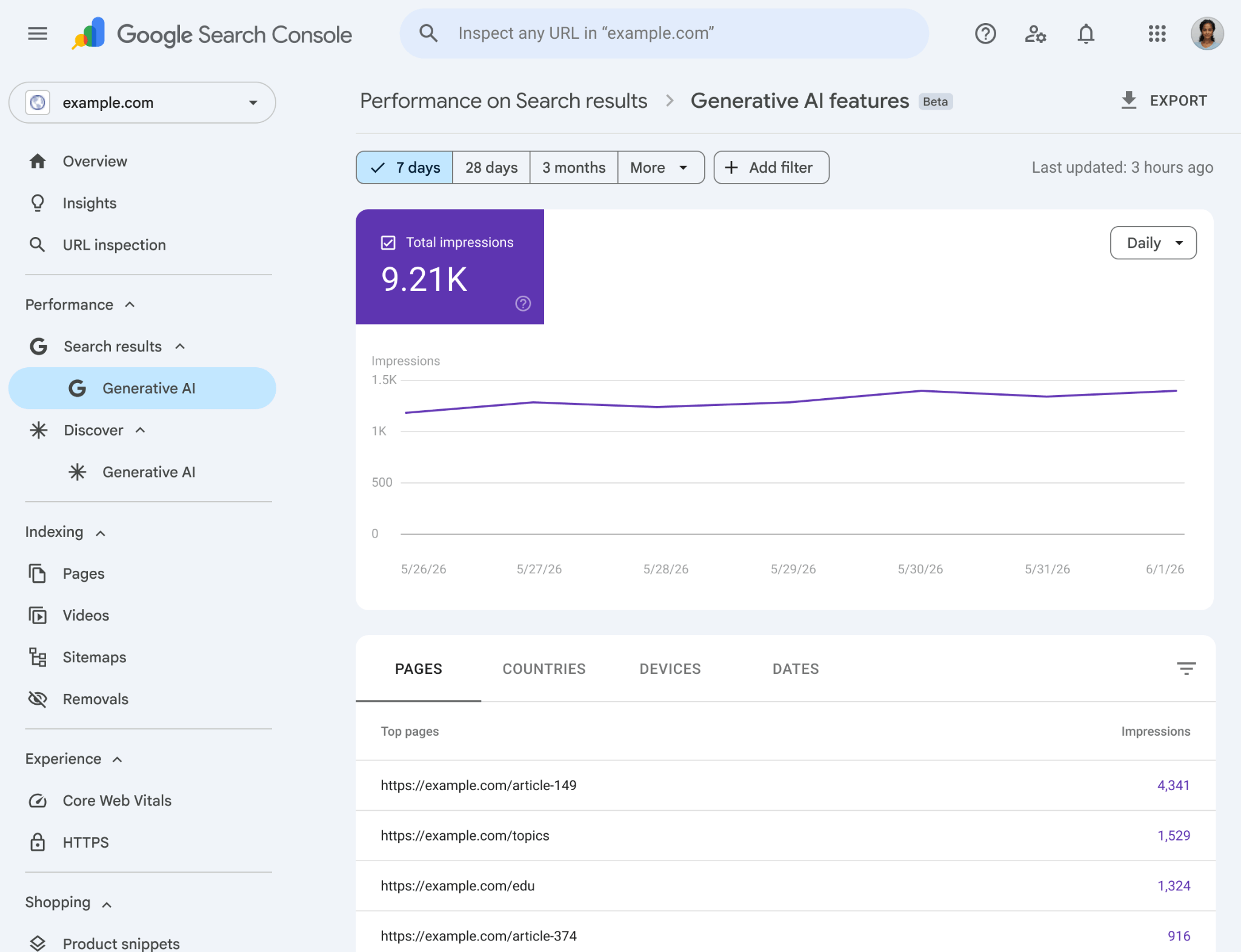
The Generative AI performance report for Search in Google Search Console, shown with example data. Source: Google Search Console.
Use a control group, so you know which change worked. Similarweb’s schema guide describes this design, and it works for any of the 12 tips.
Similarweb’s guide to tracking AI brand visibility shows how to set this up. Similarweb’s AI citation analysis tracks citations by domain and page across AI platforms. The next section shows how.
Publishers can use Similarweb AI Search Intelligence to see how often AI tools mention and cite their sites, which prompts they win, and how answers describe them. The AI Brand Visibility tools cover mentions, prompts, citations, and sentiment. The AI Traffic Tracker shows which chatbots send visits and which pages they land on.
To show how it works, I built an example workspace in Similarweb AI Search Intelligence for foxnews.com. It tracks nine topics and ten competitors in ChatGPT for the seven days from October 25 to 31, 2026, in the US.
I also used the Similarweb AI Traffic Tracker to analyze the same site’s AI chatbot traffic, worldwide, from April to September 2026.
The setup works for any publisher. The brand visibility workspace covers one AI platform, one week, and topics we chose. The traffic analysis covers six months and all tracked chatbots. Read the numbers as examples of what each view shows, and avoid treating them as a verdict on the site’s overall AI performance.
The AI Brand Visibility tool has four tabs. Each answers a different question.
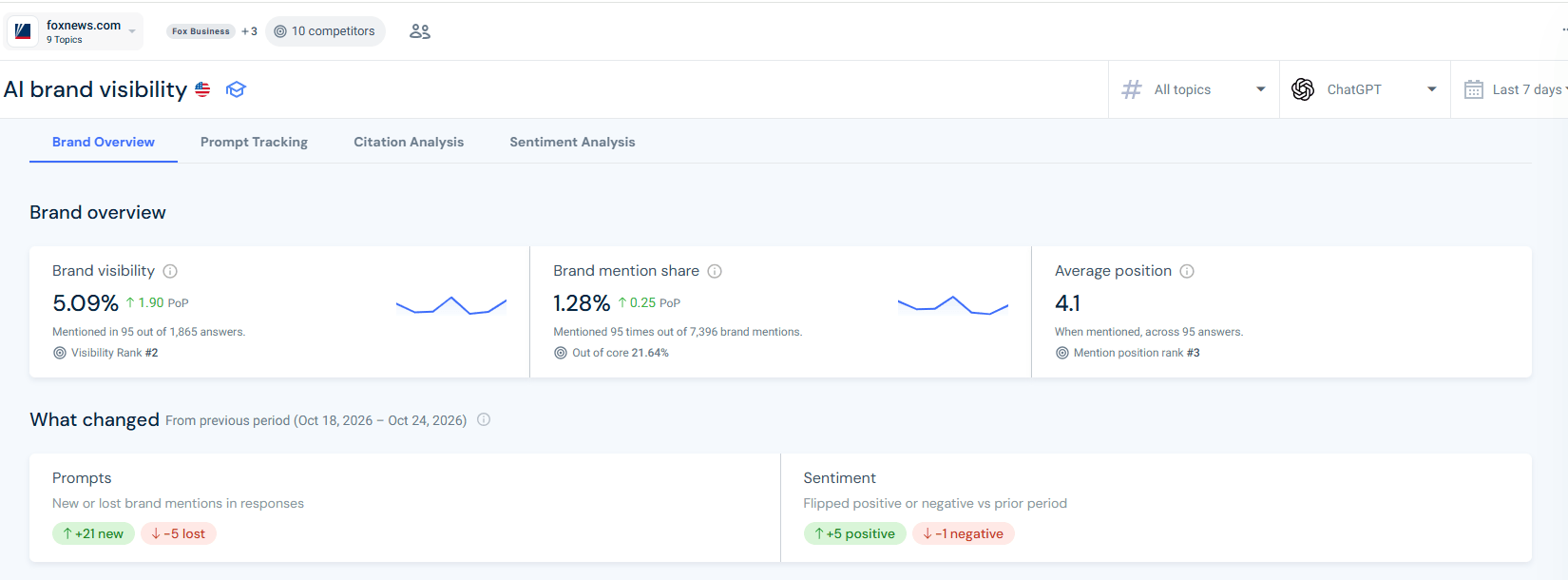
Brand Overview tab for an example workspace, ChatGPT, last 7 days. Source: Similarweb AI Search Intelligence.
In the seven days to October 31, foxnews.com had 5.09% brand visibility in ChatGPT, up 1.90 points on the prior week. Brand visibility is the share of answers that mention you. Here, ChatGPT mentioned Fox News in 95 of 1,865 answers, and Fox News ranked #2 for visibility.
Brand mention share was 1.28%. That is your share of all brand mentions across the answers: 95 of 7,396. Average position was 4.1 when Fox News appeared, which ranks #3.
The “What changed” panel compares against the previous week. Fox News gained 21 prompts with a mention and lost 5. Five mentions flipped to positive sentiment, and one flipped to negative.
Takeaway: Use this panel as a weekly scorecard: visibility, mention share, position, and what changed. It gives you the baseline for the tests in tip 12.
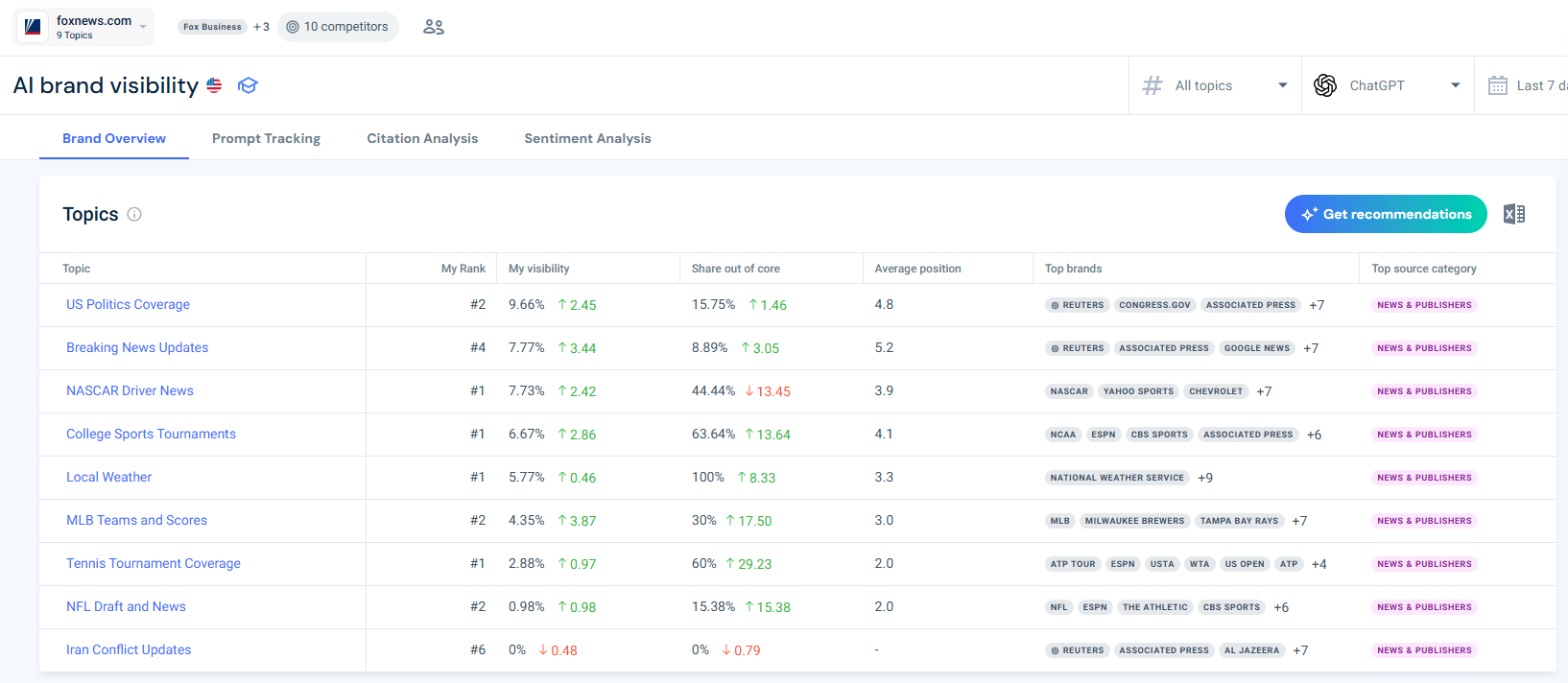
Topics table for the example workspace, ChatGPT, last 7 days. Source: Similarweb AI Search Intelligence.
The Topics table breaks the scorecard down by subject. Fox News ranks #1 in four of nine topics: NASCAR driver news, college sports tournaments, local weather, and tennis tournament coverage. It ranks #2 in US politics coverage, MLB, and the NFL draft, #4 in breaking news updates, and #6 in Iran conflict updates, where visibility is 0%.
US politics coverage has the highest visibility at 9.66%, up 2.45 points. The Top brands column shows who competes for each topic. Reuters, Congress.gov, and the Associated Press head the politics list. The National Weather Service heads the local weather list.
The pattern is easy to read. In sports and weather, Fox News ranks first. In politics and breaking news, wire services and government sites lead.
Takeaway: Sort by rank and by change. Protect the topics you lead, and plan content for the topics where wire services and reference sites lead.
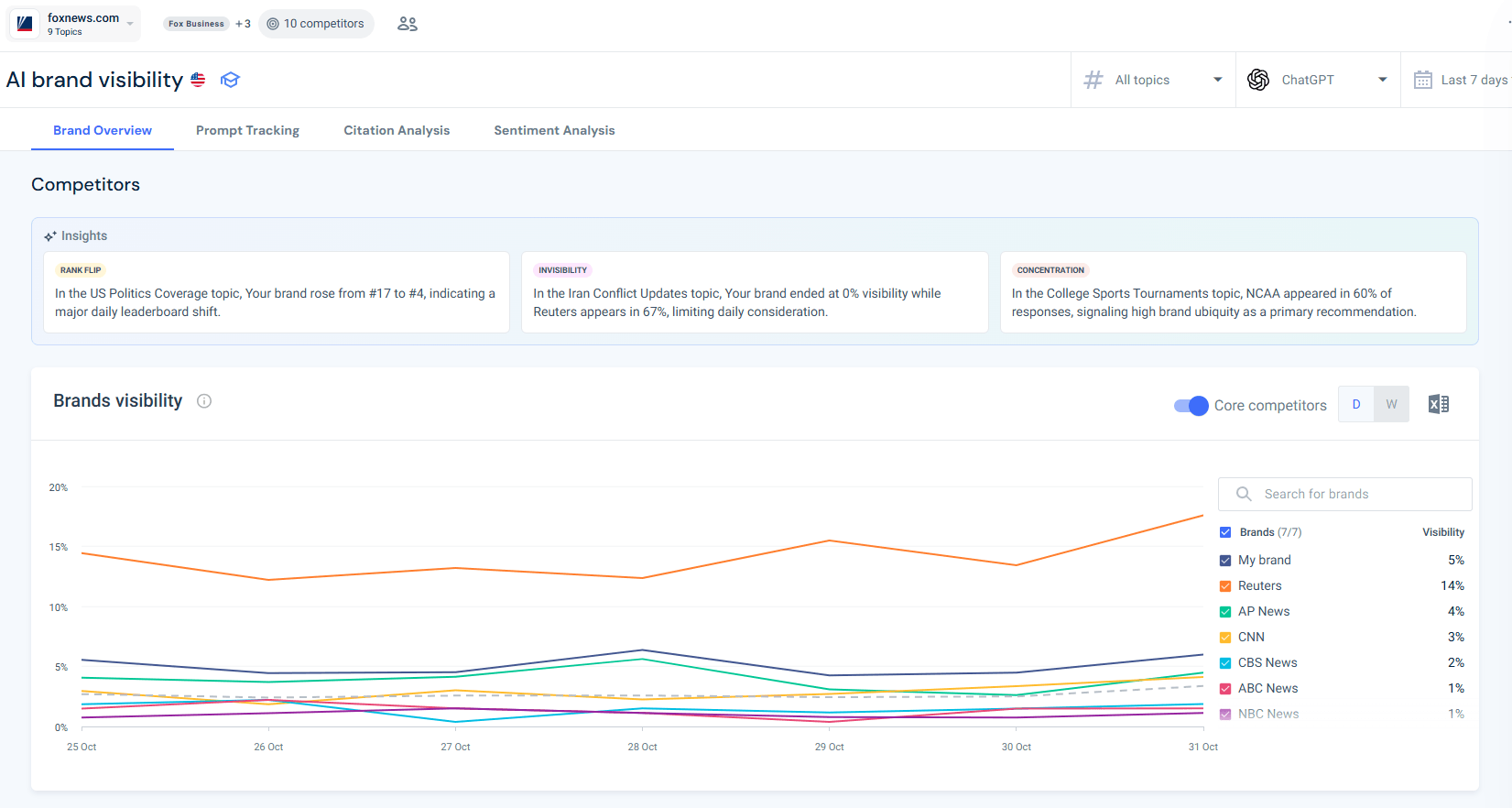
Competitors view for the example workspace, ChatGPT, October 25 to 31, 2026. Source: Similarweb AI Search Intelligence.
The Competitors view adds an Insights panel that flags changes for you. In this example, it shows three. Fox News rose from #17 to #4 on the daily US politics leaderboard. It ended at 0% visibility in Iran conflict updates while Reuters appeared in 67%. The NCAA appeared in 60% of college sports tournament responses.
The chart tracks daily visibility for the core competitors. Reuters leads at 14%, nearly three times Fox News’s 5%. AP News has 4%, CNN 3%, CBS News 2%, and ABC News and NBC News 1% each.
Your real AI competitors may be wire services, leagues, and reference sites, and they can outrank your direct rivals.
Takeaway: Add the sources AI actually cites to your competitor set, along with the sites you compete with for readers.
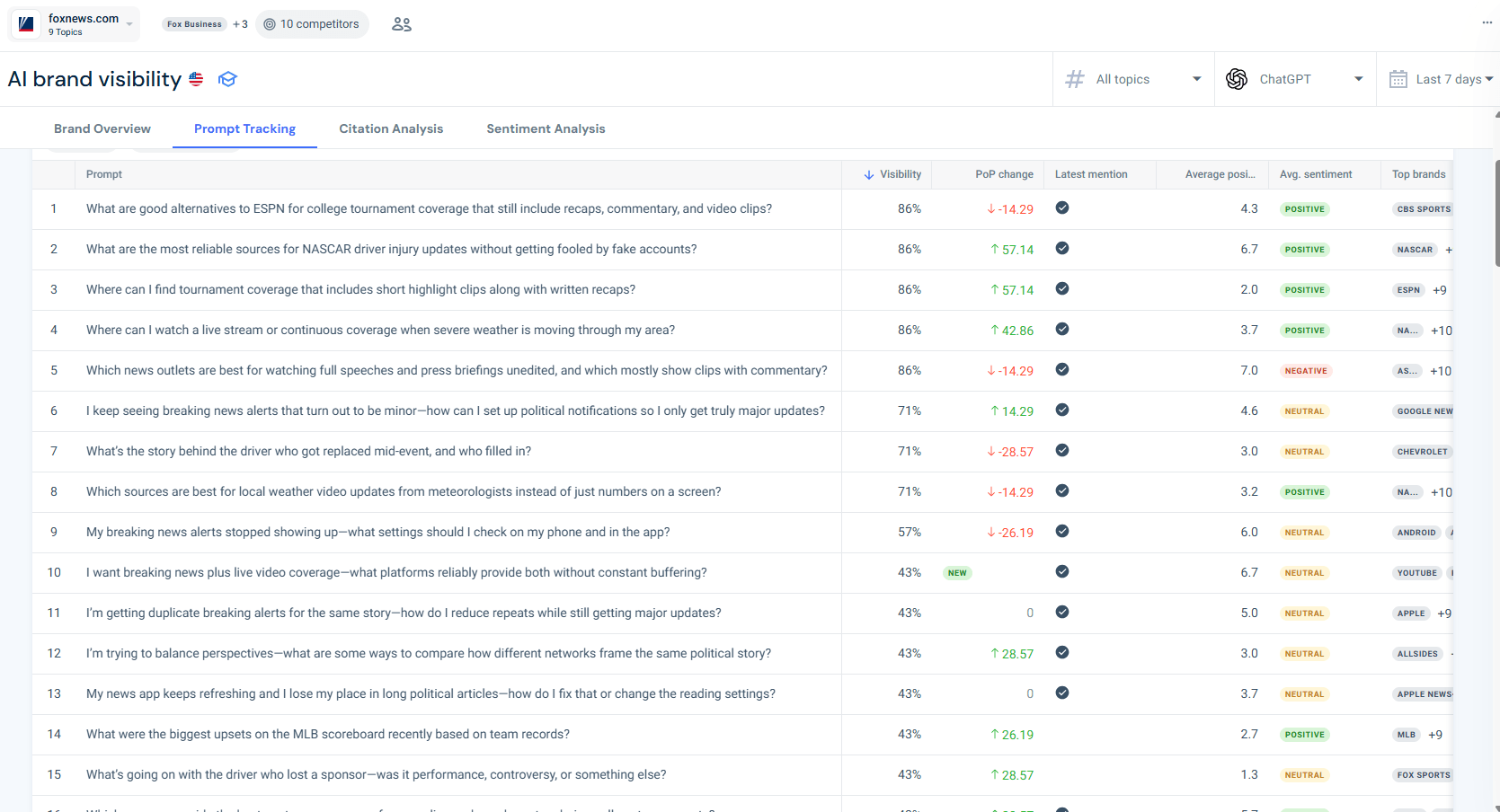
Prompt Tracking tab for the example workspace, ChatGPT, last 7 days. Source: Similarweb AI Search Intelligence.
For this view, I used Similarweb’s AI Prompt Analysis tool. The Prompt Tracking tab lists the tracked prompts with visibility, change versus the prior period, latest mention, average position, average sentiment, and top brands for each one.
Some prompts show where Fox News is strong. “Where can I watch a live stream or continuous coverage when severe weather is moving through my area?” has 86% visibility, up 42.86 points. A question about reliable sources for NASCAR driver injury updates also reaches 86%, up 57.14.
Others show gaps. A prompt about breaking news alert settings fell 26.19 points to 57%. A new prompt about platforms that offer breaking news with live video appears at 43%.
Look at the question types. Many are service questions about alerts, notifications, live streams, and app settings. They point to help pages and FAQ content as well as news stories.
One prompt carries negative average sentiment: which outlets show full speeches unedited and which mostly show clips with commentary. Open a prompt like this to read the AI wording behind the score.
Takeaway: Use the prompts you lose, and the ones that newly appear, to choose subheads, FAQs, and explainers (tips 5 and 7).
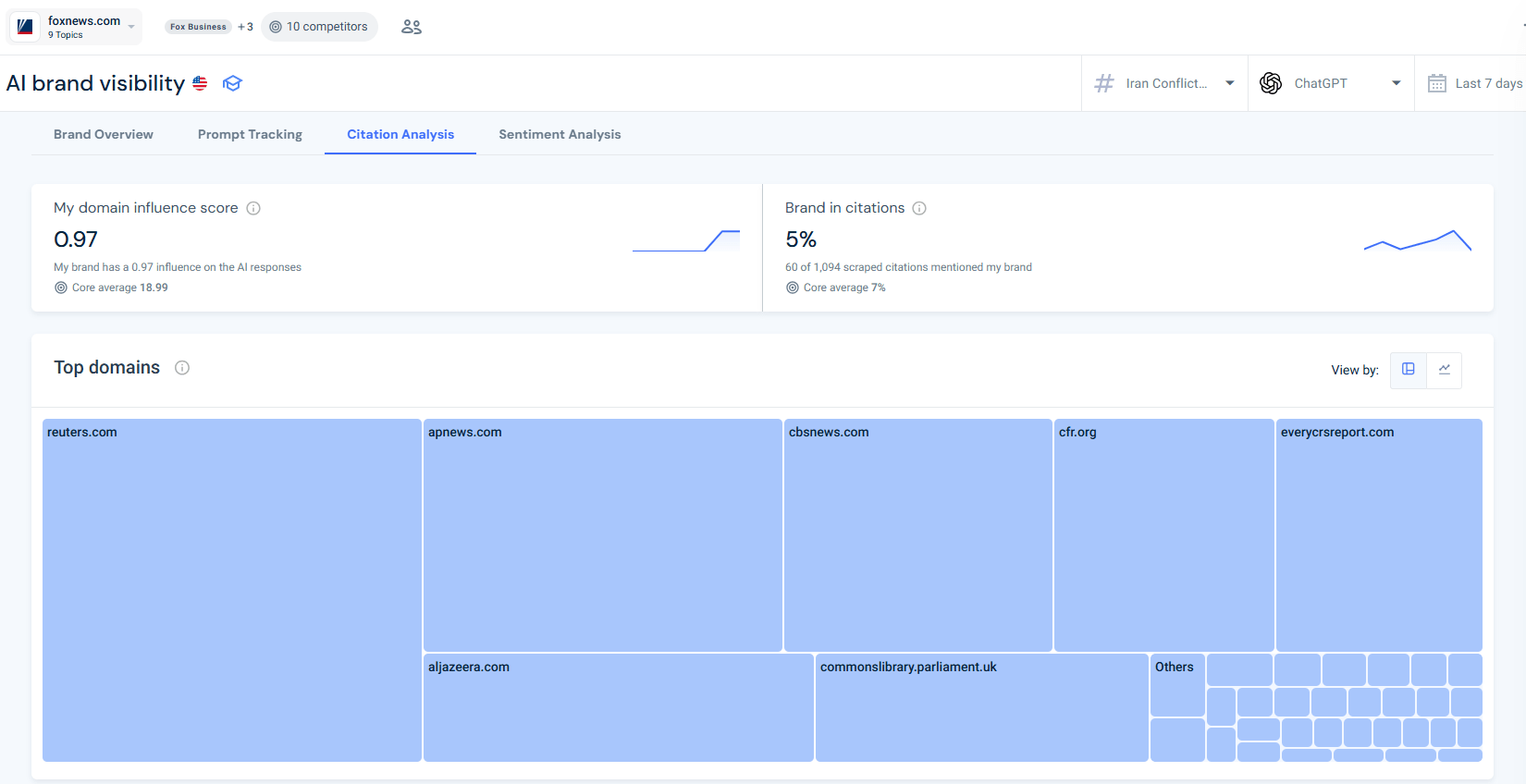
Citation Analysis tab filtered to one topic, ChatGPT, last 7 days. Source: Similarweb AI Search Intelligence.
For this view, I used Similarweb’s AI Citation Analysis tool. The Citation Analysis tab shows the sources behind the answers. This view is filtered to the Iran conflict updates topic. Fox News’s domain influence score is 0.97, against a core average of 18.99. Fox News appears in 5% of citations, which is 60 of 1,094 scraped citations, against a core average of 7%.
Compare that with the 0% visibility for this topic. Mentions and citations are different signals. Visibility counts mentions in the answer, and the citation view counts the sources.
The Top domains map shows who shapes answers on this topic: reuters.com, apnews.com, cbsnews.com, cfr.org, everycrsreport.com, aljazeera.com, and commonslibrary.parliament.uk. Three of those seven, cfr.org, everycrsreport.com, and commonslibrary.parliament.uk, are research or reference sites.
Takeaway: On fast-moving topics, AI leans on reference and research pages as well as news. Check the domain mix before you plan content.
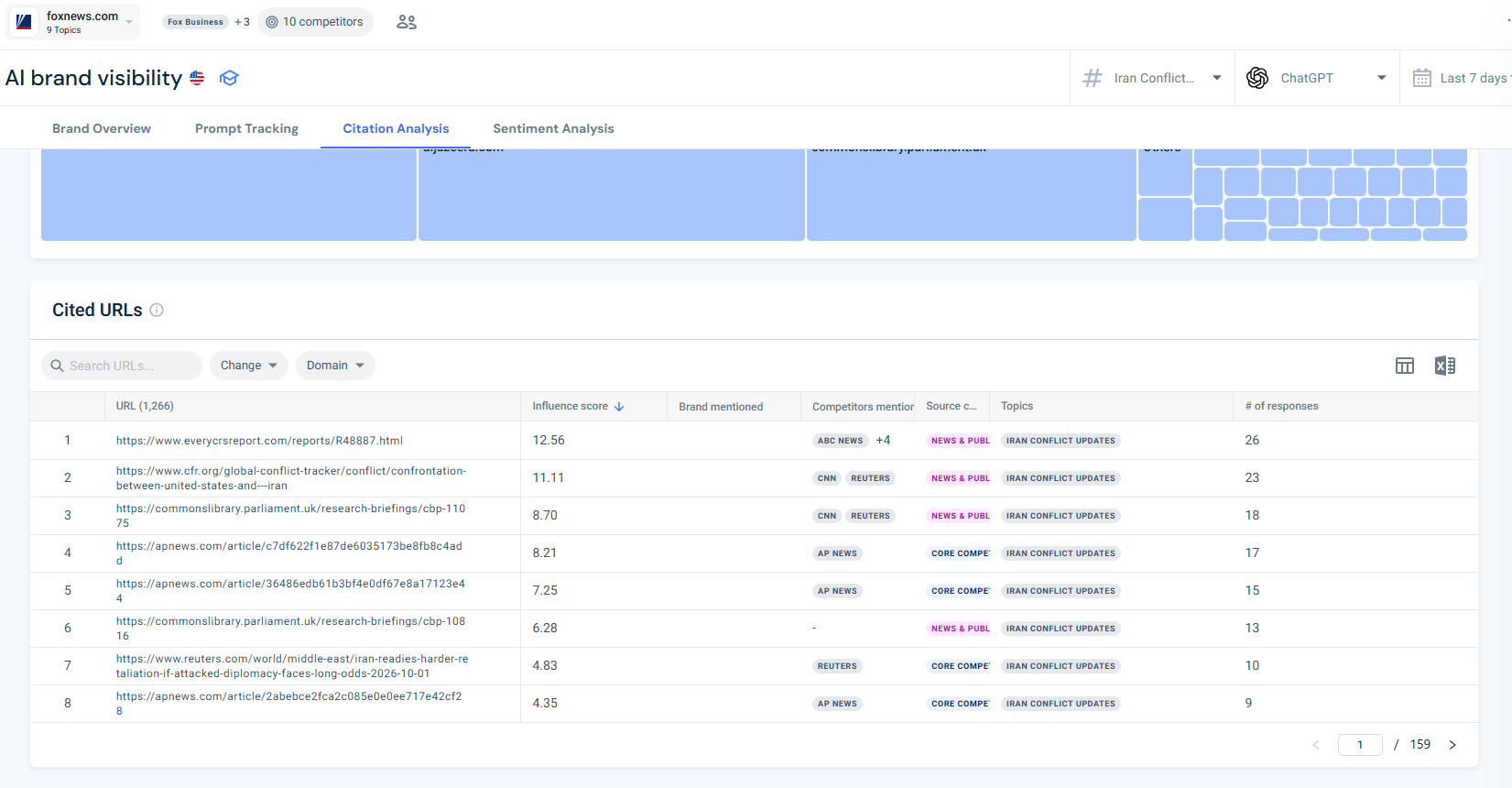
Cited URLs table for the same topic, ChatGPT, last 7 days. Source: Similarweb AI Search Intelligence.
The Cited URLs table ranks individual pages by influence score and number of responses. For this topic, it lists 1,266 URLs. The top page is a report on everycrsreport.com, with an influence score of 12.56 and 26 responses. Second is a Council on Foreign Relations conflict tracker page at 11.11 and 23 responses. Third is a House of Commons Library briefing at 8.70 and 18 responses.
AP News pages follow at 8.21 and 7.25. A Reuters article with an October 1, 2026 date in its URL appears at 4.83 with 10 responses, so a story about four weeks old still gets cited. Four of the top six URLs are research or reference pages. The Brand mentioned column is empty for all eight rows shown.
You can search for your own URLs, or filter by change and domain to see what moved.
Takeaway: Look at the format of the pages AI cites. Where your newsroom has the expertise, build a reference page that competes, and keep it updated (tip 3).
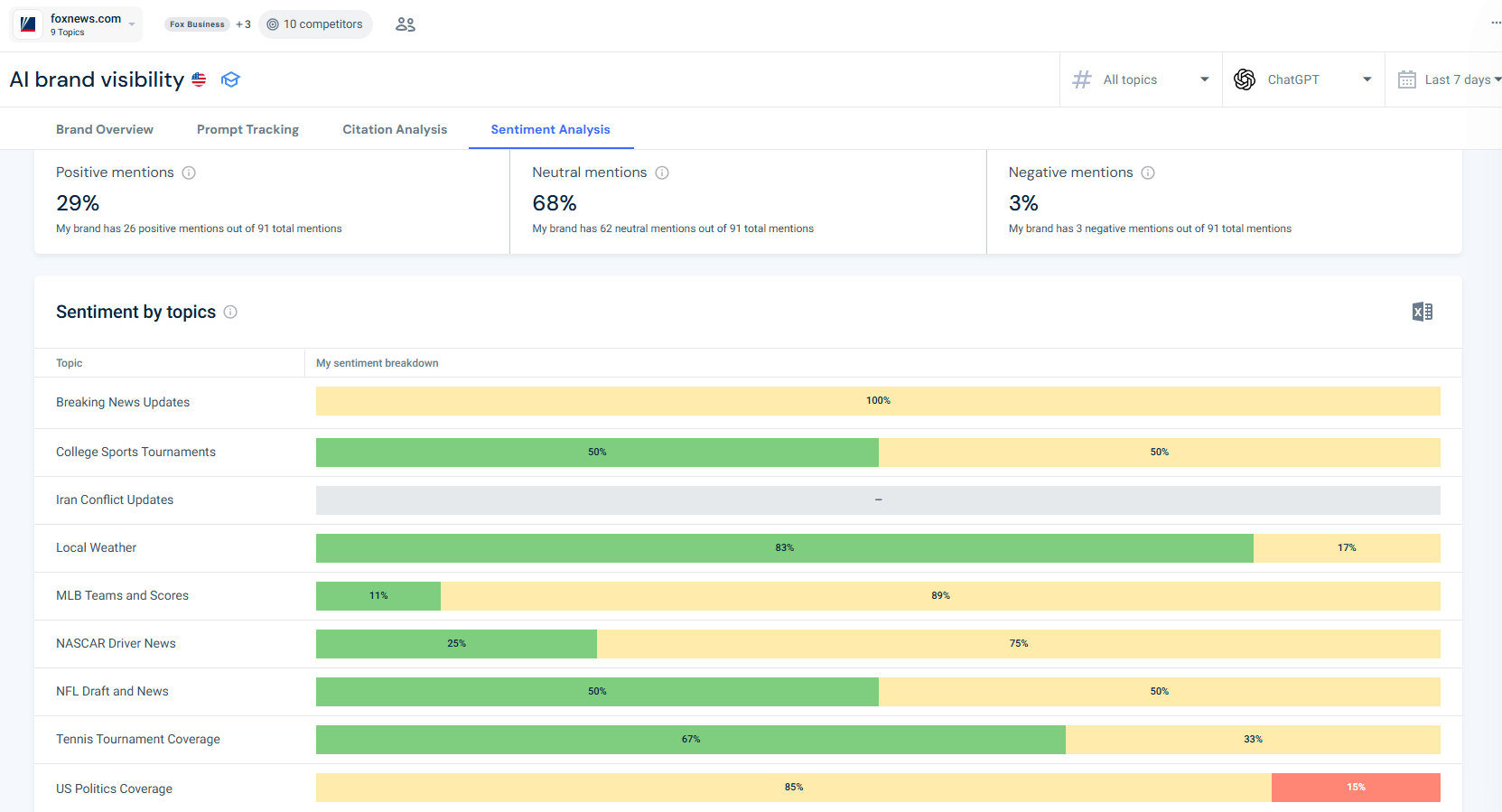
Sentiment Analysis tab for the example workspace, ChatGPT, last 7 days. Source: Similarweb AI Search Intelligence.
For this view, I used Similarweb’s AI Sentiment Analysis tool. The Sentiment Analysis tab shows the tone of each mention. Across all topics in ChatGPT for the week, Fox News had 91 mentions: 29% positive (26), 68% neutral (62), and 3% negative (3).
By topic, local weather is 83% positive, and tennis tournament coverage is 67% positive. Breaking news updates are 100% neutral. US politics coverage is 85% neutral and 15% negative, the only topic with negative mentions. The Iran conflict topic shows no breakdown because Fox News had no mentions there.
US politics is also Fox News’s highest-visibility topic. High visibility with negative framing is the first place to look. The Prompt Tracking view lists the prompt-level sentiment behind these bars.
Takeaway: Check sentiment on your highest-visibility topics first.
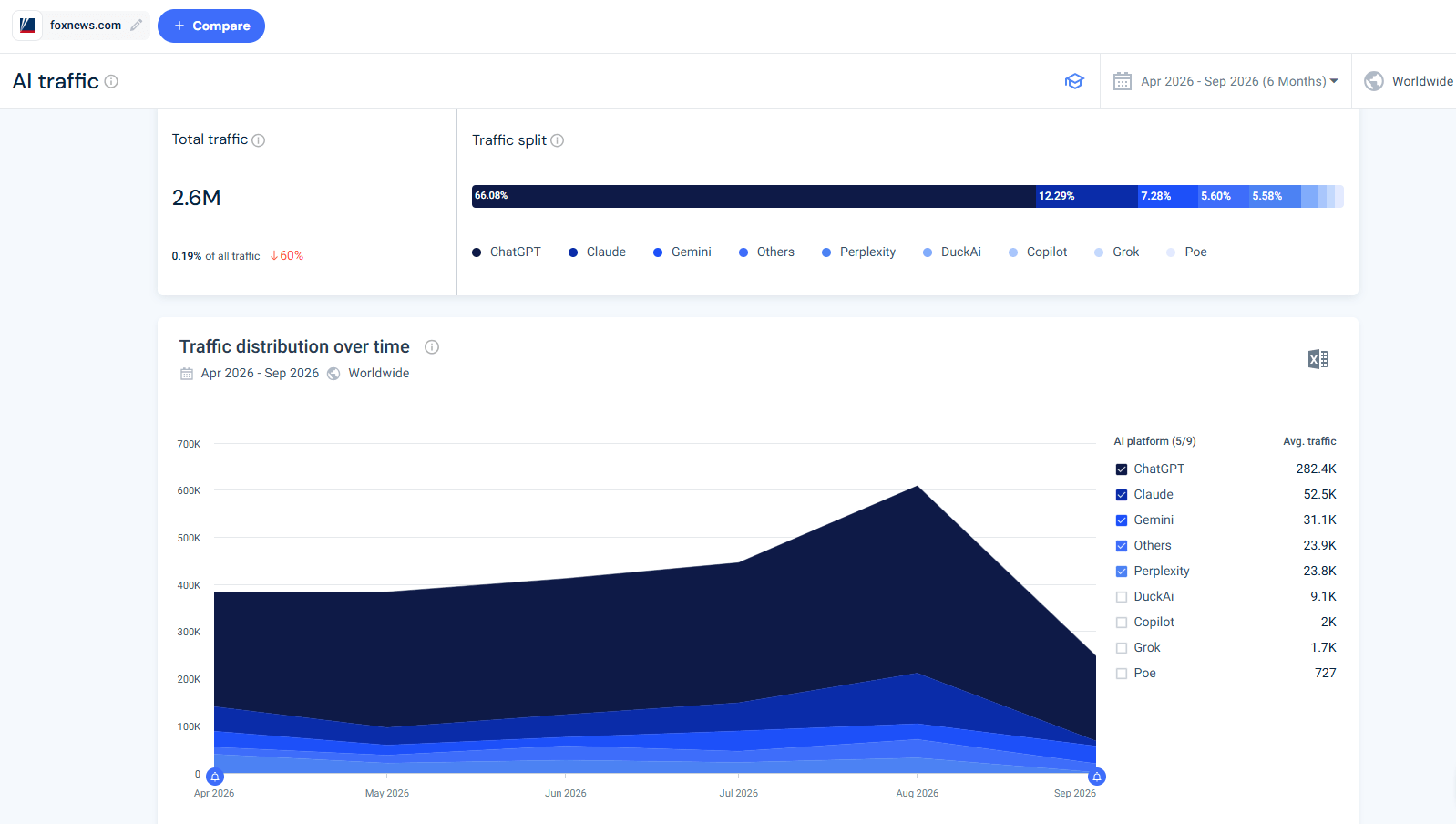
AI Traffic Tracker overview for foxnews.com, worldwide, April to September 2026. Source: Similarweb AI Search Intelligence.
The AI Traffic Tracker measures visits that arrive from AI chatbots. Brand visibility counts mentions in answers. Traffic counts the visits that follow. Mentions and visits are different outcomes, so track both.
Between April and September 2026, AI chatbots sent foxnews.com 2.6 million visits worldwide. That is 0.19% of the site’s total traffic.
ChatGPT sent 66.08% of those visits, Claude 12.29%, Gemini 7.28%, and Perplexity 5.58%. Other platforms sent 5.60%. On average, monthly visits are 282,400 from ChatGPT, 52,500 from Claude, 31,100 from Gemini, and 23,800 from Perplexity.
The chart shows monthly visits from the five selected platforms. They rose from roughly 390,000 in April to a peak near 610,000 in August, then fell to roughly 250,000 in September.
Takeaway: Report AI traffic by platform. The mix shows you which platform to test first.
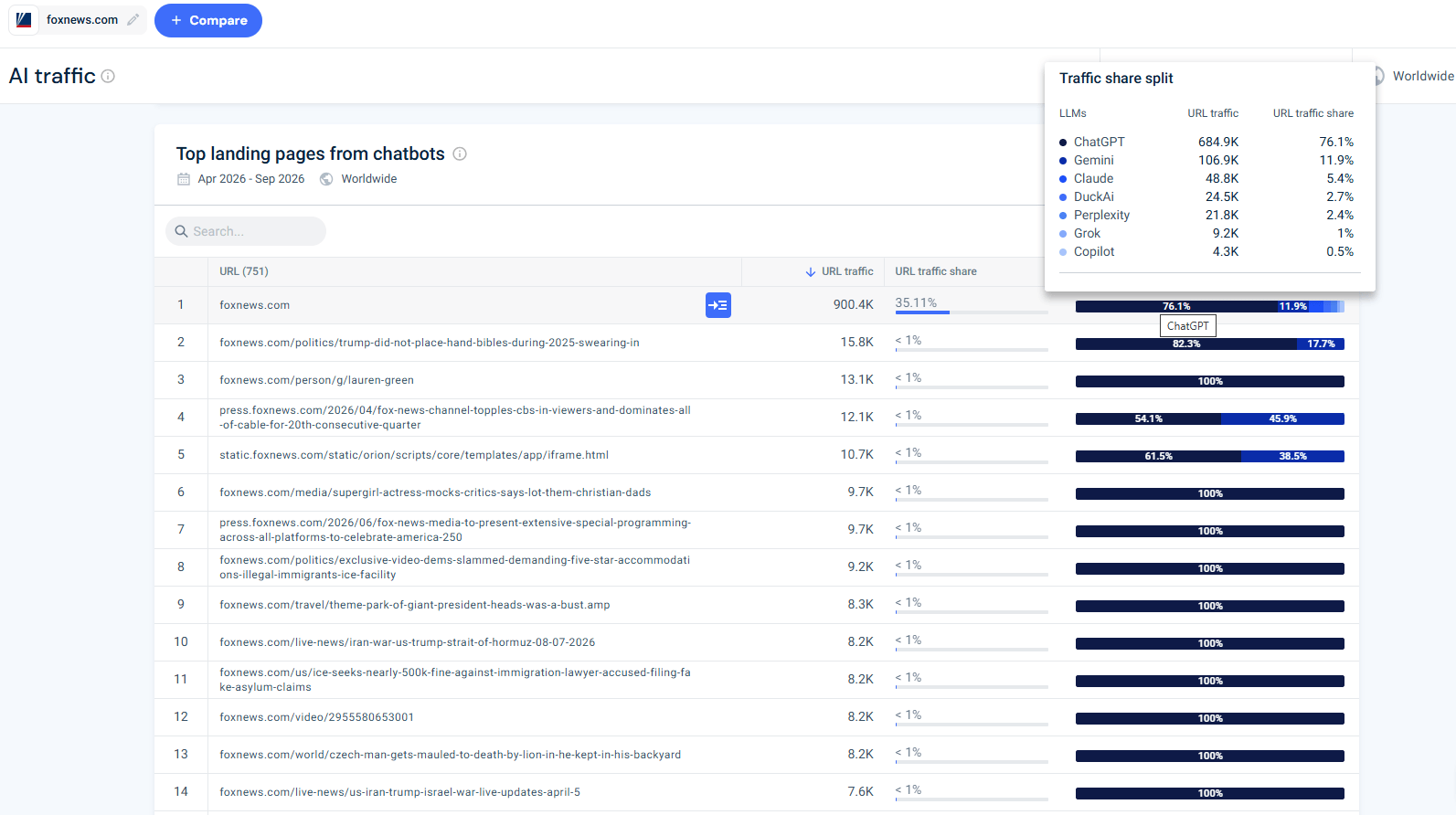
Top landing pages from chatbots for foxnews.com, worldwide, April to September 2026. Source: Similarweb AI Search Intelligence.
The Top landing pages report lists the pages chatbot visitors land on. It found 751 URLs for foxnews.com over the six months. The homepage took 900,400 visits, 35.11% of all AI traffic.
Hover over a row to see the platform split. ChatGPT sent 684,900 of the homepage visits (76.1%), Gemini 106,900 (11.9%), Claude 48,800 (5.4%), DuckAi 24,500 (2.7%), and Perplexity 21,800 (2.4%).
After the homepage, no single page passes 1% of AI traffic. The next 13 pages draw between 7,600 and 15,800 visits each. They include news stories, a person profile page, two press releases, a video page, and two live news pages.
Citations behave differently. In Similarweb’s analysis of ChatGPT citations, AI rarely cited homepages, and most cited pages sat several folders deep. Visits and citations are separate behaviors, so check both.
Takeaway: AI visits spread across many page types. Make sure your homepage and your profile and live pages carry clear, current copy. Similarweb’s guide to optimizing your homepage for AI traffic covers that page in detail.
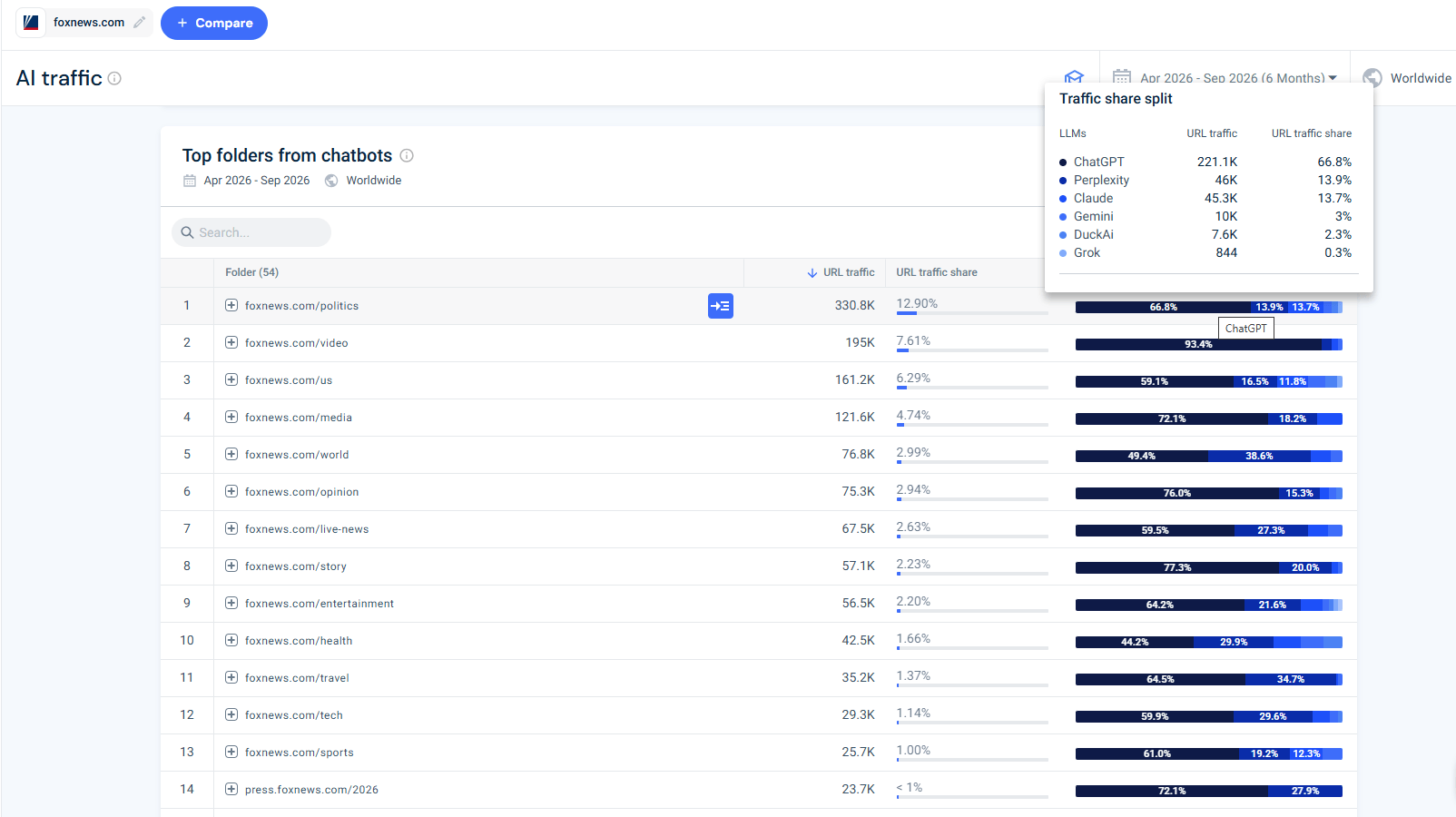
Top folders from chatbots for foxnews.com, worldwide, April to September 2026. Source: Similarweb AI Search Intelligence.
The Top folders report groups the same visits by site section. For foxnews.com, it lists 54 folders. The /politics folder leads with 330,800 visits, 12.90% of AI traffic. Next come /video (195,000 visits, 7.61%), /us (161,200, 6.29%), /media (121,600, 4.74%), and /world (76,800, 2.99%).
The platform mix varies by section. In /politics, ChatGPT sent 66.8% of visits, Perplexity 13.9%, and Claude 13.7%. In /video, ChatGPT sent 93.4%. In /world it sent 49.4%, and in /health 44.2%.
Compare this with the brand visibility view. Fox News ranks #1 for three sports topics there, but /sports is 13th by AI traffic with 25,700 visits, 1.00%. The two views cover different scopes, one week in the US versus six months worldwide. The gap is still a good question to investigate: do the mentions you win send readers back to your site?
Takeaway: Use folders to see which sections AI sends visits to. Then compare them with the topics where you win mentions, and look for mentions that do not turn into visits.
Start with the three best-supported tips: original reporting with data and named sources, a deliberate crawler policy, and clean indexing. Then test the other nine one at a time against a control group, and track the results over several weeks.
AI visibility is where many readers now meet your brand for the first time. That first meeting now happens inside the AI answer, often before a reader ever reaches your site. The audience is still there. Where it finds you is changing.
Treat each AI citation as a first meeting with a reader, and give that reader a reason to come back.
Ready to see how your site shows up in AI answers? Track your brand visibility, citations, sentiment, and AI traffic with Similarweb AI Search Intelligence.
You cannot edit the model directly, so fix what it reads. Correct the original story and any third-party pages the answer cites, then report the answer. Our guide to finding and fixing AI misinformation says a Perplexity report can trigger re-retrieval, Google can suppress specific AI Overviews on specific queries, and ChatGPT and Gemini reports only feed future training. Legal removal is for demonstrably defamatory content and takes weeks to months.
Give one team the job of tracking it, usually SEO or audience, and have that team route the work. Our misinformation guide says SEO owns the tracking and diagnosis, while fixes pull in content, PR, engineering, and sometimes legal. In a newsroom, that maps to editors for corrections and original reporting, developers for robots.txt and schema, and legal for defamation.
Check weekly, and judge changes monthly. Keep the same prompt set, because changing prompts changes the experiment. The same guide treats swings of a few points as noise and double-digit moves as a signal worth investigating. After you fix something, re-check at 30, 60, and 90 days.
Mostly follow-up questions. In the Digital News Report 2026, 42% of chatbot news users across 45 markets asked follow-up questions. Another 35% asked for the latest news, 34% for summaries, 33% to judge a source’s reliability, and 30% to make news easier to understand. Explainers and question-led formats answer those needs directly.
Yes, within limits. Google says using generative AI tools to assist with content is fine if the work meets its Search Essentials and spam policies, and mass-producing pages without adding value can violate its scaled content abuse policy. Readers are cautious too: across six countries, 12% were comfortable with news made entirely by AI, against 62% for news made entirely by humans.
No. Query fan-out is when an AI system breaks one question into several related searches and runs them in parallel. Google’s guide says creating separate content for every variation, mainly to influence rankings or AI responses, violates its scaled content abuse policy and is an ineffective long-term strategy. Answer the related questions inside one strong page.

Senior SEO Specialist
Shai, with 10+ years in SEO, holds a Bachelor’s and an MBA. He enjoys TV shows, anime, movies, music, and cooking.
Give it a try or talk to our insights team — don’t worry, it’s free!