What is RAG (Retrieval-Augmented Generation)? A Marketer's Guide
by Shai Belinsky9 Min.
Oct 01, 2026
Ask most people which AI chatbot is “winning” and they’ll name ChatGPT without hesitation. They’re not wrong about current scale. But scale and momentum are two different questions, and 2026 usage data answers them very differently depending on which metric you’re looking at.
Which platform actually looks like the leader depends entirely on which lens you use, web traffic, app growth, paid acquisition, or usage patterns, and this piece walks through each one with the data behind it before drawing any conclusions.
None of this fits neatly into a single “market share” number. That’s the point. A brand deciding where to invest in AI visibility in 2026 needs to know not just who has the most users today, but where that’s headed next. This piece compares ChatGPT, Gemini, Claude, and Perplexity across four lenses using Similarweb traffic, app, and ad spend data based on the latest 2026 Generative AI Landscape report.
ChatGPT still receives more web visits worldwide than Gemini, Claude, and Perplexity combined, but the gap that matters isn’t the gap at the top. It’s how differently each AI platform’s trend line is bending.
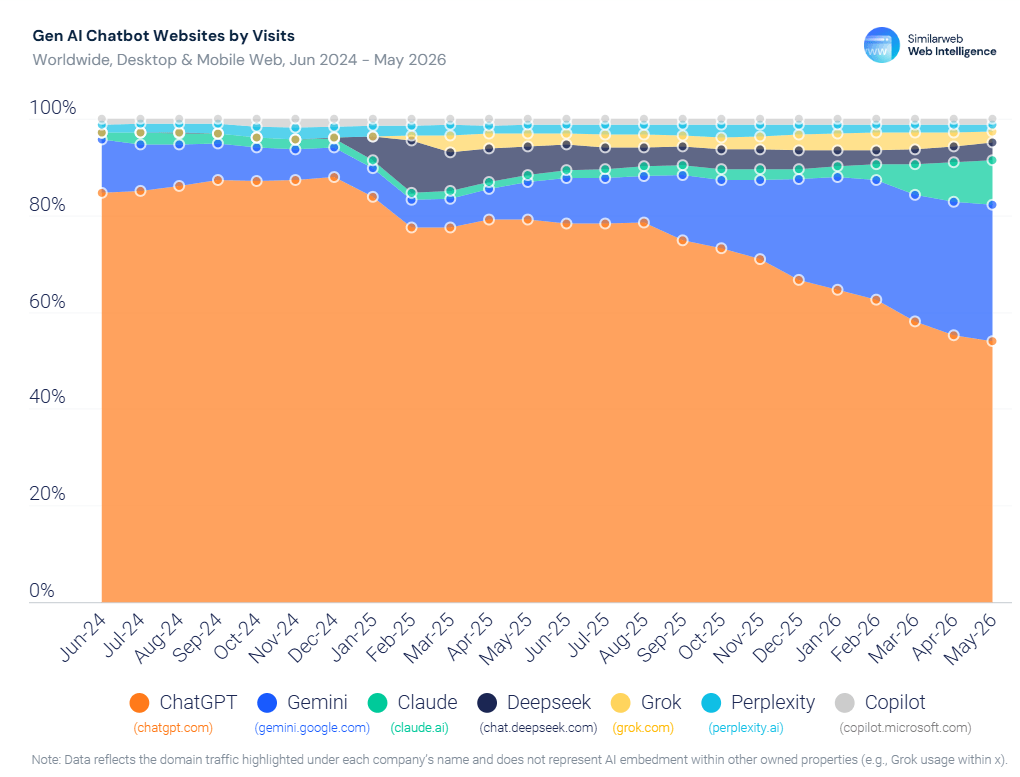
chatgpt.com’s visits growth has been steady rather than explosive over the past year, climbing month over month without a dramatic inflection point. Gemini.google.com’s curve looks different: growth was gradual through most of 2024 and early 2025, then stepped up sharply starting around September 2025, coinciding with the period Google pushed Gemini and AI Mode deeper into its core search experience. By May 2026, Gemini’s monthly visits and unique visitors had both grown to a scale that puts it clearly in second place, ahead of every other platform besides ChatGPT.
Claude.ai’s traffic line is the most dramatic of the four. Visits held in a relatively narrow, slow-growing band through most of 2024 and 2025, then broke sharply upward starting in February 2026, roughly doubling in each of the following two months.
That kind of curve, flat for a year and then near-vertical in a single quarter, usually signals a specific product or distribution event rather than gradual compounding, and it’s worth watching whether that pace holds or was a one-time step change.
Perplexity.ai tells the opposite story. Visits and unique visitors both peaked around October 2025 and have declined in most months since, sitting noticeably lower by May 2026 than at that peak. Of the four platforms compared here, Perplexity is the only one where the most recent trend points down rather than up, which is a meaningfully different competitive position than “smallest of four fast-growing platforms.”
Web visits measure reach. Stickiness, the share of a platform’s monthly users who come back on a given day, measures habit. On that second metric, the ranking shifts in an interesting way.
ChatGPT’s app leads on both fronts at once: it has by far the largest monthly user base of the four in the US and worldwide, and its stickiness rate is also the highest, well ahead of the other three.
That combination, biggest reach and best retention simultaneously, is the hardest position for a competitor to erode, because ChatGPT isn’t winning on habit despite having a bigger, more casual audience. It’s winning on habit and reach together.
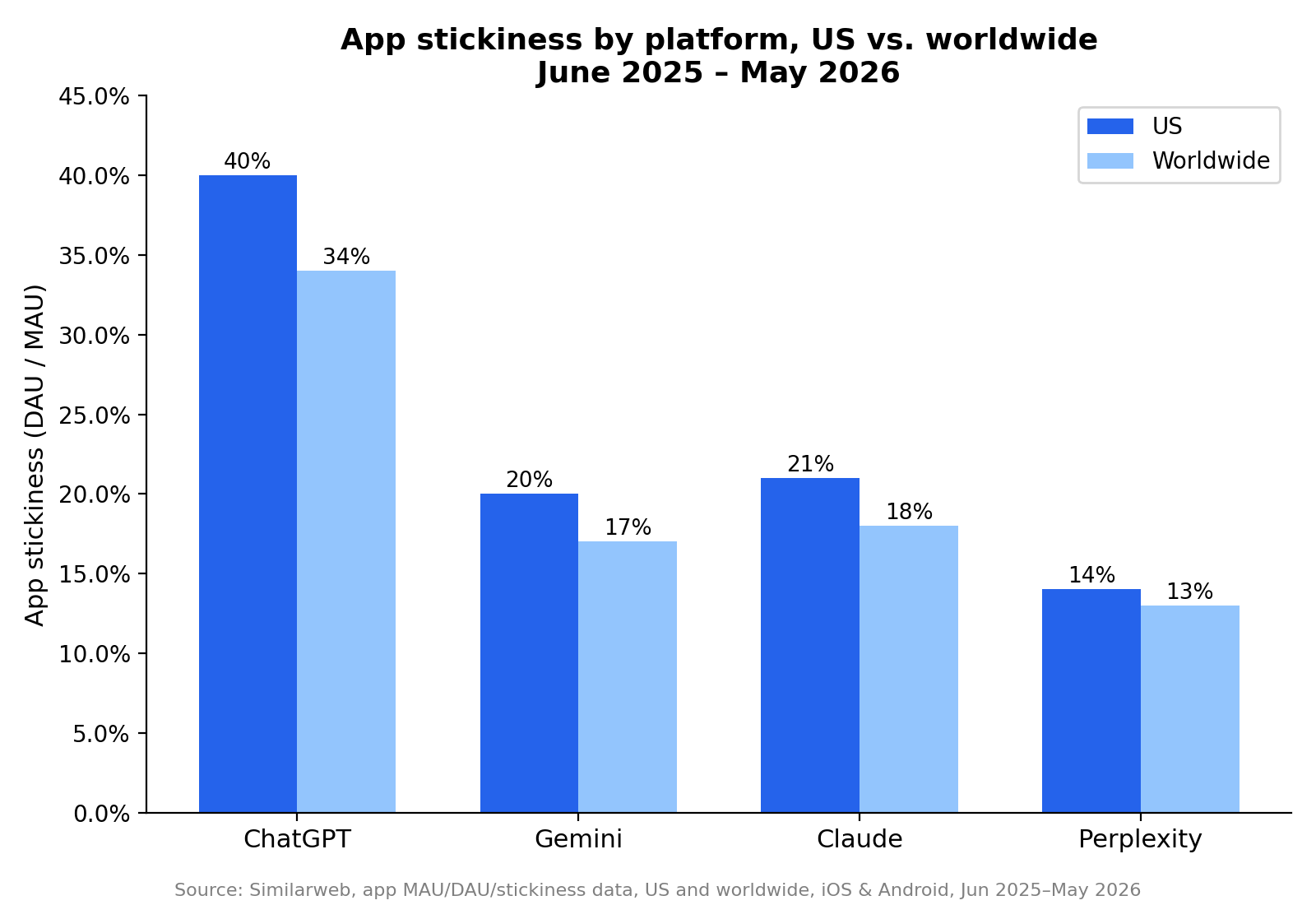
The more counterintuitive result sits between Claude and Gemini. Gemini’s app has a monthly user base many multiples larger than Claude’s, both in the US and worldwide. But Claude’s stickiness rate is slightly higher than Gemini’s in both geographies. In other words, a smaller share of Gemini’s much larger audience returns daily than the share of Claude’s audience that does.
That doesn’t mean Claude is “winning” on engagement overall, its absolute daily active user count is still far smaller, but it does suggest Claude’s current audience behaves more like committed daily users and less like occasional or default-app traffic.
Perplexity sits at the bottom of the stickiness ranking in both the US and worldwide, which is consistent with a smaller, more research- or lookup-oriented use pattern than a daily-habit one.
This is where the “ChatGPT is winning” framing breaks down most clearly. Measured by year-over-year growth in worldwide app monthly active users, the ranking inverts almost completely relative to current size. Claude’s app audience grew by a wide margin more than any of the other three platforms over the past year, on a percentage basis.
Perplexity’s audience also grew substantially, well ahead of Gemini’s rate, and Gemini in turn grew well ahead of ChatGPT’s rate. ChatGPT, despite adding the most users in absolute terms because its base is so much larger, posted the slowest percentage growth of the four.
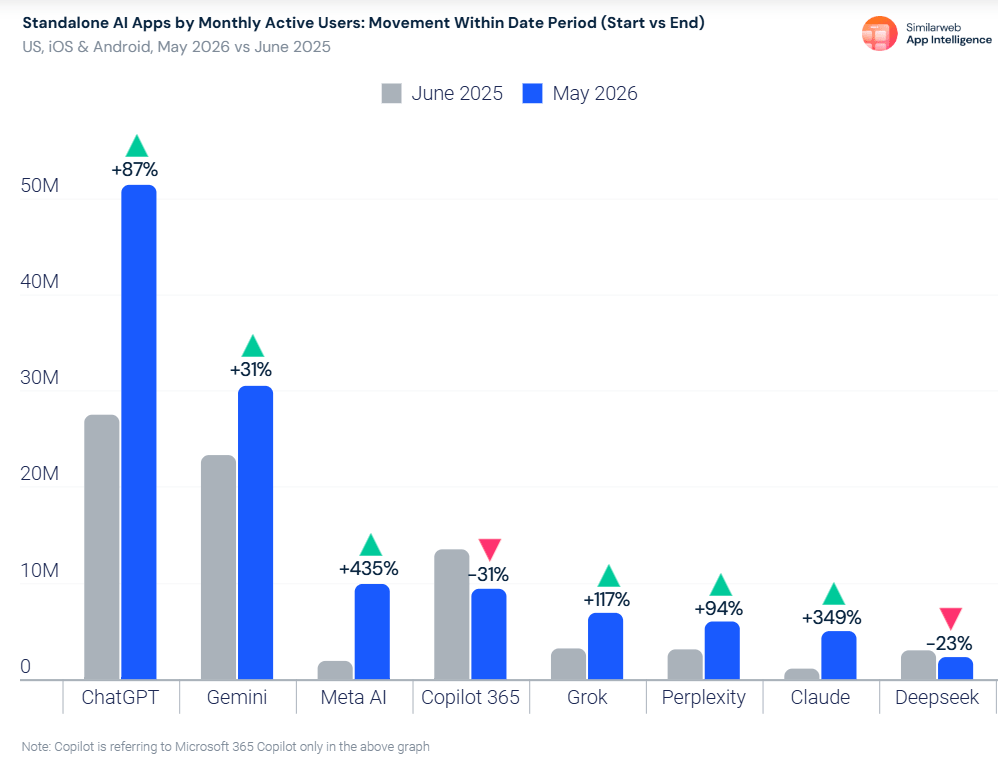
That’s not a contradiction, it’s what happens at different points on an adoption curve. ChatGPT is far enough into mainstream adoption that the easy multiples are behind it. Claude and Perplexity are earlier on their curves, so the same absolute gain looks much larger as a percentage.
The practical read for anyone tracking this space: raw scale still favors ChatGPT and increasingly Gemini, but the rate of change, the leading indicator of where the market is headed next, currently favors Claude by a wide margin.
Total dollars still favor the incumbents. Over the twelve months tracked, AI paid search spend was largest for ChatGPT among the three platforms tracked here, with Gemini’s total meaningfully behind it and Claude’s total smaller again, a fraction of ChatGPT’s spend.
If you only looked at the total-spend, you’d conclude Anthropic barely advertises Claude by comparison.
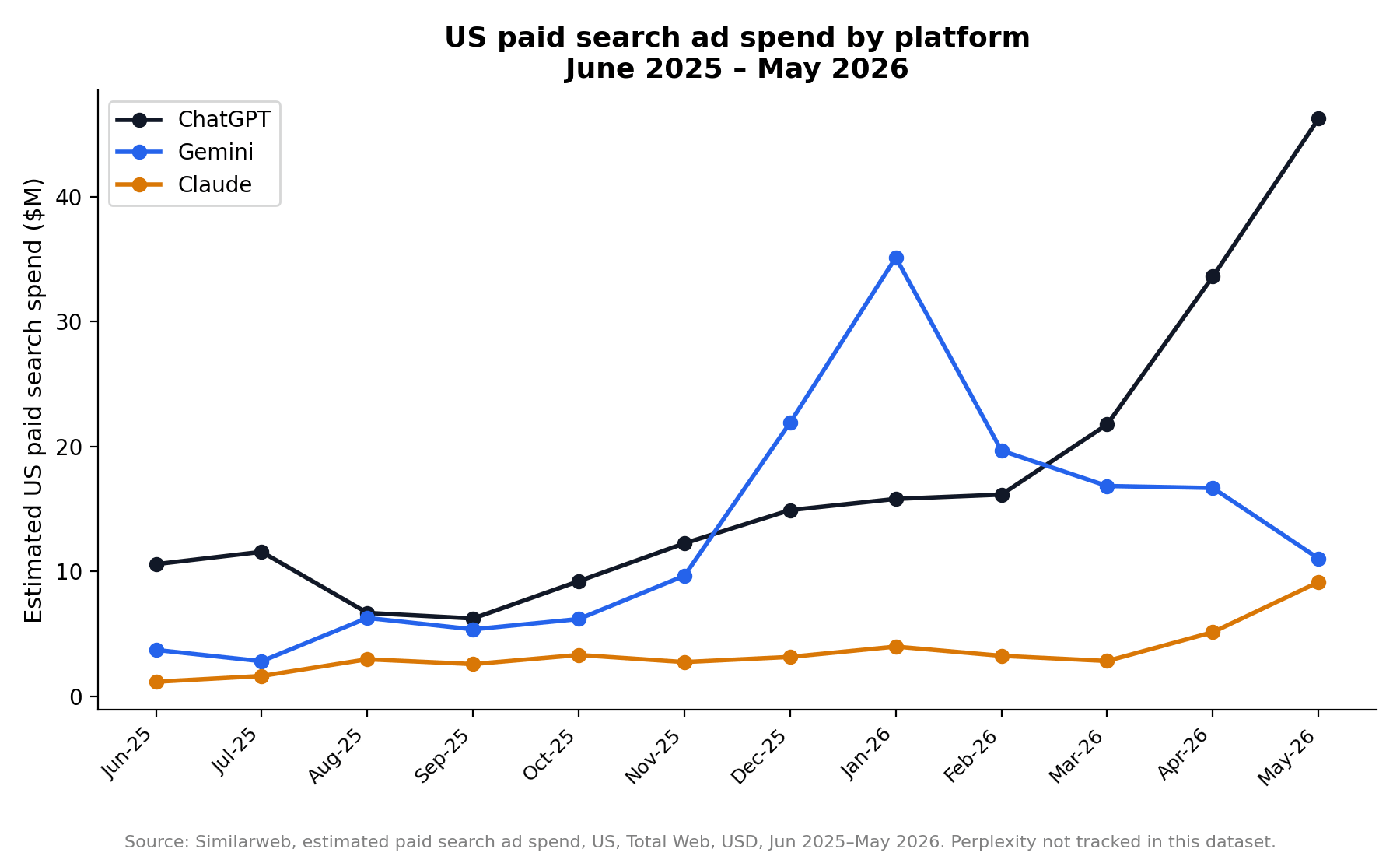
The month-by-month trajectory says something different. Indexing each platform’s spend to its own June 2025 level shows Claude’s paid search investment scaling up faster, by a wide margin, than either ChatGPT’s or Gemini’s over the same period, even as it stays the smallest in absolute dollars.
Gemini’s spend also shows a sharp seasonal spike around the December-January window before settling into a lower, steadier range. ChatGPT’s spend climbs more gradually across the full period, with its own steepest increase concentrated in the final two months of the window.
Read together with the app growth data above, a consistent pattern emerges: the platform growing fastest organically (Claude) is also the platform ramping paid acquisition fastest, which suggests Anthropic is treating consumer growth as a genuine current priority rather than letting Claude’s momentum happen on its own.
Treating “AI chatbot users” as one audience misses a real difference in composition. Comparing category share of usage across ChatGPT, Claude, and Gemini against a general Google search baseline turns up two consistent patterns.
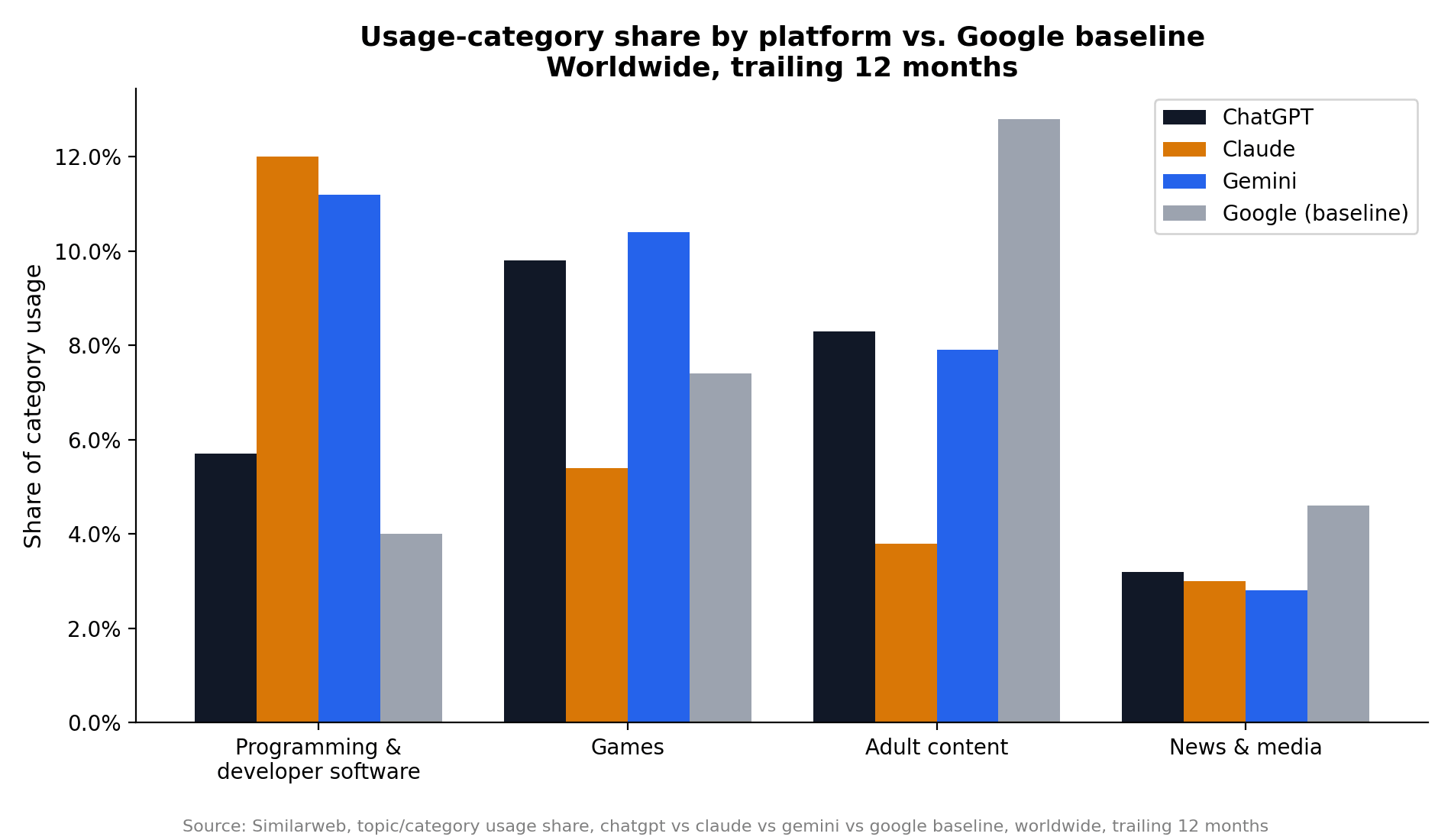
First, programming and developer-software-related usage is a meaningfully larger share of both Claude’s and Gemini’s overall activity than it is of ChatGPT’s, and all three platforms lean more technical than the Google baseline. That’s a useful correction to the common shorthand that Claude alone is “the coding one.” The data suggests Gemini’s usage mix skews just as technical, while ChatGPT’s category mix, despite being the platform most associated with developers in casual conversation, actually looks closer to a general-purpose search replacement.
Second, adult-content-category share is consistently the smallest slice of Claude’s usage mix among the four data points compared, sitting below ChatGPT, Gemini, and even the general Google baseline. Gaming-category share follows a similar, though less pronounced, pattern.
Put together, Claude’s usage composition looks the most work- and technical-task-weighted of the three chatbots measured, ChatGPT’s looks the closest to a general household search substitute, and Gemini sits in between, technical enough to rival Claude on developer topics but broader in overall reach.
Comparing four LLMS on a single number always produces a misleading headline. What the data above actually supports is a three-part framework worth applying to any AI platform, including ones that launch after this report:
No platform leads on all three simultaneously. That’s the actual competitive picture in mid-2026, and it’s a more useful lens for tracking AI platforms going forward than any single “market leader” claim, including the ones in this article a year from now.
| Platform | Reach (web visits) | Retention (app stickiness) | Rate (YoY app growth) | Paid spend trend | Usage skew |
|---|---|---|---|---|---|
| ChatGPT | Largest by a wide margin | Highest of the four | Slowest (largest base effect) | Largest total, steady climb | Closest to general search replacement |
| Gemini | Clear second, accelerated sharply since Sep 2025 | Below Claude and ChatGPT | Second-slowest | Second-largest total, sharp seasonal spike | Technical skew similar to Claude |
| Claude | Smallest of the three with web data, but rising sharply since Feb 2026 | Edges out Gemini despite smaller base | Fastest by a wide margin | Smallest total, fastest-scaling | Most work/technical-weighted, lowest adult-content share |
| Perplexity | Smallest overall, declining since Oct 2025 peak | Lowest of the four | Strong, but behind Claude | Not tracked in this dataset | Not covered in category data above |
ChatGPT receives the most web visits worldwide of the four platforms compared, chatgpt.com, gemini.google.com, claude.ai, and perplexity.ai, by a wide margin, based on Similarweb traffic data through May 2026.
On web traffic, Gemini is the clear second-place platform and has been closing the gap, with a sharp acceleration in visits starting around September 2025. It has not overtaken ChatGPT in total reach, but the trend line has bent upward faster than ChatGPT’s over the past year.
Measured by app stickiness (the share of monthly active users who return daily), ChatGPT has the highest retention of the four. Claude’s stickiness rate is second, narrowly ahead of Gemini’s despite Claude’s much smaller total user base; Perplexity’s stickiness is the lowest.
Yes, by a wide margin, measured by year-over-year growth in worldwide app monthly active users. Claude’s percentage growth over the past year outpaced Perplexity, Gemini, and ChatGPT, all of which also grew but at slower rates. ChatGPT’s growth rate was the slowest of the four, consistent with it already having the largest base.
Usage-category data suggests yes. Claude’s usage mix skews more heavily toward programming and developer-software topics than ChatGPT’s, and carries the smallest share of adult-content-category usage among the platforms compared, including a lower share than the general Google search baseline. Gemini’s usage mix is similarly technical to Claude’s, while ChatGPT’s category mix looks closest to a general-purpose search replacement.
Senior SEO Specialist at Similarweb
Maayan is a senior SEO specialist with 7+ years of experience in SEO. She loves complex research projects, creating SEO strategies and performing technical audits.
Give it a try or talk to our insights team — don’t worry, it’s free!