What is RAG (Retrieval-Augmented Generation)? A Marketer's Guide
by Shai Belinsky9 Min.
Oct 01, 2026

Every few months, a new stat resets the panic clock on search marketing. This time it’s usage growth: worldwide visits to generative AI platforms hit 9.5 billion a month in May 2026, up 70% year over year, and app downloads reached 4.4 billion, up 58%. Read those two numbers on their own and the conclusion looks obvious – AI is eating search.
It isn’t, and the data that would prove it is doing the opposite. According to Similarweb’s 2026 Generative AI Landscape report, the share of ChatGPT users who also use Google sat at 95% in September 2025. Eight months and hundreds of millions of new visits later, in May 2026, it’s still 95%. If generative AI were substituting for search, that overlap number would be falling as users switched over. It isn’t moving at all.
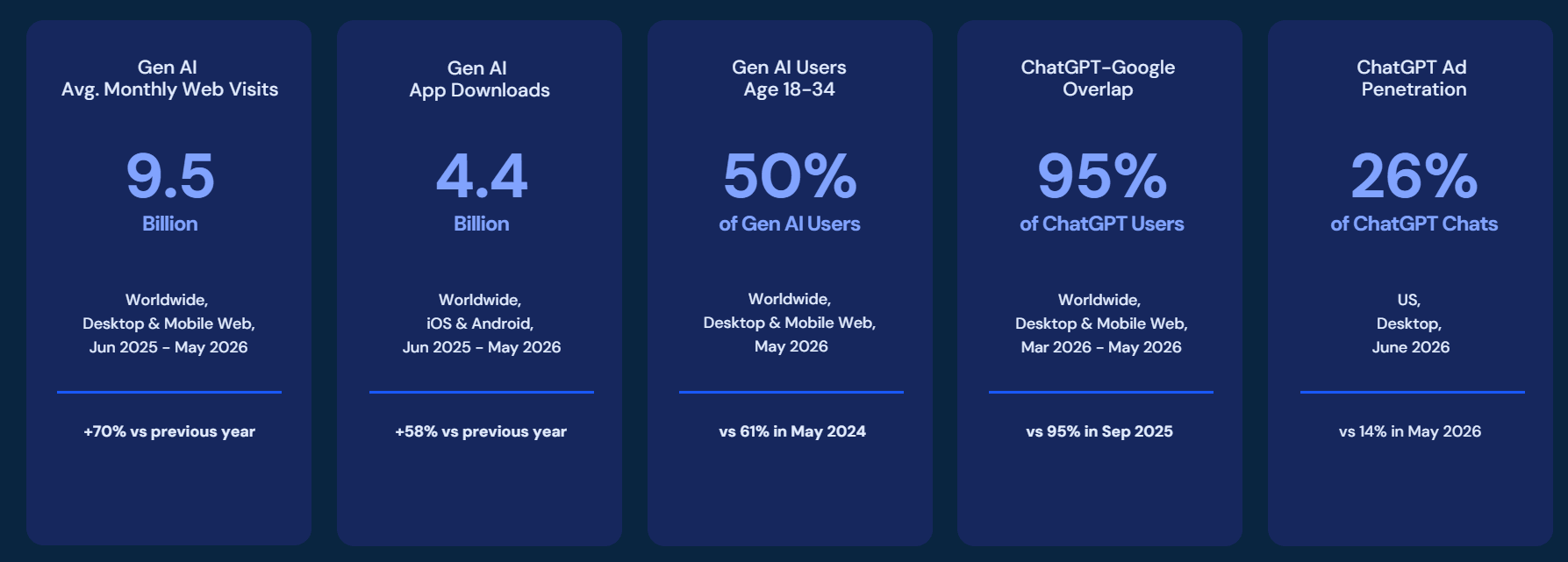
This matters because the two numbers get compared constantly and rarely together. Usage growth answers “how much are people using AI.” Overlap answers “are they using it instead of search, or in addition to it.” Growth alone can’t distinguish substitution from addition – you need to know what happened to the old behavior while the new one expanded. That’s what the overlap data shows, and it says addition.
This piece walks through what the flat overlap number actually proves, how it holds up against the raw growth rates that seem to argue against it, why traffic stopped being the metric that captures what’s happening, and what that means for where you put your effort in 2026.
No. The 2026 data shows generative AI and traditional search converging into a shared discovery layer, not one replacing the other. The clearest evidence is behavioral, not attitudinal: Similarweb’s tracking shows ChatGPT’s share of worldwide generative AI web traffic sliding from roughly 76% a year ago to around 53% today, as Gemini, Claude, Perplexity, and DeepSeek pick up the difference – a redistribution within AI, not a shift away from search.
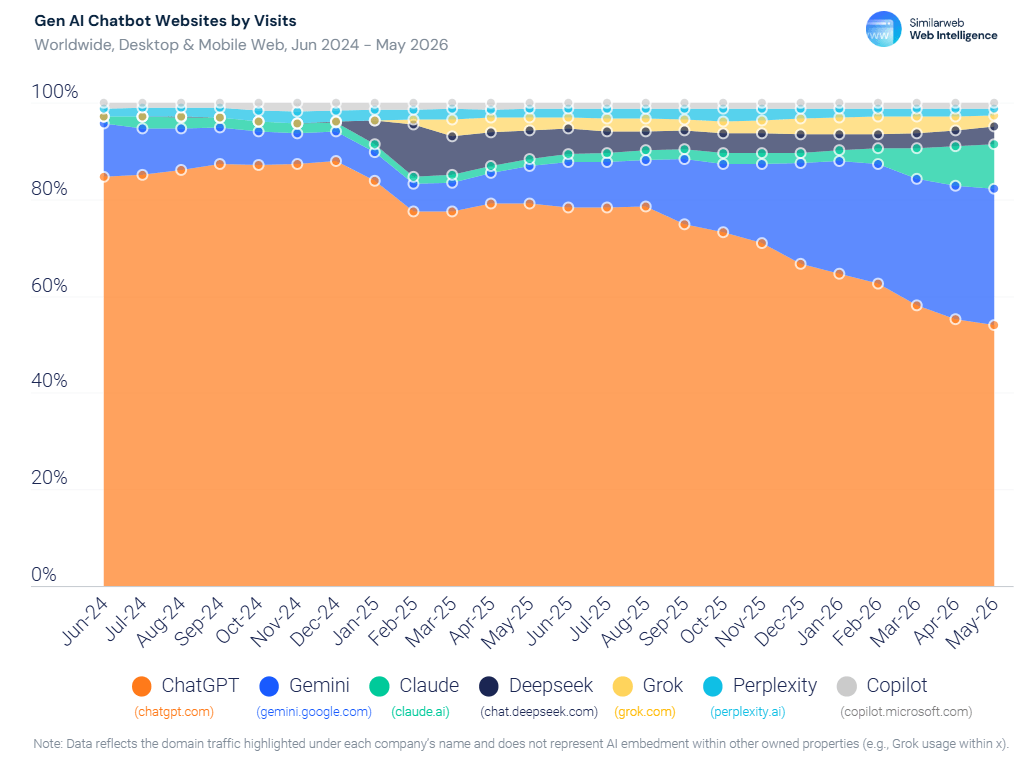
What the chart shows that the share number alone doesn’t: ChatGPT isn’t losing ground to search, it’s losing ground to three or four other AI platforms simultaneously, none of which has broken away as the clear successor. If generative AI were genuinely displacing search, the more likely pattern would be consolidation – usage concentrating around whichever single platform wins the substitution race, the way real replacements usually play out. A four-way split instead looks like a category still sorting out its winners, not a challenger closing in on an incumbent. It also cuts against the substitution story from a different angle: a user base spreading itself across several unproven tools at once is a population still hedging, and a population that’s hedging is exactly the one you’d expect to keep a stable fallback like search in the rotation rather than drop it.
The “replacing” narrative usually rests on one kind of evidence: adoption rate, not abandonment. It’s worth naming the strongest version of that case, because it hasn’t disappeared. Gartner’s analysts have forecast traditional search engine volume will drop 25% by 2026 as generative AI becomes a substitute answer engine. That’s a real prediction about real pressure on click-through behavior. But it isn’t measured against the one number that would confirm substitution is actually happening: whether the same users are dropping search as they pick up AI. The overlap data says they aren’t, at least not yet, and not at the pace the prediction implies.
The single most useful number in the 2026 Generative AI Landscape report isn’t a growth rate – it’s a ratio that refused to move. ChatGPT-Google overlap measures the share of ChatGPT’s user base that also shows up in Google’s. In September 2025, it was 95%. In May 2026, after ChatGPT visits climbed and Gemini and Claude both grew even faster, it was still 95%.
Substitution and addition produce opposite signatures in this number. If people were dropping Google as they picked up ChatGPT, the overlap would erode month over month as the AI-only cohort grew. Instead, the population using both stayed essentially fixed while the population using AI at all kept expanding. That’s the profile of an audience adding a tool to an existing habit, not swapping one habit for another.
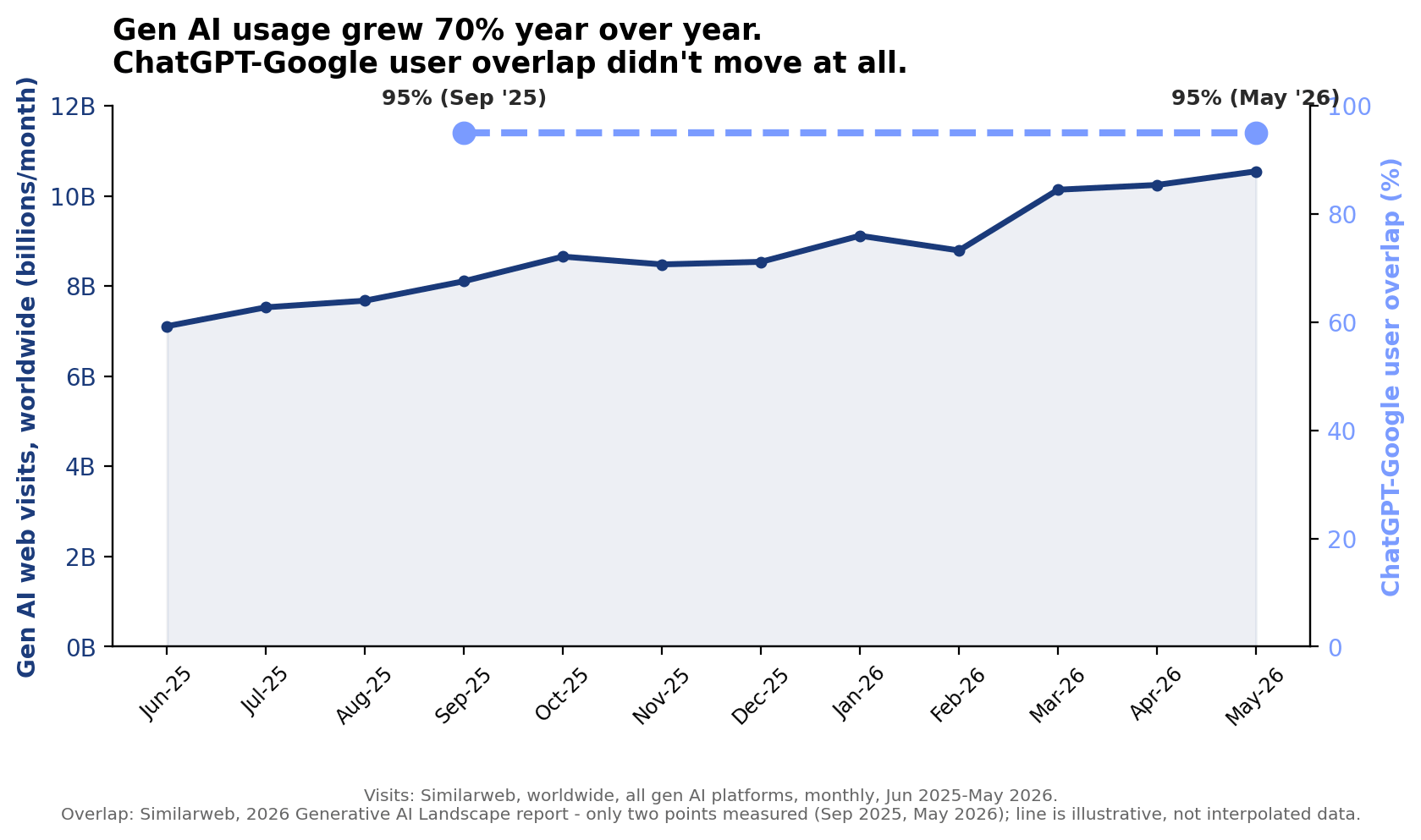
It’s worth noticing where the report chooses to put this number – look back at the infographic above. Four of the five headline tiles are growth metrics: visits, downloads, an age shift, ad penetration – the kind of numbers a data provider leads with when a category is expanding and there’s a growth story to tell. The overlap tile is the odd one out: a flat comparison, not a percentage change, given the same visual weight as the growth stats around it. That’s not a curatorial accident. Putting a number that hasn’t moved in the same lineup as four numbers that have is the report’s own way of flagging the one figure a “replacing search” claim actually has to survive – and the one this article is built around.
It’s also consistent with what’s happening at the platform level. Gemini’s worldwide app audience grew from roughly 401 million monthly active users in June 2025 to nearly 716 million in May 2026 – a 78% increase in under a year, per Similarweb’s tracking panel – the same period covered in Similarweb’s AI search stats of ChatGPT, Gemini, and Claude market share. Meanwhile, Google’s own search index is the thing several of these AI products depend on to answer anything. Growth in one doesn’t require decline in the other when the AI layer is largely built on top of the search layer rather than instead of it.
Worth being precise about what this number can’t tell you: overlap measures whether the same people show up in both audiences, not what happens inside any single research session. It’s possible for someone to still be a Google user by this measure while sending a growing share of specific query types to ChatGPT instead. The report doesn’t break out query-level substitution, and this article doesn’t claim it does. What the flat 95% does rule out is the more sweeping claim that people are leaving search behind wholesale, since that would show up here first.
There’s a second, more structural caveat worth naming rather than glossing over: the report explicitly excludes gen AI API usage, desktop applications, and in-app AI features. Those are exactly the segments most likely to be replacing search-like workflows rather than adding to them – a developer calling the API to summarize documentation, or a power user running everything through a desktop client, never shows up in this dataset at all. If real substitution is happening anywhere, this methodology is structurally blind to the population most likely to show it. That doesn’t undercut the finding; it scopes it. Within the browser- and app-based population the report can actually see, overlap is flat. Whether the same holds for the heaviest, most workflow-integrated users is a separate question this data can’t answer.
| Metric | Jun 2025-May 2026 | Change | What it actually measures |
| Gen AI avg. monthly web visits (worldwide) | 9.5B | +70% YoY | Session volume across AI platforms |
| Gen AI app downloads (worldwide) | 4.4B | +58% YoY | New-install activity, iOS + Android |
| ChatGPT-Google user overlap (worldwide) | 95% | Flat vs. Sep 2025 | Whether AI users are also search users |
| ChatGPT ad penetration (US desktop) | 26% of chats | Up from 14% in May 2026 | Monetization layer forming inside chat |
| Gemini worldwide app MAU | ~716M | +78% YoY | Redistribution among AI platforms |
Two things jump out from this data. First, visits and downloads are growing faster than the overlap tile above is standing still – which is exactly what addition looks like: the total addressable pool of AI usage keeps expanding, but almost everyone in it is also still a search user. Second, most of the eye-catching growth (Gemini’s user base, Claude’s platform gains) is redistribution between AI platforms, not evidence that search lost ground to AI as a category.
There’s a genuine nuance worth naming: usage isn’t staying flat everywhere. Gen Z’s share of AI chatbot usage has declined a few points since 2024 even as total usage climbs, meaning adoption is broadening into older demographics rather than concentrating in the group that adopted first. That’s a sign of mainstream, durable growth – the opposite of a fad cannibalizing an incumbent, and it echoes the “expanding, not disappearing” framing Similarweb has made in its roundup of gen AI data points.
The report’s own numbers make that shift sharper than the “declining a few points” framing suggests. Gen AI users aged 18-34 made up 61% of the user base in May 2024; by 2026 that had fallen to 50%. An 11-point swing in roughly two years is large in proportional terms – larger, relative to its own base, than either of the headline 70% or 58% growth figures once you account for the fact that this is a share shifting, not a volume growing. And 50% of a category isn’t a youth skew to begin with: 18-34-year-olds are only about a quarter of the world’s population, so a user base that’s half that age bracket is already closer to broad-based than niche. The more interesting story here isn’t that young people use AI. It’s that the other half of the user base, everyone 35 and older, has grown large enough this early to pull the average down 11 points in two years – a demographic shift moving considerably faster than the search-substitution behavior this article is built around, which hasn’t moved at all in eight months.
There’s a second pattern worth flagging in how ChatGPT is monetizing this audience. Ad penetration inside ChatGPT chats nearly doubled in the same window the overlap number sat still – from 14% in May 2026 to 26% by June 2026. Normally, a platform builds a captive, differentiated audience first and monetizes it second. Here, ads are scaling into a user base that’s still 95% shared with a competitor’s product. That’s a structurally weaker position than the usual “attention captured, monetization follows” story: ChatGPT is monetizing an audience it doesn’t yet have any exclusive claim on, which is a meaningfully different risk profile than monetizing a locked-in one.
If overlap is flat, the framing that traffic is being “stolen” from search doesn’t hold up – and neither does the instinct to keep watching organic-click dashboards as the main scoreboard. The behavior that’s actually changing isn’t whether people search. It’s what happens between the search and the click, and increasingly, whether there’s a click at all.
Two data points make this concrete. Similarweb’s tracking shows citation presence inside ChatGPT prompts climbing from about 1.6% in June 2025 to 6.8% by May 2026, meaning the model is naming sources more often than it did a year ago – but the pages it cites and the pages that get the resulting click are frequently different pages. And AI Overviews now appear on more than 40% of US searches, up from roughly a third a year earlier, compressing the space above the traditional results even when the traditional results still exist underneath, a trend Similarweb has tracked in depth in its zero-click marketing research.
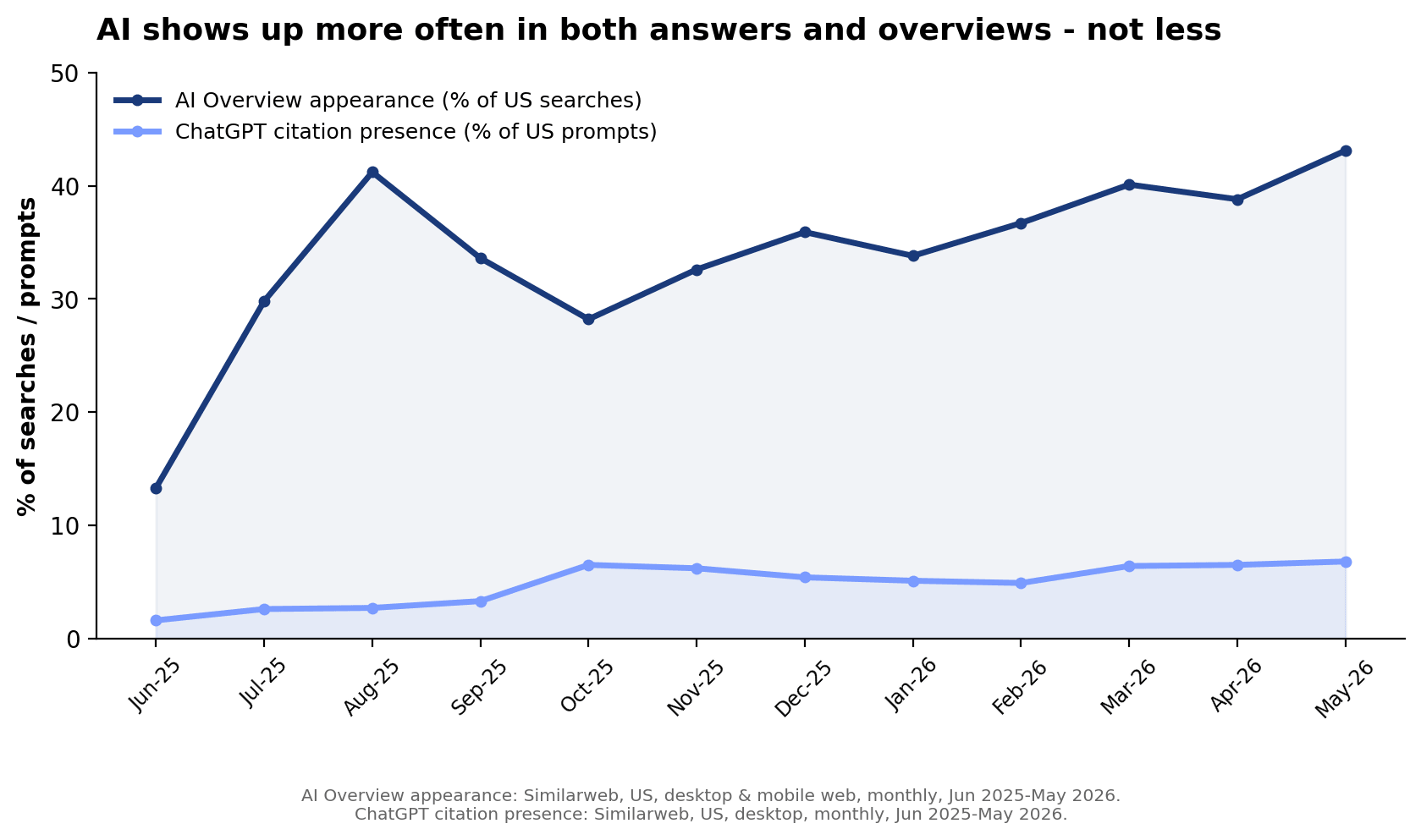
Traffic isn’t a useless metric – it’s just no longer a complete one. The metrics that actually capture what’s happening in this environment are the ones that track presence rather than clicks: citation frequency (how often your content gets named inside an AI answer), share of model (the percentage of AI responses in your category that mention your brand at all), and branded search lift (whether people who saw you inside an AI answer later searched your name directly, a conversion event most analytics tools never connect back to the AI session that caused it).
Put the pieces next to each other, and the picture holds together. Usage climbed 70% year over year. Overlap didn’t move. ChatGPT’s own share fragmented across four rising rivals instead of consolidating into a single successor. Citation presence and AI Overview appearance both climbed in the same window, while traffic stayed flat. None of that is what displacement looks like. All of it is what a discovery layer looks like while it’s still being built on top of search rather than instead of it.
That doesn’t mean nothing changed. It means the change isn’t the one the “AI is replacing search” headlines describe. Brands that pull back from SEO fundamentals because they’ve decided search is dying are reacting to a story the data doesn’t support. Brands that ignore AI visibility because search is “still fine” are missing the layer where an increasing share of consideration now happens before a click is even possible. Both mistakes come from treating this as an either/or question when the report’s own numbers say it’s an and.
The practical shift isn’t strategic, it’s measurement. Keep the organic foundation intact, since AI Overviews and AI Mode still draw from the same index that foundation depends on. Add citation frequency and share of model next to it, since those are the numbers that would actually move if the substitution story were true. Check your data in Similarweb AI brand visibility tracker, which is the fastest way to see where you actually stand instead of guessing.
No. The 2026 data shows ChatGPT-Google user overlap holding flat at 95% between September 2025 and May 2026, even as generative AI usage grew sharply. That pattern is consistent with AI use being added to search habits, not substituted for them, and most AI search products still depend on traditional search indexes to retrieve current information.
Search and AI chat serve overlapping but distinct purposes – AI compresses research and synthesizes an answer, while search still handles navigation, transactional queries, and fact-checking. Similarweb data shows the overlap between ChatGPT’s and Google’s user bases has stayed at 95% for at least eight months, suggesting most people treat them as complementary tools rather than substitutes.
Traffic is still worth tracking, but it should sit alongside citation frequency (how often AI answers name your content), share of model (the percentage of AI responses in your category that mention your brand), and branded search lift following AI exposure. These metrics capture visibility that happens before or instead of a click, which traffic alone can’t see.
No. Generative AI visits grew 70% year over year worldwide, but that measures a different, smaller population than total search volume, and the two aren’t drawing from a fixed, shared pool the way the “replacing” framing implies. Rising AI usage and stable-to-growing search usage can both be true at the same time, and the 2026 data suggests they currently are.
It can, on informational queries where AI Overviews now appear on more than 40% of US searches. But this is a change to click behavior on the same search, not evidence that people are abandoning search itself – the query still happens inside Google’s ecosystem, and ranking still determines whether a brand gets cited in the overview above it.
Senior SEO Specialist at Similarweb
Maayan is a senior SEO specialist with 7+ years of experience in SEO. She loves complex research projects, creating SEO strategies and performing technical audits.
Give it a try or talk to our insights team — don’t worry, it’s free!