
What is RAG (Retrieval-Augmented Generation)? A Marketer's Guide
by Shai Belinsky9 Min.
Oct 01, 2026
ChatGPT’s website drew roughly 5.7 billion average monthly visits worldwide over the past year, more than 17 times Claude’s 331 million, according to Similarweb Generative AI Landscape report (worldwide, June 2025 – May 2026). But on every momentum metric, the ranking flips: claude.ai visits grew 319% year over year against ChatGPT’s 53%, and Claude’s worldwide app audience grew about 14x while ChatGPT’s grew 31%.
Most Claude vs. ChatGPT comparisons stop at features and benchmarks. That tells you what each tool can do, but not what millions of people actually do with them, and the behavioral data tells a different story than the feature lists do: Claude isn’t a smaller ChatGPT. Its users write the longest prompts of any major AI platform, hold the longest conversations, and come from a measurably different audience. Choosing between them is less about which is “better” and more about which usage pattern matches yours.
Here’s how the two compare, starting with the numbers.
Claude and ChatGPT are both general-purpose AI assistants, but they’re built by different companies with different priorities. ChatGPT, made by OpenAI, launched in late 2022 and grew into an all-in-one product: text, image generation, voice conversations, live web search, custom GPTs, and agent features. Claude, made by Anthropic, launched in 2023 with a narrower focus on reasoning depth, writing quality, and safety, and has expanded mostly in the direction of work: coding agents, document analysis, and task automation.
As of late 2026, Claude’s lineup centers on the Opus, Sonnet, and Haiku model families, with context windows reaching 1 million tokens on its newest models, enough to hold entire codebases or book-length documents in a single conversation. ChatGPT runs on OpenAI’s GPT-5 generation models. Both companies ship dedicated coding agents (Claude Code and OpenAI’s Codex), and both update models every few months, so treat any specific model-name comparison as a snapshot.
The practical difference shows up less in the model cards and more in behavior, which is where the rest of this article lives.
Usage data answers the question benchmarks can’t: which tool are people actually adopting, and how is that changing? Here’s what Similarweb’s worldwide measurement shows.
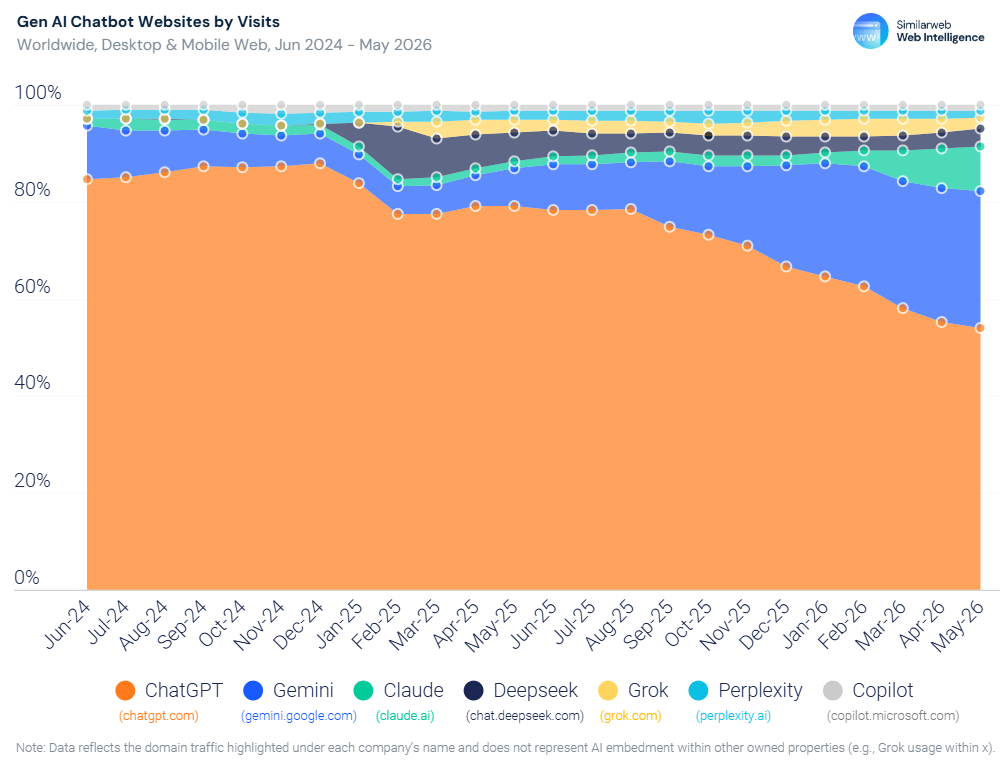
ChatGPT remains the largest AI platform on the web by a wide margin. Averaged across June 2025 – May 2026, chatgpt.com drew about 5.7 billion monthly visits and 467 million monthly unique visitors worldwide, up 53% and 45% year over year respectively (Similarweb, desktop and mobile web).
Claude’s numbers are smaller and steeper. claude.ai averaged 331 million monthly visits and 37 million unique visitors over the same period, up 319% and 252% year over year. The single-month view is even sharper: Claude went from 100 million visits in May 2025 to 953 million in May 2026, with most of that surge landing between March and May 2026, when monthly visits tripled in three months.
Two things are true at once here. ChatGPT’s scale advantage is enormous: in May 2026 it still had roughly five times Claude’s unique visitors. And Claude’s trajectory is the steepest of any major platform Similarweb tracks, which is why it moved from a rounding error to the clear number three AI website behind ChatGPT and Gemini in about a year. The market leader is still growing in absolute terms, as our look at ChatGPT’s monthly visits shows, even while its share of the category falls.
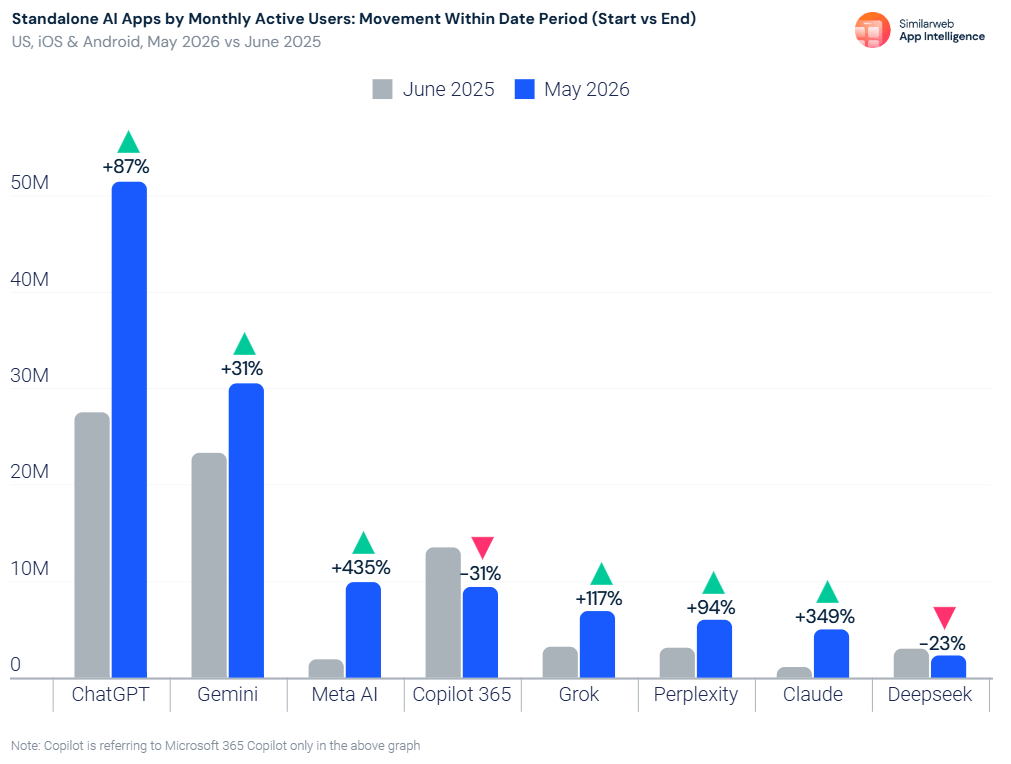
The app data makes the momentum contrast starker. Worldwide, ChatGPT’s mobile app grew from 853 million monthly active users in June 2025 to 1.12 billion in May 2026, a 31% gain that added more absolute users than every competitor combined (Similarweb App Intelligence, iOS and Android). Claude’s app grew from 7.3 million to 103.9 million monthly active users over the same window, an increase of roughly 1,300%.
In the US specifically, ChatGPT’s app MAU grew 87% (27.5M to 51.4M) while Claude’s grew 349% (1.1M to 5.0M). The fact that Claude’s worldwide growth rate dwarfs its US growth rate tells you something most comparisons miss: Claude’s expansion right now is disproportionately international.
Engagement tells a subtler story. ChatGPT’s US app stickiness, the share of monthly users who show up on a given day, averaged 40% over the year, the highest of any AI app Similarweb tracks and roughly double everyone else. Claude’s stickiness averaged 21%, which sounds modest until you notice it edges out Gemini’s 20% despite Gemini’s app audience being many times larger. Claude’s smaller user base behaves more like committed daily users than casual installers.
Put the two lenses together and you get the one insight worth remembering from all this data: every ranking of current size puts ChatGPT first by a mile, and every ranking of rate of change puts Claude first by a mile. Visits, unique visitors, app users, even paid acquisition efficiency (more on that below) all follow the same pattern. ChatGPT is far enough into mainstream adoption that easy multiples are behind it, Claude is early enough on its curve that the same absolute gain looks explosive.
Neither fact cancels the other. If you’re choosing a tool for yourself, scale matters less than fit. If you’re a brand deciding where to build AI visibility, both matter: today’s audience lives mostly on ChatGPT, and the fastest-compounding new audience is arriving on Claude. This is where an LLM comparison has to go beyond raw traffic and weigh how much each platform actually drives discovery in your category.
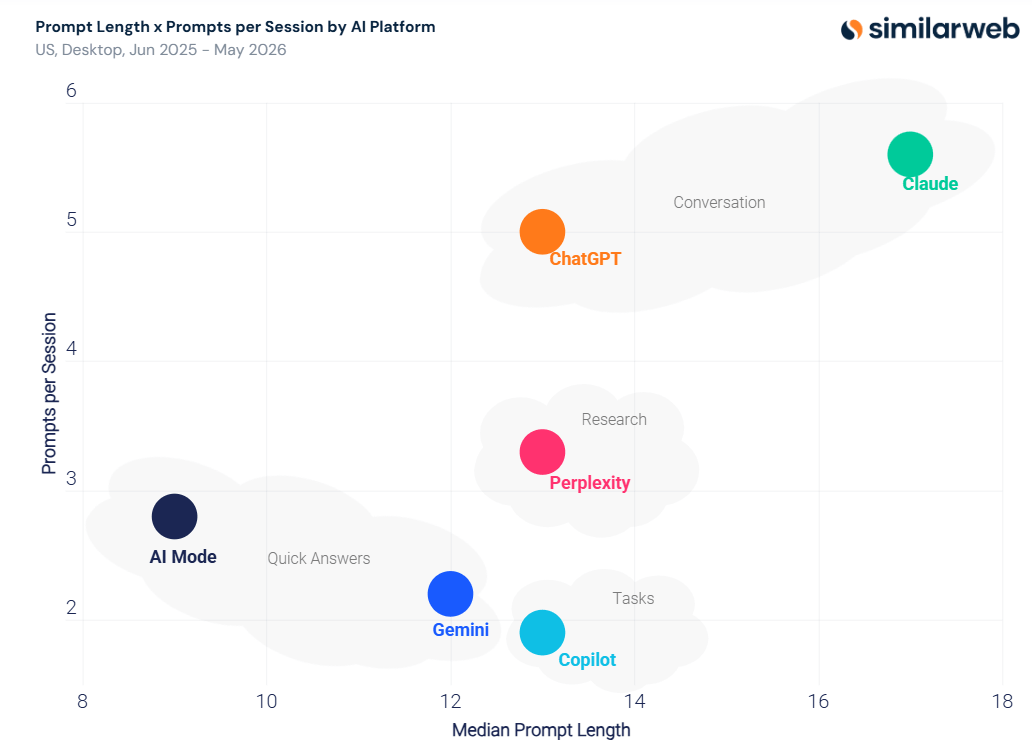
The usage behavior inside each platform is where “Claude is just a smaller ChatGPT” falls apart. Our analysis of US desktop sessions (June 2025 – May 2026) measured how users actually talk to each assistant:
| Behavior | ChatGPT | Claude | Google Search (reference) |
|---|---|---|---|
| Median prompt length | 13 words | 17 words | 3 words |
| Prompts per session | 5.0 | 5.6 | n/a |
Claude users write the longest prompts of any major AI platform and hold the most back-and-forth exchanges per session. ChatGPT sits just behind on both measures, and together the two define the “conversation” end of the spectrum, while Gemini, Copilot, and Google’s AI Mode cluster at the short-prompt, quick-answer end. In the 2026 Generative AI Landscape report, Claude stands alone in the top-right corner of the prompt-length-by-session-depth map: its users bring complex, context-heavy work and stay to iterate on it.
What that work is differs too. Anthropic’s own Economic Index research (March 2026) found 45% of Claude conversations were work-related and 42% personal. OpenAI’s published usage research, by contrast, reports that roughly 70% of ChatGPT usage is non-work-related. ChatGPT’s conversation mix spans everything from software development and marketing to test prep, mental health support, and shopping, Claude’s skews toward professional and technical tasks.
Neither pattern is better. But if your question is “which assistant matches how I’ll actually use it,” this is the most predictive data available: quick, varied, everyday tasks map to ChatGPT’s usage profile, and long, layered, work-heavy sessions map to Claude’s. These patterns are consistent enough that they’ve hardened into distinct AI platform personas.
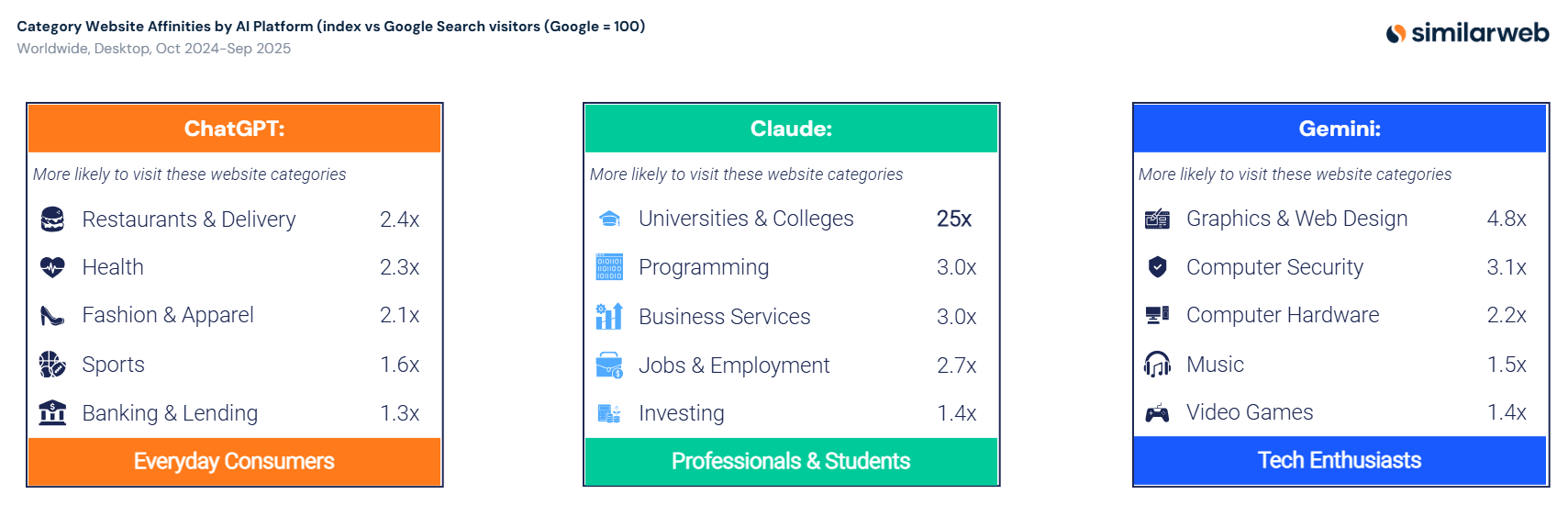
The two platforms are also attracting measurably different users:
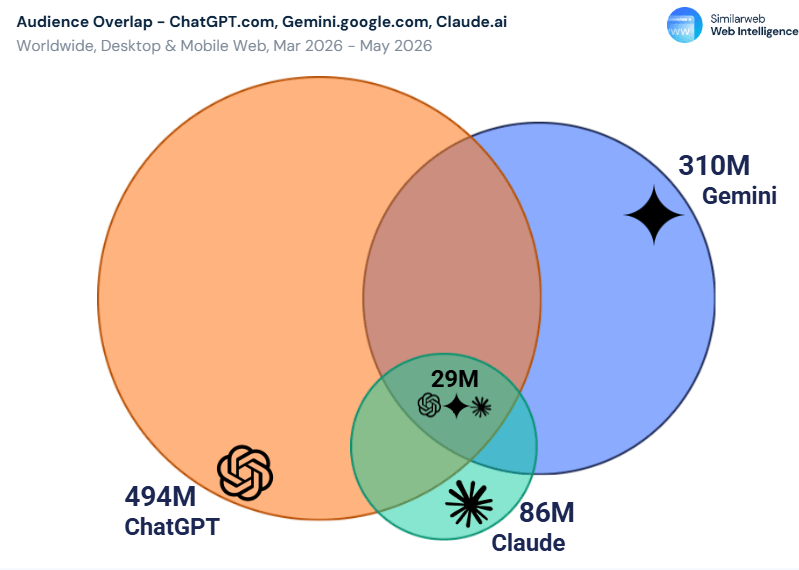
And crucially, the audiences overlap rather than divide. Between March and May 2026, Similarweb measured 494 million unique visitors on chatgpt.com and 86 million on claude.ai worldwide, with 29 million people using ChatGPT, Gemini, and Claude in the same period. People aren’t picking a side, they’re building a toolkit. That’s consistent with the broader finding that 95% of ChatGPT users also still use Google: new AI tools are being added to routines, not replacing them.
Usage data explains the “who” and “how”, capabilities explain the “why.” Here’s the honest version of the feature comparison, kept short because features change monthly while these patterns have held for two years.
Claude’s writing is the most consistent reason users cite for switching. Its long-form output holds an argument, varies sentence rhythm, and needs fewer editing passes, while ChatGPT’s drafts still lean on formulaic transitions and symmetrical structure. Claude’s million-token context window on newer models also means you can feed it an entire report, style guide, and dataset in one conversation without chunking. ChatGPT is the better pick for high-volume, templated output: batches of variations, meta descriptions, short-form copy at speed.
Both companies now treat coding agents as their flagship products. Claude Code ships with paid Claude plans, OpenAI’s Codex is available across ChatGPT tiers. Independent benchmark trackers such as vals.ai have placed Claude’s newest Opus model at the top of SWE-bench Verified, and developer consensus favors Claude for large codebases, multi-file refactoring, and ambiguous briefs, while ChatGPT’s agents tend to win on precisely specified tasks and cost per task. If coding is your primary use, Claude is the safer default, if it’s occasional, either works.
This category isn’t close. ChatGPT generates images natively, holds natural spoken conversations, and pairs live web search with the largest ecosystem of integrations and custom GPTs. Claude generates no images and has no voice mode, it can read images, charts, and PDFs, and build interactive artifacts, but if visual creation or hands-free use matters to you, ChatGPT is the only option of the two.
On hallucination benchmarks that reward models for declining to answer rather than inventing facts, Claude’s models score meaningfully better than ChatGPT’s current generation, per independent testing reported through 2026. ChatGPT counters with stronger tool coverage for verification (live search, code execution) when you use it. For high-stakes work, the practical answer is the same for both: verify outputs.
If you’re reading this as a marketer rather than a tool shopper, the competitive data carries a second message: the platforms are now fighting for users with real money, and your brand’s visibility on each is a separate, measurable channel.
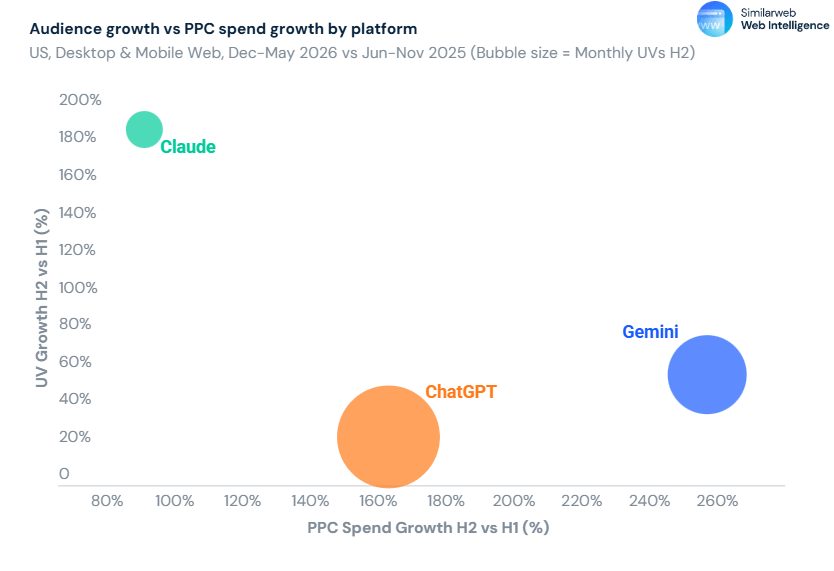
Similarweb’s Ad Intelligence data shows how seriously both sides are investing in paid acquisition. Over June 2025 – May 2026, OpenAI spent an estimated $205 million on US paid search for ChatGPT, while Anthropic spent $41.9 million on Claude. But indexed to their own starting points, Claude’s spend grew almost twice as fast as ChatGPT’s (reaching 786 vs. 437 by May 2026, indexed to June 2025), and Claude paired the smallest budget of the major platforms with the strongest audience growth. Users are worth fighting for because each platform is becoming its own discovery surface, complete with brand recommendations, citations, and, on ChatGPT, ads inside answers, which appeared in 26% of US chats by June 2026.
That’s why treating “AI traffic” as one bucket no longer works. With our AI Traffic Tracker, you can split referral visits by platform and see exactly how much traffic ChatGPT sends your site versus Claude, which pages they land on, and which prompts drove them. Given Claude’s audience profile (universities, programming, business services), a B2B or developer brand may find its Claude referrals converting differently than its ChatGPT ones, and that’s a segmentation you can only act on if you measure it.
| Your situation | Pick |
|---|---|
| Long-form writing, editing, research synthesis | Claude |
| Software development as a primary task | Claude (Claude Code), with Codex worth testing |
| One assistant for everything, including images and voice | ChatGPT |
| Analyzing long documents, contracts, codebases | Claude |
| Quick everyday answers, shopping, planning, creative variety | ChatGPT |
| You’re a student or academic | Claude (its heaviest-indexing audience, for good reason) |
| You want the biggest ecosystem of plugins, GPTs, integrations | ChatGPT |
| Budget for exactly one $20 subscription, mixed use | ChatGPT for breadth, switch to Claude if you notice most sessions are deep work |
| Your work justifies two subscriptions | Both, routed by task, like millions of multi-platform users already do |
ChatGPT is the default for range and remains the platform where most AI activity happens today. Claude is the specialist that’s growing fastest precisely because the people who need depth keep finding it. The 29 million people using both aren’t confused, they’ve noticed the tools are good at different jobs.
Neither is better overall, they win different categories. Claude leads on long-form writing quality, coding, document analysis, and answer honesty, while ChatGPT leads on versatility, image generation, voice, live search, and ecosystem size. Usage data shows the split clearly: Claude users write 17-word median prompts across 5.6-turn sessions (the deepest of any platform), while ChatGPT serves the broadest range of everyday tasks at more than 17 times Claude’s web scale.
No. ChatGPT’s worldwide web visits grew 53% and its app users grew 31% over the past year (Similarweb, June 2025 – May 2026), so its audience is still expanding. Claude is growing far faster in percentage terms (visits up 319%, app users up roughly 1,300% worldwide), but mostly by adding new and multi-platform users rather than pulling people away: 29 million people used ChatGPT, Gemini, and Claude in the same three-month window.
No. Claude cannot generate images or hold voice conversations. It can analyze images, charts, screenshots, and PDFs, and it can build diagrams and interactive visuals as code artifacts, but for native image creation or spoken interaction, ChatGPT is the only option of the two.
Claude, based on both capability and behavior. Claude users are 25 times more likely than average searchers to visit university and college websites, the strongest audience skew Similarweb measured for any AI platform, and its long-context reading, careful sourcing behavior, and writing feedback suit academic work. ChatGPT remains a strong all-rounder for study aids, flashcards, and quick explanations.
Start where your audience already is: ChatGPT holds the largest AI audience by far and drives the most AI referral traffic. Then weigh Claude by fit rather than size: if you sell to developers, professionals, students, or B2B buyers, Claude’s audience over-indexes on exactly those categories and is compounding fastest. Measure referrals from each platform separately before deciding where incremental effort goes.
Senior SEO Specialist at Similarweb
Maayan is a senior SEO specialist with 7+ years of experience in SEO. She loves complex research projects, creating SEO strategies and performing technical audits.
Give it a try or talk to our insights team — don’t worry, it’s free!