


Google AI Mode vs Gemini: Same Model Family, Different Job, Different Visibility
by Maayan Zohar Basteker8 Min.
Nov 10, 2026

Sooner or later, every SEO who tracks AI visibility runs into the same question: when should you change the prompts you track? Change them too often, and you cannot compare this month to last month, because the measurement itself has moved. Never change them, and the campaign stops covering what you publish and sell.
There’s no universal answer, so I won’t pretend there is one. I’ll describe how I handle it in Similarweb’s own campaigns, and what the data from those campaigns shows.
My answer: lock your MOFU and BOFU prompt sets so their trends stay comparable, and refresh your TOFU set on a schedule as your content grows. I run one campaign per funnel stage, so changing one stage’s prompts never moves the scores of the others.
This article starts with why one score across funnel stages is hard to read, moves to how prompts behave at each stage, and then lays out how I decide which prompts stay fixed and which change. It ends with a lock-and-refresh toolkit you can copy.
If you put every tracked prompt into one campaign, the platform gives you one visibility number. That number averages prompts that measure different things, and it moves whenever you add or remove prompts, whether or not any AI answer changed.
For example, I track 224 prompts for Similarweb’s Ad Intelligence products, spread across three campaigns. Averaged across all of them, the visibility score is 33.6% (ChatGPT, week of November 1 to 7, 2026).
I could use that number to build my AI search optimization roadmap, shape my strategy, and prioritize my efforts, but I suspect it would hide where I actually stand in AI and where to invest.
A general campaign holds many types of prompts: branded, non-branded, comparative, informational, and more. They don’t all belong to the same stage of the user’s journey, they don’t serve the same level of awareness, and they don’t match the same intent. If we were talking about SEO, you would have divided your keywords by search intent, by blog pages and product pages, a long time ago. So why would AI visibility tracking be any different?
Let’s break the Ad Intelligence prompts down into TOFU, MOFU, and BOFU, and recheck the visibility score:
| Prompts tracked | Visibility Score
| |
|---|---|---|
| All prompts combined | 224 | 33.6% |
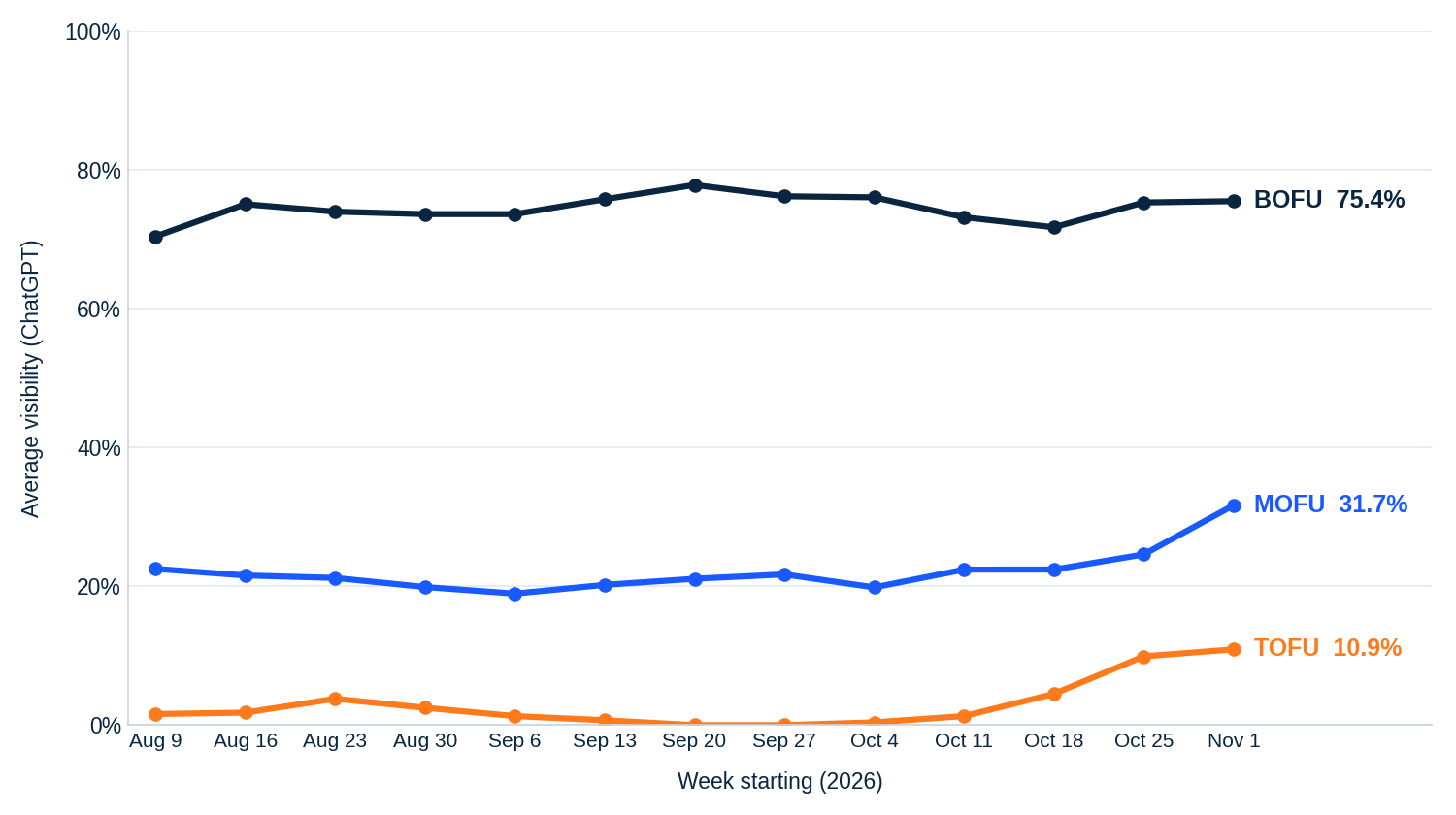
| TOFU | 64 | 10.9% |
| MOFU | 120 | 31.7% |
| BOFU | 40 | 75.4% |
The 33.6% looks like a reasonable middle score. In reality, none of the separate stages match the total, and each answers a different question.
This gap holds every week. From August 9 to November 7, 2026, TOFU stayed low, MOFU in the middle, and BOFU high, so one blended number can’t describe them all.
Say I add 64 TOFU prompts for new articles that are not published yet, so they start at 0% visibility. The combined score drops from 33.6% to 26.1%. That edit also changed a number that MOFU and BOFU are part of. Anyone looking at that dashboard would see a loss of more than seven points and start looking for what went wrong. Nothing did. I only changed the prompts.
With separate campaigns, my edits only change the TOFU line, which is why I treat it as more volatile and don’t build strategy on it (at least until other funnel stages are covered). MOFU and BOFU stay untouched.
TOFU, MOFU, and BOFU prompts measure different things. The prompts at each stage come from people with different needs, and different pages answer them. TOFU prompts come from people looking for information, MOFU prompts from people who need help choosing between options, and BOFU prompts from people who want to know more about your brand. So a brand mention means something different at each stage.
TOFU prompts track whether your content, mainly blog posts and other informational pages, shows up in AI answers to the questions people ask. Visibility at this stage is usually lower than at the others because more players compete in the field: brands publish informational content not tied to their products, and publishers that sell no products at all, like a news outlet writing about how paid search has changed, compete for the same answers.
A TOFU campaign can also include a group of pre-loaded prompts for planned content that is not published yet. They are expected to show 0% visibility until that content goes live, so disregard them when you analyze your data.
This is where competition lives, and where the range is widest. These are the prompts a user runs while comparing options, and our opportunity to make them take the right decision: Choose our brand.
None of the 120 MOFU prompts in our campaign name Similarweb, so the AI engine decides which brands answer, and the pages that earn that mention are product, use-case, and comparison pages.
Because the AI engine picks the brands, prompts where competitors show up more often than you do are the most direct optimization list in the prompt set, and you can filter them in the Prompt Analysis tool.
Branded prompts pretty much guarantee a brand mention. That is why BOFU tracking focuses on sentiment and brand accuracy, not visibility.
Visibility is expected to be high here, so the useful questions are whether AI engines describe your product, pricing, and features correctly, and whether the tone is positive.
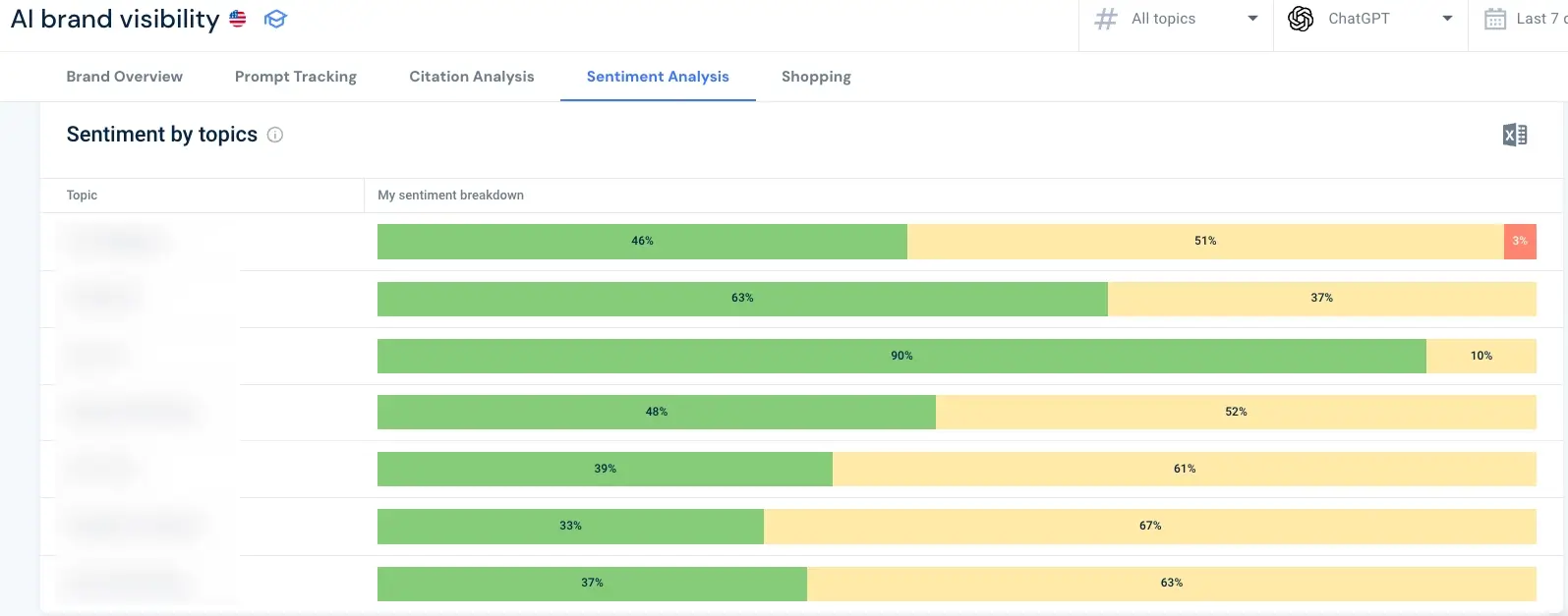
In our BOFU campaign, only a small share of mentions are negative, and they are concentrated in one topic. A visibility score would not flag that, because a negative mention still counts as visibility.
| Stage | What the prompts ask | Example prompt | Likely target pages | Typical visibility pattern (my campaigns, not a benchmark) | What a change means
|
|---|---|---|---|---|---|
| TOFU | Informational questions | “How do quality scores affect ppc ad performance” | Blog posts, documentation, whitepapers | Low, typically 10% to 30%, sometimes higher | Your content coverage changed |
| MOFU | Product-related and evaluation questions without your brand | “Ad monitoring software for agency workflows” | Product, use-case, and comparison pages | Widespread, typically 20% to 70% | Your competitive position changed |
| BOFU | Questions that name your brand | “Does Similarweb offer ad monitoring features” | Pricing, homepage, registration | High, typically 70% to 100% | Your product or brand narrative changed |
MOFU is the stage I care about most. Its target pages (product and use-case pages) are built to convert visitors into paying customers, which is why this is where I see the biggest gaps and opportunities.
BOFU matters too, but it is more clear-cut, and TOFU brings volume without much intent. The next sections cover why I run each stage as its own campaign and why I lock some sets while refreshing others.
Separate campaigns per funnel stage keep each stage’s question answerable. For Ad Intelligence, I run one campaign per stage.
The simplest setup is to put every prompt into one campaign and read the topic view. That works until the mix changes. A campaign structure is a measurement instrument, and an instrument that changes shape when you add a prompt cannot be trended.
I could weight the stages inside one score instead, for example, 50% BOFU, 30% MOFU, 20% TOFU. I don’t, because weighting is an opinion about which question matters most, and I want the platform to show me three clean answers and let the business decide which one it needs this quarter.
The structure is simple. Each product line gets three campaigns: TOFU, MOFU, and BOFU. The Ad Intelligence campaigns in this article are one example, and each stage answers a question a specific team owns:
Each campaign is set up the same way as any campaign. The only difference is that I create one per stage instead of one per product line.
This matches how my AI search optimization roadmap treats the baseline: read it by topic and platform, because a single blended score hides the prompt group that is actually broken. The funnel stage is one more cut in the same direction.
In my approach, a locked prompt set is a group of tracking prompts that stays unchanged, except for versioned and logged edits, so you can compare results over time. A refresh set is a group of tracking prompts updated on a schedule to match new content. Together they make up what I call the lock-and-refresh method.
A locked set changes through a version, never through a quiet edit. I follow four steps:
The pages behind them barely change. Each stage points to different pages, so it stays locked. A BOFU prompt names your brand or product, for example, “does Similarweb have X feature,” and the pages that answer it are usually pricing, the homepage, and registration. Those change very little, and when they do, it is mostly pricing.
A MOFU prompt is a product-related question without your brand, for example, “top tools for X,” and the pages that answer it are product, use-case, and comparison pages, which change very little or not at all.
Because these pages hold still, a fixed set of prompts keeps measuring the same thing.
Fixing the set also makes an occasional new prompt harmless, as long as you log it. In the campaigns I describe here, one prompt added to a 120-prompt MOFU set changes the stage average by well under a point. The same addition to a 40-prompt BOFU set can move it by almost two. Small sets feel every added prompt, which is why I add prompts rarely and log each one.
My rule is tied to the pages, not to a calendar. When a new product or use case page goes live, I add three to seven prompts. If pages and features haven’t changed, I rarely add any. I review the locked set every six months, and every three months if something critical changed, such as a major launch.
Blog content keeps growing. TOFU prompts are informational questions, answered by blog posts, documentation, and whitepapers. Those are the pages that get new versions and updates all the time. Every new article opens an angle an old prompt set doesn’t cover, so a frozen TOFU set slowly stops measuring the content you actually publish. Refreshing it keeps the campaign pointed at current coverage.
I do follow the TOFU trend, but it is less trustworthy than MOFU or BOFU. Its prompts change by design, especially when I add more than I remove, so I would not build my strategy on it alone.
Most of my optimization work targets MOFU, so this is the trend I need to trust most and the one I’ll follow the longest. It’s also the stage where wording matters most: Peec AI’s study of 37,804 AI responses found that middle-of-funnel prompts are the most sensitive to wording changes, while TOFU and branded BOFU prompts stay relatively stable. So I don’t reword MOFU prompts casually.
A fixed prompt set is what makes period-over-period change, share of voice, citation gaps, and sentiment comparable. On a changing set, each of those metrics mixes real movement with edits to the instrument, so a difference in the result could come from the AI engine, from your content, or from the edit.
| Analysis | Problem on a changing set | Why a fixed set works | Decision it supports
|
|---|---|---|---|
| Period-over-period change | New prompts enter the comparison | Same questions in both periods | Did our work move visibility? |
| Share of voice | The denominator shifts with the mix | Constant competitive frame | Where do we win or lose against named rivals? |
| Citation gap | Sources differ by prompt mix | Per-stage source profile | Which sources should we earn coverage on? |
| Sentiment and accuracy | Mentions from every stage blend together | BOFU prompts that name your brand are read on their own | Is the tone of AI answers about us improving, and are they accurate? |
| Content impact | Cannot separate cause from edit | TOFU refresh dated, BOFU baseline fixed | Did the new article change TOFU coverage? |
I tested whether a locked set holds still over 90 days. I pulled 13 weeks of results from Similarweb AI Brand Visibility (ChatGPT) for each of the three campaigns, from August 9 to November 7, 2026, with no prompts added or removed. Here is what held steady:
Then I ran the roadmap’s baseline and re-test protocol on the same data. The AI search optimization roadmap starts from a 28-day baseline and ends each cycle with a re-test on the same prompts, using the same protocol.
I adapted that to a 28-day re-test window and applied it to the first four and last four weeks of each campaign, and flagged any prompt that moved 15 percentage points or more, the reassessment threshold from the prompt-selection guide. I used the same threshold for the stage average.
| Campaign | Prompts | Average at baseline | Average at re-test | Change | Up 15+ pts | Down 15+ pts | Average moved 15pp+?
|
|---|---|---|---|---|---|---|---|
| TOFU | 64 | 2.4% | 6.6% | +4.2 | 8 | 1 | No |
| MOFU | 120 | 21.3% | 25.2% | +3.9 | 19 | 7 | No |
| BOFU | 40 | 73.2% | 73.9% | +0.7 | 1 | 0 | No |
Baseline window for all three campaigns: Aug 9 to Sep 5. Re-test window: Oct 11 to Nov 7, 2026. Change, pts, and pp are all percentage points. Up and Down count the prompts that moved 15 pts or more.
I want to be precise about what this shows. No optimization actions were run on these campaigns during the window, so this tests the instrument, not a roadmap. It shows that on a locked set, a re-test comparison is possible, and every stage’s movement landed under the 15-percentage-point threshold.
That is a boring result and the one I want: if the measuring stick itself moved by 4 percentage points between windows, I could not use it to judge a change I made. I have not tested whether locking leads to better decisions than a changing set. What I can show is that the locked set holds still.
The MOFU row has the most moving parts: 26 of its 120 prompts shifted by 15 percentage points or more while the stage average moved 4 percentage points. That is what a stage average does, which is why I judge stages and not single prompts. Most of the TOFU and MOFU re-test gain also comes from the last one or two weeks, so I would treat it as something to re-test, not as a trend.
This approach has limits. Branded prompts inflate BOFU visibility, so monitor its average with that in mind. One flipped answer moves a prompt by about 14 percentage points if each prompt runs daily, and stale locked prompts hide product changes. Treat weekly prompt-level movement as noise and judge trends over longer windows.
SparkToro and Gumshoe.ai had 600 volunteers run 12 prompts through ChatGPT, Claude, and Google’s AI features a combined 2,961 times. They found less than a 1-in-100 chance that two runs return the same list of brands, and the order was even less stable (SparkToro, January 2026). They concluded that visibility percentage across many prompts and many runs is a reasonable metric, while ranking position is not.
That is why I track visibility percentage and ignore position. SparkToro also says you need at least 60 to 100 runs of a prompt to know a brand’s set of recommendations. A prompt that runs daily gives me about 28 runs in a 28-day window, which is a practical floor, not a settled sample.
The platform runs each prompt once a day, so a prompt’s weekly visibility rests on seven answers. One changed answer moves that score by 14.3 percentage points (one in seven). That is why I flag prompts at 15 percentage points: a single changed answer does not trigger the flag, but two do.
Any one week of results is a small sample of answers that vary from run to run. That is why I use 28-day windows for baselines and re-tests, and why I describe the 90-day test as 13 weekly windows, not 13 independent observations.
Chen and Koudas studied 158,099 answers and 468,037 citations across two 90-day collections (October 2026, arXiv preprint). They found that the sub-queries ChatGPT rewrites for each answer rarely match Google’s or Bing’s results, and that the pages search retrieves explained 32% of the variation between pages’ citations, versus 2.8% for page properties.
The relevant point for tracking is that the model rewrites its own queries each time. A human-defined, fixed prompt set is the part of the system you can hold still.
Google’s guide to generative AI search points site owners to the Generative AI performance report in Search Console to see how their content performs in Google’s AI features, and warns that no third-party tool has access to Google’s internal ranking or AI systems (Google Search Central).
Search Console shows how your pages perform. A tracked prompt set shows how a brand appears across engines. They measure different things, and I use both.
If a product changes and the tracking prompts don’t, some prompts will likely lose visibility because nothing covers them anymore: the product or feature page was removed, and no AI SEO work supports a product that is out of focus. The trend then shows a drop caused by your own product changes, not by how AI engines see you.
Refresh the locked set when you launch a product, rebrand, enter a market, or add a language, and review it on the schedule above. The roadmap article suggests rebuilding the prompt set only in the fourth 90-day cycle. That is the longest I would go, and I would shorten it after any major product change.
I built a workbook based on the AI tracking prompts playbook on how to turn keywords into trackable prompts, so you can carry the prompts you already built into campaigns: Copy it here.
Here’s what it contains:
The 15-percentage-point threshold is the one our prompt selection guide uses to reassess a single prompt. I apply it to stage averages as a deliberately simple rule, not a statistical test. Adjust it if you have a reason to.
The lock protects the instrument, not the result. Visibility will still move, because AI answers change, competitors publish, and engines update. The lock makes that movement mean something, so a change in the line points to the AI engine, not an edit in your spreadsheet.
Splitting the funnel does not make the number look better or worse. It replaces one score that describes nothing with three that each answer a different question: how well your content is covered (TOFU), how you stand against competitors (MOFU), and how AI describes your brand (BOFU).
If you only lock one set first, make it MOFU. BOFU is clear-cut and aligns fairly quickly, and TOFU is high volume but low intent, so MOFU, whose pages convert visitors into customers, is where the biggest gaps and opportunities are. Lock that prompt set, and measure from a stable baseline. If you want to run this on your own campaigns, Similarweb AI Brand Visibility tracks the prompts daily across ChatGPT, Google AI Mode, Gemini, and Perplexity.
A score you cannot compare to last month is a number, not a measurement.
A locked prompt set is a group of tracked AI prompts that stays unchanged, except for versioned and logged edits, so you can compare results over time. In the lock-and-refresh method, the MOFU and BOFU campaigns are locked, and the TOFU campaign is refreshed on a schedule as new content ships.
Change them on a schedule or for a defined reason, never quietly. Refresh informational prompts monthly or when new content ships. Change locked prompts only after a product launch, rebrand, or new market, and log each change as a new version. The platform re-runs prompts and updates results daily, but that is no reason to change the list daily. Similarweb’s prompt tracking guide suggests monthly reviews.
One campaign averages prompts that measure different things into a single number, and that number moves whenever you add or remove prompts, even if no AI answer changed. Separate TOFU, MOFU, and BOFU campaigns keep the changing informational prompts from contaminating the stable stages, and each stage answers its own question.
Check whether the prompt names your brand. A BOFU prompt does, such as “does [brand] offer [feature],” and it is answered by pricing, homepage, and registration pages. A MOFU prompt asks about the category without your brand, such as “best [category] tools for [use case],” and it is answered by product, use case, and comparison pages.
Lock MOFU first. These are the prompts people run while comparing options, answered by your product, use case, and comparison pages, and those pages convert visitors into customers, so this is where the biggest gaps and opportunities sit. BOFU is more clear-cut and aligns faster, and TOFU brings volume with little intent, so a stable MOFU baseline gives the most useful trend.
Informational questions answered by your blog posts, documentation, and whitepapers. Each prompt shows whether your content appears in AI answers to a question people ask, so a prompt where your brand is not mentioned is something to look into, not a failing campaign. Some TOFU prompts are pre-loaded for planned content that is not published yet. Expect 0% visibility on those until the content goes live, and disregard them when you analyze the data. Refresh the set on a schedule, read it as a coverage map, and treat its trend as more volatile than MOFU or BOFU.
Yes, and they should be the core of that campaign. AI answers to a prompt that names your brand will almost always mention it, and Similarweb’s prompt tracking guide notes that branded prompts inflate visibility scores. Visibility is expected to be high, so track sentiment and brand accuracy: whether AI engines describe your product, pricing, and features correctly.
Tie additions to your pages. Add three to seven prompts for each new product or use case page, and rarely add any when pages and features haven’t changed. Review the locked set every six months, or every three if something critical changed. Log each addition as a new version, and run old and new versions in parallel for 28 days.
Use 28 days. AI answers vary run to run, and SparkToro found less than a 1-in-100 chance that two runs return the same list of brands. Similarweb’s prompt tracking guide says trend reliability builds over three to four weeks, and the AI search optimization roadmap starts from a 28-day baseline and ends each cycle with a re-test on the same prompts.
Director of SEO & AI Search at Similarweb
Limor brings 20 years of expertise in SEO and AI Search. She thrives on solving complex problems, creating scalable strategies, and building amazing dashboards.
Google AI Mode vs Gemini: Same Model Family, Different Job, Different Visibility

Should You Create an AI Info Page?

How Publishers Can Improve AI Visibility: 12 Tips Ranked by Confidence and Effort
Give it a try or talk to our insights team — don’t worry, it’s free!