


Should You Create an AI Info Page?
by Shai Belinsky12 Min.
Nov 08, 2026
On August 11, 2026, Google announced that the Gemini app had passed 1 billion monthly users. Three months earlier, at Google I/O 2026, the company had said that AI Mode in Search had surpassed 1 billion monthly users of its own. Two billion-user products, both built on Google’s Gemini models, both answering questions in fluent, confident prose.
That overlap is why so many people treat them as one thing. They are not. AI Mode is a search experience that fans your question out into related searches and answers with links to the web. Gemini is a standalone assistant for drafting, coding, document work and tasks. Which model you get on either one also depends on your subscription, and Google has been changing those models every few weeks.
This article makes one argument: the model is the least stable variable in the comparison, and the surface is the most stable. If you track, optimize for or choose between Google’s AI products, decide by surface and job first, then check which model your plan unlocks. You will get a four-part comparison framework, Similarweb traffic data on Gemini’s website, and a guide to when to use AI Mode and when to use Gemini.
No. Google AI Mode is a conversational search experience inside Google Search. Gemini is Google’s standalone assistant, available at gemini.google.com and in mobile and desktop apps. Both use models from the Gemini family, but they are separate products with different surfaces, jobs and model options.
Google AI Mode is defined as the mode of Google Search that answers complex, multi-part questions in a conversational format, using Gemini models to reason across sources. Google introduced it as an experiment in March 2025. Gemini began life as Bard and was renamed Gemini in February 2024. One is a feature of a search engine. The other is a product in its own right.
The confusion has three sources. First, Google puts the Gemini name on the models, the app and several features, so “Gemini” can mean any of them. Second, answers in the two products often read alike because the underlying models are related. Third, a third surface, AI Overviews, adds a second AI answer layer to the regular results page. Google’s own documentation notes that AI Mode and AI Overviews may use different models and techniques, so even inside Search the model is not guaranteed to be the same.
AI Mode and Gemini differ on four dimensions: Surface (where each lives), Intent (what people open it to do), Depth (what it can do beyond answering) and Exposure (how brands and sites appear in it). We call this the SIDE framework.
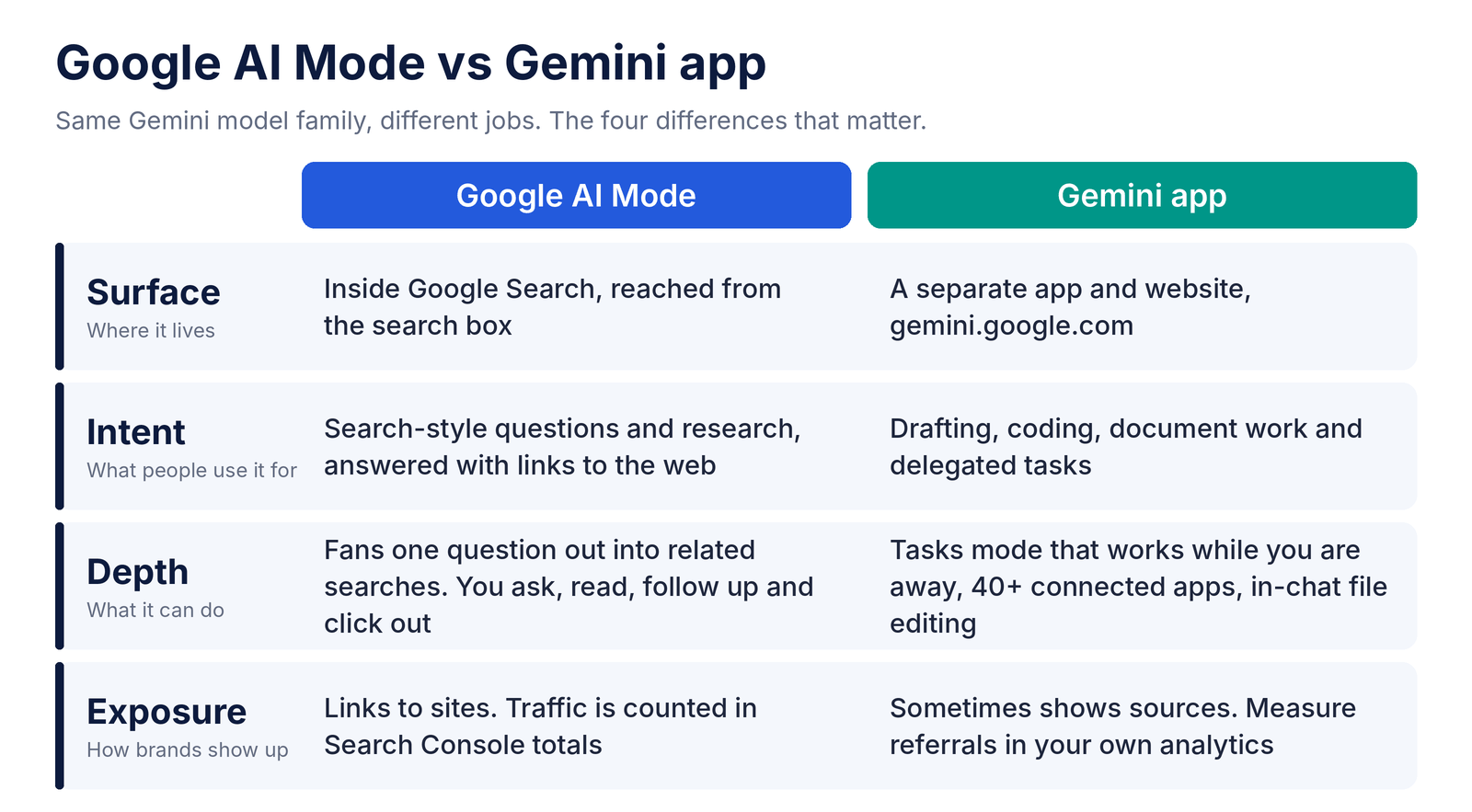
AI Mode lives inside Google Search and is reached from the search box. Gemini is a separate destination at gemini.google.com and in the Gemini mobile and desktop apps. Surface sets the context for everything else: one is a mode of a search engine, the other is a product you open on purpose.
People use AI Mode for search-style questions and research, and it answers with links to the web. They use Gemini for drafting, coding, document work and delegated tasks. A person comparing three project-management tools types the question into the search box, so AI Mode answers it. A person who wants a first draft of the vendor comparison memo opens Gemini. The same person may do both on the same day.
AI Mode runs query fan-out across subtopics and data sources, and Google said at I/O 2026 that Search can build a custom format for a question on the fly. It is built around the search journey: ask, read, follow up, click out. Gemini goes further into doing the work. On October 13, 2026, Google described a tasks mode that lets Gemini work across your Google apps even when you are not at your computer. The app also connects to more than 40 apps and creates and edits documents, PDFs, presentations and spreadsheets in the chat.
Exposure is the dimension that matters for marketers. AI Mode sits on the open web and surfaces links to sites. Google’s documentation says sites that appear in AI features are counted in overall Search Console traffic, so your existing reporting already captures part of that exposure. That documentation describes features in Search, so do not assume the same reporting covers Gemini. The app sometimes shows sources and related links, but not every response includes them. Even so, Gemini sends traffic to sites, so measure it in your own analytics instead of assuming Search Console covers it. Graphite’s State of Gen AI study, which uses our data, found that as of July 2026 Gemini sent 14% of AI referral traffic to the roughly 43,000 top sites it analyzed worldwide, behind ChatGPT at 60%.
Similarweb data shows gemini.google.com averaged 2.72 billion visits a month between May and October 2026. Visits fell about 9% over the period, and mobile web is falling faster than desktop.
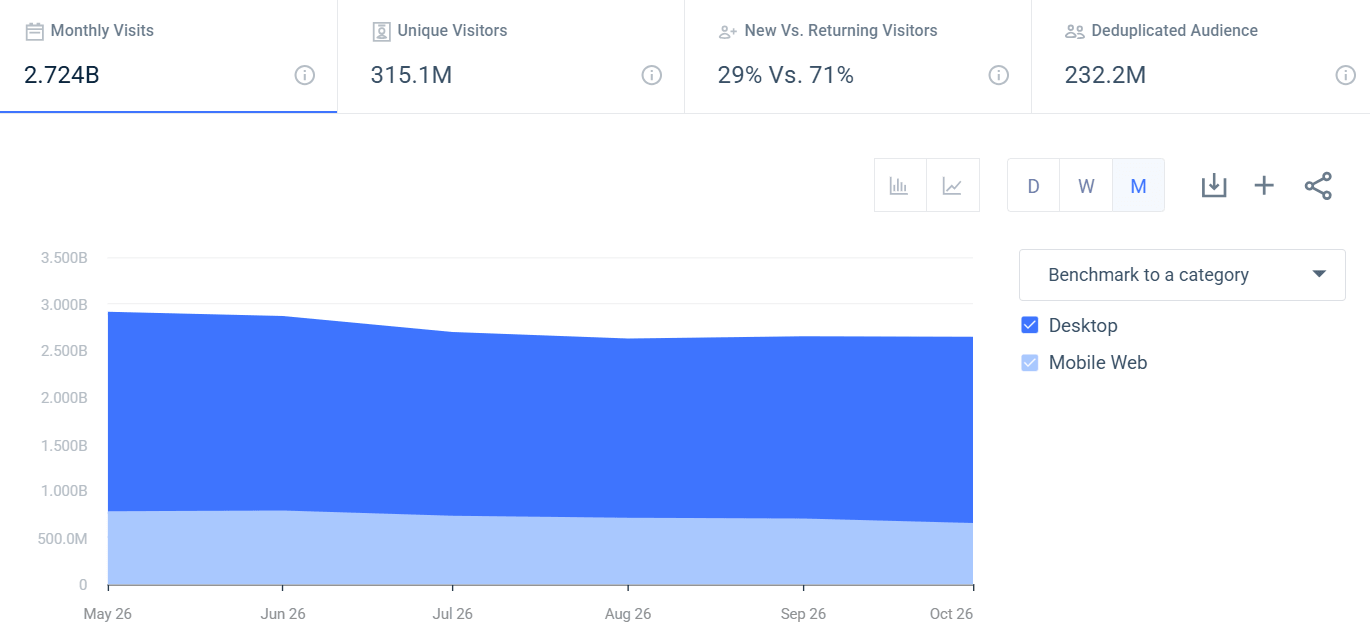
Gemini’s website drew about 315 million unique visitors a month, so the average visitor made roughly 8.6 visits a month (our calculation from the two headline figures). Similarweb classifies 71% of visitors as returning and 29% as new, so the audience is mostly people who already use it.
Visits fell from 2.90 billion in May to 2.62 billion in August, then held near 2.64 billion in September and October. October is about 9% below May.
Desktop made up 74% of visits in May and 76% in October. Mobile web is the smaller layer in the chart.
From May to October, mobile web visits fell about 16%, from 767 million to 642 million. Desktop visits fell about 7%, from 2.14 billion to 1.99 billion. Since August the two have moved in opposite directions: desktop is up about 4%, from 1.92 billion to 1.99 billion, while mobile web is down about 8%, from 698 million to 642 million.
Use AI Mode when you need a researched answer with links, such as comparisons, shopping and fact-finding. Use Gemini when you need to produce something, such as a draft, code or an edited document, or when you want Gemini to act across your apps. For brand tracking, use both.
AI Mode runs fan-out searches across related subtopics and links to web pages, so you can check the sources behind a comparison.
AI Mode is built on Search, so questions about current facts and news belong there.
Gemini creates and edits documents directly in the chat, so you can go from a rough request to a finished draft without leaving the conversation.
Gemini’s tasks mode lets it keep working across your Google apps when you are away from your computer, and the app connects to more than 40 apps.
Gemini offers agentic coding features, including the Antigravity coding interface in the macOS app.
AI Mode and Gemini can name different brands for the same prompt, so track each surface separately.
Google AI Mode vs Gemini is not a question about which model is smarter. It is a question about which surface you are standing in, and what that surface rewards. Pick the surface by the job, and if you track your brand, test the same prompts on both. Label every observation with a model and a date, and you will keep a usable record while the models turn over around you.
Similarweb’s AI Search Intelligence tracks how measurement is catching up to behavior, and can help you baseline your own visibility.
No. Google AI Mode is a conversational search experience inside Google Search, while Gemini is Google’s standalone assistant and the name of its model family. Both run on Gemini models but serve different jobs. In 2026, Google reported more than 1 billion monthly users for AI Mode (May) and for the Gemini app (August).
Use AI Mode when you need a researched answer with links, such as comparing products or finding current facts. Use Gemini when you need to produce something, such as a draft, code or an edited document, or when you want to hand off a multi-step job across your Google apps. For brand monitoring, use both, because the two may name different brands for the same prompt.
AI Overviews are short AI summaries at the top of regular Google results. AI Mode is a conversational experience for longer, multi-part questions. At I/O 2026, Google connected the two, so a follow-up question asked from an AI Overview continues in AI Mode. Google’s Search Central documentation says they may use different models and techniques, so their answers and links can differ.
Yes. AI Mode is available to free users, and at Google I/O on May 19, 2026, Google made Gemini 3.5 Flash the default model in AI Mode for everyone globally. Google AI Pro and Ultra subscribers can choose additional models. Check Google’s plan pages for current availability and limits in your country, because both change often.
Free users get the default model, which Google set to Gemini 3.5 Flash at I/O on May 19, 2026. Pro and Ultra subscribers can select newer models in AI Mode: Gemini 3.8 Flash since September 2, 2026 and Gemini 4 Argon since October 13, 2026. Google announced Gemini 4 Carbon on October 28, 2026, but access is currently limited to select cyber defenders. Because Google updates this often, confirm the model shown in your own account.
Sometimes. Google’s support documentation says Gemini Apps may show sources and related links, which can include public websites, uploaded files or Workspace documents, but not every response includes them. AI Mode, by contrast, is designed to surface links to the web, according to Google’s Search Central documentation on AI features.
Yes. Google’s documentation says specific optimization is not required for AI Overviews and AI Mode, and SEO fundamentals remain worthwhile: allow crawling, link pages internally and provide a good page experience. Because AI Mode may fan a query out into related searches, pages that answer adjacent sub-questions give you more routes into an answer. Similarweb’s guide to optimizing for AI Mode covers the on-page steps.
Yes, and you should. The two surfaces may name different brands for the same prompt, and the model can differ by subscription tier. Build a prompt set that covers category discovery, vendor comparison and purchase decision. Run it on both surfaces on the same day and log the date, account tier and model for each run. Record whether your brand is mentioned, whether it is linked and which competitors appear, then repeat monthly and after any model release. Similarweb’s guide to tracking brand visibility in AI Mode shows how to build a baseline.
Similarweb data shows gemini.google.com averaged 2.72 billion visits a month worldwide between May and October 2026. Visits fell about 9%, from 2.90 billion in May to 2.64 billion in October, and have held near 2.64 billion since September. The data covers the Gemini website on desktop and mobile web. It does not include the Gemini mobile apps or Gemini features inside Google Search.
Senior SEO Specialist at Similarweb
Maayan is a senior SEO specialist with 7+ years of experience in SEO. She loves complex research projects, creating SEO strategies and performing technical audits.
Should You Create an AI Info Page?

How Publishers Can Improve AI Visibility: 12 Tips Ranked by Confidence and Effort

Review Sites as AI Citation Sources: Why They Matter
Give it a try or talk to our insights team — don’t worry, it’s free!