



Dark Funnel Metrics: What to Measure When Buyers Decide Before They Click
by Limor Barenholtz21 Min.
Oct 14, 2026
AI chatbots are sending real traffic to websites, and the numbers are no longer small. According to Similarweb’s 2026 Generative AI Landscape report, AI platforms drove an average of 770.7 million referral visits per month worldwide between June 2025 and May 2026, more than double the year before (+117.4%, desktop and mobile web).
But the growth is not spread evenly. Beauty grew 312.5% in a year. News and Travel grew 115.6%. Marketplaces hold the most volume and still grew 237.3%. Which number matters for your business depends entirely on the industry you’re in, and misreading the data can lead to either overinvesting in a channel that’s still tiny or ignoring one that’s about to become material.
This article breaks down AI referral traffic across seven industries: who gets the most visits, who is growing fastest, and why those are two very different lists. You’ll get the full category scorecard, a simple framework for reading volume against growth, and a four-step process to benchmark your own site. AI referral traffic refers to the visits a website gets when someone clicks a link in an AI answer on platforms like ChatGPT, Gemini, Claude, Perplexity, Grok, and DeepSeek.
Marketplaces lead every industry in AI referral traffic, at 46.8 million average monthly visits between June 2025 and May 2026, per Similarweb’s 2026 Generative AI Landscape report, with News and Travel essentially tied just behind. The full ranking is in the chart below. What the chart doesn’t show is how steep the drop-off is: the top three categories pull in three times the combined volume of the bottom four, and the gap between first place (Marketplaces) and last (Beauty) is more than 20x.
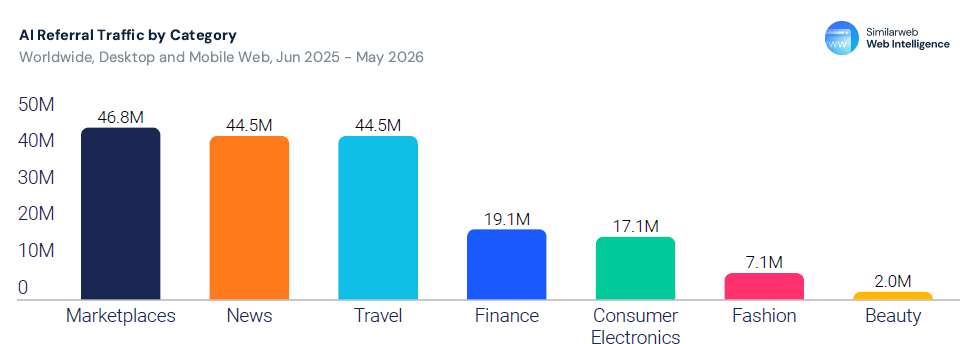
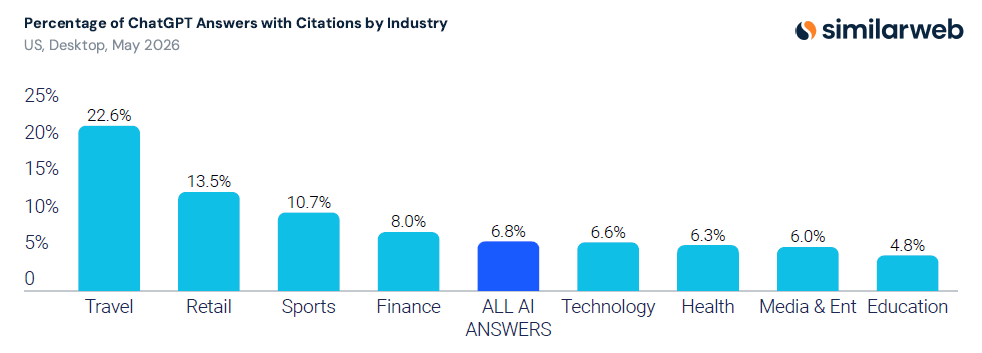
The volume hierarchy makes intuitive sense. Marketplaces, News, and Travel are the categories where an AI answer most often needs to hand the user off to a website: to buy a product, read a full article, or book a flight. They also overlap heavily with the most cited domains by LLMs, where retail platforms, publishers, and travel aggregators fill most positions. These are the queries where AI platforms search the live web most aggressively: the same report found that 22.6% of ChatGPT answers in Travel included web citations in May 2026 (US, desktop), against a 6.8% average across all conversations, the highest citation rate of any industry measured.
Volume, though, is only half the picture, and for most marketing teams it’s the less useful half.
Takeaway: if you operate in Marketplaces, News, or Travel, AI referrals are already a line item worth reporting monthly. Everywhere else, the growth numbers below are your early warning that the channel is about to become material.
Marketplaces broke the usual rule that big bases grow slowly: the category holds the largest AI referral volume (46.8 million average monthly visits) and still grew 237.3% year over year, more than double the growth rate of News and Travel. The category, anchored by giants like Amazon and Temu, tripled from 13.9 million average monthly visits the year before.
The monthly trajectory is even more striking than the annual average. Marketplaces’ AI referrals climbed from 33.2 million in June 2025 to 89.9 million in May 2026, and the single largest jump came at the very end of the period: from 66.0 million in April 2026 to 89.9 million in May 2026, a 36% month-over-month surge. That inflection lines up with ChatGPT’s May 7 update, which turned brand names in answers into prominent clickable links and pushed referral volume sharply higher across the web. Given the scale of ChatGPT monthly visits, even a small change in its linking behavior moves millions of referrals overnight.
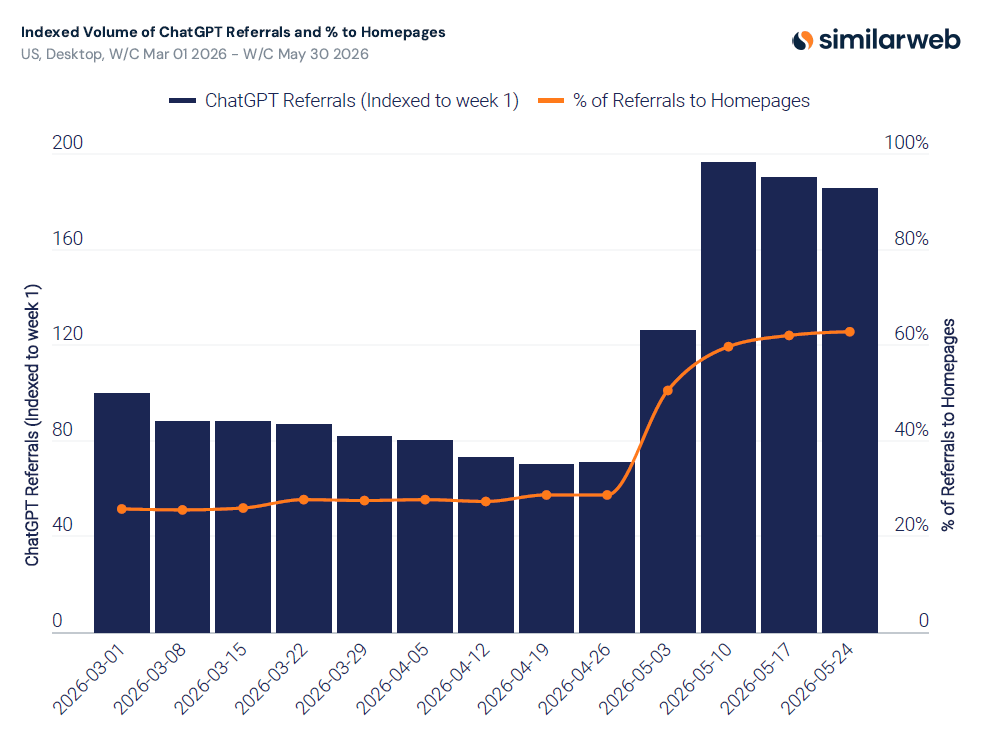
Why do Marketplaces defy the small-base growth rule? Because they benefit from a structural bias in how AI assistants answer shopping queries. When a user asks “where can I buy a mid-range espresso machine,” the safest, most complete answer links to a multi-category platform that stocks everything, not to a single-brand storefront. The 2026 Generative AI Landscape report calls this out directly: AI favors large, multi-category platforms over smaller, vertical-specific sites. That dynamic compounds with scale, so the biggest destinations keep absorbing a disproportionate share of new referral volume.
Takeaway: if you sell through marketplaces, your AI visibility strategy has two layers: your own domain and your presence on the platforms AI already prefers to link.
Beauty is the fastest-growing industry for AI referral traffic, up 312.5% year over year, with Fashion close behind at 278.2%, per Similarweb’s 2026 Generative AI Landscape report (worldwide, desktop and mobile web, June 2025 to May 2026). The full growth ranking is in the chart below, and it’s nearly a mirror image of the volume chart above it: the two categories at the bottom of the volume table sit at the top here, while News and Travel, the volume heavyweights, grew at roughly a third of Beauty’s pace. Not one of the seven categories grew less than 115%.
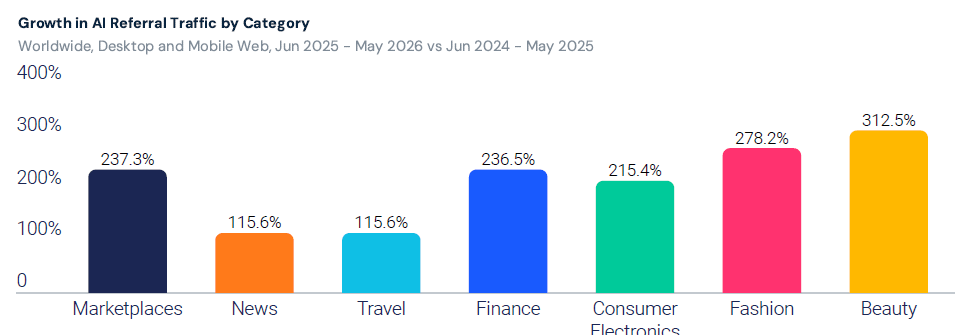
Beauty’s monthly numbers show the compounding in real time: the category drew 1.0 million AI referral visits in May 2025 and 4.0 million in May 2026, a 4x jump in a single year, with the steepest climbs arriving in the final quarter of the period. Fashion followed a similar curve, climbing from 4.4 million monthly visits in May 2025 to 6.7 million by October 2025, with its annual average nearly quadrupling.
Two forces are driving the consumer-category surge. First, product discovery is exactly the kind of query people increasingly bring to a chatbot: “what serum works for sensitive skin” or “capsule wardrobe basics under $200” are conversational questions, not keyword searches. This mirrors what Adobe Digital Insights measured on the retailer side: AI-driven traffic to US retail sites grew 693% year over year during the November to December 2025 holiday season, with travel up 539% and financial services up 266%. Second, AI answers in these verticals lean unusually hard on commerce destinations. The 2026 Generative AI Landscape report found that 54.7% of sources cited in ChatGPT beauty conversations were retail and ecommerce domains (US, desktop, May 2026), far above any other category’s commerce share, meaning beauty answers are built to send shoppers somewhere.
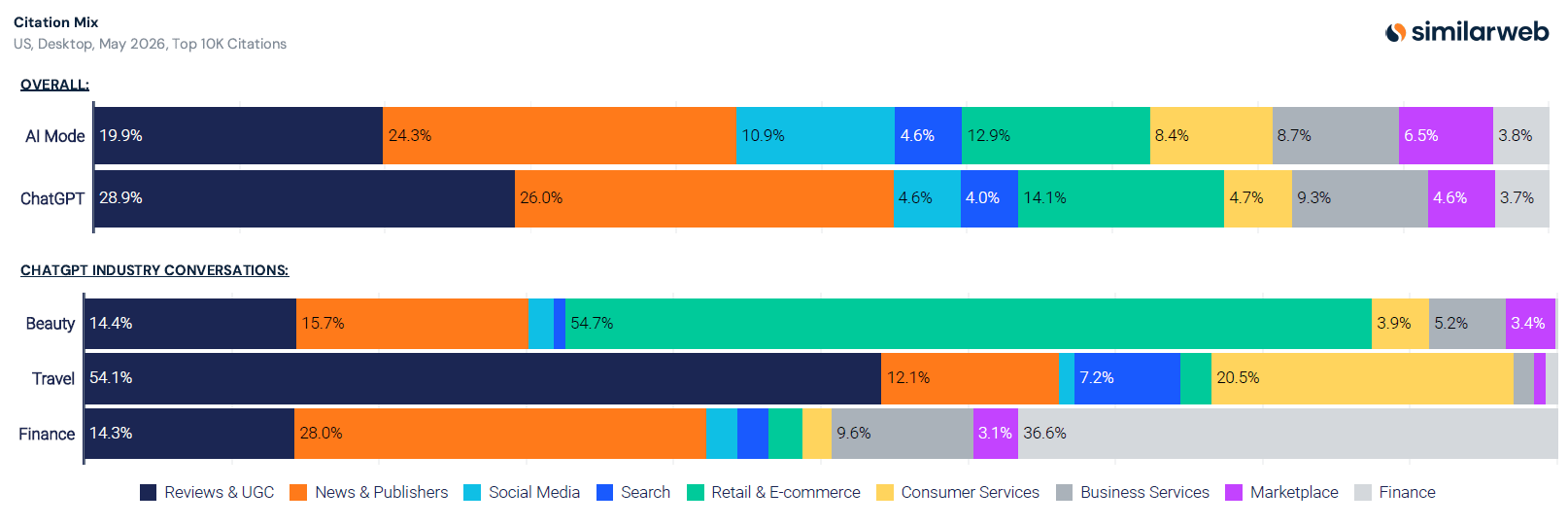
Takeaway: In Beauty and Fashion, AI referrals are moving from rounding error to reportable channel within quarters, not years. The window to establish citation share while competitors ignore the channel is open now.
Smaller categories grow faster for two compounding reasons: low starting bases make percentage growth mathematically easy, and consumer product discovery is migrating into AI chat faster than news reading or trip booking, which were already AI-referral-heavy a year ago. Both effects are visible in the data, and separating them is the difference between reading the scorecard correctly and overreacting to a percentage.
Start with the base effect. Beauty’s 312.5% growth translates to roughly 1.5 million added monthly visits (473.3K to 2.0 million). News and Travel’s “slow” 115.6% growth added about 23.9 million monthly visits each (20.6 million to 44.5 million). In absolute terms, the slowest growers each added roughly 16x more monthly volume than the fastest. A percentage alone will mislead you, the base determines what that percentage is worth.
But base effects do not explain everything, because Finance (+236.5%) and Consumer Electronics (+215.4%) grew from mid-sized bases, and Marketplaces grew 237.3% from the largest base of all. The second force is behavioral: shopping and evaluation queries, the ones that end in a click to compare, verify, or buy, are the fastest-growing use cases inside AI assistants. Adobe’s data points in the same direction from the destination side: by May 2026, AI traffic to US retail sites had surged 1,324% versus October 2024 and converted 54% better than non-AI sources.
Takeaway: never read growth percentages without base sizes next to them. A 312% jump on 473K visits and a 116% jump on 20.6 million visits are different phenomena that demand different budgets.
The 2026 scorecard comes down to three patterns: the volume and growth rankings are nearly inverted, every category at least doubled year over year, and referrals concentrate exactly where AI platforms cite the web most. All three are visible in the two charts above and the citation data below.
First, the volume and growth rankings are nearly inverted: the two categories tied for second in volume sit last in growth, and the smallest category grows fastest.
Second, every single category at least doubled year over year; there is no shrinking or flat industry in the dataset. Even the mid-table categories more than tripled, with Finance reaching 19.1 million average monthly visits (+236.5%) and Consumer Electronics 17.1 million (+215.4%).
Third, the categories align with where AI platforms search the web most: the report’s citation data shows Travel (22.6%) and Retail (13.5%) generating cited answers far above the 6.8% all-conversation average, which is precisely where referral clicks originate. One caveat: referral counts understate AI’s real influence, since visits arriving without referrer data land in direct traffic, so these figures are a floor, not a ceiling.
Takeaway: treat volume and growth as two separate lists. Volume tells you what to report today, growth tells you what to budget for next year.
The 2026 category data resolves into one sentence: AI referral volume today lives where AI answers must link out (marketplaces, news, travel), but AI referral growth lives where consumers are learning to shop by conversation (beauty, fashion, finance, electronics). The inverted rankings are not noise, they are a 12-to-24-month preview of the volume table.
Every category in the dataset at least doubled in a year, against a web where mature channels grow single digits. Marketplaces proved a large base is no ceiling. Beauty proved a small base can quadruple before most of its incumbents notice the referrer in their analytics.
The channel is no longer too small to measure, it is only too new to have settled winners. Track your AI referral traffic, your category’s trajectory, and your competitors’ share of it in Similarweb’s AI Traffic Tracker.
AI referral traffic is the visits a website receives when users click links inside AI-generated answers on platforms such as ChatGPT, Gemini, Claude, Perplexity, Grok, and DeepSeek. It reached 770.7 million average monthly visits worldwide between June 2025 and May 2026, up 117.4% year over year, according to Similarweb’s 2026 Generative AI Landscape report.
Marketplaces lead all industries with 46.8 million average monthly AI referral visits (June 2025 to May 2026, worldwide), per Similarweb data. News and Travel tie for second at 44.5 million each. AI assistants favor large, multi-category platforms like Amazon and Temu when answering shopping queries, which concentrates referral volume at the top.
Beauty (+312.5% year over year) and Fashion (+278.2%) combine small starting bases with the fastest-shifting user behavior: conversational product discovery. Beauty conversations in ChatGPT cite retail and ecommerce sources 54.7% of the time, the highest commerce share of any category in Similarweb’s 2026 data, so beauty answers are structurally built to send users to websites.
AI referrals remain a low single-digit percentage of most sites’ total traffic, but the channel is compounding faster than any other measured: total AI referral visits grew 117.4% year over year in Similarweb’s 2026 dataset, and every tracked industry at least doubled. Growth trajectory, not current share, is the reason to measure it now.
ChatGPT sends the large majority of AI referral traffic, accounting for more than 80% of AI referrals to the top 1,000 global domains in Similarweb’s mid-2025 analysis. Gemini, Perplexity, Claude, Grok, and DeepSeek make up the remainder, with several of the smaller platforms growing faster than ChatGPT from lower bases.
Filter your analytics for referring domains like chatgpt.com, gemini.google.com, perplexity.ai, and claude.ai, or use Similarweb’s AI Traffic Tracker to see AI-driven visits, landing pages, and the prompts behind them for any domain, including competitors. Some AI visits arrive without referrer data and land in direct traffic, so referrer-based counts understate true volume.
Yes, on quality as much as volume. Adobe Digital Insights measured AI-sourced traffic to US retail sites converting 54% better than non-AI sources by May 2026, and every industry in Similarweb’s 2026 dataset at least doubled its AI referral volume year over year. A channel doubling annually while converting above baseline justifies early investment.
Senior SEO Specialist at Similarweb
Maayan is a senior SEO specialist with 7+ years of experience in SEO. She loves complex research projects, creating SEO strategies and performing technical audits.
Dark Funnel Metrics: What to Measure When Buyers Decide Before They Click
What Happens After AI Recommends Your Brand?
ChatGPT Ads CTR by Country: Brazil, Mexico and Japan Out-Click the US by More Than 2x
Give it a try or talk to our insights team — don’t worry, it’s free!