What is RAG (Retrieval-Augmented Generation)? A Marketer's Guide
by Shai Belinsky9 Min.
Oct 01, 2026
In late 2024, most brands were still treating generative AI as a thing to watch. By January 2026, the question had shifted from whether AI search matters to how fast you are falling behind if you are not measuring it.
Similarweb has been tracking this shift with three consecutive research reports. The 2025 Generative AI Landscape established the baseline: platform adoption, user behavior inside sessions, and the first signs of a referral plateau. The 2026 AI Brand Visibility Index confirmed what the plateau meant and introduced brand visibility as the metric that actually captures AI’s commercial weight. Then, the 2026 Downstream Impact of AI Visibility did something neither of the first two could: it tracked real user journeys to prove that AI recommendations drive measurable site visits, mostly through channels that standard attribution never connects back to AI.
Together, the three reports cover roughly 18 months of data and tell a coherent story: not just that AI search is growing, but exactly what changed, in what order, and what the compounding effect looks like for brands that are visible versus those that are not. This piece pulls the trends across all three, the ones with strategic implications for how you measure, what you optimize, and where the competitive risk actually sits.
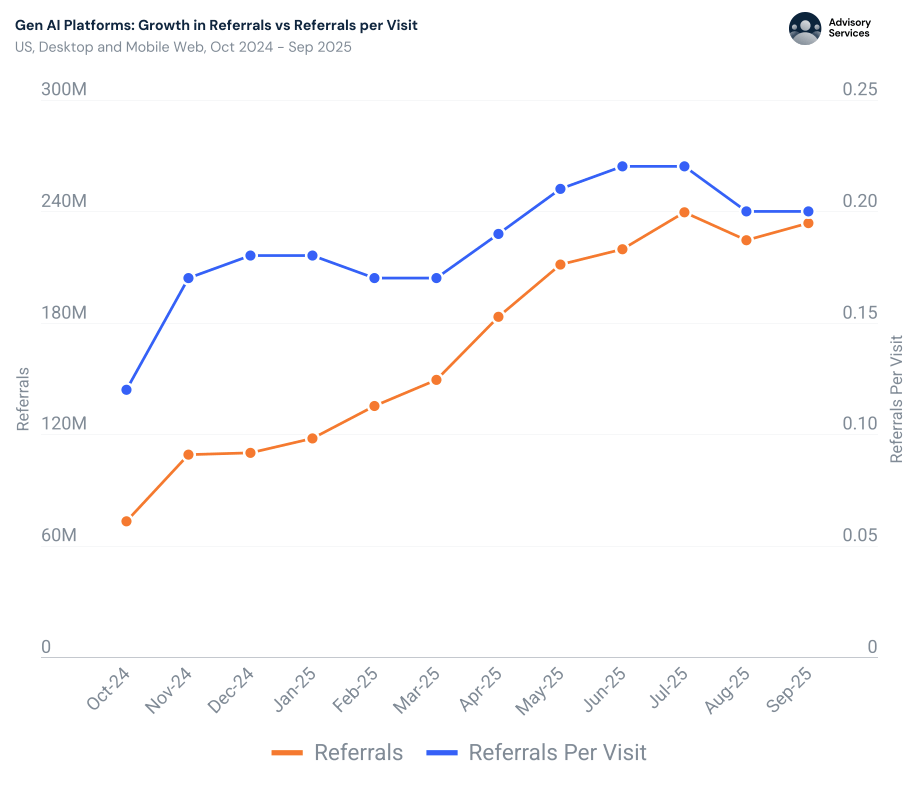
The 2025 Generative AI Landscape caught referral traffic mid-rise. Between October 2024 and September 2025, monthly referrals from generative AI platforms climbed from roughly 60 million to around 240 million, a steep ascent by any measure. But the same chart revealed a warning sign running in the opposite direction: the referrals-per-visit line was declining even as total volume grew. Users were visiting AI platforms more often but clicking out less frequently each time they did. By late 2025, the volume line had stopped climbing. The report called it plainly, Gen AI clicks may be a difficult commodity to secure moving forward, but the data only covered 12 months and the plateau was still fresh.
The 2026 AI Brand Visibility Index told the rest of the story. Where the 2025 report tracked referral volume and referrals per visit on the same chart, the 2026 report separated the picture into two distinct metrics: AI visits as orange bars growing steadily toward 1.5 billion monthly, and AI referrals as a blue line sitting flat between 240 and 280 million from mid-2025 all the way through January 2026. The visits kept climbing. The referrals did not move. The divergence that looked like a slowdown in the first report was confirmed as a permanent structural decoupling in the second.
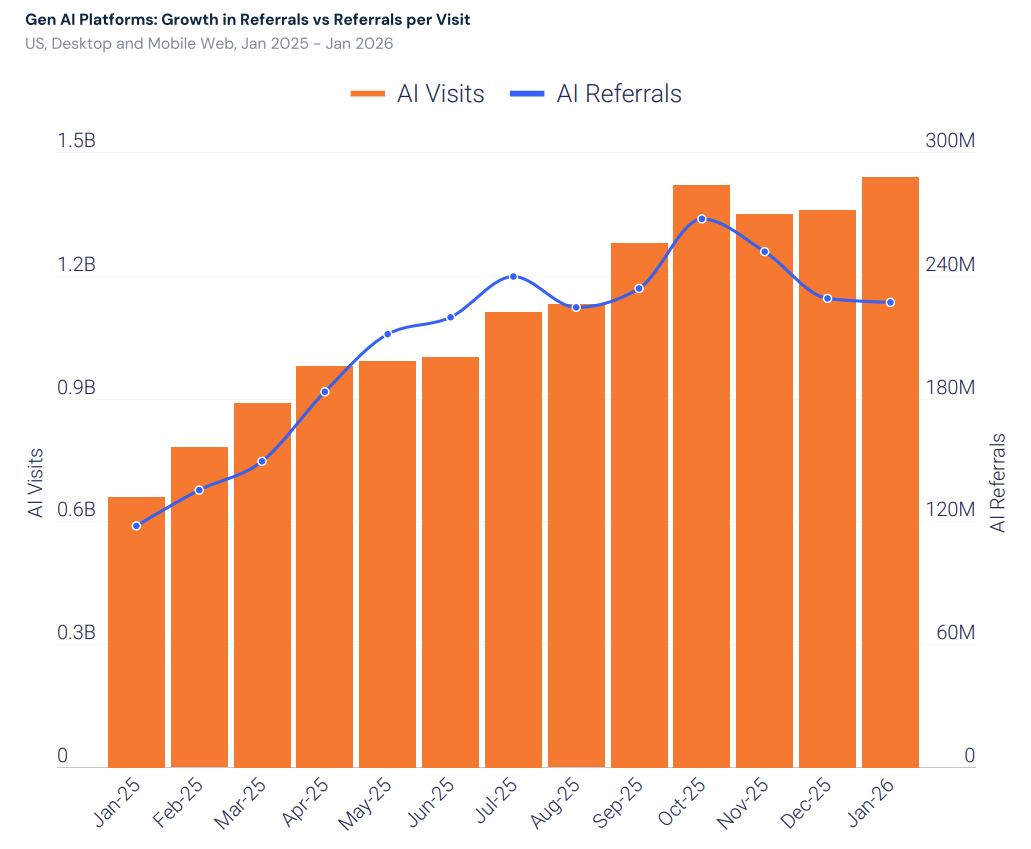
The explanation the 2026 report gave: AI chatbots had evolved into all-in-one solutions where users complete research, comparison, and decision-making entirely inside the conversation. The click out was no longer necessary. This is the same dynamic driving zero-click behavior across Google Search, users getting complete answers without leaving the platform. As Similarweb & Rand Fishkin’s zero-click marketing research shows, 68% of Google searches now end without a click, a trend accelerating alongside AI search adoption.
What the 2025 Generative AI Landscape caught as an early warning, the 2026 AI Brand Visibility Index confirmed as a new baseline, and the measurement implication is direct. Brands tracking AI’s commercial impact through referral dashboards are measuring a metric that stopped reflecting reality by mid-2025. The channel behaves like brand awareness that converts later through search and direct, which is exactly what the Downstream Impact of AI Visibility then went on to prove.
This trend spans all three reports and is the clearest example of how the understanding of AI’s commercial impact matured from one publication to the next.
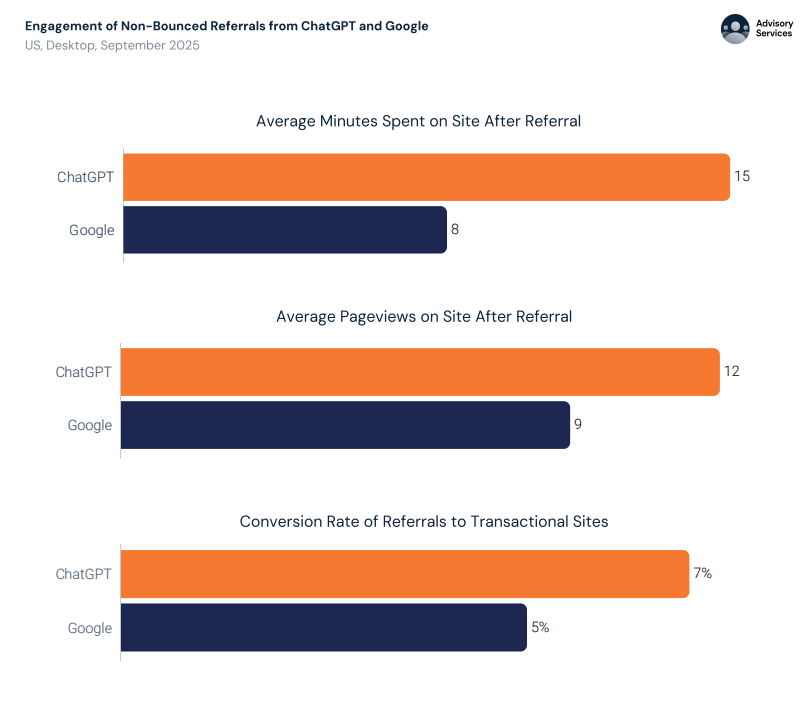
The 2025 Generative AI Landscape could only infer AI’s role in purchase decisions from engagement signals. When users did click through from ChatGPT, they spent 15 minutes on site versus 8 from Google, viewed 12 pages versus 9, and converted at 7% versus 5% on transactional sites. The implication was clear, users arriving from AI had already done more of their decision-making inside the conversation before clicking. But the report could not directly measure where in the purchase journey AI was influencing that decision. It showed the quality of the traffic that came out the other end. It could not show what happened inside the funnel before the click.
The 2026 AI Brand Visibility Index filled that gap with a direct consumer survey. It asked US consumers in January 2026 at which stages of the purchase journey they found AI tools versus search engines most useful. The orange bars for AI stay consistently tall across every funnel stage, while search stays low, until the very last step, finding where to buy, where the two nearly converge. AI does not just own the top of the funnel. It leads at every stage until the moment of the transaction.
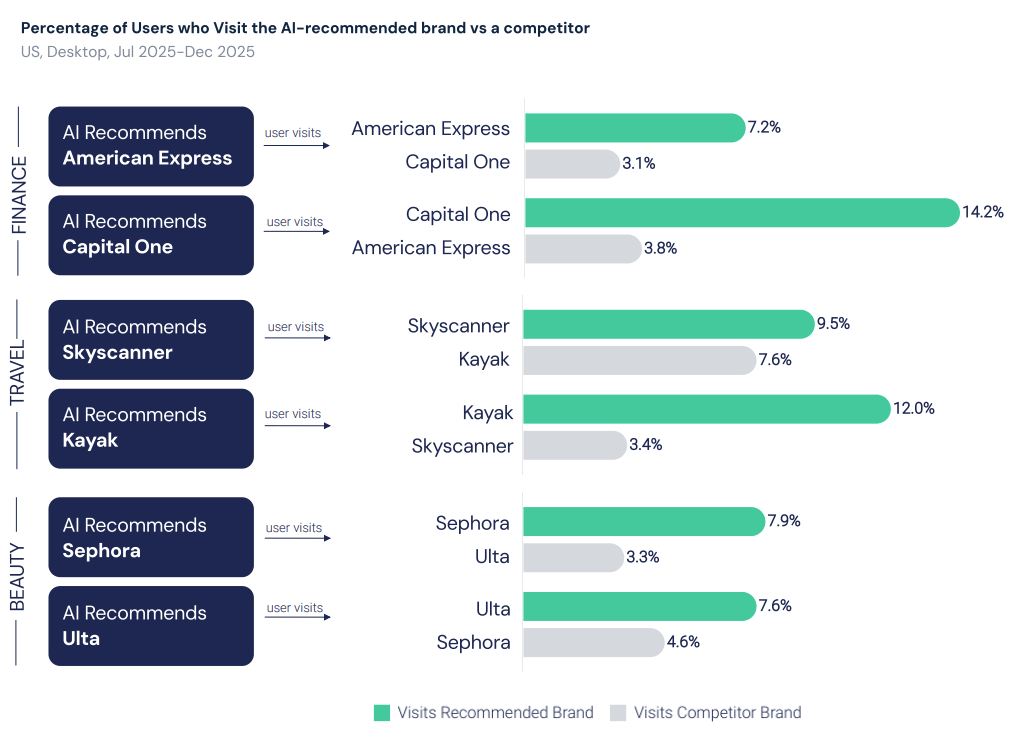
The 2026 Downstream Impact of AI Visibility replaced survey responses with behavioral proof. It tracked real user journeys: people who asked ChatGPT a category question, received a specific brand recommendation, did not click, and ended the session. Then it followed those users for seven days. What it found was that the AI recommendation had already done its work silently. Whoever the AI recommended received the visit. Whoever it did not, did not, consistently, across every brand pair and every category studied.
The progression across the three reports shows the same commercial reality coming into focus one layer at a time. The 2025 Generative AI Landscape saw the quality of traffic coming out of AI conversations and inferred that something significant was happening inside them. The 2026 AI Brand Visibility Index asked consumers directly and confirmed that AI dominates every stage of the purchase journey except the final transaction step. The 2026 Downstream Impact tracked the actual journeys and proved it, the intent created in an AI conversation drives real downstream site visits days later, at rates that make AI visibility a measurable acquisition channel, not a soft brand metric.
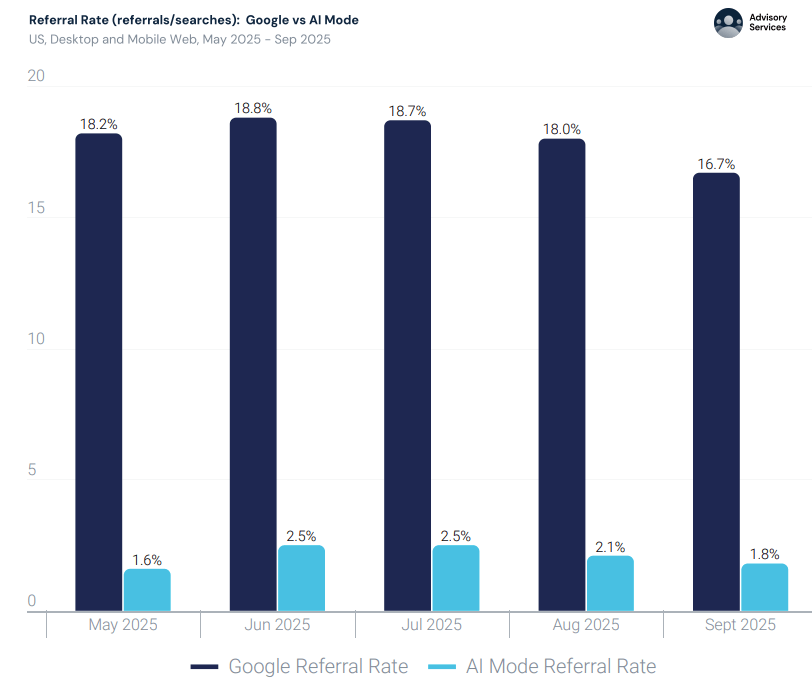
The 2025 Generative AI Landscape identified a measurement problem clearly. The chart shows it visually: Google’s referral rate held steady at around 17–19% throughout mid-2025, while AI Mode’s referral rate sat between 1.6% and 2.5%, a gap of roughly ten to one. For every click Google sends out, AI Mode sends a fraction. The report explained why: AI platforms are designed to synthesize and answer within the conversation, not to direct users outward. But the implication runs deeper than a low click rate. As AI platform visits kept growing while the referral rate stayed flat, the gap between AI’s actual influence on users and what referral analytics could capture was widening with every passing month. The report could name the problem. It could not yet measure how large it actually was.
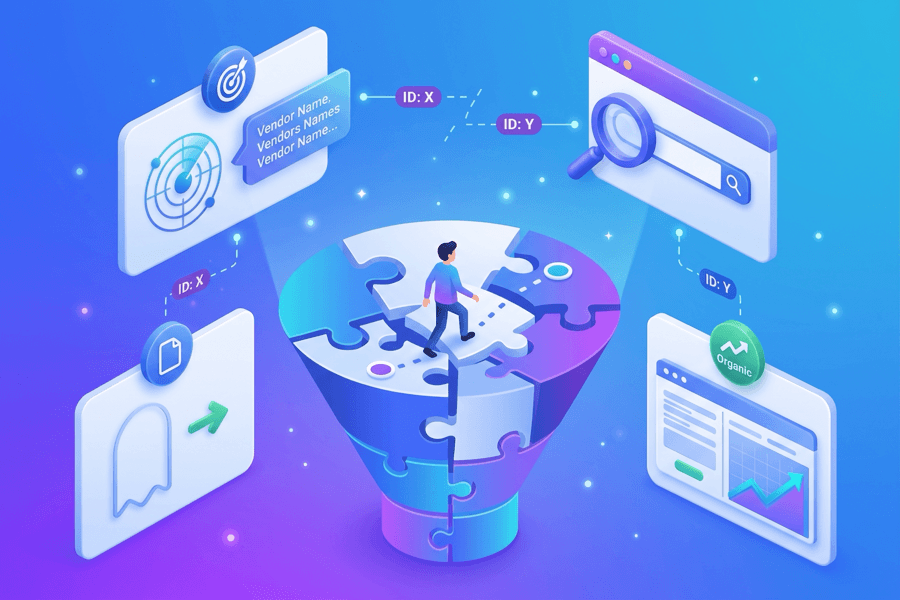
The 2026 Downstream Impact of AI Visibility provided that measurement. It tracked users who asked ChatGPT a category question, something like where to book flights or which credit card to choose, and received a specific brand mentioned in the answer. The user did not click anything. The session ended. Similarweb then followed those same users for seven days to see what they did next. Most of them visited the brand’s website, but when they did, they came through Google search, not through an AI referral link. The brand’s analytics recorded a search visit. Nobody connected it back to the ChatGPT conversation that put that brand in the user’s mind in the first place.
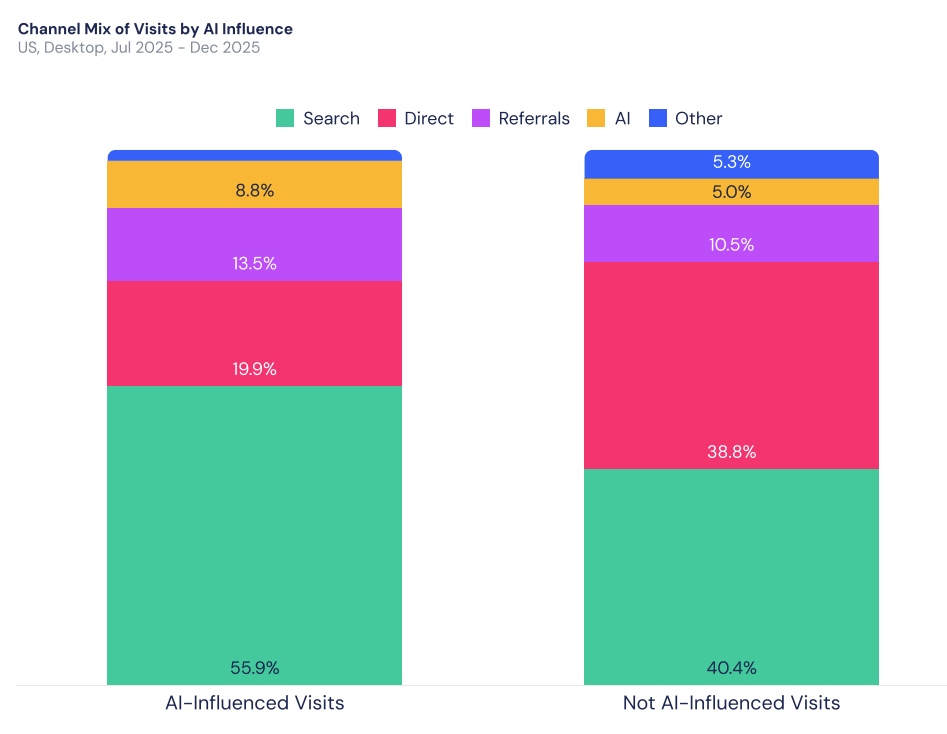
The shift between the two reports: the 2025 Generative AI Landscape identified that AI’s referral rate was structurally too low to capture its real commercial impact. The 2026 Downstream Impact found where that impact was hiding, in search and direct traffic, misattributed to other channels. Your analytics were never missing the traffic. They were just giving Google the credit.
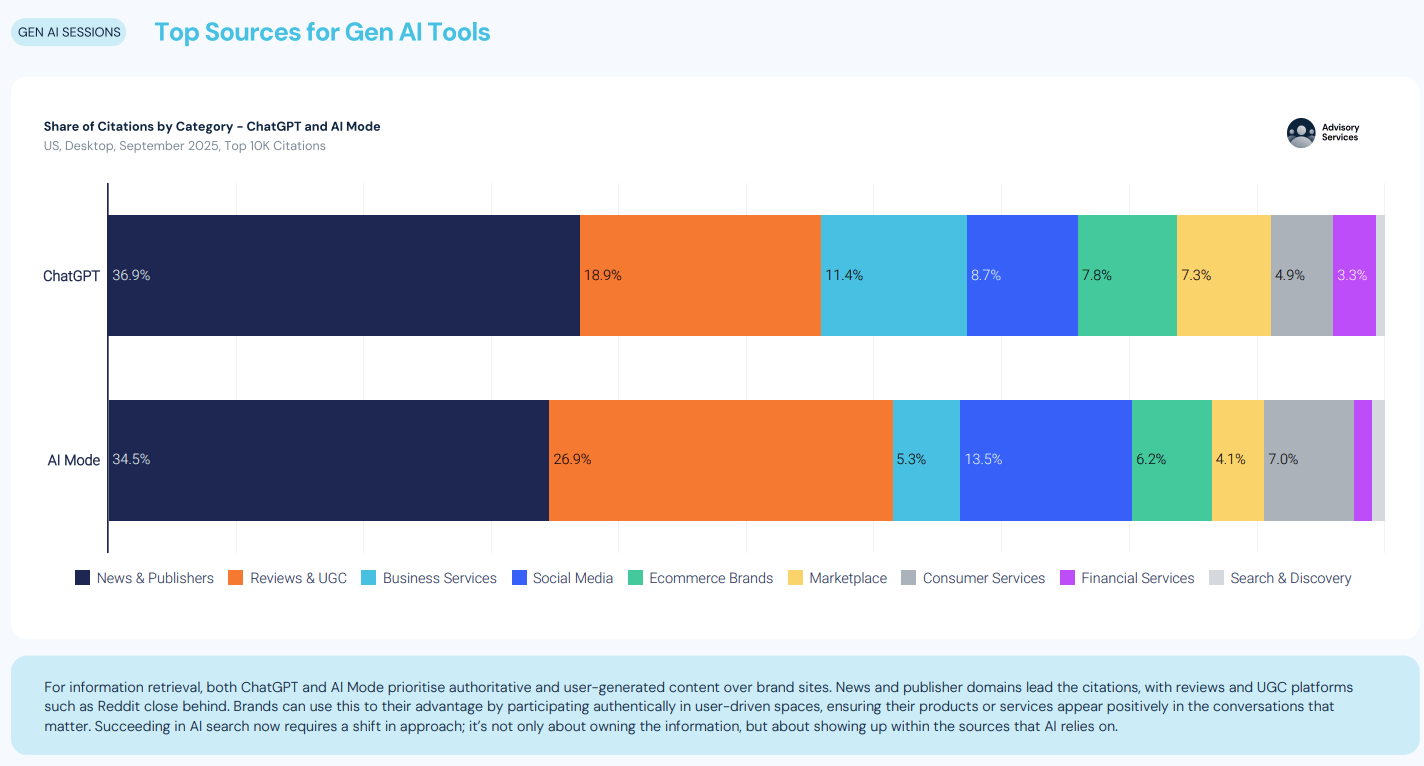
The 2025 Generative AI Landscape established where AI systems get their information. The chart shows two horizontal bars, one for ChatGPT, one for AI Mode, broken into source categories. The dark segment on the left, News and Publishers, dominates both bars. The orange segment, Reviews and UGC platforms like Reddit, comes second. Business Services, brand-owned pages, is a thin slice toward the right of both bars. The message is visual before it is statistical: AI systems cite independent, authoritative, user-generated content far more than anything a brand publishes on its own domain. The report’s conclusion was direct, winning AI visibility requires presence across the sources AI trusts, not just on your own website.
The 2026 AI Brand Visibility Index moved the question forward. Knowing which source categories AI trusts is useful. Knowing which specific brands are winning inside those categories, and why, is actionable. The Consumer Electronics scatter plot makes the pattern concrete. Brands like Adorama, Swappa, Crutchfield, iFixit, Soundcore, and Backmarket all sit in the over-represented quadrant: their AI visibility rank is higher than their brand demand rank would predict. These are not the biggest consumer electronics brands. They are specialist retailers, repair platforms, and comparison-focused sites, exactly the kind of structured, question-answering content the 2025 report said AI systems prefer to cite.
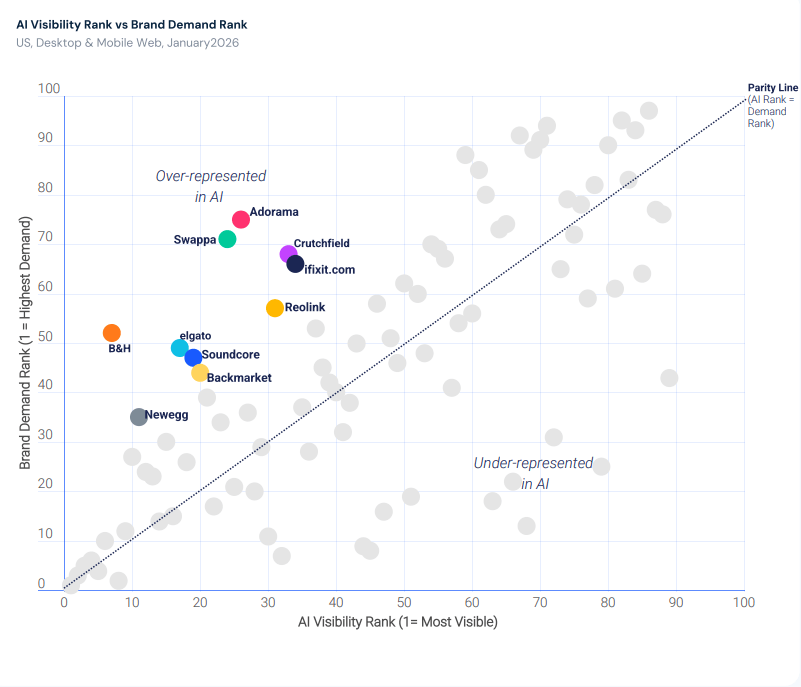
The 2025 Generative AI Landscape told brands where to show up. The 2026 AI Brand Visibility Index showed that the brands who figured this out first were not the category giants, they were the specialists, the repair sites, the comparison tools. In AI search, being the best answer to a specific question turned out to matter more than being the biggest brand in the room.
The four changes across the three reports describe a single coherent shift in how AI search works as a commercial channel, and how the understanding of it matured across 18 months of data.
Referral traffic climbed fast then flatlined, while AI platform visits kept growing, the two lines decoupled and never reconnected. AI’s role in purchase decisions went from inferred through traffic quality, to confirmed by consumer survey, to proven by real user journeys. The attribution gap went from a named problem to a measured one, most AI-driven visits arrive through search and direct, misattributed to other channels while the AI conversation that created them goes unrecorded. And the brands winning AI visibility turned out to be the specialists, the repair sites, the comparison tools, not the category giants anyone would have predicted.
The signal was never going to show up where everyone was looking for it. Similarweb AI Search Intelligence is where you start looking in the right place.
Across Similarweb’s three reports, four changes stand out. Referral traffic climbed fast then flatlined while AI platform visits kept growing. AI’s role in purchase decisions went from inferred, to surveyed, to proven by real user journeys. Most AI-driven visits arrive through search and direct, standard analytics misattributes them and never connects them back to the AI conversation that started it. And the brands winning AI visibility turned out to be specialists and comparison tools, not category giants.
The 2026 AI Brand Visibility Index extended the referral chart from the 2025 Generative AI Landscape through January 2026 and confirmed a structural decoupling: AI visits continued climbing toward 1.5 billion monthly while referrals held flat. The cause is that AI platforms evolved into all-in-one answer environments where users complete research, comparison, and decision-making without clicking out, the AI equivalent of zero-click search, but more complete. The more capable AI platforms became at answering questions, the less users needed to leave.
The 2026 Downstream Impact of AI Visibility tracked users who received a brand mention in a ChatGPT response and followed them for seven days. Most of them visited the brand’s website, but they arrived through Google search, not through an AI referral link. Standard analytics recorded a search visit and credited Google. The ChatGPT conversation that put that brand in the user’s mind never appeared in the data. The traffic was never missing. It was being misattributed to other channels all along.
The 2026 AI Brand Visibility Index found that AI visibility rank and branded search demand rank diverge consistently across every sector studied. The brands winning AI visibility are not the biggest brands in their categories, they are specialist retailers, repair platforms, planning utilities, and comparison-focused sites whose content answers specific questions at depth. In Consumer Electronics, brands like iFixit, Adorama, and Crutchfield outrank mass-market giants. In Travel, route-planning tools outperform major airlines. In Finance, research platforms outrank major banks. Being the best answer to a specific question matters more than being the biggest brand in the room.
The 2026 Downstream Impact study tracked real user journeys across Finance, Travel, and Beauty from July through December 2025. Users who had a brand mentioned in a ChatGPT response were significantly more likely to visit that brand’s website within seven days than users who received a competitor mention instead. The effect held consistently across every brand pair and every category, whoever the AI mentioned received the visit, whoever it did not, did not.
Standard referral analytics capture only a small fraction of AI-driven traffic according to the Downstream Impact report. Effective measurement requires tracking brand visibility share as a percentage of relevant AI responses benchmarked against direct competitors, monitoring branded search volume as a downstream indicator of AI influence, and auditing which third-party platforms, news sites, review platforms, UGC spaces, are driving your AI citation share. Because AI visibility is zero-sum, relative competitive share matters more than your absolute score in isolation.
Senior SEO Specialist at Similarweb
Maayan is a senior SEO specialist with 7+ years of experience in SEO. She loves complex research projects, creating SEO strategies and performing technical audits.
Give it a try or talk to our insights team — don’t worry, it’s free!