



Gen AI Glossary: The Must-Know AI Search Terms
by Maayan Zohar Basteker18 Min.
Sep 24, 2026

Type “best CRM for a small sales team” into ChatGPT, and it answers with three cited sources. Your own blog post on the topic ranks second on Google. It isn’t one of the three.
That gap is RAG at work. RAG, or retrieval-augmented generation, is the step that decides which pages an AI engine reads before it writes an answer, and which of those it actually names as a source. That’s what RAG in AI means in practice, and it runs on different rules than classic search ranking, rules most marketers have never seen explained in plain terms.
By the end of this article, you’ll know what RAG is, how it works stage by stage, how it differs from fine-tuning a model, and what to change in your own content so you have a real shot at being the source it cites.
RAG, or retrieval-augmented generation, is the architecture where an AI model searches an external index for relevant passages before writing its answer, instead of relying only on what it memorized during training. It’s why ChatGPT and Google AI Overviews can cite a live source instead of relying solely on a snapshot of the internet baked into the model’s parameters.
Standalone language models have a limit. They only know what was in their training data, and that data has a cutoff date. Ask one about something that happened last week, or about your company’s internal pricing page, and before it had access to external sources or web search, it hallucinated something, inventing an answer that sounded right and wasn’t.
RAG was built to fix both problems at once. Instead of answering purely from memory, the model first retrieves current, relevant text from an index, an internal document store, or the live web, and then generates its answer grounded in what it just found. The name describes the two-step process exactly: retrieval, then generation.
The technique comes from a 2020 paper by Lewis et al. at Facebook AI Research, who showed that a model retrieving external passages before answering produced more specific, more factual outputs than one working from parameters alone. Every major AI search product built since has used some version of that same two-step design.
RAG runs in five stages between the moment you ask a question and the moment an AI names a source: query processing, retrieval, chunking and ranking, generation, and citation. This is the RAG pipeline. Understanding each stage tells you exactly where your content can win, or get filtered out.
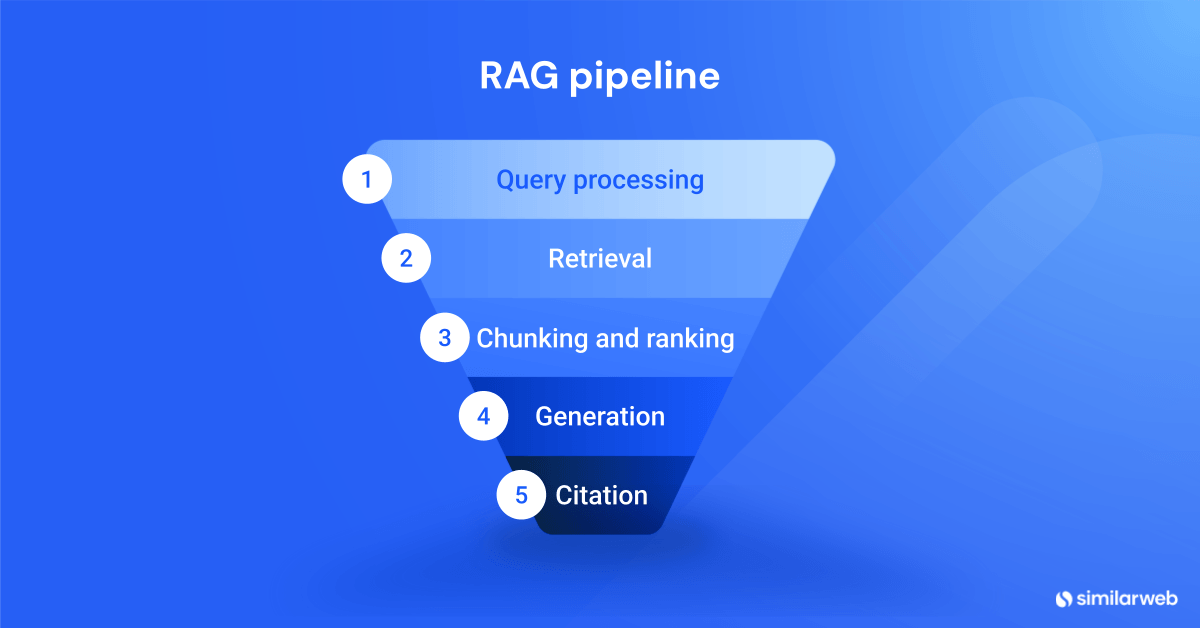
2. Retrieval. Each sub-query hits an index of web pages, documents, or a database, and pulls back a set of candidate passages that look topically relevant. That index isn’t static, so the same question can return a different set of passages depending on when you ask and what’s changed since. That’s one reason AI chatbots like ChatGPT don’t give everyone the same answer, on top of the randomness built into how the model generates text.
3. Chunking and ranking. Those candidates get split into smaller, passage-sized pieces, scored for how closely they match the query’s meaning, and reranked. This is the step most marketers don’t know exists, and it’s the one your content competes inside.
4. Generation. The model writes its answer using the surviving chunks as source material, not its training memory.
5. Citation. The model attributes specific claims back to the chunks it actually used. Those attributions are what shows up as a link or a named source in the answer, what’s generally known as an AI citation.
Each stage is a filter, and the funnel narrows fast. This same five-stage shape runs behind every major LLM RAG implementation, from ChatGPT search to Google AI Mode, even though the specific index and ranking model behind each one differs. In one large-scale analysis of 548,534 pages ChatGPT retrieved across 15,000 prompts, only about 15% of retrieved pages ever appeared as a citation in the final answer. The other 85% were read, evaluated, and never mentioned to the user.
What decides which 15% make it through? Content structure matters more than most marketers assume. Princeton and IIT Delhi researchers tested nine content changes across 10,000 queries and found that the best-performing changes, like adding citations and statistics, improved a passage’s citation-worthiness by up to 41%, while keyword stuffing performed below baseline. Retrieval rewards precision and evidence, not repetition.
Here’s the pipeline in action, using a realistic scenario.
A content lead asks Google’s AI Mode: “what’s the best way to track how often my brand shows up in ChatGPT answers.” Behind the scenes, the query fans out into related sub-questions: what AI visibility tracking is, which tools measure it, how citation frequency is calculated, and what a good benchmark looks like.
Retrieval pulls back dozens of candidate pages that mention AI visibility, brand tracking, or citation monitoring. Most are vague. A handful open with a direct, checkable claim, something like a specific percentage, a dated data point, or a named methodology, instead of a general statement about “the importance of AI visibility.” Those are the passages that survive the ranking step, because they give the model something concrete to attribute a claim to.
The model generates its answer from that surviving set and cites two or three of them by name. The pages that only described the topic in general terms, however well written, don’t make the cut. They were retrieved, read, and discarded, invisible to the person who asked the question.
This is the mechanic worth internalizing: retrieval only narrows down the topically relevant candidates, but chunk-level structure decides who’s actually named. The passages that win are usually the ones adding something the other retrieved sources don’t already say, the same information gain logic that governs synthesis once generation starts.
RAG and fine-tuning solve the same core problem, an AI model that doesn’t know something, in two different ways. RAG adds external information at the moment of answering. Fine-tuning changes the model’s own parameters ahead of time by retraining it on new examples.
For marketers, this is really about who controls what the model knows, and how fast that knowledge can change.
| Dimension | RAG | Fine-tuning |
|---|---|---|
| How it works | Retrieves external passages at answer time | Retrains the model’s own parameters in advance |
| Update speed | Content updates take effect as soon as they’re indexed | Requires a new training run to reflect changes |
| Cost | Low, mainly indexing and retrieval infrastructure | High, requires compute and labeled training data |
| Who controls the knowledge | Whoever controls the retrieved source (often you, if your content is indexed) | Whoever trained the model |
| Best for | Current events, brand-specific facts, anything that changes often | Teaching a model a new skill, tone, or reasoning pattern |
| Marketer’s lever | Structure and index your content so it’s retrievable | Largely outside a marketer’s control |
The two aren’t mutually exclusive. A production AI system can be fine-tuned to follow a certain format or reasoning style, and still use RAG to pull in whatever changed since its last training run. For marketers, the practical takeaway is simpler: fine-tuning isn’t a lever you can pull, but RAG is. Your content’s structure, freshness, and indexability directly affect whether it gets retrieved.
RAG reduces two specific problems, staleness and some hallucination, but it doesn’t guarantee your content gets retrieved, ranked, or cited. What actually improves your odds is structuring content the way the pipeline reads it: chunk by chunk, not page by page.
What RAG fixes, and what it doesn’t. Grounding an answer in retrieved text cuts down on the model making up facts from thin air, because it now has something concrete to reference. It doesn’t eliminate hallucination entirely; a model can still misread or misattribute a passage it retrieved. And it doesn’t fix a deeper problem: if your content was never indexed or never survives the ranking step, RAG has nothing of yours to retrieve in the first place. That’s the real cost of losing at retrieval: not a lost visit, but total invisibility for that query, since the answer got assembled and delivered without you in it.
What to actually change. Four things follow directly from how the pipeline works. Write each section so it stands alone, with a direct answer in the first sentence or two, because retrieval pulls passages, not pages, the same principle behind content chunking for AI search. A short, specific TL;DR near the top of longer pieces works the same way, giving retrieval a clean, self-contained passage to pull from before a reader even scrolls. Lead with checkable facts, numbers, dates, named sources, because vague passages give the model nothing to attribute a claim to, which is also why publishing original data works so well: a competitor saying the same generic thing gives the model nothing to prefer, but a number only you have forces it back to your page every time the topic comes up. And keep content current, because a system retrieving from a live or recently refreshed index has no reason to prefer a stale page over a newer one that says the same thing more precisely.
One thing worth understanding here: many RAG systems match your content to a query using a vector database, a store that indexes passages by meaning rather than by exact keyword. That’s part of why retrieval finds relevant content even when it doesn’t share your exact wording, and part of why keyword stuffing does nothing to help you get pulled into that index.
Measuring whether any of this is working is the last piece. Similarweb’s AI Citation Analysis tool tracks this directly: it shows which domains and specific URLs get cited for a given topic across ChatGPT, Gemini, Perplexity, and AI Mode, each with an Influence Score that reflects how much weight that source actually carries in the generated answers.
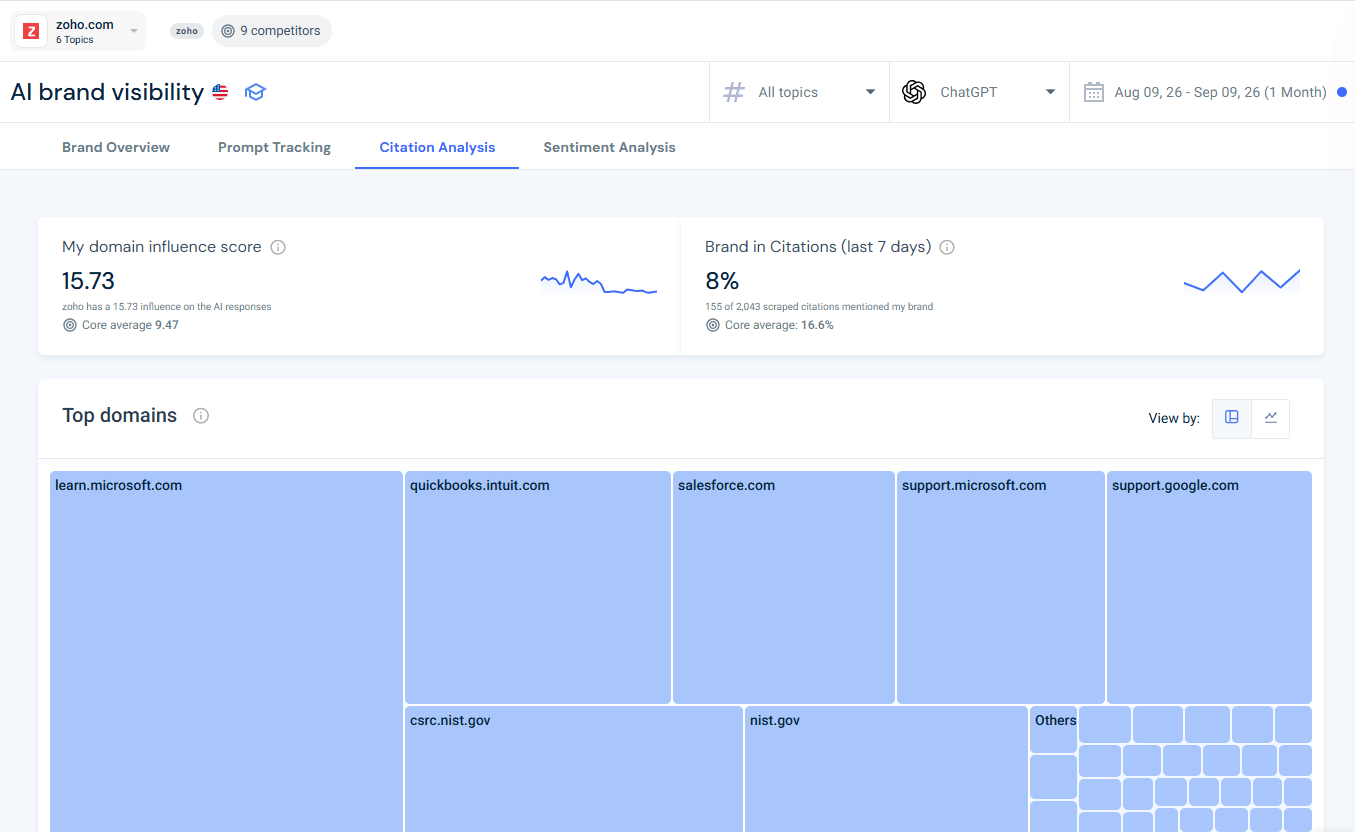
Most of what used to earn a click now gets answered without one. Of the pages ChatGPT retrieves to build an answer, 85% never get mentioned at all, read, evaluated, and discarded before a person ever sees them. Most marketers have never looked directly at the retrieval step where that decision actually gets made.
RAG is that step. It’s the reason a page can rank well on Google and still never get named by ChatGPT, and the reason a smaller, more precisely structured page sometimes wins over a longer or more optimized one. If you remember one thing from this explanation of what RAG is, make it this: understanding the five stages, query, retrieve, rank, generate, cite, turns AI visibility from a guessing game into something you can actually structure content for and measure. Similarweb’s AI Intelligence tools are built to show you exactly where in that pipeline your own content is winning or losing.
Yes, “RAG” already meant other things long before this, including red-amber-green status reports in project management. Patrick Lewis, the 2020 paper’s lead author, has said the team never found a better name and regrets how it turned out. If you see “RAG” in a business context and the meaning seems off, check whether the writer means retrieval-augmented generation or something else entirely.
No. Indexability and crawlability still come first, a page a search engine can’t access or render can’t be retrieved by anything. RAG adds a layer on top of that foundation: once your content is technically accessible, chunk-level structure and specificity decide whether it’s the passage that gets pulled and cited.
Smaller sites have a real shot, because citation and domain authority don’t move together the way they do in classic rankings. One analysis of the 1,000 URLs ChatGPT cited most often found that 25% had zero visibility in Google’s organic results, and among the top three most-cited URLs specifically, that figure rose to 50%. Structure and specificity can outweigh raw authority at the retrieval stage.
Google uses the same retrieve-then-generate pattern inside AI Overviews and AI Mode, pulling from its own search index rather than a separate one. So the content habits that help with ChatGPT or Gemini citations, direct answers, specific facts, clean structure, help inside Google’s own AI features too, not just third-party chat tools.
Track it directly rather than guessing, and do it on a recurring cadence since the set of cited sources changes from one month to the next. Similarweb’s AI Citation Analysis shows which sources a given topic cites most often, so you can see what’s actually earning citations right now rather than auditing once and assuming the picture holds.
Senior SEO Specialist
Shai, with 10+ years in SEO, holds a Bachelor’s and an MBA. He enjoys TV shows, anime, movies, music, and cooking.
Gen AI Glossary: The Must-Know AI Search Terms

Marketing Funnel Fragmentation: Why AI Broke Attribution
The Best AI Citation Analysis Tools in 2026
Give it a try or talk to our insights team — don’t worry, it’s free!