What is RAG (Retrieval-Augmented Generation)? A Marketer's Guide
by Shai Belinsky9 Min.
Oct 01, 2026

New AI search terminology shows up faster than most teams can track it. One quarter it’s Generative Engine Optimization, the next it’s Agentic Search, and by the time your team agrees on what GEO means, three more terms have entered the conversation.
This glossary covers what you actually need: foundational concepts like Large Language Models and RAG that explain how AI systems process information, alongside newer practitioner vocabulary like Agentic Search, LLMO, and Prompt Tracking. Some of these describe genuinely new mechanics; others are old ideas with a new label, and we’ll tell you which is which.
Let’s get into it.
Autonomous AIs (agents) can make purchases on behalf of customers. This is anticipated to be a major change to shopping, possibly the biggest since the advent of the internet. For example, a customer might ask an AI, “Can you help me find a great housewarming gift for my friend?” and the AI agent then handles finding options, comparing alternatives, researching, deciding, checking out, and purchasing on its own.
👉 It’s like having a personal shopper who doesn’t roll their eyes when you ask if it’s ok to buy your mom another scented candle for her birthday.
A search behavior where an AI agent independently plans, executes, and synthesizes multiple research steps on a user’s behalf, rather than the user issuing a single query and reading the results themselves. It’s the research-and-decision cousin of Agentic Commerce, and it’s what makes Query Fan Out possible at scale.
Example: Instead of Googling “best CRM for a 10-person startup,” searching three review sites, and comparing pricing pages themselves, a user asks an AI agent to do it, the agent runs the searches, filters, and returns a ranked shortlist with reasoning.
👉 It’s less “here are some links” and more “I did the homework, here’s my answer, and yes I checked your budget too.”
Read more: What is agentic search
An autonomous system built on AI that can perform complex, multi-step tasks. They can work independently, often coordinating with other agents and utilizing memory and tools. They go beyond the simple input-output responses in answer engines. These agents are designed to automate repetitive tasks and can execute entire SEO workflows.
A good example is Similarweb Sales Intelligence’s AI Prospecting and AI Outreach Agents. The latter two build targeted lead lists and create personalized outreach messages, demonstrating practical applications of AI agents in sales. Another is our SEO Strategy Agent, which provides assistance, like competitive analysis and high-impact opportunities.
👉 It’s like having an SEO intern who works at lightning speed, doesn’t take vape breaks, and never asks if it’s okay to bring their dog in on Fridays.
A modern search paradigm focuses on directly answering a user’s question with a synthesized response, rather than simply presenting a list of links (the traditional “answer engine”) for the user to conduct their own research. Perplexity AI or ChatGPT are prominent examples of an AI answer engine. These systems often use LLMs to perform the synthesis.
👉 In other words, you ask the internet your question and get a one-page cheat sheet, no tab-opening, link clicking, or scavenger hunt required.
An optimization strategy focusing on making content easy to cite or include in the AI-generated answers, summaries, or conversational responses provided by various AI search engines and platforms. AEO focuses on content clarity, conversational language, semantic understanding, and using structured formats like tables and bullet points. Similarweb Web Intelligence’s Citation Analysis report helps identify domains and URLs that have the most significant influence on AI answers, providing valuable insights for AEO strategies.
How is AEO different to GEO? GEO is an umbrella term for optimizing content for AI-driven search engines. While AEO focuses specifically on the challenges of optimizing for answer engines (see above), like ChatGPT.
👉 Think of it as slipping your best one-liner into the AI’s wedding party speech; it quotes you, applause follows, and you get to throw your moves.
Fundamentally, this is a tool powered by a large language model (LLM) that is designed to answer a user’s prompt or question in a human way. In the context of product expertise, the underlying LLM can be trained or fine-tuned to acquire highly specific knowledge, moving beyond the general (and often outdated) information available in its initial knowledge base.
Example: The most dominant example of an AI Chatbot is ChatGPT. Other common examples include Google’s Gemini and Perplexity AI, as well as the regular helper bots like Amazon Rufus.
👉 In other words, using an AI Chatbot is like having instant access to a brain that’s read the entire internet and remembers all the interesting parts.
Structuring content into distinct, meaningful segments that are easy for AI search engines to digest and extract often involves clear headings, bullet points, or tables to isolate specific facts or answers. This technique helps AIs find the precise answer they need within a larger body of text, which matters because AI search is “lazy” and favors content architectures designed for citation.
Example: Instead of a long paragraph describing average rent prices, a page uses headings like “Average Rent in Paris (Q1 2025)” followed by a clean table of median rent prices, separated by apartment size (Studio, 1 Bedroom, 2 Bedrooms).
👉 It’s like leaving post‑its around the page for a robot that refuses to read anything longer than a headline.
Read more: Content Chunking: Is Your Content Built For AI Search?
A reference or link provided by an AI search engine or Large Language Model (LLM) response, indicating the source from which the information was drawn. In AI search, citations have replaced traditional backlinks as a key metric for measuring authority and influence, as AI places a significantly higher value on third-party citations than on a brand’s own content.
Web Intelligence’s AI Citation Analysis tool reveals domains and URLs with the most significant influence on AI answers
👉 The equivalent of getting name-dropped by the smartest person in the room. You get instant authority, more trust, and fewer awkward explanations.
The goal of a human searcher who knows what products or services they want and is seeking more detailed information to compare options before making a final decision.
Content optimized for this intent often includes comparison guides, reviews, ratings, and features. Example: a user asking an AI to “Compare the best 12v rice cookers” demonstrates a commercial search intent.
👉 It’s the searcher with their wallet out. No browsing, just a quick, convincing sales pitch so they can click “buy” and get on with life.
Material, such as text, images, or videos, created using Artificial Intelligence tools, particularly Gen AI. While AI content generation can save significant time and enable scale, the influx of low-quality, “slop” AI content lacking originality, expertise, or authentic human experience has become a widespread challenge in search results.
A small marketing team uses a budget-friendly LLM to produce 5,000 product descriptions daily for new inventory. However, because the input data was low-quality (“garbage in, garbage out”), the resulting content is generic and risks being flagged by search engines.
👉 Don’t expect a gourmet meal if you’ve given the chef a can of beans.
A mathematical calculation used to measure the similarity between two vector embeddings (see below). Example: To map pages related to “back pain,” an SEO analyst converts the metadata of all URLs into vector embeddings.
By calculating the cosine similarity, they discover that an article on “stretching exercises” and a product page for a “lumbar support cushion” have a high score, indicating they are semantically related and should be linked together.
👉 Imagine a dating app for copy. It pairs words and phrases that “get” each other, even if they don’t use the same chat-up lines.
Specialized AI models built on top of foundational Large Language Models (LLMs), which are fed first-party data (known as a “knowledge base”) and given specific instructions or a “persona” (e.g., “kitchen furniture expert”) for tailored outputs. They are crucial for avoiding hallucinations and ensuring brand-compliant content because they do not rely solely on the LLM’s general training data.
👉 Like buying a bespoke jacket that actually fits. Plus, you won’t have to return it because it is sprouting a third sleeve.
The distribution and sharing of content that traditional analytics can’t easily track. Typically occurring through private channels such as direct messages, email, or secure chat groups like Slack. Measuring the Dark Funnel is important because these shares often represent authentic endorsements and can help marketers connect visibility to real impact, such as an increase in branded searches.
👉 It’s like passing notes in class: you see the answer appear, just not who first slid it across.
A distinct and well-defined concept in the real world, such as a person, place, thing, or idea, which is a key focus of semantic keyword research, contrasting with traditional keyword research that focused only on phrases or words. Entities have attributes (characteristics) and variables (specific values for those attributes), and search engines and AI use entity recognition to understand and expand queries.
Example: In the query “[Shop online Nike Jordan Air Force One],” “Nike” is the Organization entity, and “Air Force One” is the Product entity.
👉 Imagine it as the AI’s Rolodex entry.
The overall category of Artificial Intelligence models, often built on Large Language Models (LLMs), is capable of producing new content, including text, images, video, or code, rather than merely analyzing existing data. It is driving a technological revolution across SEO, content marketing, and paid media, but its widespread use also introduces ethical concerns regarding data consumption and environmental impact.
Example: A developer uses a GenAI tool (like ChatGPT) to read complex API documentation and write a working Python script in minutes, a task that would have previously taken hours of manual coding.
👉 It’s the umbrella term for AIs that create stuff. Text, images, video, code, basically anything you used to hire a human for, but at less time than it takes to open Slack.
An umbrella term for the processes and strategies used to optimize content for visibility within Large Language Model (LLM) driven platforms and AI search results, prioritizing being cited in conversational answers rather than ranking solely in the traditional “10 blue links”. GEO shifts the marketing focus from driving traffic to websites to ensuring the brand’s information and content are authoritative enough for AI to reference.
Example: Instead of focusing on ranking #1 for a specific keyword, a GEO strategy concentrates on creating a “Best [Topic] Tools” list that is so comprehensive and fresh that AI models consistently cite it when answering user prompts about that topic.
👉 Like the TV clip everyone pauses and repeats at dinner, you get quoted, nobody watches the whole show.
A framework or set of policies established by a company or governing body (like the EU AI Act) to ensure the ethical, responsible, and safe use of AI. Policies typically cover which tools employees should or shouldn’t use, how customer data and intellectual property (IP) are handled, and the necessity of human oversight. It’s critical to define these protocols, including using “do not train” settings, as part of a move toward responsible scaling.
Example: A marketing agency develops a robust AI policy, stipulating that employees must not input client data into general LLMs due to intellectual property risks and must use “do not train” settings. Furthermore, all AI-generated campaign assets must undergo a human review to ensure factual accuracy and avoid potential legal liability.
👉 In other words, imagine a bouncer at the AI nightclub, making sure only the right data gets in and nobody ends up dancing on the legal liability table.
An output from a generative AI model that contains highly confident, yet factually incorrect, false, or fabricated information. Since basic LLMs are effectively “babies in suits”, they may make up numbers or cite non-existent sources, underscoring the need for claim checks and using Retrieval Augmented Generation (RAG).
👉 It’s when your AI sounds like it’s got a PhD… and then you realize it just invented the university.
The broad purpose of a query where the user is looking for general or high-level knowledge, typically including learning, guides, tutorials, definitions, and facts. Google’s AI Overview (AIO) targets this intent, with 88.1% of keywords triggering an AIO for informational queries.
Searches like “What is AI Search” or “How do I calculate ROAS” fall under the informational intent category.
👉 It’s not “take my money” mode, it’s “explain it to me like I’m five” mode.
Strategically including new, unique, or previously unavailable information helps a piece of content stand out from the existing corpus of content AI models have been trained on. Bringing this new information to the table is vital, as content that simply copies what is already known risks not being indexed.
Example: A clothing brand writes an article comparing different types of hiking boots. They include proprietary data from internal durability tests that no competitor has published. This novel data functions as Information Gain, making the content more likely to be prioritized by search engines and LLMs as an authoritative source.
👉 The secret sauce that tells search engines, “Hey, this one’s done its homework, not copied it.”
A type of AI-powered chatbot or platform, such as ChatGPT, Perplexity, or Gemini, that serves as an alternative to traditional search engines by generating conversational summaries and responses directly on the results page. LLMs act like “forgetful journalists,” fetching notes from various sources (websites, reviews, interviews) and filtering conflicting accounts to write a story in response to a user’s prompt.
Example: when asked “How can I consolidate credit card debt?”, an LLM provides a synthesized answer with multiple methods, rather than just a list of links.
👉 Think Wikipedia with opinions and a chat box.
The practice of deliberately placing accurate, well-structured brand and product information across the sources (forums, review sites, documentation, structured data) that LLMs draw on when training or retrieving, so the model has correct material to cite when it’s asked about you. It’s fundamentally a data-availability problem, not just a content-quality one.
Example: A B2B software company notices that ChatGPT consistently misdescribes its pricing tiers. Rather than rewriting its own website, it identifies and corrects the third-party comparison sites and community threads the model is actually pulling from.
👉 You can’t fix what the AI thinks about you by only talking to yourself, you have to fix what everyone else is saying too.
Read more: LLM Seeding is a Data Problem. Here’s How to Solve It.
A newly developed protocol, stored as a text file at the root directory of a website, is intended to guide Large Language Models (LLMs)on how to interpret the site’s content. It is similar in function to robots.txt or an XML sitemap, providing a digestible, structured (Markdown) map of the site’s key content to reduce computation cost and improve LLM visibility.
Example: A large organization implementing a new data structure uses LLMs.txt to clearly map out its knowledge base and key articles. This ensures that when an AI engine visits the site, it can quickly identify and ingest the most important, authoritative information without processing heavy JavaScript or large volumes of unstructured text.
👉 Basically, a polite “here’s the good stuff” note for AI engines.
A subfield of Artificial Intelligence that focuses on algorithms that allow computers to learn from data and improve over time without being explicitly programmed. ML has been integrated into Google’s ranking algorithm for years and is now used extensively in PPC for automated bidding and custom audience targeting.
Example: A PPC specialist uses machine learning systems within Google Ads to categorize search terms and automatically manage bid adjustments across thousands of campaigns, improving efficiency and saving hours of manual work.
👉 It’s the magic behind your ads, optimizing themselves while you pretend it was your strategy all along.
An open standard that lets an AI agent or client connect to external tools, data sources, and services in a consistent way, so the agent can retrieve live information or take action instead of relying only on what it already knows. MCP runs as a server that any compliant AI client can connect to, making it the connective layer behind a growing number of agentic workflows.
Example: A marketer connects Claude to Similarweb’s MCP server and asks it to pull keyword volume and competitor data directly into a research workflow, without manually exporting reports or switching tabs.
👉 It’s the plug standard that lets an AI actually reach into your toolbox, instead of just describing what a hammer is.
Read more: How I Automated GEO Keyword Research Using Claude and Similarweb MCP
A rapidly scaling search experience offered by Google, designed to generate a full page of synthetic content customized to the individual user’s context, background, skill level, and knowledge on the subject. This feature, which includes reasoning and clarifying questions, is Google’s response to the challenges posed by conversational AI search models.
Example: A beginner chef searches for “how to make hollandaise sauce” using Google’s AI Mode. Instead of traditional links, the AI generates a customized, step-by-step full-page guide that assumes minimal cooking knowledge and anticipates potential clarifying questions, based on the user’s interaction history.
👉 In other words, a search engine that knows you still confuse “ctrl” with “alt,” patiently guides you without the usual “Did you mean…?” nod.
A system where all content types (text, images, video, audio, etc.) are embedded into a shared vector space, allowing AI to process and understand information regardless of its format. In this environment, AI systems use techniques like Optical Character Recognition (OCR) to extract text from visuals and decompose video into searchable data streams (faces, objects, tone, sentiment, transcribed speech).
Example: An ecommerce brand optimizes the alt text and product descriptions for their high-resolution images, using detailed attributes like color, material, and branding. This ensures that when a user searches using an image via a multimodal search engine, the model can match the product’s visual features to the relevant search intent.
👉 Think of it as AI connecting the dots between your photos, your questions, and your cat videos.
A technique within AI that enables machines to read, understand, and derive meaning from human language. NLP is crucial for LLMs to analyze content, understand user intent, and summarize key themes from large volumes of text, such as user reviews.
Example: A developer utilizes NLP to analyze SERP data for priority keywords, identifying instances where Google has rewritten the meta title or description for top-ranking results. This process provides insight into how the algorithm interprets the page’s relevance and user intent.
👉 Basically, it’s the reason your computer finally understands sarcasm, or at least calculates the likelihood that it does.
A user searching for a specific website, address, or physical location typically looks for branded terms, contact information, or login pages. Queries for this intent often include terms such as “login,” “homepage,” or “contact us.”
Example: a user searching for “Starbucks London address” as they navigate to a specific store location.
👉 Or when Google sighs and says, “You know, you could’ve just typed the URL. But sure, I’ll find it for you.”
A technology used in generative search to extract text from visuals, making almost all content, including images and packaging, machine-readable. Low contrast, stylized fonts, busy backgrounds, and glossy packaging finishes can all cause OCR failure points.
Example: A brand optimizing its product packaging for multimodal search might use clear, sans-serif fonts and high contrast to avoid OCR failure when an AI attempts to read the ingredient list from a photo.
👉 When AI stares at your fancy product font and says: “I think that says ‘gluten-free’… or is it ‘guitar fret’?”
A generative SERP feature from Google that displays a synthesized, direct answer, often positioned above traditional organic results. AIOs typically trigger for informational, long-tail, and specific queries (questions, processes, how-tos), and their presence has been shown to reduce clicks to the organic listings they summarize.
👉 It’s like having the answer delivered to your doorstep, so you don’t even have to leave the house, or in this case, click on a link.
A system Google uses that represents a shift in how it evaluates content for search results. Instead of focusing only on ranking a small number of “data objects” (pages), this method allows Google to understand and rank specific segments or passages of content within a page. This approach is part of Google’s effort to develop a Natural Language Understanding (NLU) model.
👉 It’s how search engines learned to skim, so now they can read more like us.
A data-driven strategy in which systems, typically using AI, analyze large amounts of historical data (e.g., clicks, conversion rates, seasonality) to anticipate future outcomes and trends. This approach lets marketers shift from reactive (responding to past performance) to predictive (acting before a trend peaks).
Example: A retail brand utilizes predictive modeling to forecast which product categories are likely to experience significant growth in search volume over the next 12 months, even if their current search volume is low. This lets the SEO team proactively allocate resources and optimize content before peak demand, gaining a competitive advantage.
👉 The moment your dashboard stops saying “what happened” and starts whispering “brace yourself.”
The specific instruction or question provided as input to a generative AI model (LLM) or an AI agent directs its function and generates a desired output. Effective prompting often requires being highly detailed, providing context, specifying the required format, and assigning the AI a “persona” (e.g., “act as an expert SEO writer”).
👉 It’s the art of asking a robot nicely… and then rephrasing it three more times.
The ongoing practice of monitoring how a brand appears across a fixed, representative set of prompts over time, rather than checking AI answers ad hoc. It’s the AI-search equivalent of rank tracking, giving marketers a consistent baseline to measure visibility, sentiment, and citation changes against.
Example: A team builds a tracked list of 50 prompts relevant to their category and checks weekly which brands get mentioned, in what order, and with what sentiment, spotting a competitor’s visibility spike within days instead of stumbling on it months later.
👉 It’s less “let me Google this and see” and more “I already know exactly what the AI’s been saying about us all week.”
Read more: What is Prompt Tracking
Specific terms linked internally to a given keyword that Google uses to pre-select content pages that are capable of ranking for that query. This concept highlights how Google generalizes important terms from clicked pages and links them to the original keyword to better understand the search context.
Example: If a user searches for a commercial product, Google identifies QBSTs related to product specifications and use cases. When evaluating a page, Google checks whether these saliency terms are present to determine if the content is truly relevant to the query, thus deciding if it should be pre-selected for ranking.
👉 In other words, it’s saying: “I know what you meant, not just what you typed.”
A sophisticated technique employed by AI systems, particularly when generating responses in Google’s AI mode or deep research mode.
For example, an AI executes hundreds of simultaneous searches across the web to gather specific details. It processes them and constructs a factual, contextually relevant answer, moving beyond the simple constraints of traditional keyword-based search results.
Read more: Query Fan Out: What It Is, How It Works & Why It Matters for SEO
👉 How AI turns one question into a full-blown investigation, with itself as the detective, witness, and judge.
A modern SEO and content strategy framework that aligns digital content with how AI-driven search engines interpret meaning, not just keyword matching.
Instead of optimizing for exact terms, Relevance Engineering uses concepts from information retrieval, machine learning, and semantic search to ensure content is contextually relevant, trustworthy, and easy for search systems powered by embeddings and large language models to understand.
👉 Think of it as when optimization stops being about stuffing keywords and starts being about making sense.
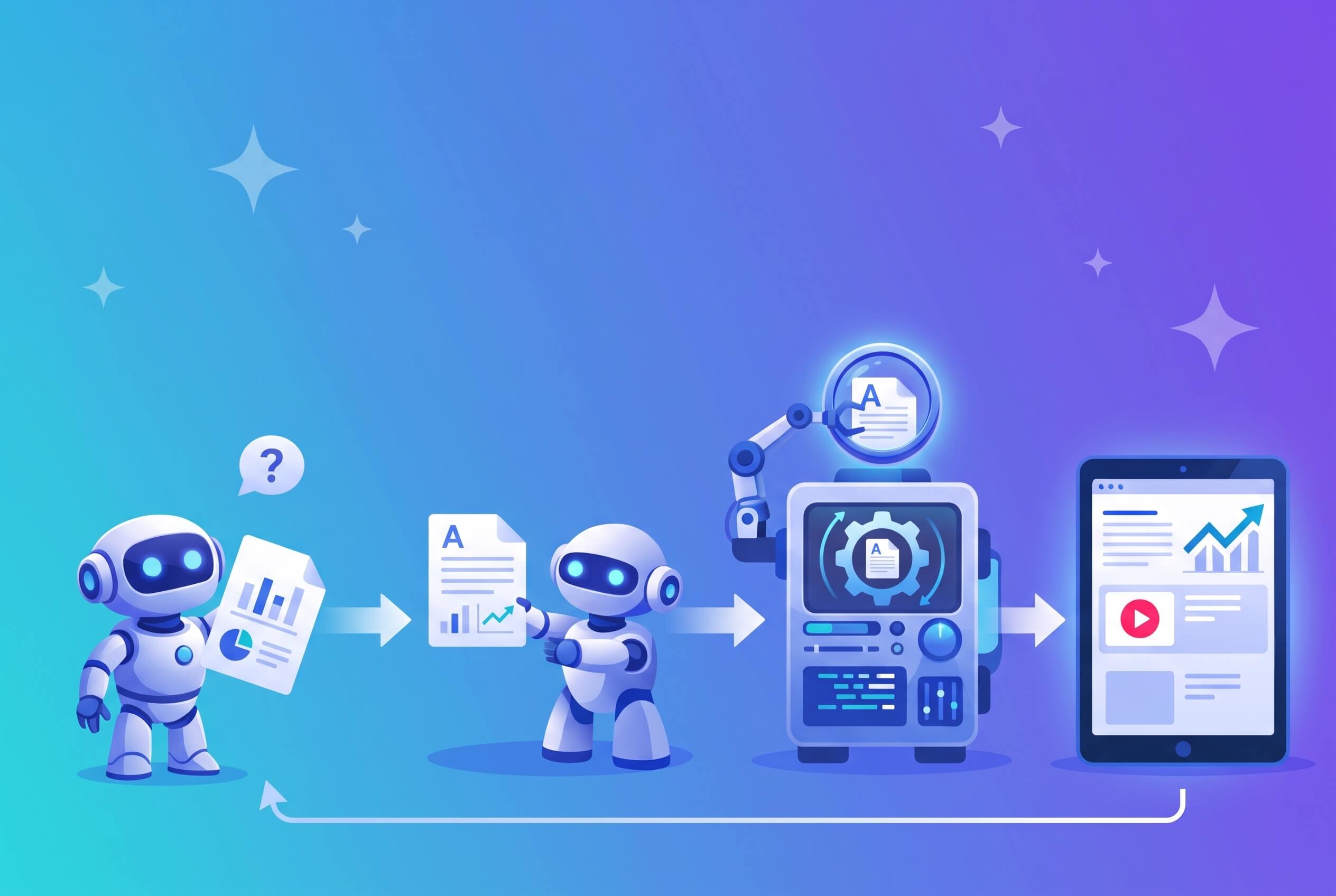
RAG is an advanced AI architecture designed to improve the factual accuracy and relevance of Large Language Model (LLM) outputs. In the RAG approach, the LLM performs a live search, retrieves data from search indexes, and then uses that verified information to synthesize its final answer. It significantly reduces the frequency of hallucinations.
Example: An AI search tool uses RAG when asked about the latest stock prices. The LLM initiates a real-time query to Google’s current indexes, pulls the verified stock market data, and then generates an accurate, up-to-date answer for the user.
👉 Like digging through the haystack and returning just the needle (labeled, cited, and polished).
A search methodology focused on understanding the true meaning and conceptual relevance of content, rather than relying solely on exact keyword matches. LLMs and modern algorithms prioritize meaning and relevance by modeling words and concepts in a multi-dimensional space, often using vectors.
Example: A user searches for “safe driving tips for winter.” A semantic search engine successfully retrieves content optimized for “cold weather road safety,” even though the exact phrase “safe driving tips” was not used.
👉 In other words, talking to someone who finally listens to what you mean, not just what you say.
A structured format of (Subject | Predicate | Object) that is fed to Large Language Models (LLMs) to ensure they ingest, process, and reference information with greater accuracy and less ambiguity than vague natural language.
Semantic triples help machines extract the underlying facts, which is crucial to avoid “AI Fluff” or vague interpretations, such as “unlocking potential.” Example: Instead of writing “Our software helps companies,” the structured facts are fed as follows: [Our Software] | [provides] | [analytics] and [Our Software] | [streamlines] | [workflows].
👉 So you’re feeding AI the facts in bite-sized Lego bricks instead of interpretive poetry.
The proportion of AI-generated answers on a given topic that mention a specific brand, relative to all brands mentioned across those answers. Unlike AI Visibility Score, which measures presence in isolation, Share of Voice is inherently competitive, showing how a brand stacks up against named rivals within the same set of prompts.
Example: Across 100 tracked prompts about “project management software,” a brand is mentioned in 40 AI answers, while its top competitor appears in 65. That gap is the brand’s Share of Voice deficit.
👉 It’s the AI-era version of “who got more airtime,” except the room is a chatbot and everyone’s talking over each other.
Read more: What Is AI Share of Voice?
A derogatory term used to describe the large volume of low-quality, generic content created easily and cheaply by generative AI tools. This material often lacks human expertise, authenticity, or unique information (information gain), which damages search quality and contributes to negative consumer perceptions of AI.
For example, a content farm mass-produces 10,000 product descriptions by feeding minimal input into an LLM. Because this content is generic and repetitive, search engines may flag it as “AI slop,” potentially leading to de-indexing or low-quality ratings.
👉 It’s like your junk drawer: full of filler you never asked for, impossible to sort through, and somehow multiplying every time you look away.
A control parameter in a Large Language Model (LLM) that regulates the randomness and creativity of the output generated. A low temperature setting produces a more conservative, precise, and consistent response (ideal for data processing), while a high temperature allows the model to be more creative but increases the risk of hallucination.
Example: A PPC team utilizes an LLM to categorize thousands of search terms for generating negative keywords. They set the temperature very low to ensure the model’s output is conservative and precise, guaranteeing consistency and avoiding creative interpretations of irrelevant terms.
👉 It’s how you decide whether your AI plays it safe or starts making stuff up with confidence.
Let’s say the user’s goal is to perform a decisive action, such as making a purchase, signing up for a service, or booking an event, having completed their research phase. Keywords associated with this intent include “buy,” “price,” “purchase,” “signup,” “demo,” or “free trial”.
Example: A user searching for “Stripe pricing” or a customer instructing an AI agent to proceed with a one-click purchase demonstrates transactional intent.
👉 Or when the searcher’s finger is tantalizingly hovering over “Add to cart.”
A specialized database used to store and manage vector embeddings. When connected to an AI application, a vector database facilitates semantic search, enabling the LLM to quickly retrieve highly relevant data from a specific, controlled dataset, rather than relying solely on its general training knowledge.
Example: An agency creates a vector database containing all client testimonials, case studies, and brand guidelines. When generating new content briefs, a custom GPT queries this vector database to pull in highly relevant, first-party data, ensuring the output is brand-compliant and factually correct.
👉 Basically, the organized friend every AI needs before it starts spouting confident nonsense.
A numerical representation of a piece of data (like a word, sentence, or entire document) in a multi-dimensional space. These embeddings capture the semantic meaning of the data, allowing computers to perform mathematical calculations like cosine similarity to find conceptual relationships, fundamentally replacing keyword matching with meaning matching.
Example: The phrase “high-performance sports car” is converted into a vector embedding. This vector can then be mathematically compared to the vector for “luxury coupé” to confirm that they are semantically similar, even if they share no common keywords.
👉 It’s feelings… but in vectorized matrices.
A metric used in Generative Engine Optimization (GEO) that quantifies how often a brand appears in AI-generated answers, calculated by dividing the number of answers mentioning the brand by the total number of tracked answers, and then multiplying by 100.
This metric serves as a North Star for brands seeking to gauge their presence in the new era of search, as a brand without a mention essentially “doesn’t exist” in the context of AI search.
Example: Similarweb’s ‘Brand Sentiment’ report can complement this by monitoring how AI answers portray your brand and if it’s mentioned.
👉 It’s the digital party-photo test. If AI’s answers don’t show your face, you weren’t really there.
Search tools that allow users to submit an image to find relevant information, products, or visually similar items. This capability is a core driver of multimodal search, with billions of users engaging with visual search engines monthly.
Example: A user sees a unique pair of trainers on social media and uses Google Lens to search for them. To ensure the product ranks in the visual search results, the e-commerce company must have optimized the image’s alt text with descriptive details about the brand, color, material, and product type. When words fail, the camera speaks. Loudly. And usually about shoes.
The use of AI and machine learning tools, often orchestrated through platforms like Make.com, Zapier, or n8n, to connect data sources (like Google Ads or Search Console) and execute complex, multi-step processes automatically. This practice is key for scaling SEO and PPC tasks efficiently, allowing marketers to shift focus from manual “doing” to high-impact strategy and oversight.
👉 It’s like putting the tedious tasks on autopilot so you can spend your time on strategy (or at least appear to be doing so).
Read more: How I Automated GEO Keyword Research Using Claude and Similarweb MCP
Senior SEO Specialist at Similarweb
Maayan is a senior SEO specialist with 7+ years of experience in SEO. She loves complex research projects, creating SEO strategies and performing technical audits.
Give it a try or talk to our insights team — don’t worry, it’s free!