



Dark Funnel Metrics: What to Measure When Buyers Decide Before They Click
by Limor Barenholtz21 Min.
Oct 14, 2026

In May 2026, an ad showed up in roughly 26% of ChatGPT’s US desktop conversations. A month later, that number was 26%. That’s the clearest signal yet that OpenAI has stopped testing advertising inside ChatGPT and started scaling it.
The data behind this piece comes from Similarweb’s 2026 Generative AI Landscape report, which tracks ad penetration, advertiser mix, and in-conversation ad behavior across ChatGPT and other leading AI platforms.
For paid media teams, now is the time to enter the market before it becomes competitive.
According to our data, ChatGPT ad penetration on US desktop nearly doubled between May and June 2026, a pace of change that has no precedent in the history of paid search. Google Ads took years to become a fixture of the search results page. ChatGPT ads have gone from pilot to a quarter of all conversations in a matter of months, and the mechanics of how those ads work, where they appear, and who’s buying them are shifting month to month.
This article breaks down what the data actually shows:
The short version is that ChatGPT ads don’t act like display, social, or search ads in a chat interface. They follow their own rules, and treating them like a smaller version of Google Ads will cost brands the early-mover advantage that’s still available today.
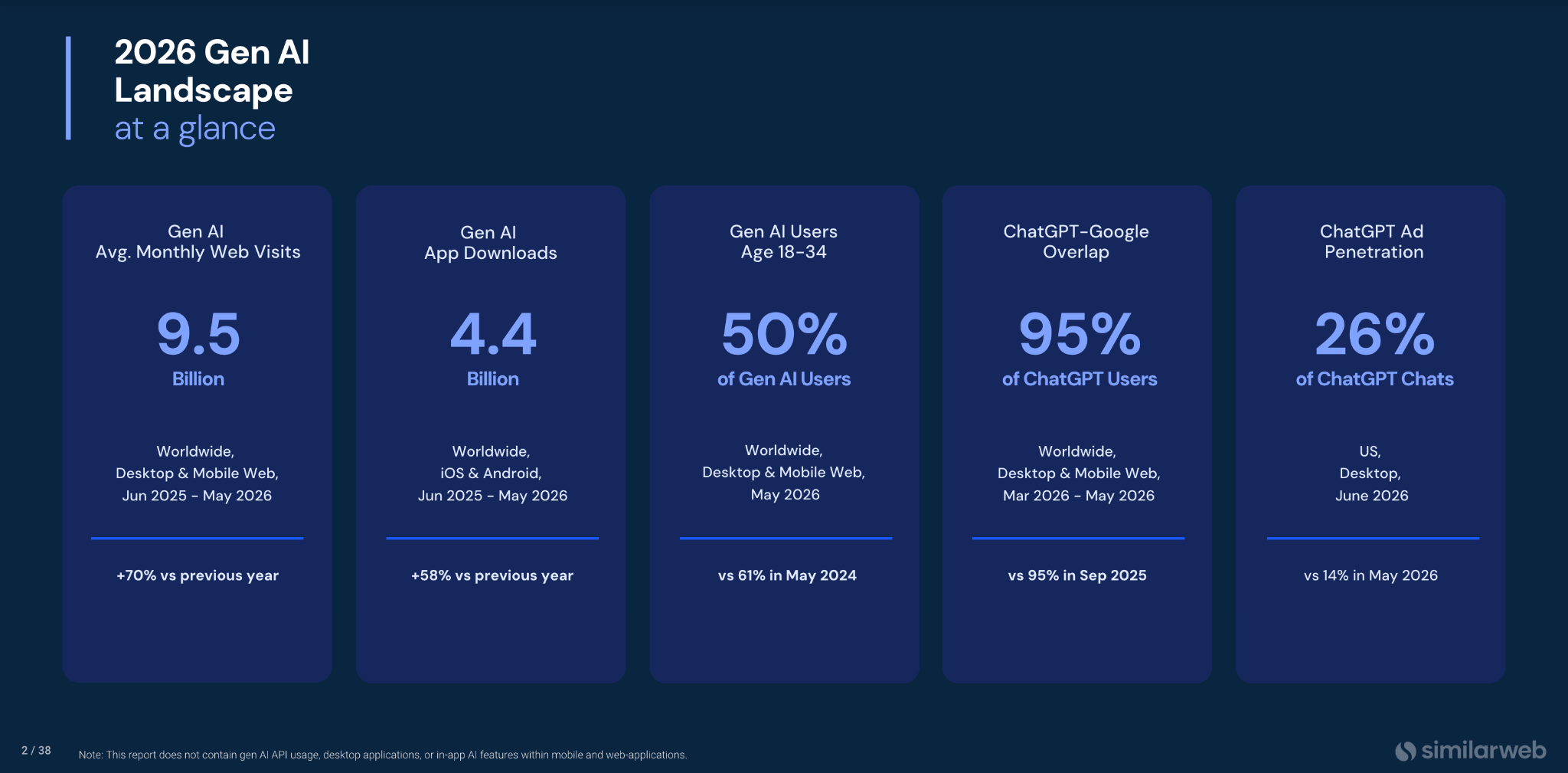
ChatGPT ad penetration on US desktop climbed from 14% of responses in May 2026 to 26% in June 2026, according to Similarweb data. This increase outpaces every prior month of the rollout combined. That jump followed OpenAI’s decision to strip away the barriers that had kept the ad pilot small. A self-serve Ads Manager launched on May 5, 2026, eliminating the six-figure minimum spend that had limited the program to enterprise budgets and agency holding companies.
The rollout itself moved unusually fast for a company that had spent years calling advertising a last resort. OpenAI began testing ads in ChatGPT on February 9, 2026, limited to logged-in adult users on the Free and Go tiers, with ads placed below the organic response and clearly labeled as sponsored. Early pricing reflected the scarcity of the inventory. Brands that committed to CPMs around $60 with a $200,000 minimum buy, roughly three times what the same impressions cost on Meta. By the time the self-serve platform opened in May, that minimum had dropped to $50,000, and CPC bidding replaced the flat-rate model, a shift that opened the door to a much broader base of advertisers.
Similarweb’s 26% figure isn’t an outlier. It sits close to a separate estimate of 24.7% ad frequency published by an independent AI search-ad tracker around the same period, which is one of the few points of external agreement on any ChatGPT advertising statistic so far. Most public trackers currently disagree by wide margins depending on methodology and sample. That rough alignment matters because the channel remains young enough that its measurement infrastructure is still being built by multiple parties in parallel with the ad product itself.
Takeaway: If your brand’s ChatGPT ad strategy is still in a “let’s watch this for a quarter” holding pattern, the inventory you’re waiting to evaluate has already changed twice. Set a review cadence measured in weeks, not quarters.
Similarweb’s tracking of the US ChatGPT advertiser mix in June 2026 shows a pool skewed heavily toward software, professional services, and direct-response categories, not the retail and CPG brands that dominate Google Shopping and Meta feed ads.
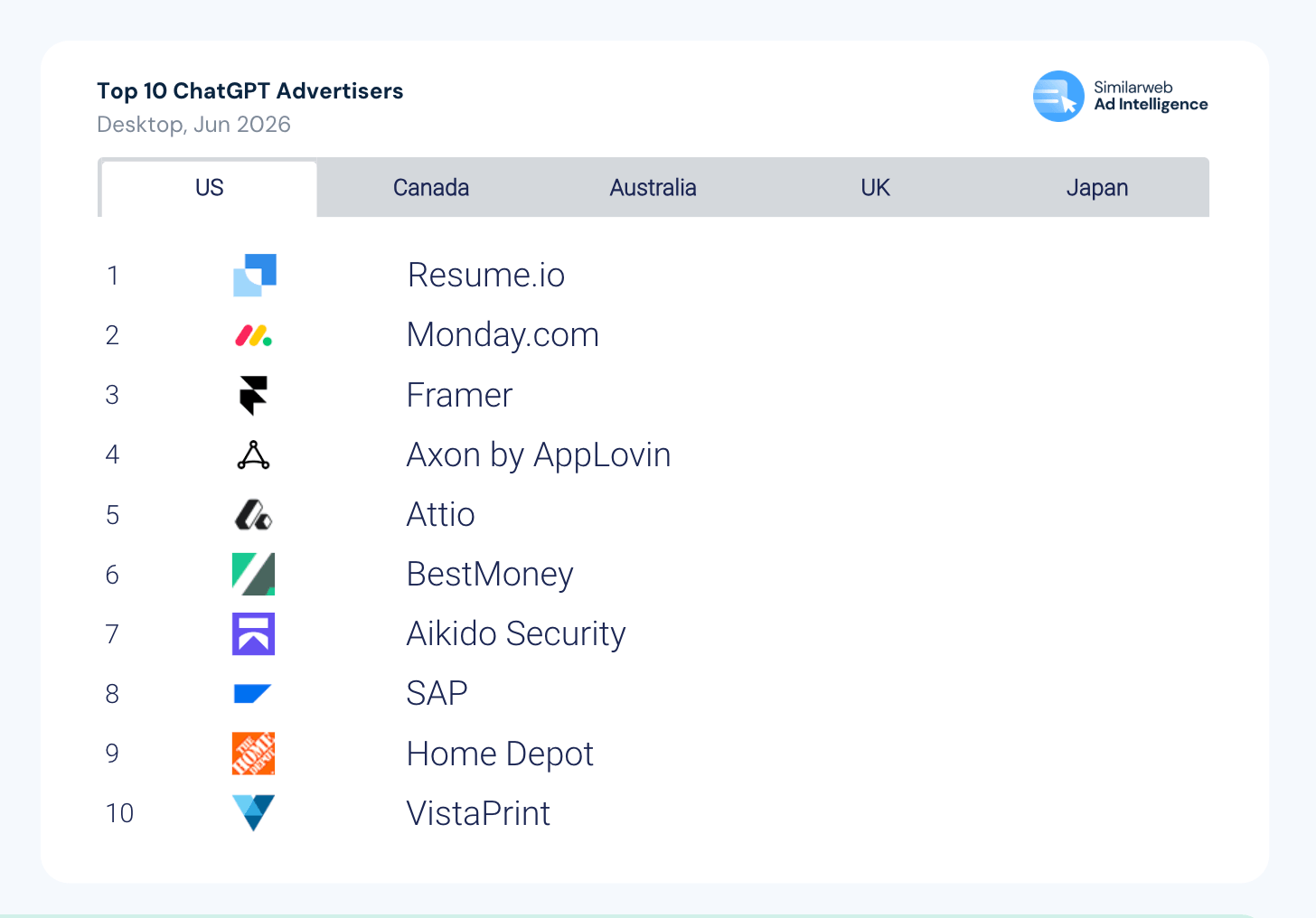
Eight of the ten are software or B2B services brands with high customer lifetime value and a natural fit for the research-heavy conversations ChatGPT is built around. For instance, someone asking about CRM options or website builders is deep in a comparison, which is exactly the moment OpenAI has designed ads to appear. Home Depot and VistaPrint are the exceptions, and both are already active, well-documented participants in OpenAI’s broader ad pilot rather than late arrivals.
That mix is a departure from the early pilot, when high-minimum-spend requirements meant only enterprise brands and holding-company clients like Target, Ford, and Adobe could participate. As the self-serve platform matured through the second quarter of 2026, mid-market SaaS and comparison/affiliate brands moved in. This pattern is consistent with a channel that rewards advertisers willing to bid on intent rather than brand awareness.
Takeaway: If your category resembles software, financial comparison, or professional services, you’re competing in the segment where ChatGPT ad demand is currently most concentrated, it’s time to build your account and creative now, before the auctions mature and prices climb with more bidders in the pool.
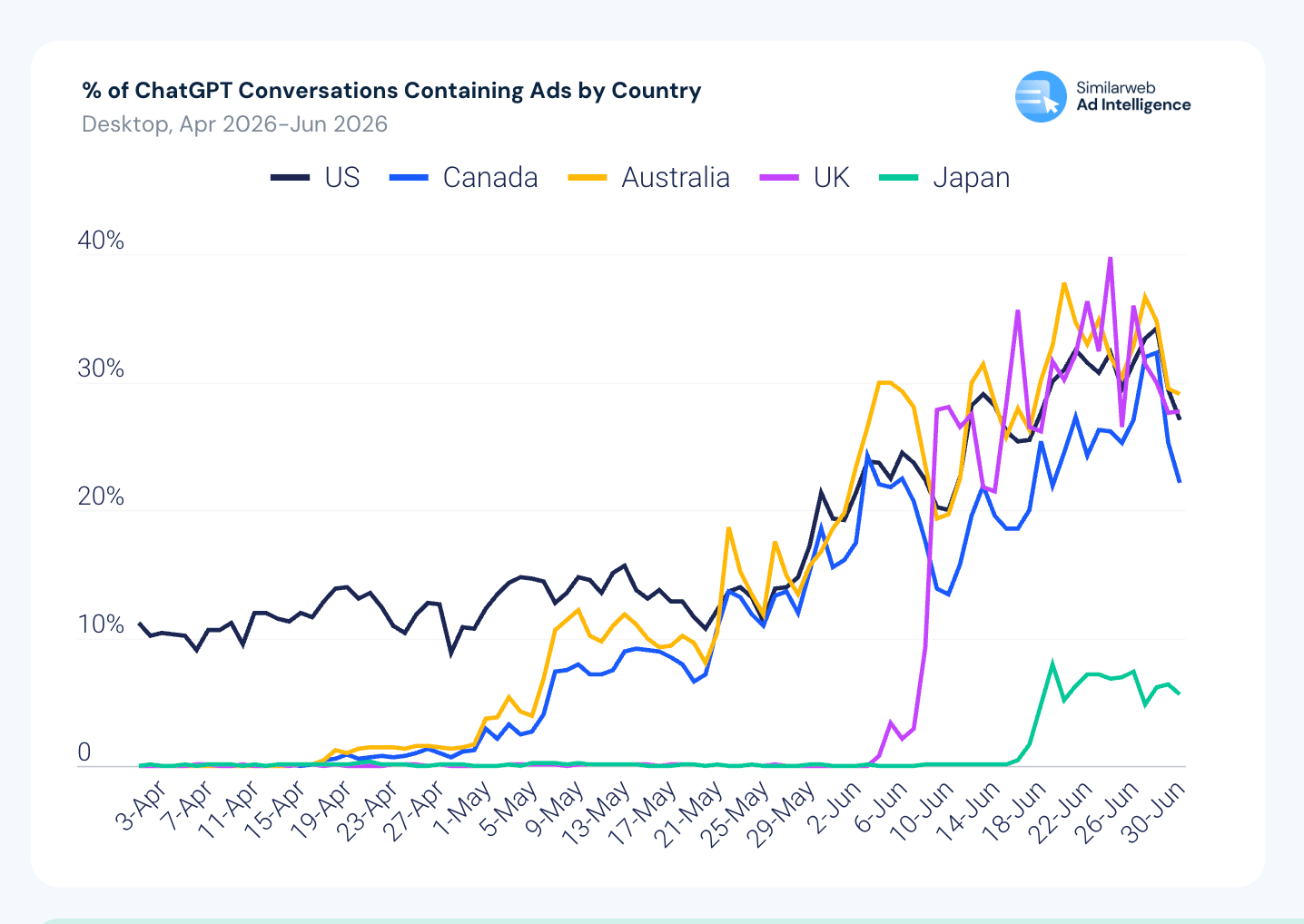
ChatGPT advertising has taken a country-by-country approach that OpenAI is rolling out at different speeds. Similarweb’s tracking of ad frequency across five markets between April and June 2026 shows the US, Canada, and Australia climbing steadily and in tandem, while the UK arrived later and Japan barely registered through most of the window before starting to move in June.
That sequencing lines up with OpenAI’s own disclosed timeline. The company confirmed expansion into Canada, Australia, and New Zealand on March 26, 2026, the same day it disclosed that the US pilot had crossed $100 million in annualized revenue within six weeks of launch. A May 7, 2026 update added the UK, Mexico, Brazil, Japan, and South Korea to the near-term roadmap, and UK ad delivery was activated in early June, the exact inflection point visible in Similarweb’s country chart.
The country-level spread matters strategically for two reasons:
Takeaway: Treat ChatGPT ads as a market-by-market rollout, not a single US line item. Build country-specific launch triggers tied to OpenAI’s stated expansion markets rather than waiting for a single global “go” signal.
A direct-response ad inside a chat window doesn’t behave like a search ad or a social feed ad, and the data on when and how ChatGPT ads appear shows why.
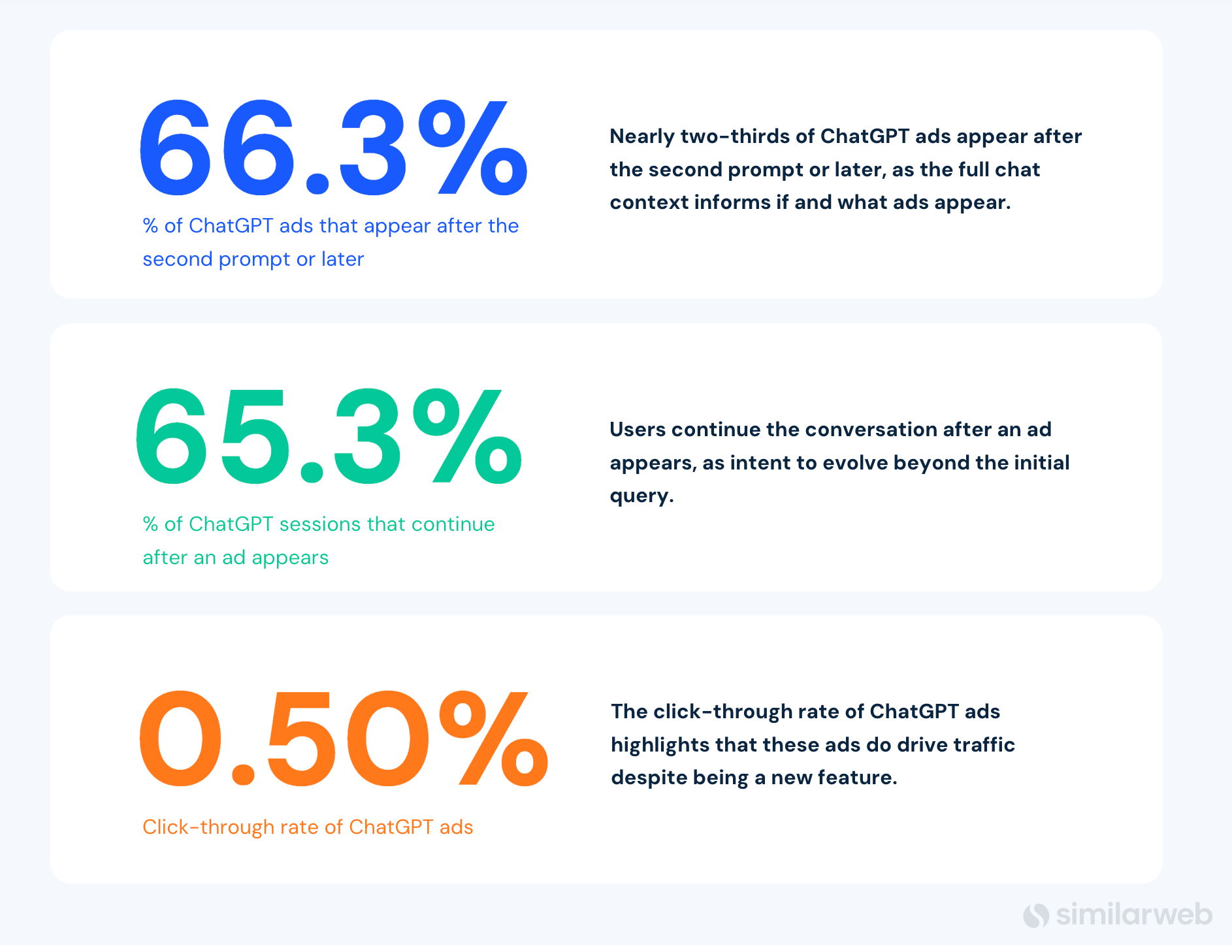
Similarweb’s behavioral tracking of the ad unit finds that 66.3% of ChatGPT ads appear after the second prompt or later in a conversation, not on the first response, which is when a traditional search ad would show up. That timing isn’t incidental. It reflects the fact that the full conversational context, not just the initial query, is what determines whether and what ad gets served.
Crucially, the ad doesn’t end the interaction.
65.3% of ChatGPT sessions continue after an ad appears, meaning the majority of users keep chatting rather than bouncing, a very different signal from a search results page, where a click (or the absence of one) is typically the end of the interaction on that page.
Click-through rate on the ad unit itself sits at 0.50%, which is low relative to Google Search Ads’ benchmark average of roughly 6.4%, but that comparison undersells what’s happening.
The ad isn’t competing for a click as the primary conversion event, because the conversation itself continues to develop after the ad is shown.
Harel Amir, Similarweb’s Head of Product and Solution of Ad Intelligence, has described this shift in similar terms when writing about AI-driven advertising economics. The traditional metrics built for page-based environments, impressions, click-through rate, and position, were designed for a world with a rank to monitor and a results page to scrape, and a conversational interface has neither.
As he put it when discussing how AI is rewriting advertising, the measurement model has to move from clicks toward understanding impact across the full discovery journey. Applied to the ad-moment data, conversational ads appear designed to sit inside that journey rather than interrupt it, which is a fundamentally different design goal than winning a single click.
To make that distinction concrete, here’s a working framework for how to think about a ChatGPT ad placement versus a traditional search ad:
The 3 C’s of the ad moment
Takeaway: If your creative and bidding strategy for ChatGPT ads mirrors your Google Search Ads playbook, including front-loading the value prop, optimizing purely for CTR, you’re optimizing for the wrong moment. Build creatives that assume the user is already several turns into a decision, not landing cold.
Use this as a working checklist before committing budget to the channel. Similarweb’s AI Advertising can help you track competitor ad placements and creative to see what’s already working before you spend a dollar:
ChatGPT advertising is still a fraction of what Google and Meta generate. OpenAI’s own disclosed $100 million annualized run rate in the pilot’s early weeks is a rounding error next to the $224.53 billion Google generated in 2025.
But the trajectory matters more than the current scale.
A channel that moved from a $200,000-minimum enterprise pilot to a self-serve auction with a broadening advertiser base in under four months, and that nearly doubled its ad penetration in a single month once that auction opened, is not a niche experiment brands can safely defer.
The structural shift is the same one reshaping organic visibility. The unit of competition is no longer the page or the query, it’s the conversation.
Brands that have spent the past year building an AEO and GEO strategy for organic visibility in ChatGPT’s answers now have a paid complement to that strategy arriving on the same surface, and the two will increasingly need to be planned together, since a brand’s organic citation frequency and its paid ad relevance score both draw on the same underlying signal. How well it’s represented in the conversations people are already having about its category.
The takeaway that matters most: Treat ChatGPT ads as their own channel with their own rules, not a smaller, stranger version of Google Ads. The brands already active in the June advertiser mix, mostly software and services companies willing to bid on intent inside a still-forming auction, are the ones proving out what works before the rest of the market catches up.
According to Similarweb data, ChatGPT ads appeared in 26% of US desktop responses in June 2026, up from 14% in May 2026. Ad penetration varies significantly by country and has fluctuated sharply month to month since the pilot expanded, so any single figure should be treated as a snapshot rather than a stable baseline.
OpenAI began testing ads in ChatGPT on February 9, 2026, for logged-in adult users on the Free and Go subscription tiers in the US. Plus, Pro, Business, Enterprise, and Education subscribers do not see ads.
Early pilot pricing started around $60 CPM with a $200,000 minimum commitment. After OpenAI opened a self-serve Ads Manager on May 5, 2026, the minimum spend dropped to $50,000 and the platform moved to CPC bidding, opening access to a much broader range of advertisers.
No. OpenAI states that ads run on separate systems from the underlying chat model and that advertisers cannot shape, rank, or alter ChatGPT’s organic responses. Ads are visually separated and labeled as sponsored.
Similarweb’s June 2026 US data shows the top ChatGPT advertisers concentrated in software and professional services, including Monday.com, Framer, Attio, Aikido Security, and SAP, alongside consumer brands like Home Depot and VistaPrint.
ChatGPT ad click-through rate was roughly 0.50% in June 2026, well below the ~6.4% industry benchmark for Google Search ads. However, the two aren’t directly comparable: the majority of ChatGPT sessions (65.3%) continue after an ad appears, suggesting the ad functions as one input into an ongoing conversation rather than a single terminal click event.
Darrell creates SEO content for Similarweb, drawing on his deep understanding of SEO and Google patents.
Dark Funnel Metrics: What to Measure When Buyers Decide Before They Click

What Happens After AI Recommends Your Brand?
ChatGPT Ads CTR by Country: Brazil, Mexico and Japan Out-Click the US by More Than 2x
Give it a try or talk to our insights team — don’t worry, it’s free!