What is RAG (Retrieval-Augmented Generation)? A Marketer's Guide
by Shai Belinsky9 Min.
Oct 01, 2026
Six weeks ago, you pulled up a prompt you track, and your brand was cited in the answer. Last week, you checked the same prompt. You weren’t there. A competitor was. Your Google rankings haven’t moved. Organic traffic looks fine. Nothing in your analytics explains it.
No content was deleted. No penalty fired. No Search Console alert arrived.
This is AI citation decay, and it’s one of the biggest visibility problems a brand can face right now, because nothing in your current analytics will tell you it’s happening.
According to the AirOps 2026 State of AI Search report, only 30% of brands show up consistently when the same prompts are run back to back. The other 70% lose visibility between runs, and most of them have no idea.
This article explains what AI citation decay is, why it happens, how fast it moves, how to detect it early, and how to get cited again using a structured recovery approach.
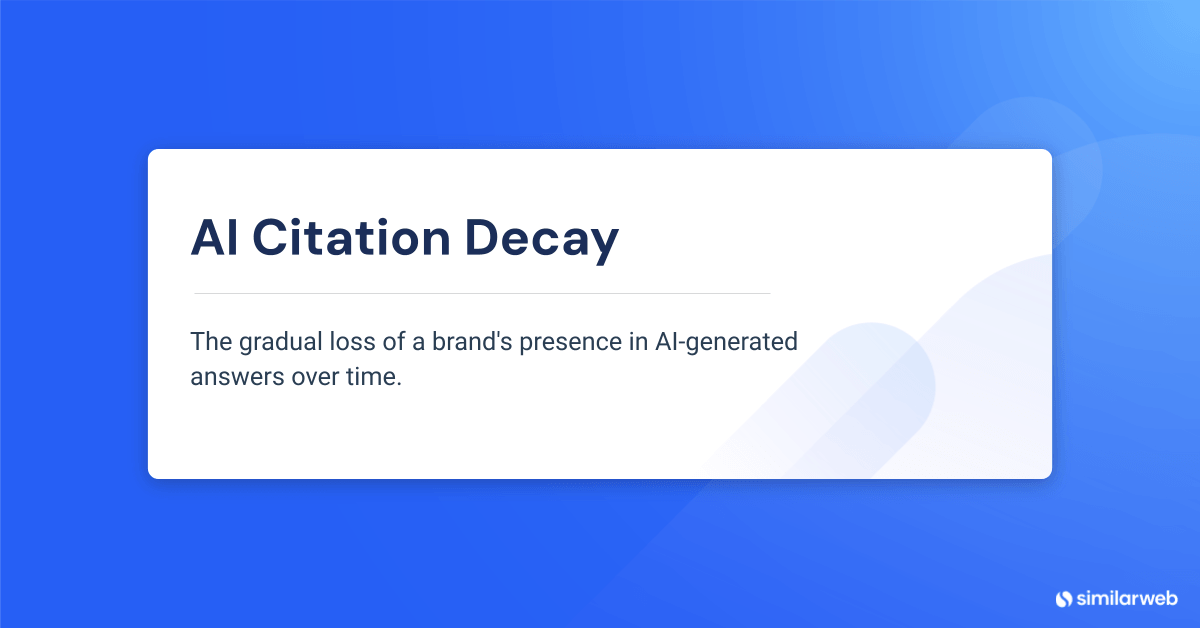
AI citation decay is the gradual loss of a brand’s presence in AI-generated answers over time. It’s caused by content going stale, competitors publishing better pages, and third-party coverage drying up. Your content doesn’t have to get worse for it to happen.
The term is worth distinguishing from AI citation volatility, which refers to the natural, unpredictable fluctuations in citations across model runs. Volatility is the background noise. Decay is a trend: your brand consistently appears less and less in the answers that matter, and it gets worse if you don’t act on it.
This is usually not an SEO problem. A brand can hold position one for every target keyword and be completely absent from every AI-generated answer in its category. SEO and GEO are different systems, measured differently, built on different signals.
When Google evaluates a page, it weighs on-page relevance, backlinks, and engagement signals. When a generative engine constructs an answer, it pulls from a constantly updated pool of sources. It favors recent content, sources with topical authority for AI, and content that multiple independent third parties reference. A brand that stops publishing, earns no new mentions, and builds no new citations doesn’t lose rank. It loses its place in that pool. The absence shows up in AI answers long before it shows up anywhere else.
Standard analytics measure clicks. AI citation decay is a visibility problem that precedes the click entirely.
Buyers use ChatGPT, Perplexity, and Google AI Mode to compare vendors, build shortlists, and validate choices before a single click happens. If your brand isn’t cited in those answers, it isn’t on the shortlist. You’ll see no drop in rankings, no spike in bounce rate, no anomaly in Search Console. The demand that should have found you simply found someone else.
AI citation decay has three causes. None of them requires your content to get worse. You can lose ground simply by standing still while everything around you moves.
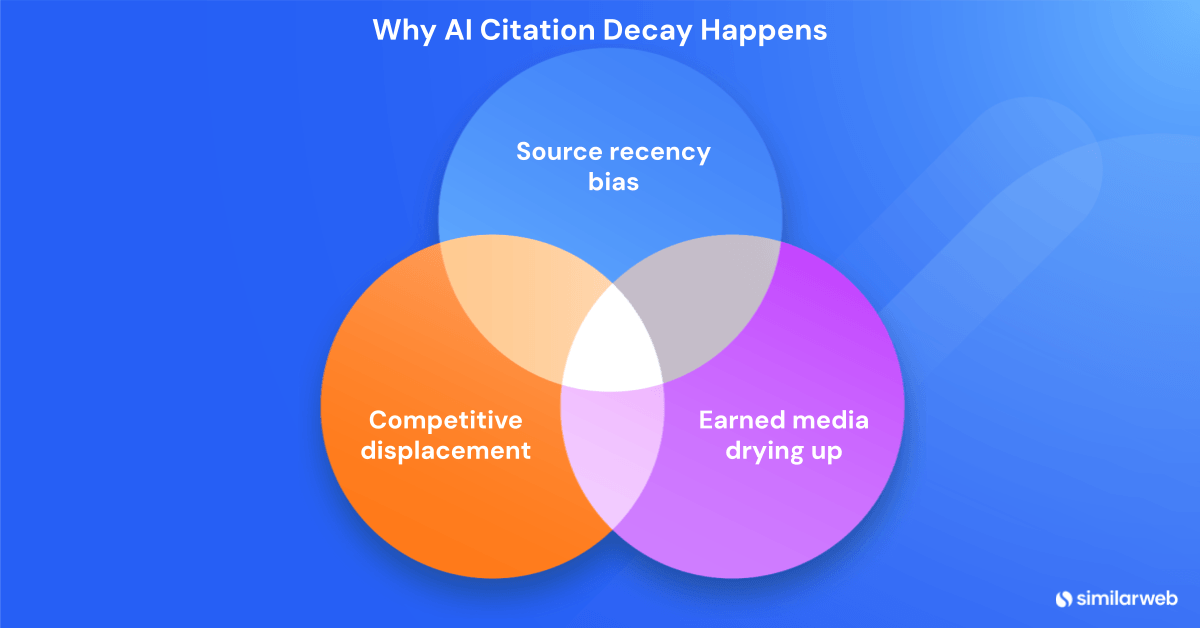
AI retrieval systems weigh recency heavily. Research found that recency bias is present across seven major large language model rerankers, including GPT-4o, LLaMA-3, and Qwen-2.5. Newer passages are consistently preferred over older ones. Put two equally relevant passages side by side and give one a more recent date: the model will change its preference up to 25% of the time. Larger models reduce the effect, but none eliminate it.
The practical implication: an article your team published eight months ago is competing against a weaker one published last week. The model may prefer the newer one simply because it looks fresher.
Even if your content doesn’t change, the competitive landscape does. AI engines continuously update which sources they draw from. When a competitor publishes a better-structured, more data-dense, or more recently updated piece on a topic you own, you get pushed down relative to them. You’re not penalized. You’re outcompeted. Tracking how competitors are gaining citation share is often the fastest way to see where this is happening.
Your citation presence stays strong partly because third-party sources keep referencing your content. When that stops, when PR efforts pause, and new coverage slows down, AI engines have fewer independent sources to validate what you’re saying. Your content becomes less trustworthy to the system, not because anything changed on the page, but because the surrounding web stopped vouching for it.
The median citation half-life is 4.5 weeks. That means roughly half of a brand’s citations turn over within a single month. This is the central finding from a Scrunch and Stacker joint study that tracked 3.5 million citation events across 120,000+ domains, 8 industries, and 6 AI platforms from September 2025 to March 2026. The same study found that brands with active earned media distribution hold citations for about 10 weeks on average, more than twice as long.
The pace varies significantly by platform.
| AI platform | Citation half-life | Recommended monitoring cadence |
| ChatGPT | 3.4 weeks | Weekly |
| Google AI Mode | 4.3 weeks | Weekly |
| AI Overviews | 4.7 weeks | Bi-weekly |
| Gemini | 4.6 weeks | Bi-weekly |
| Perplexity | 5.8 weeks | Bi-weekly |
ChatGPT turns over sources fastest. A brand can lose its presence there in under a month. Perplexity holds citations longest: both content quality and recency affect how long you stay cited there. The gap between platforms is wide enough that a brand can gain visibility on one engine while losing it on another at the same time.
This is why monitoring only one AI platform gives an incomplete picture. Strong citation presence in Perplexity tells you nothing about what’s happening in ChatGPT.
In active B2B categories where competitors publish weekly, measurable citation drops typically appear within 4 to 6 weeks of stopping earned media activity.
So how do you know when it’s happening? The Domain Influence Score in Similarweb’s Citation Analysis tool gives you a direct read on your citation presence over time.
The Domain Influence Score measures how often a domain is cited across AI-generated answers for a tracked topic, expressed as a percentage. A domain cited in every answer has a score of 100%. A domain cited in half of the answers has a score of 50%. Tracking this week over week shows you exactly when your presence starts to slip.
Similarweb’s AI Brand Visibility campaigns track across ChatGPT, Google AI Mode, Gemini, and Perplexity in one place. Since each platform has a different decay rate, that cross-platform view is what tells you where you’re losing ground first.
No standard analytics tool captures this.
Access Citation Analysis through the AI Brand Visibility module. Set up a campaign for the topics you want to track, then open the Citation Analysis tab.
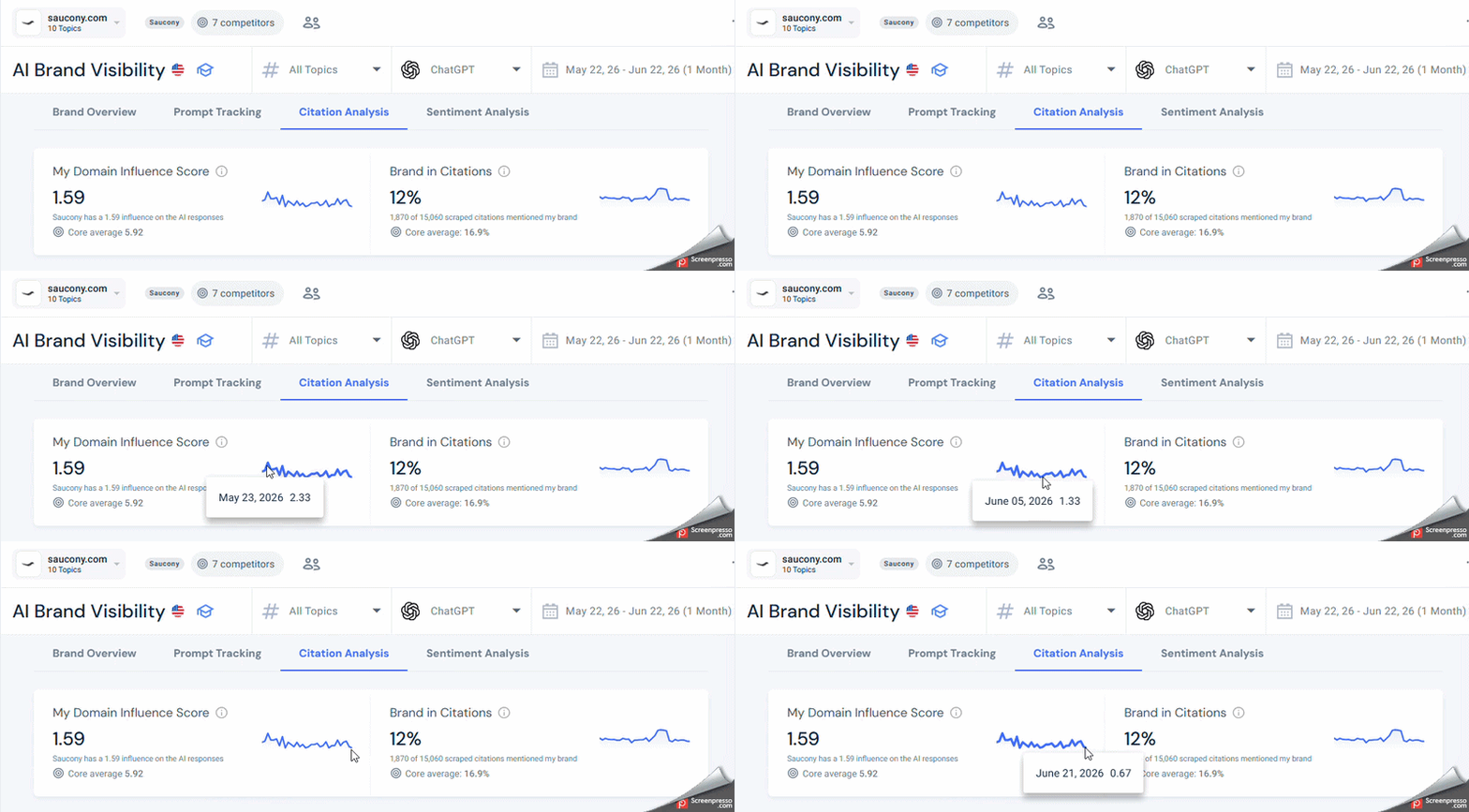
Your Domain Influence Score sits at the top. It shows the percentage of AI answers for your tracked topics cited your domain in the selected timeframe. Watch this number week over week. A score that’s trending down is the clearest sign that AI citation decay is in progress.
Take Saucony as an example. Over the course of a single month, their Domain Influence Score dropped from 4.67 to 0.33, meaning they went from appearing in roughly 1 in 20 AI answers to barely registering. Their organic rankings didn’t necessarily move. Nothing in standard analytics flagged it.
From there, use Prompt Analytics to see exactly which queries drove that drop. Sorting by PoP (period-over-period) change shows you the worst-hit prompts first.
In Saucony’s case, the picture is stark. The prompt with the biggest drop, “what sneaker models tend to lock down the heel without squeezing the toes,” lost 34.38 points of visibility in a single period. A prompt about wide-fit walking shoes dropped 31.25. Multiple high-intent queries about running shoe recommendations each fell between 15 and 25 points.
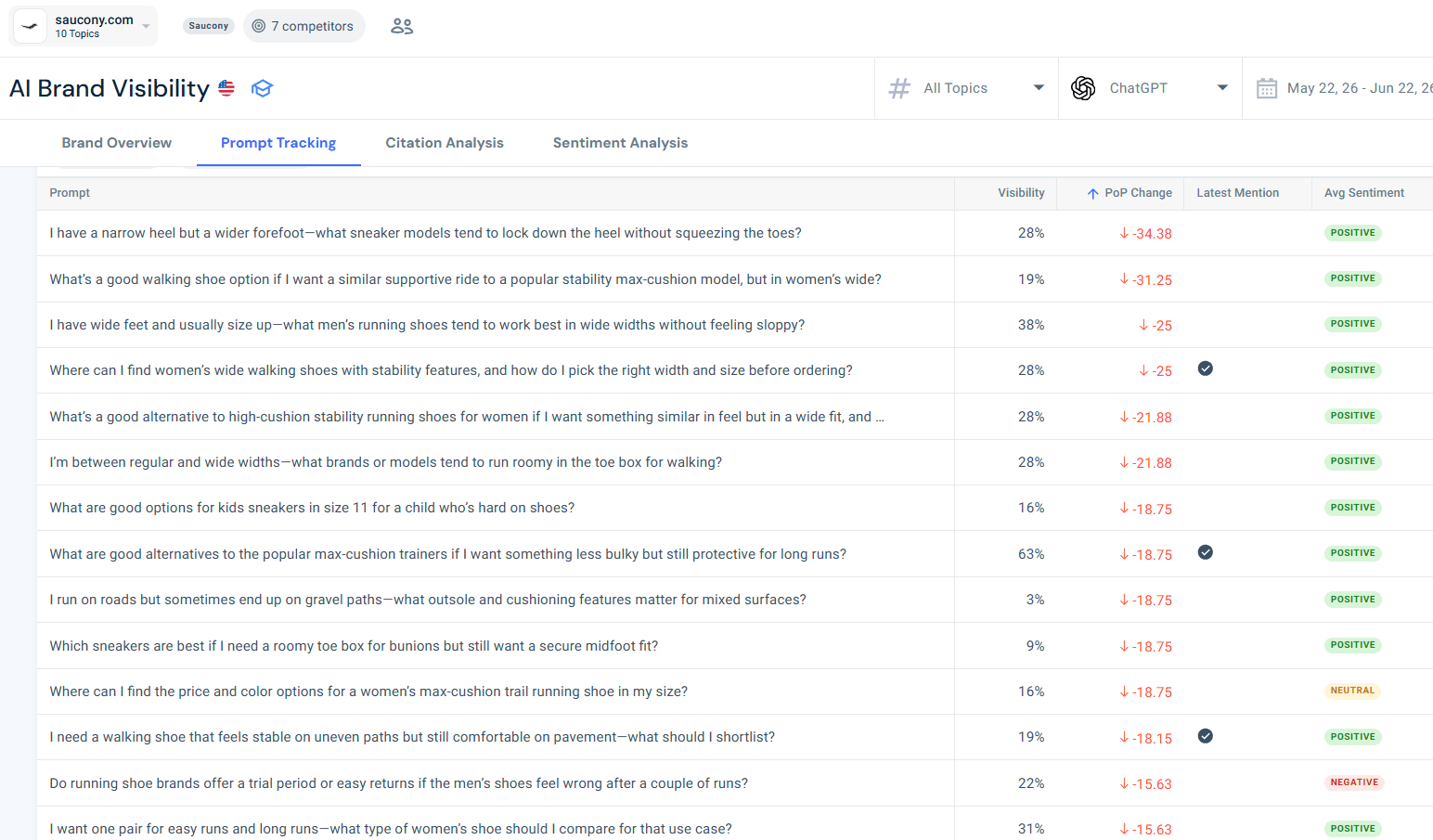
For a team looking at this data, the next step is opening the Citation Analysis tab to see which domains are now getting cited on these prompts instead of Saucony. The prompts where visibility dropped most fall across four topics: Sneakers, Walking Shoes, Men’s Running Shoes, and Women’s Activewear. The top source categories driving citations on those prompts are Reviews & UGC, Ecommerce Brands, and News & Publishers. That tells the Saucony team where to focus: earning coverage on review and UGC platforms in the running and walking shoe space, and making sure their product pages are competitive on the ecommerce sites that AI engines are already citing.
Getting back into AI answers means fixing three things. First, your own pages need to be fresher and more useful than what’s currently being cited. Second, you need coverage from the third-party sources AI engines already trust in your space. Third, your brand needs to be represented consistently across those sources. Recovery typically takes 6 to 12 weeks after a publishing gap. The sooner you start, the shorter that window.
Use Prompt Analysis in Similarweb AI Brand Visibility to find every tracked query where your brand no longer appears in cited sources. This is your recovery list. Start with the prompts that represent active buyer research in your category. Those are the ones costing you the most.
Changing a publish date or tweaking a subheading won’t do much. What moves the needle is genuine new content: new data, updated statistics, new examples, new sections that answer questions your original page didn’t cover. For a practical guide on how to structure page content so AI engines can find and use it, see how to optimize content for LLMs.
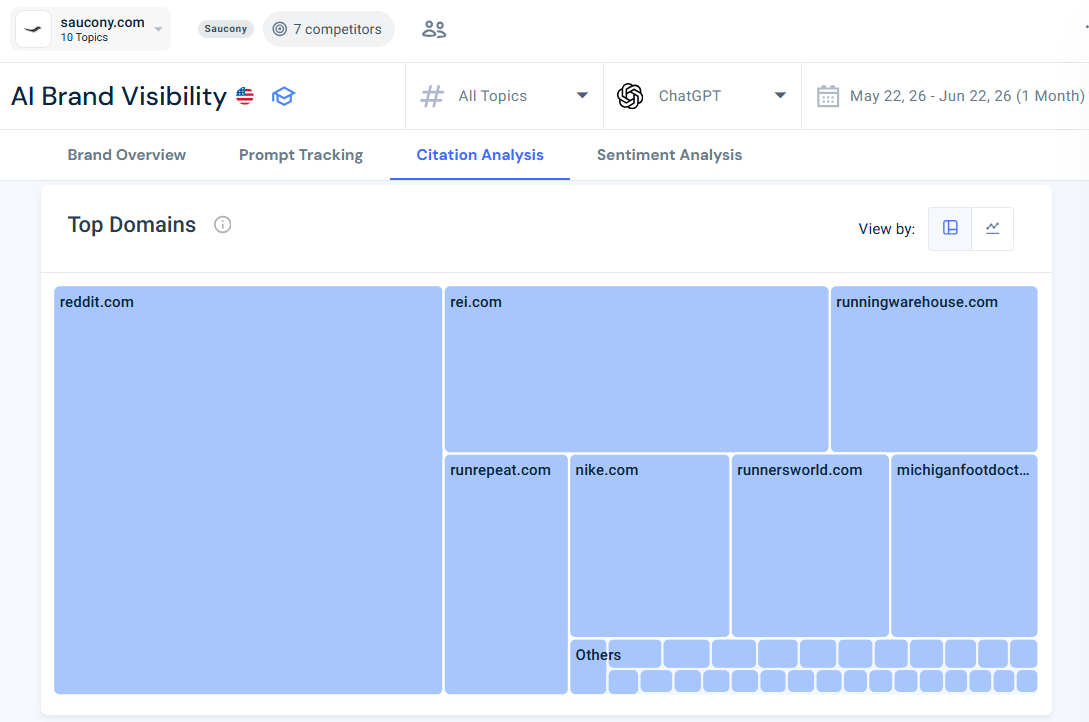
The Citation Analysis tab shows which third-party domains are driving AI answers for your tracked topics. These aren’t competitors. They’re the sites AI engines trust when answering questions in your space, and they’re your clearest signal of where to invest.
For Saucony, the Top Domains treemap tells the story immediately. Reddit.com is the largest box by far, meaning it’s cited more than any other source across Saucony’s tracked topics in ChatGPT. REI.com and runningwarehouse.com are the next two. Runrepeat.com, runnersworld.com, and michiganfootdoctors.com follow.
The Cited URLs table narrows it further. Grivetoutdoors.com’s trail running shoe guide has the highest Influence Score at 2.41, followed by runningwarehouse.com’s footwear guide at 1.99, and racedaylab.com’s trail shoe guide at 1.75. These are the specific pages AI is drawing from most often when answering Saucony-adjacent prompts.
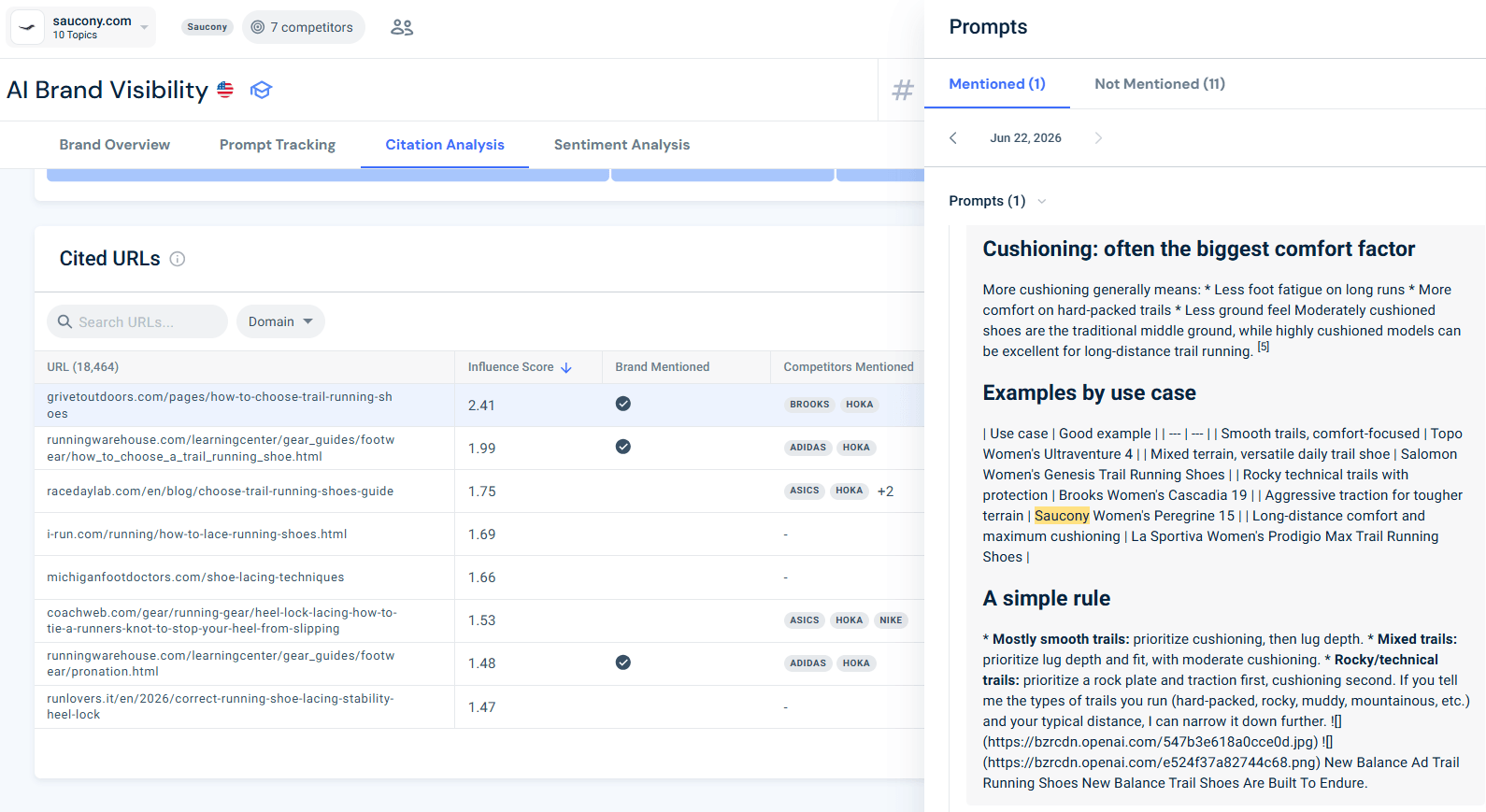
For the Saucony team, this is a concrete action list: earn coverage in the Reddit threads appearing in these citations, work toward placement in runningwarehouse.com and runnersworld.com content, and look at what grivetoutdoors.com’s trail running guide covers that Saucony’s own pages don’t.
Set a weekly check-in on Citation Analysis during the recovery period. Look for the score to stop falling before it starts rising. That stabilization usually comes one to two weeks before you see actual citation gains. For a full walkthrough of how to set up ongoing AI visibility tracking, see how to track AI visibility using Similarweb.
| Signal type | What to do | Expected timeline |
| Content freshness | Substantive page updates: new data, examples, new sections | 1 to 2 weeks to publish |
| Earned media | Placements on top cited sources for your category (find them in Citation Analysis) | 2 to 4 weeks to place and index |
| Brand consistency | Same brand name, description, and positioning across all owned and third-party pages | Ongoing |
| Monitoring | Weekly Domain Influence Score check | Ongoing |
The most common mistake in recovery is treating page updates as the only fix. Refreshing your content helps you re-enter the citation pool, but without new third-party coverage coming in at the same time, you’ll lose ground again just as quickly.
AI citation decay is not a content quality problem. It’s a maintenance problem. The brands that hold top citation positions don’t necessarily have better content. They publish consistently, earn coverage regularly, and keep their presence consistent across the web.
A falling Domain Influence Score is an early warning, not a write-off. Catching it at week three means a six-week fix. Catching it at week twelve means six months.
Start tracking your citations in Similarweb AI Brand Visibility and set a weekly check before you need it.
How do I tell if I’m seeing decay or just normal fluctuation?
Manually running the same prompt and eyeballing results isn’t a reliable method. AI engines don’t always give the same answers to the same question, so a single check tells you very little. You need an AI visibility tool that tracks your citation presence consistently across multiple prompts and time periods. Normal fluctuation means you appear inconsistently, sometimes in, sometimes out, with no clear direction. Decay has a pattern: you show up less each time you check, across multiple prompts, not just one. If your Domain Influence Score in Similarweb shows a downward trend across two or three consecutive measurement windows, that’s decay, not noise.
Can AI citation decay happen even if my SEO rankings are strong?
Yes. Organic rankings and AI citations are independent signals. A brand can hold the top Google result for every target keyword and still be absent from ChatGPT, Perplexity, and Google AI Mode answers in its category. AI engines select sources based on freshness, how many independent third parties reference your content, and topical authority, not ranking position. According to AirOps’ research, roughly 60% of AI Overview citations come from pages that don’t rank in the top 20 organic results.
How long does recovery from AI citation decay take?
Typically, 6 to 12 weeks, depending on how long the gap was and how competitive your category is. The timeline has two phases: stabilization, where your citation presence stops falling, usually within two to four weeks of publishing fresh content and earning new third-party coverage; and recovery, where citations start climbing back. Brands that only refresh owned pages without earning new external coverage tend to stabilize but not fully recover.
What’s the fastest way to start recovering AI citations?
The highest-leverage first step is identifying which specific prompts you’ve dropped out of, then checking which domains are being cited on those prompts instead of you. That tells you exactly where to focus earned media efforts. Page updates alone won’t be enough. New third-party coverage on the right sources is what moves the score.
What is the difference between AI citation decay and AI citation volatility?
A practical test: look at your citation presence for the same five prompts over four weeks. If you’re in and out with no clear pattern, that’s volatility, meaning normal behavior for a dynamic retrieval system. If you’re appearing less each week across multiple prompts, that’s decay. The distinction matters because the responses are different: volatility calls for monitoring; decay calls for a content and earned media intervention.
Senior SEO Specialist
Shai, with 10+ years in SEO, holds a Bachelor’s and an MBA. He enjoys TV shows, anime, movies, music, and cooking.
Give it a try or talk to our insights team — don’t worry, it’s free!