



Dark Funnel Metrics: What to Measure When Buyers Decide Before They Click
by Limor Barenholtz20 Min.
Oct 14, 2026
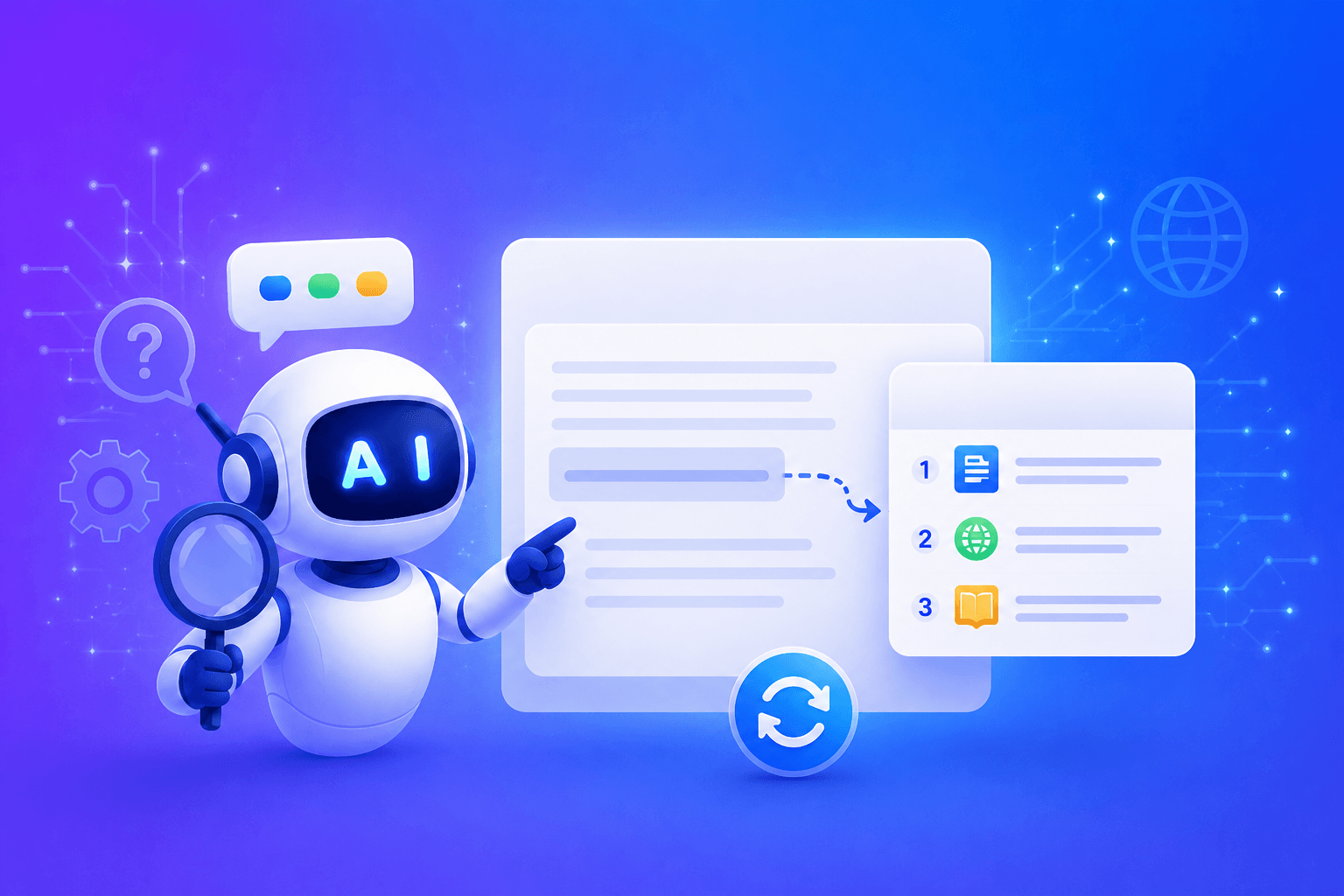
Every day, hundreds of millions of search queries are answered without a single website being visited. Users get what they need from an AI-generated response and move on. The traffic that once flowed to publishers, brands, and content marketers is staying inside the answer box.
This is the structural change that makes AI citations matter. When a generative AI engine answers a question, it synthesizes information from multiple sources and names a handful of them. The named sources get a link, a trust signal, and a direct path to their site. Everyone else gets nothing, regardless of where they rank in organic search.
Ranking is no longer the same as being visible. A page that ranks first on Google may not be cited at all in an AI Overview or a Perplexity response. A page with no organic visibility may be cited repeatedly. The selection criteria are different, the platforms are different, and the measurement approach is entirely different.
This guide covers the concept from the ground up: what an AI citation is, how the underlying technology decides what to cite, the four types of citations AI engines produce, why they differ from backlinks, how citation behavior varies by platform, and what it takes for your content to become citation-eligible.
An AI citation is an explicit attribution by a generative AI engine, such as ChatGPT, Perplexity, or Google AI Overviews, that credits a specific web page or source as the basis for part of its generated answer. It typically appears as a clickable link, a numbered footnote, or an inline source card attached to a claim or passage in the AI-generated response.
Think of it as a footnote in a research paper, except the paper is the answer box that 100 million daily users are reading instead of your website.
An AI citation is not the same as an AI mention. When a model writes “Similarweb is a widely used analytics platform,” that is a mention, the model drew on something it learned during training and named your brand in passing. When a model writes “According to Similarweb’s 2025 Gen AI Landscape Report [↗],” it is citing your content as the source of a specific claim. The model is not just aware of your brand, it is staking its credibility on your page.
That distinction matters strategically. A mention gives you brand awareness inside an AI answer. A citation gives you a verifiable trust signal, a direct path for the user to reach your site, and a signal to the model that your domain is a reliable source. As AI answers are replacing the first scroll of search results, being mentioned is table stakes. Being cited is the actual competitive advantage.
Most AI search platforms that cite sources use a technique called Retrieval-Augmented Generation, or RAG. RAG is a two-step architecture that determines not just what the AI answers, but which sources it names when doing so. Understanding it is the foundation of any citation strategy.
When you ask an AI a question, it doesn’t just pull the answer from its memory. First, it breaks your question down into smaller sub-questions and searches the web for pages that answer each one. It’s looking for content that matches the meaning of your question, not just the exact words you used. So a page doesn’t have to contain your specific phrase to get cited. It just needs to clearly answer what you were actually asking.
Here’s the surprising part: a page can earn an AI citation without ranking anywhere in Google’s top 10. Research by seoClarity looked at the top 1,000 URLs cited by ChatGPT in the US and found that 25% of them have zero visibility in Google’s organic results. For the top three most-cited URLs, that number jumps to 50%. In other words, Google rankings don’t predict AI citations as well as most people assume.
Once the AI has gathered relevant pages, it writes a single answer by pulling together the most useful bits from each source. As it does this, it links specific claims back to the pages they came fromת that’s the citation. But not every page that was retrieved gets credited. The AI picks the sources that best support the specific points it’s making. Content that is clear, well-organized, and backed by facts is more likely to make the cut.
One more thing worth knowing: if the AI is working from its training data alone, without actively searching the web, no citations appear at all. This is why the same ChatGPT query can look very different depending on whether web browsing is turned on. With browsing on, you get citations. Without it, the AI draws on what it already learned, and there’s nothing to link to.
Not all AI citations look the same. The format depends on the platform architecture, the query type, and the model’s product philosophy. There are four primary citation formats across the major AI engines.
Used by Perplexity as its default format. Every retrieved passage is numbered in the text at the point of use – [1], [2], [3] and the corresponding sources appear in a sidebar or at the bottom of the response. This is the most granular format: users can see exactly which claim maps to which source, making verification explicit. Perplexity averages 21.87 citations per response, nearly three times ChatGPT’s 7.92, the highest of any major AI platform, according to ZipTie.dev’s cross-platform citation analysis.
Used by ChatGPT (with web browsing enabled) and increasingly by Google AI Mode. Sources appear as clickable cards or a panel attached to the response, rather than inline footnotes. The connection between a specific claim and its source is less explicit than Perplexity’s numbered system, but the visual presentation is cleaner and more familiar to users coming from traditional search. This format is more common for commercial and product-related queries.
Google AI Overviews present a collapsible source list alongside the summary. Google does not use inline reference numbers, instead, a “Sources” chevron reveals the pages that contributed to the answer. The selection logic is tied directly to Google’s existing search index: if a page does not rank in organic search for the related query, it will not appear in an AI Overview citation. Google’s AI search draws exclusively from its index, making traditional SEO eligibility the non-negotiable prerequisite for this citation type.
Some AI responses, particularly from models that aren’t actively searching the web, reference sources through inline prose rather than clickable links. The model might write something like “according to [brand]’s official documentation” without linking anywhere. These are technically citations in that they name a source, but they don’t generate a verifiable link or send any traffic. For brand visibility purposes, they function more like mentions than citations.
The easiest mental model is to think of backlinks and AI citations as parallel authority systems operating in parallel channels. They are complementary, not interchangeable, and confusing the two leads to flawed strategy.
A backlink passes authority through Google’s link graph. PageRank calculates how much trust flows from one domain to another based on the network of links across the web. The traffic benefit is mediated by a user clicking a link in search results or on another website.
An AI citation passes trust through a model’s source selection algorithm. It is not link equity. It signals to the retrieval layer that your content is worth surfacing when users ask relevant questions, and it gives the user a direct path to your site from inside the AI-generated answer.
| Traditional backlink | AI citation | |
|---|---|---|
| Where it appears | Google’s link graph | AI-generated response |
| Traffic type | Click-based, search-mediated | Direct from AI answer (often zero-click context) |
| Selection mechanism | PageRank and authority signals | RAG retrieval + trust signals |
| Platform dependency | Google-centric | Platform-specific: ChatGPT, Perplexity, AI Overviews, Gemini |
| Overlap with Google rankings | Direct relationship | AI Overview citations increasingly pull from pages that don’t rank in Google’s traditional top 10 and ChatGPT shows even weaker alignment with organic rankings, often drawing from sources that page-one SEO would never surface. |
| Volatility | Relatively stable | AI citation sources shift significantly month to month |
The business case is straightforward once you accept what the numbers show about how user behavior has changed. For informational and navigational queries, the AI answer is increasingly the entire user experience, users get what they need inside the answer box and never visit a website.
At the same time, traffic that does come from AI search is high-intent. Microsoft Clarity analyzed more than 1,200 publishers and news sites over eight months and found that LLM-referred visitors converted to sign-ups at 1.66% compared to 0.15% from organic search, roughly 11x higher on that conversion event. The volume is smaller; the quality is materially higher.
The implication is that the search channel is splitting. High-volume informational queries are increasingly answered without a click, and brands win by being cited as the source rather than by capturing the click. Lower-volume, higher-intent queries produce clicks from AI answers, and those clicks convert at multiples of traditional organic traffic.
For brands operating in B2B, SaaS, financial services, and any category where purchase decisions are research-driven, AI citation visibility is already as commercially important as first-page Google rankings.
One of the most common errors in GEO strategy is treating all AI platforms as the same optimization target. They are not. Research shows only 11% of domains cited by ChatGPT are also cited by Perplexity for the same topic, meaning 89% of citation opportunities require platform-specific strategies.
Google AI Mode draws exclusively from Google’s search index. Organic ranking is the prerequisite, there is no path to an AI Overview citation for a page that does not rank in Google’s results. The selection logic mirrors featured snippet selection: Google identifies passages that directly answer the query, are concisely stated, and carry authoritative page-level signals. The practical takeaway: traditional on-page SEO is the non-negotiable foundation for Google citation eligibility, but ranking alone is no longer sufficient for citation inclusion.
ChatGPT uses a hybrid architecture: it draws on both training data and selective live web retrieval. When browsing is active, ChatGPT typically surfaces 7–8 cited sources per response. Wikipedia and Reddit dominate its citation share, followed by official documentation and high-authority publishers, based on our most cited domains research covering nearly 600,000 citation events in the US.
Perplexity runs a live web search on every query, there is no knowledge cutoff and no hybrid architecture. New content can be cited within hours of being indexed. The platform averages 21.87 citations per response and shows strong freshness bias: content published within the last 30 days is cited at meaningfully higher rates than older content, and visible year signals (for example, “2026” in titles and headings) improve citation rates by approximately 30%, according to a 2026 analysis. For B2B brands targeting research-oriented buyers, Perplexity represents the fastest feedback loop in AI citation strategy, results become visible within two to four weeks of publishing and optimizing content.
Gemini’s citation behavior is closer to Google AI Overviews in its reliance on web search and indexed content. It tends to favor authoritative domains with strong E-E-A-T signals and performs well for product-comparison and commercial queries. If Google is already indexing and ranking your content, Gemini is the platform where that existing SEO investment is most likely to translate directly into citation visibility.
Being citation-eligible is not a single thing. There are three simultaneous conditions, and failing any one of them is enough to be excluded from retrieval. In practice, when running citation analysis for brands at Similarweb, the most common failure point is Condition 2, structurally competent pages that bury their answers rather than leading with them.
The AI retrieval layer can only cite what it can crawl and index. This means: correct robots.txt configuration (no LLM-blocking directives unless intentional), valid canonical tags, fast page load, clean HTML structure without JavaScript-dependent content, and active indexing in the platforms relevant to your strategy. For Google AI Overviews, Google Search Console indexing status is the starting point. For Perplexity and ChatGPT, confirming that no well-intentioned LLM blocking has been added to your robots.txt or via the newer llms.txt standard is the first check.
RAG systems retrieve at the passage level, not the page level. A 3,000-word article is not retrieved as a unit, the retrieval layer extracts specific paragraphs, sections, and structured elements that match the sub-query it is evaluating. This has direct implications for content structure.
Every major section (H2 and H3) should open with a direct, standalone answer that makes sense without context from the surrounding article. If someone reads only that section, they should walk away with a complete, useful answer. This is the BLUF (Bottom Line Up Front) structure: lead with the conclusion, follow with the evidence.
The retrieval layer does not evaluate only the passage, it evaluates the source. E-E-A-T (Experience, Expertise, Authoritativeness, Trustworthiness) signals, which Google formalized in its quality guidelines, apply directly to AI citation eligibility. Named authors with verifiable credentials, consistent brand entity signals across the web, structured data markup, and external citations from trusted third-party sources all contribute to domain-level authority in the eyes of the retrieval system.
AI citations do not appear in Google Search Console. They are invisible to standard web analytics unless you are actively tracking AI referral traffic in your analytics platform. This is one of the most significant operational gaps in current SEO workflows, brands earn citations they never know about, or fail to earn them in ways they never diagnose.
What you need to measure:
How often does your domain appear in AI-generated answers for queries relevant to your business? This is the top-line metric, the equivalent of organic keyword visibility, but for AI retrieval.
Of the citations your domain earns, how significant is your source contribution to the answer? A domain cited for a peripheral claim has lower influence than one cited as the primary source of the answer.
Which query topics and content themes drive your citations? This reveals where your content authority is strongest and where competitors are outpacing you.
Of the queries users are actually submitting to AI engines in your category, what percentage result in your brand being cited? Gaps here are content opportunities.
Because 50% of cited domains change month-to-month, a one-time citation audit tells you almost nothing. Regular monitoring, ideally weekly, is necessary to detect shifts before they become entrenched.
Here are the main steps to measure it with our AI citation analysis tool:
Enter your domain and one or two competitors.
The Citation Analysis tab shows which domains and URLs AI engines cite when mentioning your brand, each with an influence score. This tells you which third-party sites you need to appear on.
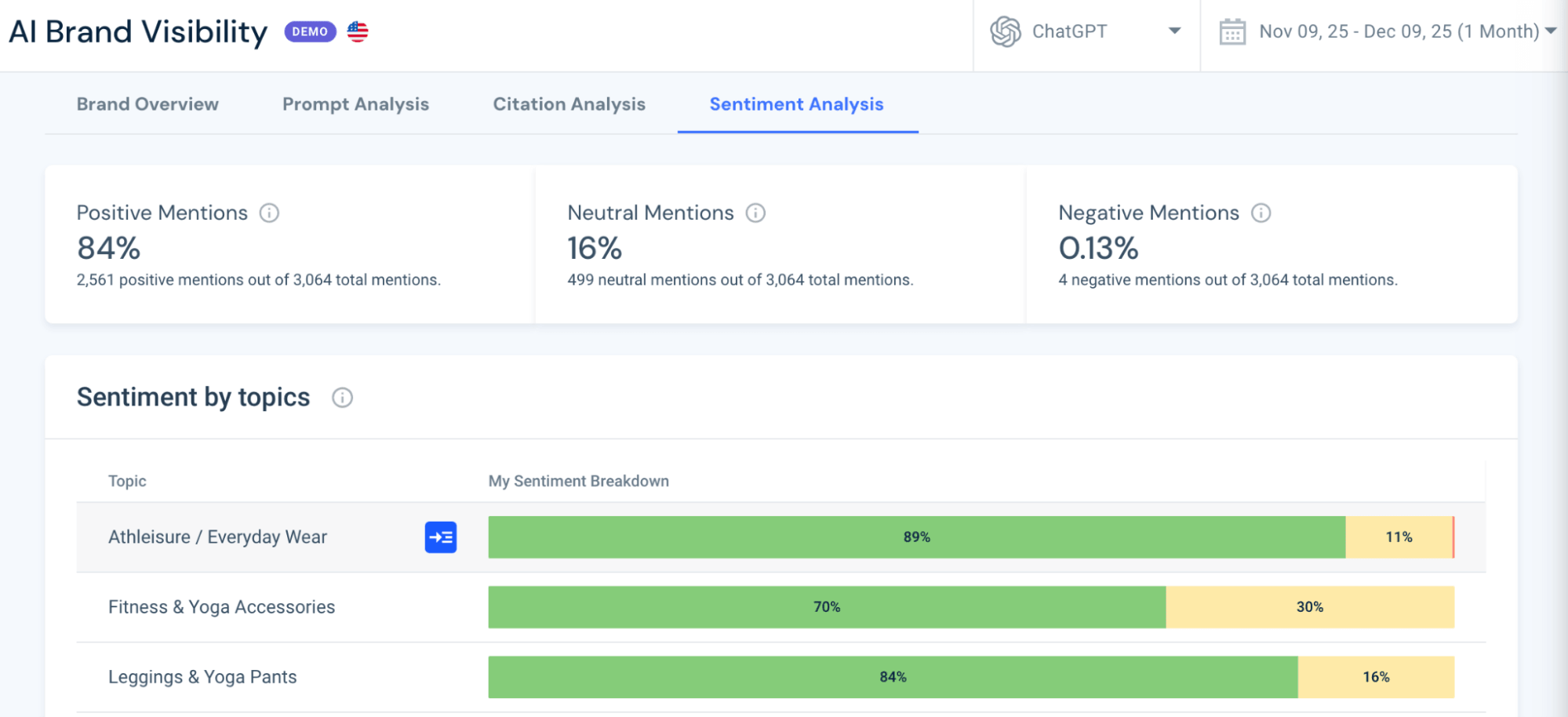
Compare your cited domains against competitors. High-authority domains that cite your competitor but not you are your priority targets, and closing that distance is exactly what citation gap analysis is built for.
Filter by topic to see which actual user questions are generating citations, and which aren’t mentioning your brand at all. Those gaps are your content roadmap.
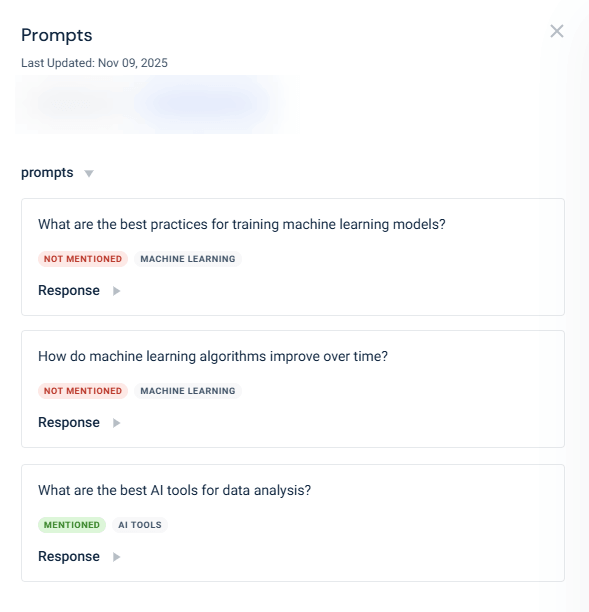
Citation sources shift constantly, set a weekly or monthly cadence to track changes in share of voice, citation count, and influence scores.
For the full step-by-step process, read our AI Citation Analysis guide.
For decades, a high Google ranking was the primary signal that your content had authority. That signal still matters, but it is no longer sufficient, and in many query categories, it is no longer the primary driver of visibility.
AI-powered search engines are now a parallel discovery channel with distinct source selection logic, different volatility dynamics, and higher-intent traffic for brands that earn citations in them. The 69% zero-click rate on Google is not a temporary anomaly, it reflects a structural change in how people consume information online. As that channel grows, the brands that invest in citation eligibility now will have compounding advantages that latecomers will struggle to close.
The starting point is understanding what an AI citation is, how it is produced, and what it actually takes to earn one, which is exactly what this guide has covered.
What is an AI citation?
An AI citation is an explicit attribution by a generative AI engine, such as ChatGPT, Perplexity, or Google AI Overviews, that credits a specific web page as the basis for part of its generated answer. It typically appears as a numbered footnote, a source card, or an inline link. It is the AI-era equivalent of a backlink: a trust signal that also gives users a direct path to your content.
How is an AI citation different from an AI mention?
An AI mention is when a model includes your brand name in a response based on training data, without attributing a specific source. An AI citation is when the model explicitly credits your page as the source of a specific claim, typically with a verifiable link. Mentions build brand awareness, citations build trust and drive direct traffic.
Do I need to rank on Google to earn AI citations?
For Google AI Overviews and AI Mode, yes, Google draws exclusively from its own search index, so organic ranking is the entry fee. For ChatGPT and Perplexity, no, since 25% of ChatGPT’s most-cited URLs have zero organic visibility in Google. Each platform uses distinct retrieval logic, and a cross-platform citation strategy must account for those differences.
What content signals earn AI citations?
Three conditions must be met simultaneously: technical accessibility (the page must be crawlable and indexed by AI retrieval systems), passage-level retrievability (each section should open with a direct, standalone answer rather than burying the point), and domain-level authority (E-E-A-T signals, named authors, and external citations from trusted sources). Failing any one of them is enough to be excluded from retrieval.
Are AI citations the same across platforms?
No. ChatGPT, Perplexity, and Google AI Overviews each use fundamentally different retrieval logic and source preferences. Only 11% of domains cited by ChatGPT are also cited by Perplexity for the same topic. Perplexity runs a live web search on every query, averaging 21.87 citations per response, while Google AI Overviews draws from its organic index and averages far fewer. A single content strategy cannot optimize for all three simultaneously, platform-specific approaches are required.
How do I measure my AI citation rate?
Standard web analytics and Google Search Console do not track AI citations. You need a dedicated AI brand visibility tool that tracks citation frequency, domain influence score, prompt-level coverage, and platform-specific citation share. Similarweb’s AI Citation Analysis tool maps all of these metrics across ChatGPT, Perplexity, and Google AI Mode, making it possible to diagnose citation gaps and benchmark against competitors.
Senior SEO Specialist at Similarweb
Maayan is a senior SEO specialist with 7+ years of experience in SEO. She loves complex research projects, creating SEO strategies and performing technical audits.
Dark Funnel Metrics: What to Measure When Buyers Decide Before They Click
What Happens After AI Recommends Your Brand?
ChatGPT Ads CTR by Country: Brazil, Mexico and Japan Out-Click the US by More Than 2x
Give it a try or talk to our insights team — don’t worry, it’s free!