
What is RAG (Retrieval-Augmented Generation)? A Marketer's Guide
by Shai Belinsky9 Min.
Oct 01, 2026
In the early days of the web, search engines had a fundamental need: a standard way to determine where to crawl. That’s why robots.txt became so important.
One small text file at the root of a site provided crawlers with a predictable, machine-readable set of rules, and over time, it evolved into an unofficial but widely respected standard.
We’re in a similar transition point now, with one main difference: The consumer of your content is often a large language model (LLM), not just a classic search engine bot.
Instead of just indexing pages and ranking blue links, Gen AI engines synthesize answers from multiple sources.
At the same time, they have very different constraints: limited context windows, difficulty dealing with complex HTML, and (in many implementations) no persistent, full-site index in the traditional sense.
That’s the context behind llms.txt: a proposal for a root-level, Markdown-based file that doesn’t tell bots where not to go (like robots.txt), but instead tells AI systems which pages you consider most important and how to interpret them.
Over the last year, discussion around llms.txt has split into camps, each with a different POV about the importance of this new file. However, it often seems like everyone is ignoring the real question SEOs should be asking about llms.txt:
“Given limited time and resources, does llms.txt deserve a place in our SEO and AI visibility strategy? And if so, where and how?”
This article is my data-informed answer and opinion on:
Let’s dive in.
llms.txt is a small Markdown file served at https://yourdomain.com/llms.txt that lists a curated set of your most important pages, each with a short description, in a tightly defined format.
The llms.txt file is designed primarily for inference time (i.e., when an LLM or agent is actively answering a user’s question), not for training or broad web indexing.
If you like analogies:
That last line is the key.
As SEOs, we’re used to influencing discovery and indexing. Llms.txt tries to influence prioritization under a hard constraint: an LLM can’t load and understand your entire site on every query. You can think of it as a type of “crawl budget”.
The official spec (proposed by Jeremy Howard/Answer.AI) defines a strict, simple structure:
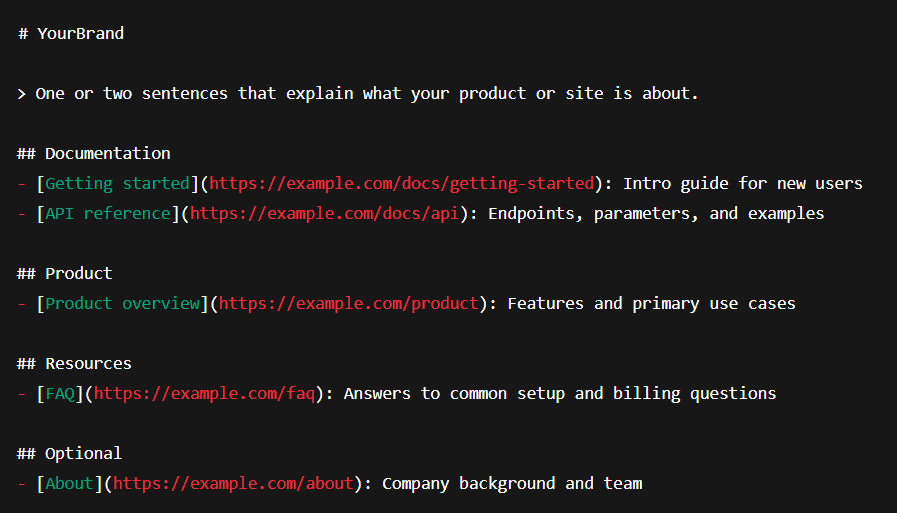
From an SEO and AEO point of view, this structure matters because it forces you to:
You’re not “optimizing the llms.txt file” for rankings, you’re making your content model legible to machines.
Around this spec, a small ecosystem has emerged:
Why this matters:
If you’re a dev platform or docs-heavy product, this ecosystem already improves agent reliability and developer experience, regardless of whether Google or OpenAI ever officially “use” llms.txt.
Because llms.txt lives at the domain root and ends in .txt, it’s easy for stakeholders to assume it works like robots.txt. It doesn’t.
In plain language:
The spec explicitly states that llms.txt coexists with (not replaces) robots.txt and sitemap.xml.
Mis-framing llms.txt leads to bad expectations:
From a strategy perspective:
If you treat llms.txt like a second sitemap and dump 200 URLs into it, you’ve missed the point, and you’re actively making life harder for any agent that tries to use it.
To decide if llms.txt is worth your attention, you need to be clear on the friction it addresses.
Classic search engine crawlers:
Many LLM-based systems, especially in “browsing” modes or agent setups:
The result:
Similarweb’s research on GenAI and publishers shows how these dynamics play out: AI Overviews increasingly satisfy user intent on the SERP, driving “zero-click” behavior and reducing visits to the underlying sites.
That same “answer-first” pattern applies when LLMs browse your site directly: they’re trying to get in, grab exactly what they need, and get out. Quickly.
Because of those constraints, we see failure patterns like:
Traditional SEO is mostly about being discoverable and indexable. In the AI era, we also need to be legible and prioritized within narrow context windows.
Llms.txt doesn’t pretend to fix everything. But it does attack one narrow yet important question:
If a model can only look at a handful of your pages, how do you help it pick the right ones and understand what each is for?
It does that by:
From a GEO/AEO perspective, llms.txt is less about chasing a ranking factor and more about increasing the odds that, if AI tools use your site, they start with the right content.
If you read across SEO blogs, dev docs, and product updates, four distinct positions show up.
This point of view is driven by the current adoption reality:
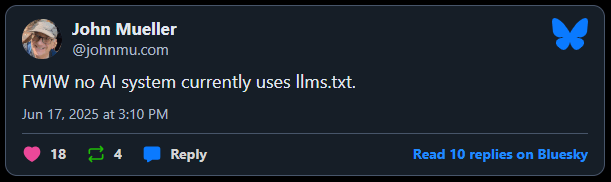
From that vantage point:
If you’re still dealing with crawl issues, thin content, weak website infrastructure, or fragile technical SEO, this camp is right: llms.txt does not belong anywhere near the top of your backlog.
This group agrees the impact is unproven, but looks at the cost differently:
They also value the internal exercise:
If your fundamentals are in good shape and you already care about AI visibility and Generative Engine Optimization, I’m aligned with this camp.
Think of llms.txt as “future insurance + content clarity,” not as a lever you report on quarterly.
In developer ecosystems, the discussion is much less theoretical.
Here, the upside is tangible:
If your product is developer-first or heavily API-based, I’d treat llms.txt and its ecosystem as a DX/docs requirement, not an SEO experiment.
The value shows up in developer adoption and retention, even if it never shows up in “organic sessions” reports.
This camp is focused on the bigger shift from clicks to answers.
In that world, GEO (Generative Engine Optimization) is about:
For this group, llms.txt is one more supporting signal:
Strategically, I agree with the GEO direction. Tactically, llms.txt is a small, aligned tactic, not the core of your AI optimization strategy.
Strong, straightforward, authoritative content still does most of the heavy lifting.
Strip out the hype, and you get a reasonably consistent picture.
Relative to the entire web, it’s still an early adopter pattern, not a mainstream standard.
Across public statements and independent experiments:
Today, classic ranking systems still respond to technical health, relevance, authority, and user signals. Not to llms.txt.
On the other hand:
If your product’s success depends on developers understanding your docs via AI tools, this matters.
With so many pros and cons to llms.txt, SEOs need to weigh the benefits it can bring to their site vs. the potential time waste of a 0-impact project. We don’t always have all the resources we need to carry out SEO tasks, so why add tasks that don’t result in more traffic or revenue for us?
Let’s get concrete, here’s how I’d prioritize it:
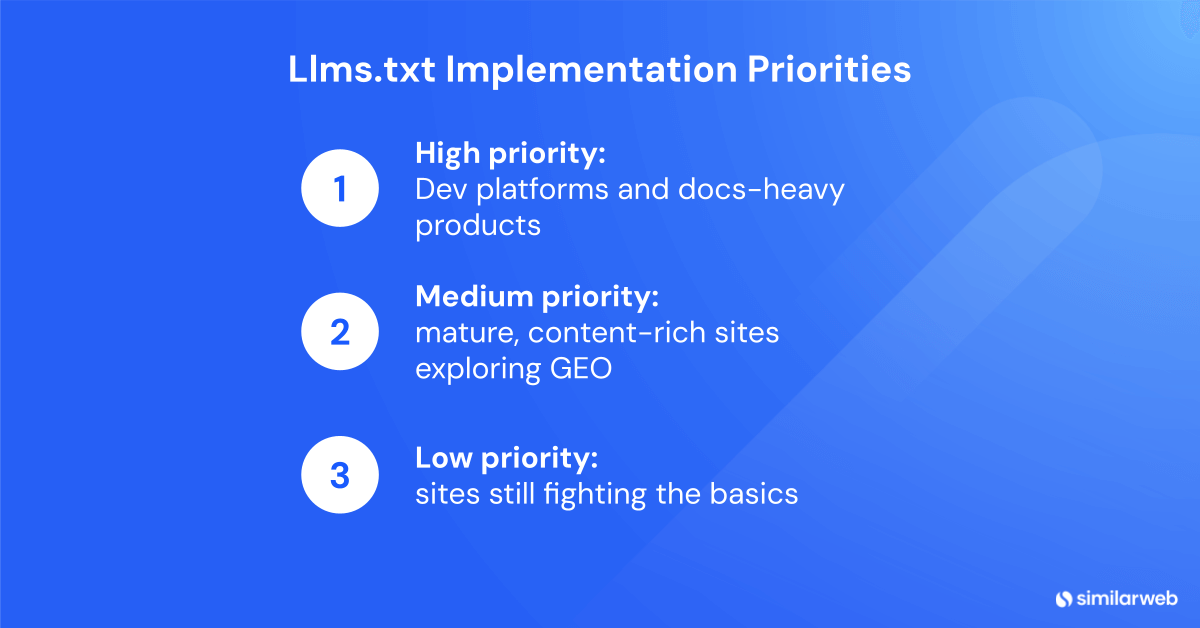
You should strongly consider llms.txt (plus llms-full and .md docs) if:
In that context:
Own this as a product/docs initiative, with the SEO team as a stakeholder.
Measure success via developer outcomes (time-to-first-success, reduced support burden), not ranking charts.
You should consider a lightweight llms.txt if:
Here, a small llms.txt is:
Invest ~45-60 minutes to create a curated llms.txt, then review it a few times a year alongside your normal content audits. Don’t sell it internally as a “growth lever”, present it as readiness + modeling clarity.
You should not prioritize llms.txt yet if:
In that world:
Keep llms.txt in your 20% “experimental” bucket for later. Get the 80% core SEO work stable first.
If you’ve decided to test llms.txt, here’s a pragmatic way to do it.
First, define what the file describes:
For most SaaS and dev companies, starting with docs only is realistic and high impact.
Then assign ownership:
If no one owns it, it will drift out of date (which is worse than not having it).
This is where the real thinking happens. Ask yourself: If an AI could only look at 5-15 URLs, which ones would we trust to represent us?
This exercise itself is valuable: it often exposes gaps and inconsistencies in your content strategy.
Using the spec, you might end up with something like:
# YourBrand
> YourBrand is a [short, factual description: what you do, for whom, and in what use cases].
This file provides a curated guide to our most important public resources for large language models and AI assistants.
## Documentation
- [Getting started](https://example.com/docs/getting-started): Introductory guide for new users
- [API reference](https://example.com/docs/api): Endpoints, parameters, and usage examples
- [Authentication](https://example.com/docs/auth): How to authenticate and manage API keys
## Product
- [Product overview](https://example.com/product): Features, plans, and core use cases
- [Pricing](https://example.com/pricing): Current pricing tiers and billing details
## Support & FAQ
- [FAQ](https://example.com/faq): Answers to common setup and account questions
- [Status](https://status.example.com): Live service status and incident history
## Optional
- [About](https://example.com/about): Company background and team
Why this works:
Think of it as internal linking + schema for AI, written in Markdown.
Implementation basics:
If you don’t want the file itself to appear in search results, configure your server to send an X-Robots-Tag: noindex header for that path.
You want AI engines and tools to easily find the file. You don’t need it cluttering up SERPs.
llms.txt should evolve with your site:
If you can’t commit to basic maintenance, it’s better to wait than to ship stale guidance.
You won’t (yet) see a neat “llms.txt → traffic spike” pattern in your dashboards, but you can use data to learn whether it’s being touched and whether AI visibility is changing.
If you want to do this at scale, you don’t have to write your own log parser. Similarweb’s Site Audit tool integrates log-file summary data from log analyzers like Logz.io and other tools, so you can overlay bot behavior with crawl and technical insights instead of treating logs as a separate, one-off project.
Be realistic:
That’s why I recommend positioning llms.txt internally as a forward-looking optimization and clarity tool, not a primary SEO KPI lever.
If you do implement llms.txt, avoid these traps:
Treat llms.txt like early schema markup or early XML sitemaps: worth testing after the fundamentals are in place, not instead of them.
llms.txt is interesting because it sits exactly where:
Whether llms.txt becomes widely adopted or not, the direction is clear:
In this “new world”, the SEO job shifts from “get us ranked” to “make sure we are the trusted, quoted source when AI systems answer questions in our space”.
That’s essentially Generative Engine Optimization (GEO): structuring clear, factual, self-contained content so answer engines choose you when they assemble responses.
llms.txt can support that, but only as a thin layer on top of a solid content strategy, strong entities and structured data, clean technical foundations, and a real view of how AI-driven traffic already behaves (which you can track with Similarweb’s AI search visibility and AI Chatbot Traffic tools).
In practice, llms.txt makes the most sense for dev and docs-heavy products, is a low-cost experiment for mature sites, and should sit behind core SEO work for everyone else.
Don’t build your AI optimization strategy around llms.txt. Build it around clarity, authority, and structure, then use llms.txt as one more small, aligned step in that direction.
Llms.txt is a Markdown file at your domain root that lists a small set of your most important pages for AI systems, each with a short description. It’s meant to guide LLMs and agents toward your “source of truth” content when they answer questions about your brand.
No. Right now, llms.txt is not a ranking factor and doesn’t directly influence AI Overviews. It’s best treated as future-facing documentation and agent support, not as a way to boost website traffic.
Publicly, major consumer assistants have not confirmed using llms.txt as a standard input for answers. However, some documentation platforms and agent frameworks already rely on llms.txt, llms-full.txt, and Markdown docs to power dev tools and coding assistants, so it’s gaining traction in those ecosystems.
Robots.txt controls where crawlers can go on a website. Llms.txt doesn’t block anything, but simply highlights a curated set of URLs and explains what they’re for, helping AI systems prioritize the right content.
Not exactly. A sitemap lists many or all indexable pages for discovery. llms.txt lists only a handful of high-value, canonical URLs and labels them with concise descriptions.
Prioritize it if you’re an API-first/developer platform. Nice-to-have if you’re a mature brand with solid SEO basics and you’re already investing in GEO/AEO. Skip for now if you still have core SEO issues.
GEO is about being selected and cited inside AI answers, not just ranking in SERPs. llms.txt supports GEO by giving AI systems a clear list of the pages you consider authoritative. However, it’s a supporting tactic; strong, structured, trustworthy content is still the core of any GEO strategy.
You can use Similarweb’s GenAI Intelligence and AI Chatbot Traffic capabilities to see which AI chatbots (like ChatGPT, Gemini, Perplexity, and others) refer traffic to your site and which pages they hit. That helps you connect llms.txt and AI legibility work to real-world behavior.
For most sites, 5-15 URLs is ideal. Focus on pages that clearly explain what you do, how to use your product, your pricing and policies, and your core docs or FAQs. If a page wouldn’t make sense as a standalone “source” in an AI answer, it probably doesn’t belong in llms.txt.
Used correctly, llms.txt shouldn’t hurt traditional SEO at all. It doesn’t change how classic search crawlers index your site, and you can mark the file itself noindex. The real risk is strategic: if you point AI tools at outdated or non-canonical pages, you might reinforce the wrong messages. That’s why light, ongoing maintenance is essential once you ship it.
Director of SEO & AI Search at Similarweb
Limor brings 20 years of expertise in SEO and AI Search. She thrives on solving complex problems, creating scalable strategies, and building amazing dashboards.
Give it a try or talk to our insights team — don’t worry, it’s free!