What is RAG (Retrieval-Augmented Generation)? A Marketer's Guide
by Shai Belinsky9 Min.
Oct 01, 2026
Your YouTube channel might already be doing work you can’t see in YouTube Analytics.
Picture a buyer asking ChatGPT to compare project management tools. More and more, the answer it gives doesn’t cite a blog post. It cites a YouTube demo video. Sometimes that video only has a few hundred views, and neither the brand nor the buyer would have found it by browsing YouTube search.
According to OtterlyAI’s YouTube Citation Study, YouTube now accounts for 31.8% of all social media citations across six AI search platforms. The study analyzed more than 100 million AI citation instances. Combined with Reddit, the two platforms make up 78.2% of that category.
That’s a reason to keep making videos, but it’s just as much a reason to optimize the ones you already have. Most teams only think about the first part.
In this guide, I’ll show you how to make your existing YouTube library citable by AI engines, why view count doesn’t predict AI citation the way it predicts YouTube success, and what YouTube GEO looks like in practice once you filter a real AI citation dataset down to YouTube sources.
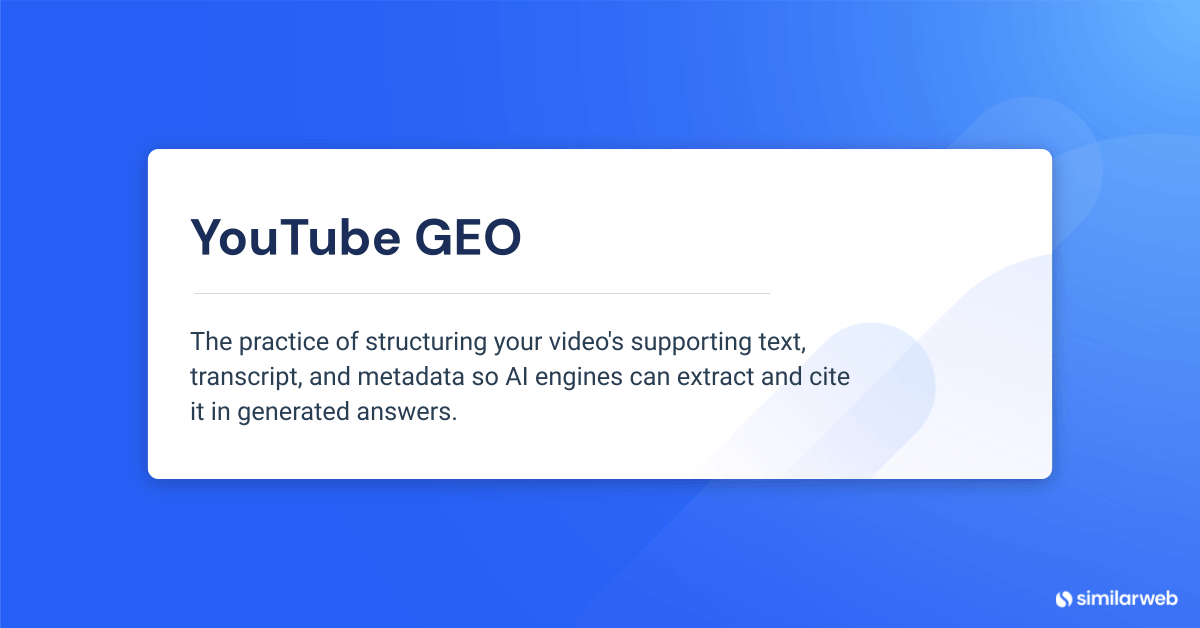
YouTube GEO is the practice of structuring your video’s supporting text, transcript, and metadata so AI engines like ChatGPT, Gemini, and Perplexity can extract and cite it in generated answers. If you’re new to the broader concept, Our GEO guide covers the fundamentals this article builds on.
YouTube SEO is the practice of optimizing the same elements so YouTube’s own algorithm ranks your video higher in search and Suggested.
The two overlap a lot, but the goal is different. SEO optimizes for a click. GEO optimizes for a citation, sometimes without a click at all.
| YouTube SEO | YouTube GEO | |
| Goal | Rank in YouTube search and Suggested | Get cited inside an AI-generated answer |
| Primary signal | Watch time, CTR, engagement | Transcript accuracy, description structure, chapters |
| Audience metrics matter | Yes | Barely. See the data below |
| Where it shows up | YouTube Analytics, Search Console | Not visible in either. Needs a dedicated AI visibility tool |
If you haven’t covered the ranking side yet, our YouTube SEO guide walks through titles, tags, and watch time in depth. This guide picks up where that one stops.
Views still matter. They drive ad revenue, channel growth, and YouTube’s own recommendation algorithm. What they don’t do is predict whether AI engines cite a video.
Views, likes, and subscriber count show almost no relationship to whether a video gets cited by AI. OtterlyAI’s analysis found a Pearson correlation of r = -0.03 between subscriber count and citation frequency. Nearly 41% of AI-cited YouTube videos had fewer than 1,000 views at the time they were cited.
Two metadata factors did correlate, though only modestly: description length (r = 0.31) and hashtag presence (r = 0.20). Everything else that drives traditional YouTube success barely moved the needle.
You can see the same shift outside citation-tracking data too.
In May 2026, YouTube announced Ask YouTube at Google I/O. It’s a Gemini-powered conversational search feature that answers complex questions by pulling together and summarizing videos from across the platform, instead of returning a list of results. YouTube’s own search box is starting to work the same way ChatGPT, Gemini, and Perplexity already do.
Two more findings from the OtterlyAI study should change how you prioritize your back catalog:
Put those two findings together and the priority is clear. A well-structured long-form video with clean chapters can earn multiple citations across multiple prompts, from a single upload you already made months ago.
You don’t need to re-record anything. AI engines mostly read the text around your video, not the pixels. That means the highest-leverage fixes are things you can do this week.
YouTube’s automatic captions often get brand names, product names, and technical terms wrong. A wrong transcript is worse than no transcript if an AI system is trying to quote you accurately. Upload a cleaned, human-checked transcript or caption file for every priority video.
Chapters work like H2 headers inside a video. Each one becomes a separately citable, timestamped chunk. That’s exactly the structure behind the 78% multi-citation rate above.
Open with a direct answer to the question the video addresses. Then list the key points in a scannable structure. This is the description-length signal (r = 0.31) that actually correlated with repeat citations.
The VideoObject schema gives AI systems and traditional search engines a structured, machine-readable summary of what the video is, who made it, and when it published.
None of this requires a new upload. It’s a metadata pass on videos you’ve already made.
Here’s what it actually looks like when you filter a live citation dataset down to YouTube sources.
I used Similarweb’s AI Brand Visibility tool to run a Citation Analysis for zoho.com, filtered to ChatGPT and the youtube.com domain, over a 7-day window. The Cited URLs table returned four YouTube videos.
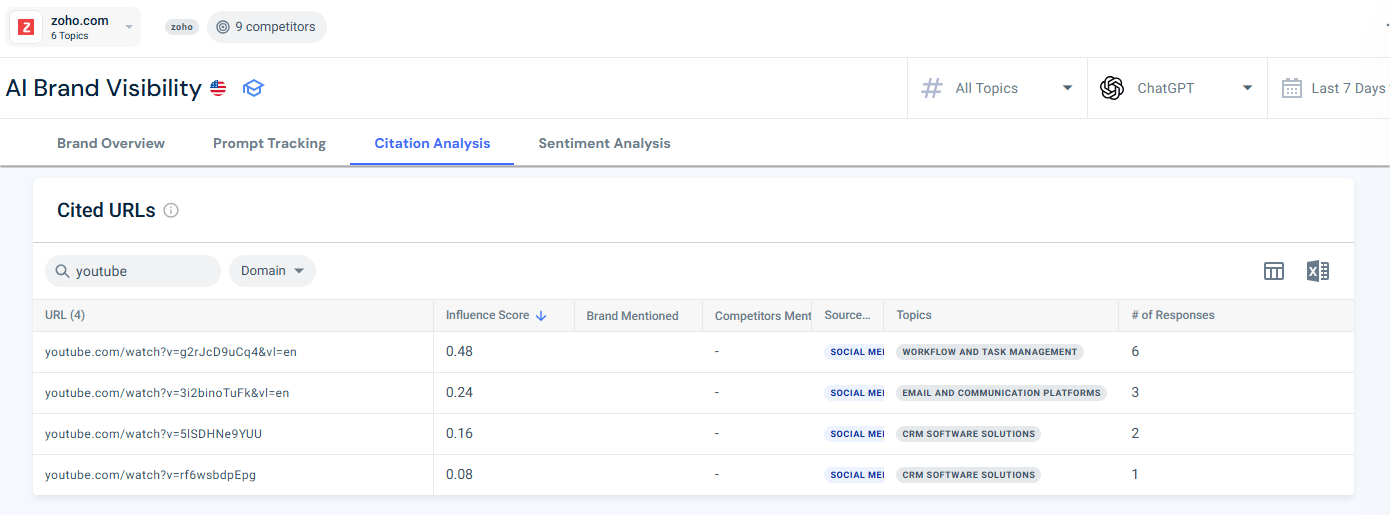
Video 1, the top result, turned out to be “Best Workflow Management Software in 2026 (Automation & AI Features)” from The Digital Project Manager:
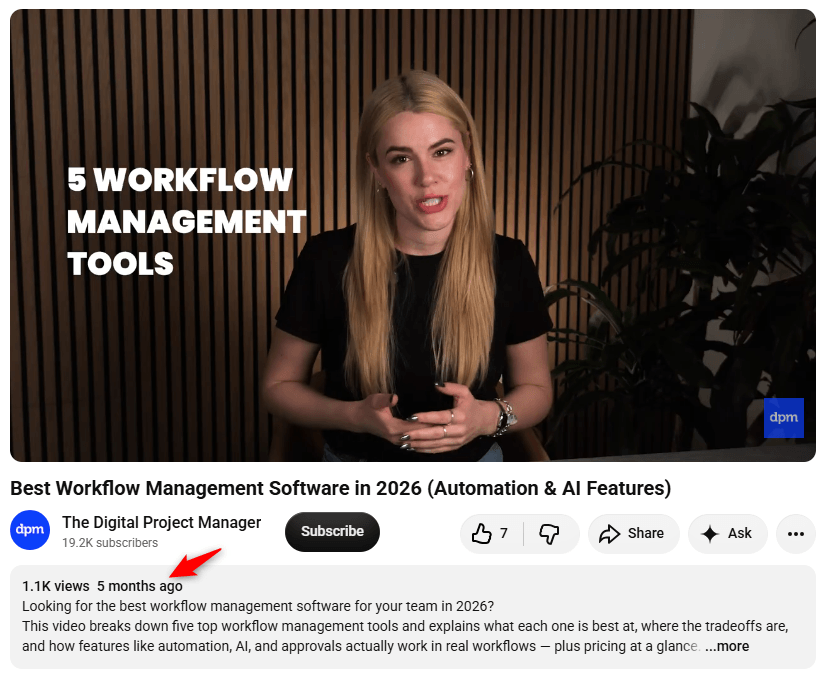
That channel has 19.2K subscribers, but this specific video has only 1.1K views and 7 likes. It was published 5 months before I pulled this data. It’s a small, unremarkable-looking video by YouTube’s own metrics, and it’s still the single most-cited YouTube source in this dataset.
Two things stood out to me. First, influence score drops off fast after the top result. Each video down the list earns roughly half the influence and half the response count of the one above it. Second, the top three videos by influence score were all published within the past few months.
That’s a small sample from one campaign and one 7-day window, so I’d treat it as a pattern worth testing at scale, not a proven ranking factor. But it lines up with something OtterlyAI found independently across its full 100 million-citation dataset: a weak positive correlation (r ≈ 0.3) between a video’s recency and how often it gets cited. Two different datasets pointing the same direction is a reason to take freshness seriously, even before either one qualifies as a proven ranking factor. And it points to something worth acting on regardless: a video from two years ago that never gets refreshed is competing against videos the model has more reason to treat as current, the same citation decay pattern that shows up in written content too.
You can also read the Cited URLs table as a content brief.
If “CRM software solutions” and “workflow and task management” are already earning citations for a competitor in your category, an AI engine has already decided those topics are worth sourcing from YouTube. That’s an AI visibility gap worth closing with a video, not a competitor’s win to shrug off.
If freshness correlates with influence score the way the pattern above suggests, an existing video that already ranks in the citation table is a candidate for an update pass. Refresh the transcript, update the chapter titles, and republish, rather than starting a new video from zero.
Once you can see which channels already earn citations for your category’s topics, you have a data-backed shortlist for co-marketing, guest explainer segments, or sponsored walkthroughs. That beats outreach based on subscriber count alone. Since subscriber count barely correlates with citation frequency, a smaller, well-structured channel that’s already earning citations in your space can be a better partner than a bigger one that isn’t.
None of this shows up in YouTube Analytics or Google Search Console. Citation frequency, which prompts trigger your videos, and which AI engine is doing the citing all require a dedicated AI visibility tool.
Track it the way you’d track AI-driven referral traffic generally. Watch which of your videos are being cited, for which topics, and by which engine. Then put more effort into the format and structure of whatever is already working. The same AI citation analysis approach you’d use for written content applies directly to your YouTube library, since both get read as text by the same underlying systems.
Start with your highest-performing existing videos, not new ones. Fix the transcript, add chapters, and rewrite the description as a direct-answer summary. Then track which videos start showing up in AI citation data, and let what’s working become the brief for what you make next.
If you want to see which of your own YouTube videos are already earning AI citations, Similarweb’s AI Search Intelligence is where to look.
Start with 5 to 10 of your best-performing existing videos on your core topics, not your whole library. Optimizing a smaller set well beats a fast, shallow pass on everything, since structure and topic fit matter more than volume here.
You can, but it’s not the priority. Title changes mainly affect click-through and YouTube’s own ranking, not citation eligibility. If you’re short on time, fix the transcript, chapters, and description first, then revisit the title as a second pass.
Treating this as a production problem instead of a text problem. Teams re-shoot videos for AI visibility before fixing the transcript, description, and chapters on what they already have, which is almost always the faster win.
Not negatively. Cleaner transcripts, better descriptions, and chapters all support traditional YouTube SEO too. You’re not trading one for the other.
There’s no fixed timeline. Google-based AI surfaces tend to pick up new video metadata faster than platforms like ChatGPT, which don’t recrawl as often. Treat this as an ongoing measurement habit, not a one-time check a few weeks after publishing.
Senior SEO Specialist
Shai, with 10+ years in SEO, holds a Bachelor’s and an MBA. He enjoys TV shows, anime, movies, music, and cooking.
Give it a try or talk to our insights team — don’t worry, it’s free!