What is RAG (Retrieval-Augmented Generation)? A Marketer's Guide
by Shai Belinsky9 Min.
Oct 01, 2026

Brand visibility and mention share tell you that AI engines know your brand exists. AI citation share tells you whether those same engines trust your content enough to cite it as evidence, to put your URL in front of a user as a verified source. Those are not the same thing, and conflating them is one of the most common strategic errors in GEO right now.
The gap between being known and being trusted is what AI citation share measures. It’s the metric that answers the only question that matters in AI-era search: when the engine needs evidence, does it reach for your content?
This article defines AI citation share precisely, explains why it differs by engine, shows you how to measure it using real data, and gives you a clear path to improving it. If your GEO reporting doesn’t track citation share yet, this is where to start.
AI citation share is the percentage of AI-generated responses, within a defined set of tracked prompts, in which your brand’s content is cited as a source, measured as a ratio of your citation events to all citation events across those same responses.
Formula:
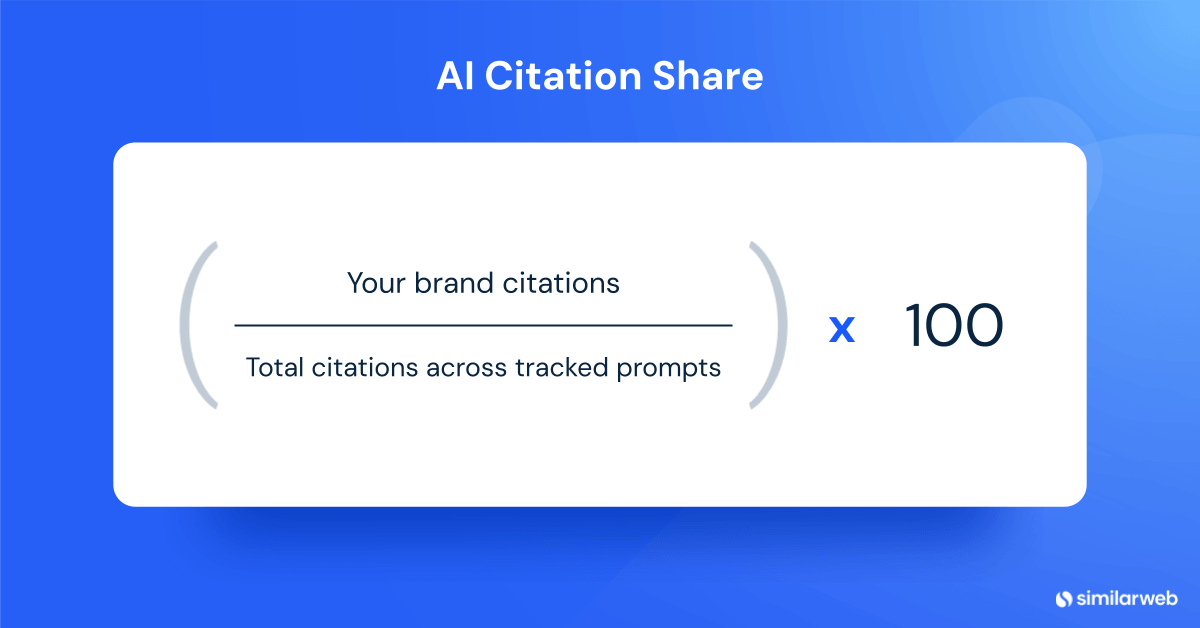
An AI citation is a specific event: the AI engine references your domain or URL as supporting evidence for its answer, typically by including a clickable link. This is distinct from a brand mention, where your brand name appears in the text of the response without a linked source attribution.
Total citations across tracked prompts mean that when you run a set of prompts through an AI engine, each response typically cites multiple sources: your brand, your competitors, third-party publishers, and others. The denominator is the total number of citation events across all your tracked prompts, not just the ones where your brand appears.
Example: You track 100 prompts across ChatGPT. Across all 100 responses, AI engines cite a total of 800 URLs, from your domain, competitors, Wikipedia, Reddit, and other sources. Your brand appears as a cited source in 80 of those citation events. Your AI citation share is 80 ÷ 800 × 100 = 10%.
These two metrics are often conflated. They measure fundamentally different things, and confusing them leads to the wrong diagnosis and the wrong fix.
AI share of voice (also called brand mention share) measures how often your brand is named in AI-generated responses relative to competitors, across a defined set of prompts. Being mentioned means the model associates your brand with a topic. It’s a recognition signal.
AI citation share measures whether AI engines are actually using your content as evidence, citing your URL when constructing an answer. It’s a trust signal.
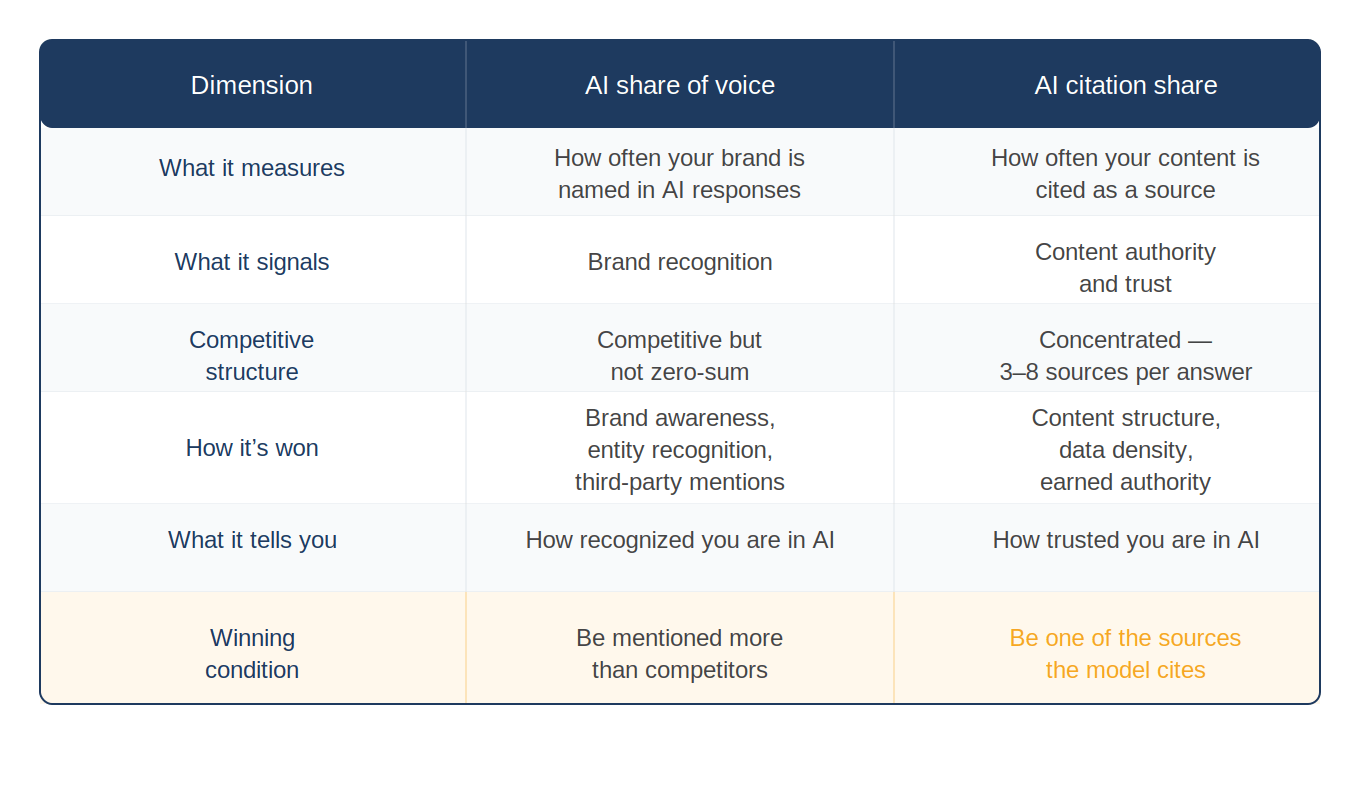
A brand can have a strong AI share of voice and a near-zero citation share simultaneously. That pattern, recognized but not cited, means the model knows your brand exists but doesn’t trust your content enough to use it as evidence. Those are different problems requiring different fixes.
One of the most consequential findings from our citation analysis on the most-cited domains by LLMs is that ChatGPT and Google AI Mode do not cite from the same source pool.
For ChatGPT, Wikipedia and Reddit lead the citation list, each accounting for roughly 12–13% of all citation events, a dominant share compared to every other domain on the list.
For Google AI Mode, the picture is strikingly different: Fandom.com leads by a significant margin, ahead of Wikipedia and YouTube. A fan wiki platform outranking Wikipedia as the top-cited source is counterintuitive, but it reflects how Google AI Mode draws from the full Google index, including highly topical community content, not just encyclopedic authority sources.
The strategic implication is the same: a platform-agnostic citation strategy underperforms. The sources that earn citations in ChatGPT are not the sources that earn citations in Google AI Mode, and your optimization priorities should reflect that difference.
Standard analytics tools don’t track AI citations. Setting up citation share measurement requires a dedicated approach.
To show how this works in practice, I ran the analysis on Sephora using Similarweb’s AI Prompt Analysis tool within the AI Brand Visibility tool.
The campaign tracked 179 prompts in total across ChatGPT. Of those, 19 prompts generated at least one citation event, meaning an AI engine cited a source URL in the response.
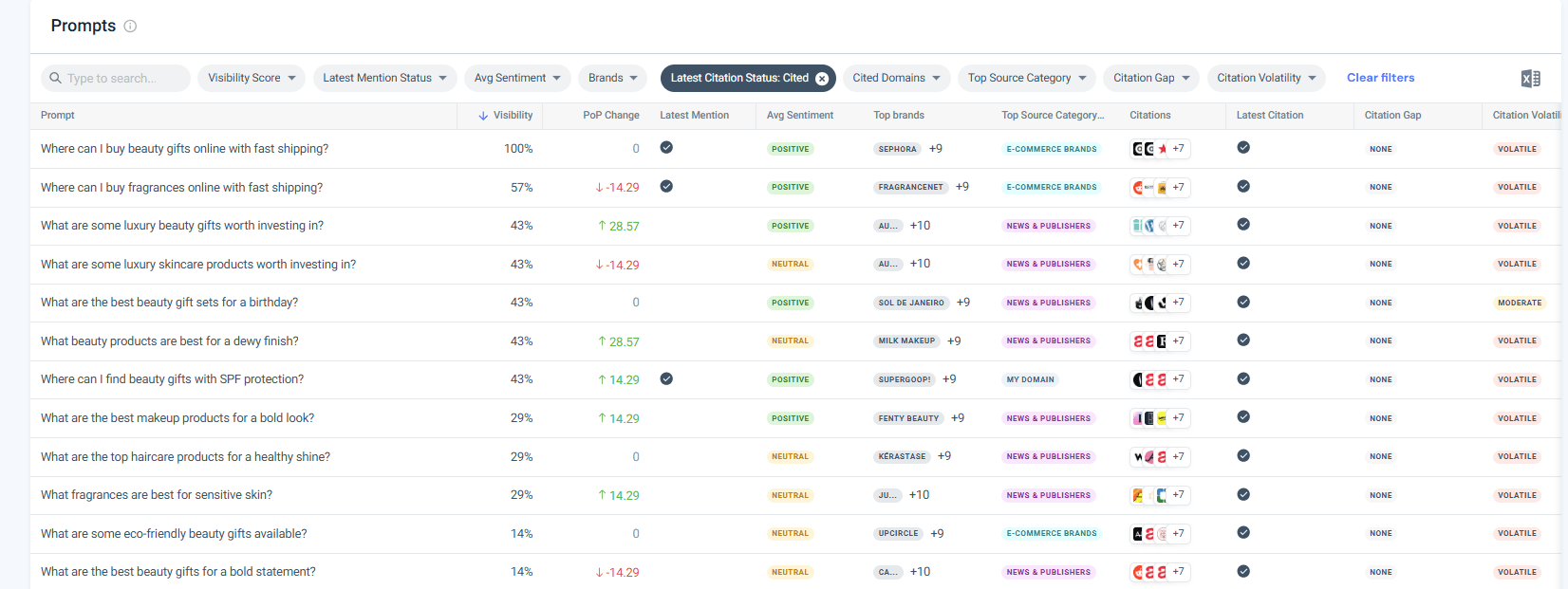
When I filtered specifically for Sephora, the brand appeared as a cited source in 3 of those 19 prompts.

That gives Sephora an AI citation share of 3 ÷ 19 × 100 = ~16%.
The three prompts where Sephora earned citations were all transactional and high-intent:
That pattern is telling: Sephora earns citations on purchase-intent queries, where AI engines treat it as a trusted commerce source. Its citation share on informational or inspiration queries: “what are some luxury skincare products worth investing in?” is weaker. That’s a content gap, not a brand recognition problem.
Here’s the process I followed, which you can replicate for any brand:
There is no universal benchmark. Citation share depends entirely on your defined query set, your competitive category, and the AI engine being measured.
The Sephora example gives a useful reference point for a competitive consumer brand: ~16% citation share across a 179-prompt beauty category query set on ChatGPT. That’s a meaningful position, cited in roughly 1 in 6 prompts that generated any citation at all.
What our data does show is that citation is highly concentrated. In brand categories, a small number of domains claim the majority of citation events within any given topic. Most brands that appear in AI answers at all are mentioned far more often than they are cited, which is why even a 16% citation share in a competitive category like beauty represents a real, defensible position.
AI citation share is the metric that separates brands that are known in AI search from brands that are trusted in AI search. The Sephora analysis shows what that distinction looks like in practice: cited in only 3 out of 19 prompts that generated any citation at all, and all three on high-intent, transactional queries where the brand’s commerce authority is undeniable.
That’s not a weak result. It’s a precise strategic signal. Sephora owns the purchase-intent citation space in beauty. The gap is on informational and inspiration queries, and that gap has a fix: better content structure, original data, and earned coverage on the domains AI engines actually cite.
The same diagnostic applies to any brand. Measure your citation share, identify where the citations land, and find the prompts where competitors are cited but you aren’t. That’s your roadmap.
What is AI citation share?
AI citation share is the percentage of AI-generated responses, within a defined set of tracked prompts, where your brand’s content is cited as a source. Formula: (your brand citations ÷ total citations across tracked prompts) × 100. A citation is a specific URL attribution, distinct from a brand mention that appears in the response without a linked source.
What is the difference between AI citation share and AI share of voice?
AI share of voice measures how often your brand is named in AI responses relative to competitors, it’s a recognition signal. AI citation share measures whether your content is actually used as evidence, it’s a trust signal. A brand can have strong AI share of voice and near-zero citation share at the same time, and those are different problems requiring different fixes.
What is a good AI citation share?
There is no universal benchmark. It depends on your query set, your category, and the engine you’re measuring on. The Sephora example provides a real-world reference point: ~16% citation share across a set of 179 beauty-query prompts on ChatGPT. Use your category’s top-performing brand as your ceiling and work toward closing that gap.
Why does my brand get mentioned but not cited in AI answers?
Usually it’s a content structure problem, not a brand awareness problem. AI engines extract at the passage level, content that buries answers in dense prose, lacks original data, or isn’t formatted for retrieval won’t get cited even if the brand is well known. Restructuring for extraction is typically more effective than publishing more content.
Does AI citation share differ between ChatGPT and Google AI Mode?
Yes, significantly. Our analysis of approximately 600,000 citation events in the US shows that ChatGPT and Google AI Mode do not cite from the same source pool. Wikipedia and Reddit dominate ChatGPT citations, while Fandom.com leads in Google AI Mode, ahead of Wikipedia and YouTube. A strategy optimized for one engine will underperform on the other.
Senior SEO Specialist at Similarweb
Maayan is a senior SEO specialist with 7+ years of experience in SEO. She loves complex research projects, creating SEO strategies and performing technical audits.
Give it a try or talk to our insights team — don’t worry, it’s free!