


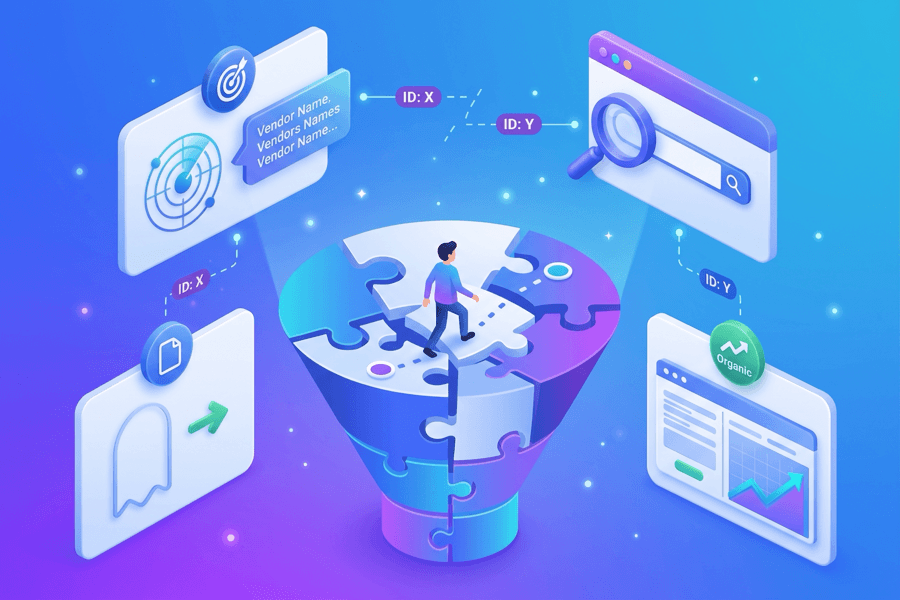
Marketing Funnel Fragmentation: Why AI Broke Attribution
by Limor Barenholtz20 Min.
Sep 17, 2026
Your brand can rank #1 on Google and still be invisible where a growing share of buying decisions now happen. When someone asks ChatGPT “what’s the best project management tool for a remote team,” the answer names four or five brands and cites a handful of sources. If you’re not in that answer, you lost more than a click. You lost the shortlist.
Generative AI platforms drew 9.5 billion average monthly web visits worldwide between June 2025 and May 2026, up 70% year over year, according to Similarweb’s AI search statistics. In the US, 35% of consumers now say AI tools are most useful at the product discovery stage, versus 13.6% for traditional search engines (Similarweb US Market Research Panel, January 2026). The shortlist is being written inside AI answers, and the sources behind those answers decide who makes the list.
The catch: you can’t manage what you can’t see, and spot-checking prompts by hand doesn’t scale. Our analysis of roughly 600,000 AI citation events into how AI chooses citations found that engines weigh relevance, clarity, structure, and trust more heavily than traditional rankings, and that cited sources barely overlap from one platform to the next. You need systematic tracking.
This guide compares the best AI citation analysis tools in 2026. You’ll get a five-point evaluation checklist you can reuse in any procurement conversation, a breakdown of each platform’s strengths and honest trade-offs, and a comparison matrix across the criteria that actually separate these tools: data quality, citation granularity, and whether visibility connects to real traffic.
Five criteria separate a serious AI citation analysis platform from a dashboard of vanity metrics: Coverage across LLMs, Integrity of prompt data, Traffic attribution, Evidence granularity, and Detection of your brand in cited sources. Score any tool you’re considering against these five, in this order, and the shortlist mostly builds itself.
Citation behavior varies wildly by engine. Our citation gap research found roughly 11% domain overlap between the sources ChatGPT and Perplexity cite, with about half of all cited domains changing monthly. A tool that tracks one engine shows you a fraction of a fast-moving picture. Look for ChatGPT, Gemini, Perplexity, and Google AI Mode at minimum, with per-platform filtering.
Every tracker runs prompts against AI engines and logs the answers. But that answer is only as good as the prompt behind it – a citation number is really a proxy for a question, and if the question is unreliable, the number is too.
Prompts distilled from real user behavior carry the messy, specific phrasing that actually drives buying decisions. Synthetic prompts, generated from keyword lists or APIs, carry a vendor’s guess at that phrasing instead. Feed an engine a question no real buyer would ask, and the citation pattern you get back is one no real buyer would ever see or click on.
A citation is a means, not an end. The tools worth enterprise budgets also connect citation data to downstream AI referral traffic, so you can report “our citation share on [topic] grew, and AI referral visits to these landing pages grew with it”.
AI referral traffic is still a sliver of total volume next to organic search. But the visitors it does send convert at a disproportionately high rate: they’ve already had the engine synthesize a comparison and make a recommendation before they click, so they arrive further down the funnel than a typical search visitor.
Domain-level counts tell you Reddit gets cited a lot. URL-level data with influence scoring tells you which specific thread, review page, or article is shaping answers in your category, which is what you need for digital PR, partnerships, and content modeling. Look for source categorization (editorial, forum, brand site), per-prompt citation visibility, and trend tracking.
Many of the URLs AI engines cite aren’t yours: review roundups, comparison posts, forums, news coverage. Those citations still shape the answer, and they matter even more when your brand appears inside them. A strong tool shows whether your brand is present in the third-party URLs being cited, and on which exact URL, so you can measure whether your digital PR and partnership placements are actually earning citation-level visibility.
Similarweb’s AI Citation Analysis tool, part of its AI Search Intelligence suite, tracks the domains and URLs cited across ChatGPT, Gemini, Perplexity, and Google AI Mode, and is the only platform in this comparison that connects those citations to measured AI referral traffic. For teams that need citation data they can defend in front of a CFO, that combination is the reason it leads this list.
Three things set it apart on the CITED criteria.
Similarweb’s tracking is built on prompts distilled from real user behavior: raw prompts are grouped, cleaned of personal information, and normalized into representative prompts that reflect what people actually ask. Because Similarweb owns its data infrastructure end to end, the numbers aren’t reconstructions bought from a broker or generated from keyword lists. When your visibility score moves, it’s because real user demand moved.
The Citation Analysis module assigns every cited domain and URL a Domain Influence Score, a measure of how much weight that source carries in shaping AI answers across your tracked topics. You can filter by platform, topic, and source category, see the exact URLs earning citations in answers that mention you and in answers that don’t, and turn the output directly into a PR and content roadmap.
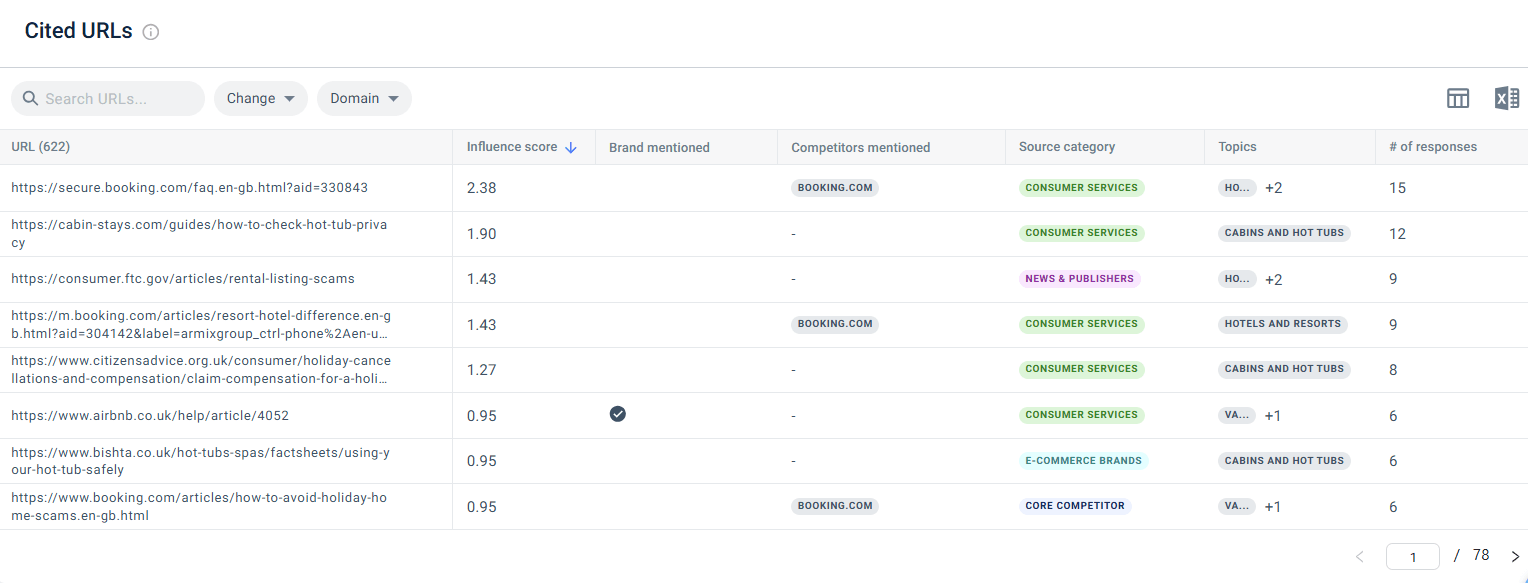
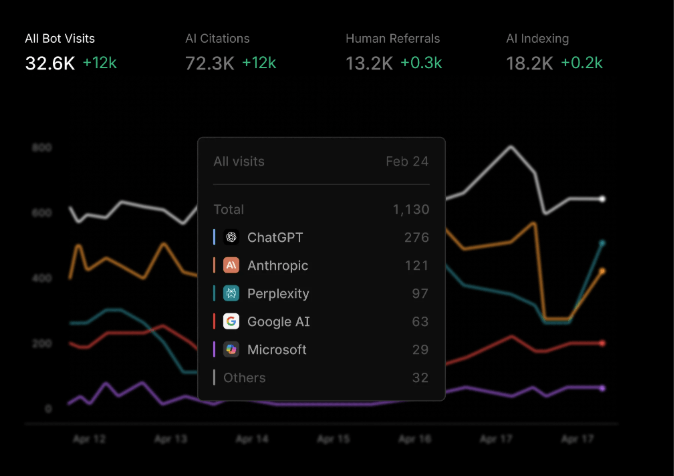
The same platform tracks AI referral traffic from ChatGPT, Gemini, Perplexity, Claude, Copilot, and DeepSeek, alongside Similarweb’s core web and SEO intelligence. Add Brand Visibility Scores, sentiment analysis, and trending topics, and citation work stops being a side dashboard and becomes part of how you measure digital performance. Campaigns support up to 300 prompts, multiple languages and countries, and custom competitor sets, with daily data updates.
Best for: mid-market and enterprise marketing, SEO, and competitive intelligence teams that need citation data grounded in real user behavior and tied to traffic outcomes.
Profound is a standalone AEO tracker aimed at technical SEO teams. On citation analysis specifically, it shows which sources appear in AI answers for tracked prompts and offers query fan-out analysis of how engines decompose a prompt into sub-queries, with granular metric slicing on top.
Its limits define its fit. Profound operates within the AI visibility layer only, so citation data sits without surrounding web traffic, SEO, or audience context. Profound does not describe an owned real-user prompt panel behind its tracking, and as of publication it does not connect citations to downstream traffic, so it can tell you a source was cited but not what that citation is worth.
Best for: AEO-only teams that want prompt-level diagnostics and already measure traffic elsewhere.
BrightEdge adds AI visibility features, including prompt-level research and audience persona tagging, to its enterprise SEO platform. Citation-specific capability is narrower than the dedicated platforms on this list, and its methodology for generating and sampling prompts is less publicly documented, which makes its citation numbers harder to independently interpret.
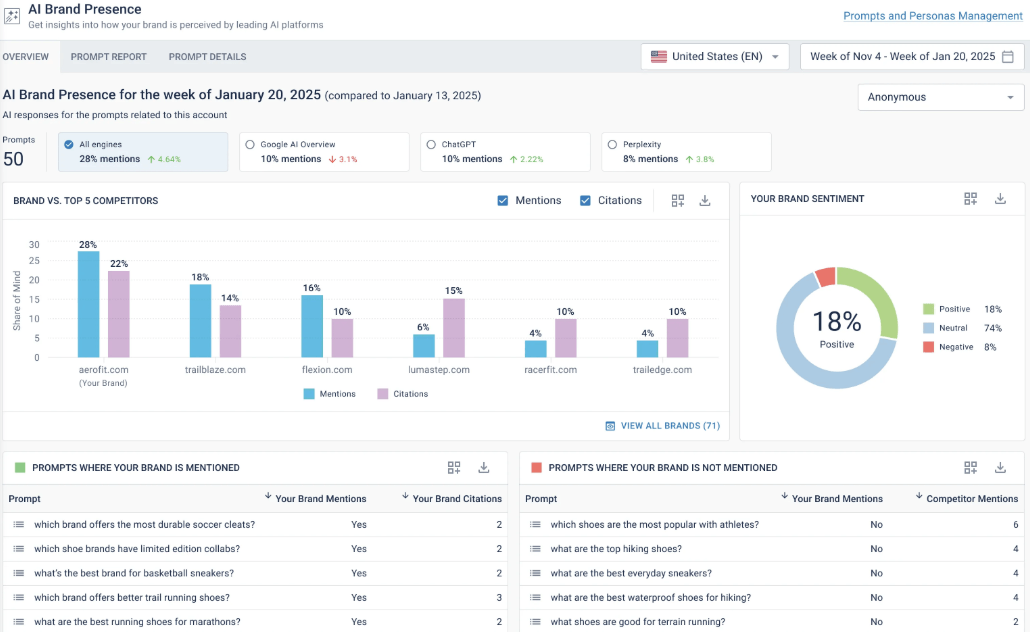
The packaging adds friction. AI visibility ships inside the broader enterprise platform rather than as a standalone product, and it does not currently connect AI visibility to AI referral traffic measurement.
Best for: organizations already standardized on BrightEdge that want basic AI presence tracking without adding a vendor.
Peec AI is the budget option: a simple dashboard and fast onboarding. Citation capability is basic-to-moderate, built on API-generated prompts rather than owned real-user data, which limits depth and auditability. There is no traffic attribution, so you can see whether you’re mentioned but not what it’s worth, and the governance layer (security certifications, API access, admin controls) is thinner than larger organizations typically require; verify current compliance posture directly with the vendor.
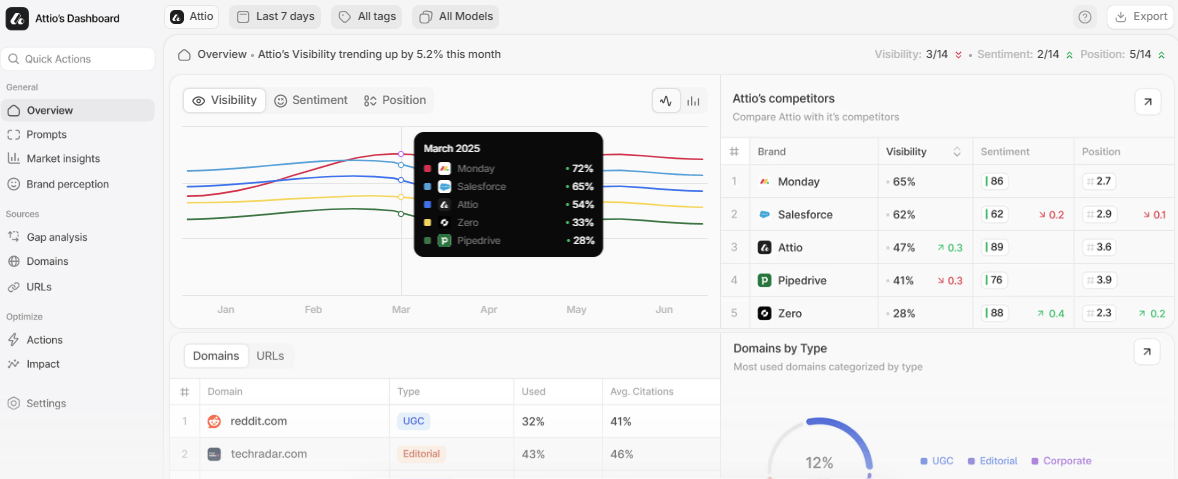
Best for: SMBs and small agencies testing whether AI visibility matters in their category before committing to a full platform.
The CITED checklist does the heavy lifting, and when you run all four platforms through it, one answer comes back: Similarweb is the best AI citation analysis tool in 2026. It’s the only platform on this list that combines real-user prompt data it fully owns, URL-level citation intelligence with Domain Influence Scores, and a direct line from citations to measured AI referral traffic. Profound, BrightEdge, and Peec AI each earn their place for a specific team and budget, but they all stop at telling you whether you were cited. Only Similarweb tells you what that citation is worth.
That difference decides who wins the next few years. Rankings decided who got the click; citations now decide who gets recommended, and increasingly, who gets bought. The brands that treat AI citations as a measurable channel, tracked daily, benchmarked against competitors, and tied to traffic, will own the shortlists their buyers never scroll past.
See exactly who AI cites in your category, and what it’s worth in real traffic, with Similarweb AI Search Intelligence.
An AI citation analysis tool tracks which domains and URLs AI platforms like ChatGPT, Gemini, and Perplexity cite when answering prompts in your category. It shows which sources shape AI answers, how your citation share compares to competitors, and where to focus content and PR to earn more citations.
Similarweb is the best AI citation analysis tool. It’s the only platform that combines real-user prompt data it fully owns, URL-level citation tracking with Domain Influence Scores across ChatGPT, Gemini, Perplexity, and Google AI Mode, and direct attribution from citations to measured AI referral traffic. Profound, BrightEdge, and Peec AI fit narrower needs: technical AEO diagnostics, enterprise SEO bundles, and entry-level tracking respectively.
A mention is when an AI answer names your brand in its text. A citation is when the answer credits a specific URL as a source. They move independently: you can be mentioned without being cited and cited without being mentioned, so strong tools track both signals separately.
A Domain Influence Score measures how much weight a domain carries in shaping AI-generated answers across tracked topics. A higher score means the domain is cited more frequently and across more prompts, making it a priority target for digital PR, partnerships, or content modeling.
For any brand whose buyers research with AI, yes. With 35% of US consumers rating AI tools as most useful at the discovery stage (Similarweb, January 2026) and cited sources churning monthly, systematic tracking is the only way to manage AI visibility as a measurable channel rather than an anecdote.
Fast. Similarweb’s citation research found about half of cited domains change month to month, and only around 11% of cited domains overlap between ChatGPT and Perplexity. That volatility is why daily or weekly tracking cadence matters far more here than in traditional rank tracking.
Backlink analysis tracks which sites link to your pages as an authority signal for search rankings. AI citation analysis tracks which sources AI engines actively pull from when generating answers, whether or not those sources link to you. The two overlap less than most teams expect, which is why citation tracking needs its own tooling.
Senior SEO Specialist at Similarweb
Maayan is a senior SEO specialist with 7+ years of experience in SEO. She loves complex research projects, creating SEO strategies and performing technical audits.
Marketing Funnel Fragmentation: Why AI Broke Attribution
Should You Add A TL;DR to Your Blog Posts To Help You Get Cited By AI?
Claude vs. ChatGPT: What 2026 Usage Data Says About Which AI to Pick
Give it a try or talk to our insights team — don’t worry, it’s free!