



Dark Funnel Metrics: What to Measure When Buyers Decide Before They Click
by Limor Barenholtz21 Min.
Oct 14, 2026

Every AI platform answer comes from somewhere. When ChatGPT tells someone how long a package usually takes to arrive, or which tool is best for managing seller returns, it’s synthesizing that answer from a specific set of sources, in response to a specific pattern of questions people keep asking. That pattern has a shape: some topics are climbing fast, some are cooling off, and some are being answered almost entirely from forum threads and reviews rather than from anyone who actually owns the subject.
This piece is about identifying which topics are actually gaining traction in AI platform conversations, how to read the signals that separate a real opportunity from a saturated one, and how to turn what you find into a prioritized content plan.
A trending AI topic is a subject or question that’s increasingly appearing in the prompts people send to generative engines like ChatGPT, Perplexity, and Gemini, not a rising Google search term. The two can move in completely different directions at the same time, because a search query and a conversational prompt are different units of demand: one is typed into a results page, the other is typed into a conversation the engine has to synthesize an answer for.
That distinction matters practically. A topic can carry high, rising interest inside AI platforms while barely registering in traditional keyword tools, because people phrase questions to a chatbot (“is there any way to get my order delivered sooner?”) very differently than they phrase a search query (“expedited shipping”). That gap is exactly where the opportunity sits: the sooner you can see a topic rising in AI conversations, the more room you have to become the source those conversations point to, before the rest of the field catches up.
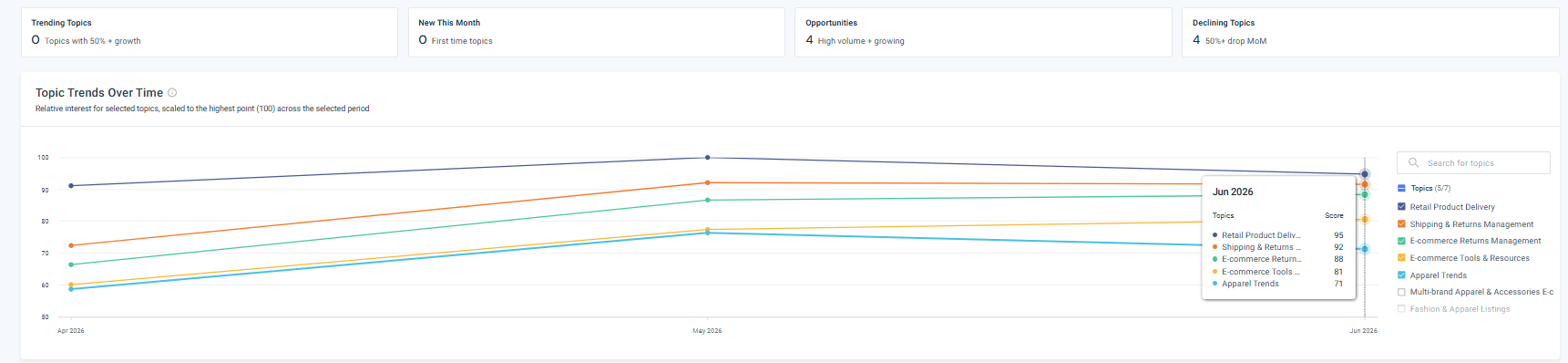
Start from a tracked category (an industry vertical or a set of competitors) inside AI Research view within Similarweb’s AI Search Intelligence, then work from the aggregate trend down to individual prompts. The workflow has three steps: scan the trend chart for what’s rising, open the ranked topic table to see the full list, then drill into any topic to read the actual prompts people are sending.
The value here isn’t any single topic’s position, it’s whether several topics are climbing together. When multiple related topics in the same account (delivery, returns, e-commerce tools) are all trending upward in the same window, that’s a category-wide shift in how people are asking AI platforms about your space, not noise on one term. That’s your signal to dig into the ranked list rather than treat any one topic in isolation.
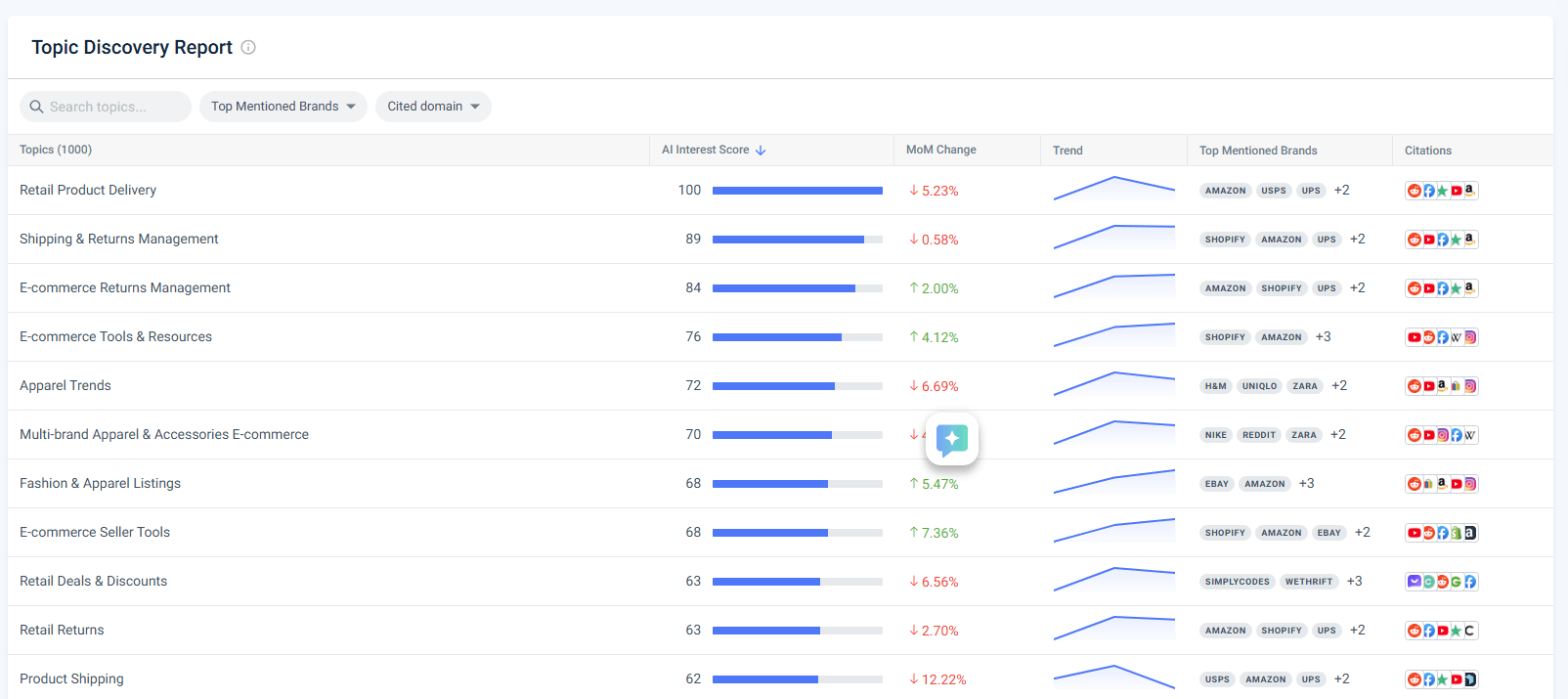
The real insight lies in the mismatch between the absolute score and the direction of movement. The topic with the highest AI interest score isn’t automatically the best one to act on, if it’s already flat or declining, it likely means the topic has matured and the field of sources answering it is already established. The better targets are usually mid-ranked topics with the strongest positive month-over-month movement: they haven’t peaked yet, which means there’s still room to become a source before the topic is fully saturated. Ranking by score alone will point you at the wrong priorities, ranking by score and trend direction together is what actually tells you where to spend effort first.
That pattern shows up clearly in this data set. “Retail Product Delivery” sits at the top with a score of 100, but it’s down 5.23% month over month, a sign the topic has already peaked and the current crop of cited sources is likely entrenched. Further down the table, “E-commerce Seller Tools” and “Fashion & Apparel Listings” both sit at a lower score of 68, yet they’re climbing at +7.36% and +5.47% respectively, faster than almost everything ranked above them. On score alone, those two would get overlooked, on score plus trend, they’re the stronger bet, rising interest with less time for a fixed set of sources to lock in the citations.
This step exists to close the gap between ‘this topic is trending’ and ‘this is exactly what to write.’ It’s the practical side of prompt tracking: the prompts, the summary, and the citation list together tell you the specific angle people care about, and who’s currently winning the right to answer it.
Take “E-commerce Seller Tools” for example. The topic name is broad, but the actual demand inside it is narrow: the summary shows cross-listing and listing management leading the questions, moving product data between marketplaces, reusing inactive listings, choosing multi-channel tools, alongside seller account navigation, fees, reports, and variant/quantity setup. None of the representative prompts (“What tool can cross-list my products across multiple marketplaces and sync inventory?”, “How do I find the right seller dashboard settings and reports for my account?”) are about seller tools in general, they’re all operational, “how do I do this specific task” questions.
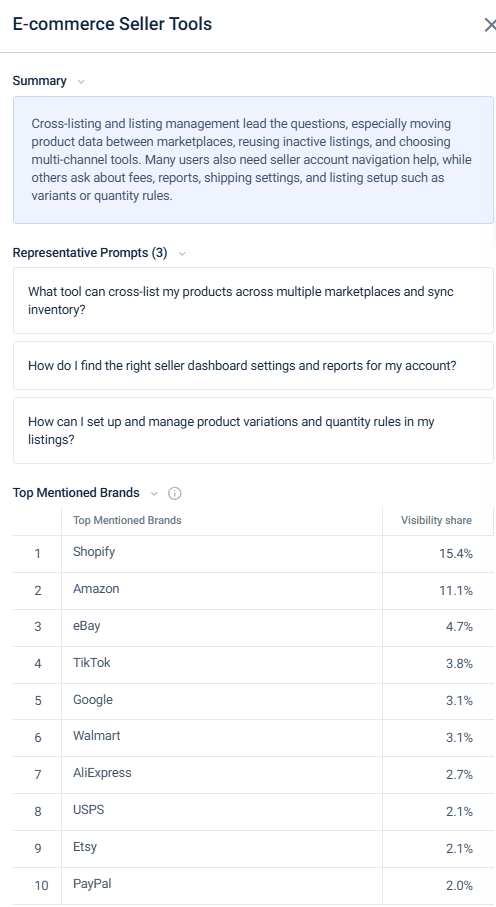
The citation list is where the real gap shows up, this is exactly the kind of citation gap analysis worth running on any topic before you commit to writing about it. Shopify leads the mentioned-brands table by a wide margin (15.4% visibility share, ahead of Amazon at 11.1%), but Shopify’s own domains, help.shopify.com, apps.shopify.com, community.shopify.com, combine for roughly 31% of citation influence, almost exactly matched by YouTube alone (31.15%) and closely trailed by Reddit (29.09%) and Facebook (19.27%). In other words: the brand people ask about most isn’t the source AI engines lean on most. Video walkthroughs and community/forum discussion are carrying as much or more weight as the brand’s own documentation.
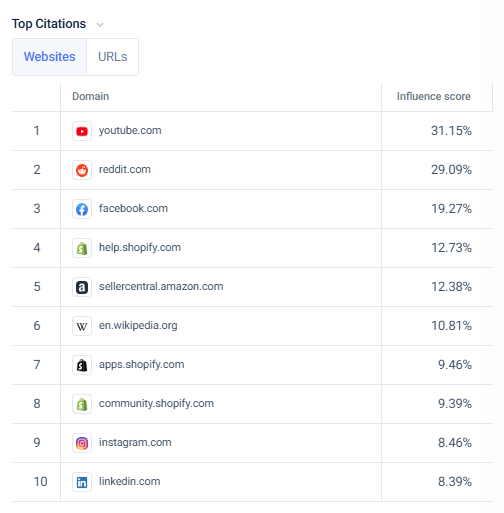
The practical takeaway: don’t write one broad “best seller tools” piece, write to the individual task. A page titled around cross-listing and inventory sync, another around seller dashboard settings and reports, another around setting up variants and quantity rules, each answering its representative prompt directly, has a real shot at pulling citation share away from video and forum sources, even in a topic where one brand already dominates the conversation.
Not every rising topic deserves the same format. The size of the gain and the number of distinct questions inside a topic point to different outputs.
“E-commerce Seller Tools” is rising fastest and, per Step 3, contains several genuinely separate operational questions (cross-listing, dashboard settings, variant setup), that spread of distinct prompts is what justifies a standalone article, or even several narrow ones, rather than a single page.
“E-commerce Returns Management” is rising more slowly (+2.00%) and sits closer to a mature topic (“Shipping & Returns Management” nearby is already declining), that combination suggests a single FAQ entry or a section inside an existing returns page is enough, rather than a new standalone piece competing for attention on a topic that’s close to peaking.
The rule of thumb: the steeper the rise and the more distinct prompts a topic contains, the more it justifies dedicated, standalone content. A modest riser sitting near an already-mature neighbor topic is better served by adding to something that exists than by publishing something new. Before committing to either format, run the topic through GEO keyword research to confirm there’s real demand behind it before you invest in it.
| Topic | AI Interest Score | MoM change | Direction |
| E-commerce Returns Management | 84 | ↑ 2.00% | Rising |
| E-commerce Tools & Resources | 76 | ↑ 4.12% | Rising |
| Fashion & Apparel Listings | 68 | ↑ 5.47% | Rising |
| E-commerce Seller Tools | 68 | ↑ 7.36% | Rising fastest |
The workflow doesn’t require guessing at what an AI platform might be asked about your category. Scan the trend chart to spot category-wide shifts, prioritize by change rather than raw score, then drill into any rising topic to find the specific question inside it and check whether its citations are still open. From there, match the format to what you find: a topic with several distinct questions and a steep rise justifies standalone content, a slower riser sitting near an already-mature neighbor is better served by adding to something that already exists. Run that same sequence on your own tracked category, and the topics worth writing next stop being a guess.
Once you’ve run this workflow a few times, spotting which topics are worth writing about stops being guesswork, it becomes a habit, built on watching what’s rising and acting before the field catches up.
A trending AI topic is a subject or question that’s increasingly appearing in the prompts people send to generative engines like ChatGPT, Perplexity, and Gemini. It’s a different signal than a rising Google search term, since a search query and a conversational prompt represent different units of demand.
Traditional keyword tools measure search volume for terms typed into a results page. AI topic tracking measures how often a subject comes up in conversational prompts, which are phrased differently and can rise or fall independently of search volume. A topic can be climbing fast inside AI platforms while its closest keyword equivalent shows little movement.
It’s a relative score, typically 0–100, showing how much attention a topic is getting inside tracked AI-platform conversations, normalized to the highest-scoring topic in the set. On its own it shows scale, not direction, it needs to be read alongside month-over-month change to know if that attention is building or fading.
Not necessarily. A high score paired with a flat or declining trend usually means the topic has matured and its citations are already established. A lower-scoring topic that’s rising fast, with a citation set that hasn’t hardened yet, is often the better target, because there’s more room to become a source before the field fills in.
Look at how many distinct questions sit inside the topic and how steep its rise is. A fast-rising topic containing several genuinely separate questions justifies a standalone article, or several narrow ones. A modest riser sitting close to an already-mature related topic is usually better served by a section or FAQ entry added to existing content.
Senior SEO Specialist at Similarweb
Maayan is a senior SEO specialist with 7+ years of experience in SEO. She loves complex research projects, creating SEO strategies and performing technical audits.
Dark Funnel Metrics: What to Measure When Buyers Decide Before They Click

What Happens After AI Recommends Your Brand?

ChatGPT Ads CTR by Country: Brazil, Mexico and Japan Out-Click the US by More Than 2x
Give it a try or talk to our insights team — don’t worry, it’s free!