



AI Search Optimization: Tips, Best Practices, and Techniques That Worked in 2026
by Limor Barenholtz18 Min.
Oct 22, 2026

Prompt tracking gives you a direct line of sight into how AI engines talk about your brand. But that visibility only becomes strategically useful when you’re tracking the prompts that sit at the intersection of what your audience actually asks, where you realistically compete, and where AI behavior is distinct enough to measure. Track the wrong prompts and you get noise. Track the right ones and you get a roadmap.
This article walks through a practical, metric-driven process for building a prompt set that does what it’s supposed to do: help you understand where your brand wins, where it loses, and what to do about it. I’ll show you exactly how this works in Similarweb’s AI Search Intelligence, using a real example, Uber, so you can see the decision logic, not just the theory.
One important framing note before we get into it: prompt selection is different from prompt discovery. How to find prompts and how to research them for GEO is covered in our guide on GEO keyword research. This piece is about what happens after you have a list of candidates, how you decide which ones earn a permanent slot in your campaign.
The instinct to track more prompts makes sense. More data should mean more insight. But in practice, prompt sets that grow without a selection framework create three problems that compound over time.
When you mix high-relevance prompts with low-relevance ones in the same campaign, the low-relevance prompts don’t just sit quietly, they pull your averages, distort your topic-level metrics, and make it genuinely harder to see what’s moving on the prompts that matter.
Generic prompts produce inconsistent AI responses because they’re genuinely contested, AI models hedge more, cycle through more brands, and produce more variable outputs across runs. That instability shows up as performance swings in your data that look like meaningful changes but aren’t.
Every prompt in your tracking set is an implicit claim on someone’s time. When a visibility gap shows up on a prompt that doesn’t connect to a real buyer situation, acting on it means optimizing for a metric, not for business impact.
Prompt selection works best when it’s driven by a consistent set of signals rather than judgment calls made on a prompt-by-prompt basis. Based on how Similarweb structures AI visibility data, five signals matter most when evaluating whether a prompt belongs in your tracking campaign.
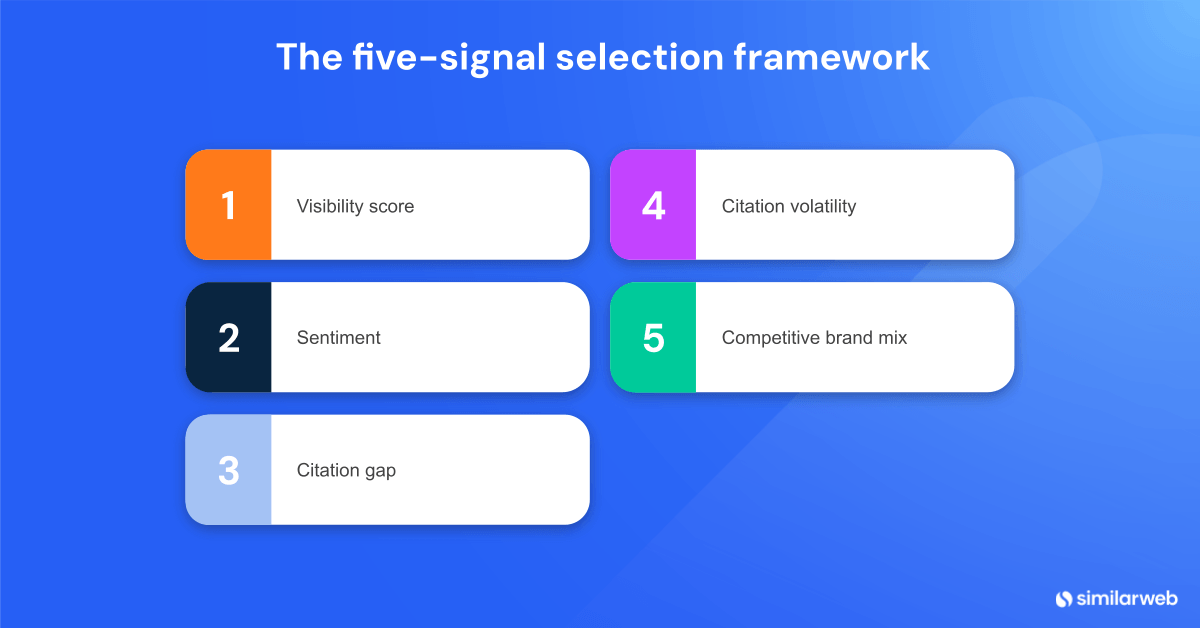
Visibility score tells you how often your brand appears when that prompt is run across the AI engines in your campaign. A prompt where you score 60% means your brand is present in 6 out of 10 AI responses. Visibility score is a relative metric, your score only tells you something useful when you know where your competitors stand. The selection logic runs in both directions: track prompts where you’re already strong (to protect and monitor) and track prompts where you’re clearly below your competitive position (to measure improvement as you close the gap). What you don’t need to track are prompts in the middle range where your brand appears inconsistently and the gap to the nearest competitor is too small to act on.
The tone AI models use when they reference your brand matters as much as frequency. A prompt where you appear consistently but with neutral or negative framing, caveats about pricing, limitations, and service reliability, is more important to track than a positive-sentiment prompt where you’re already well-positioned. Sentiment analysis lets you separate brand awareness from brand perception, which is where the real optimization work lives.
Citation gap tells you whether your brand is appearing in AI citations for a given prompt or not. A prompt where your brand is mentioned in responses but absent from citations is a different problem than a prompt where you’re not mentioned at all. It signals that your content isn’t being used as source material even when the AI knows your brand exists. Closing a citation gap requires a different content strategy than closing a visibility gap.
Citation volatility tracks whether the sources AI engines cite for a given prompt are stable or constantly changing. Volatile prompts, where the cited sources shift frequently, indicate that the AI model hasn’t settled on an authoritative source for that topic. That’s an opportunity. Stable prompts mean the citations are locked in. Both types deserve a place in your tracking set, but for different reasons: volatile prompts represent active optimization opportunities, stable prompts tell you whether your authority holds.
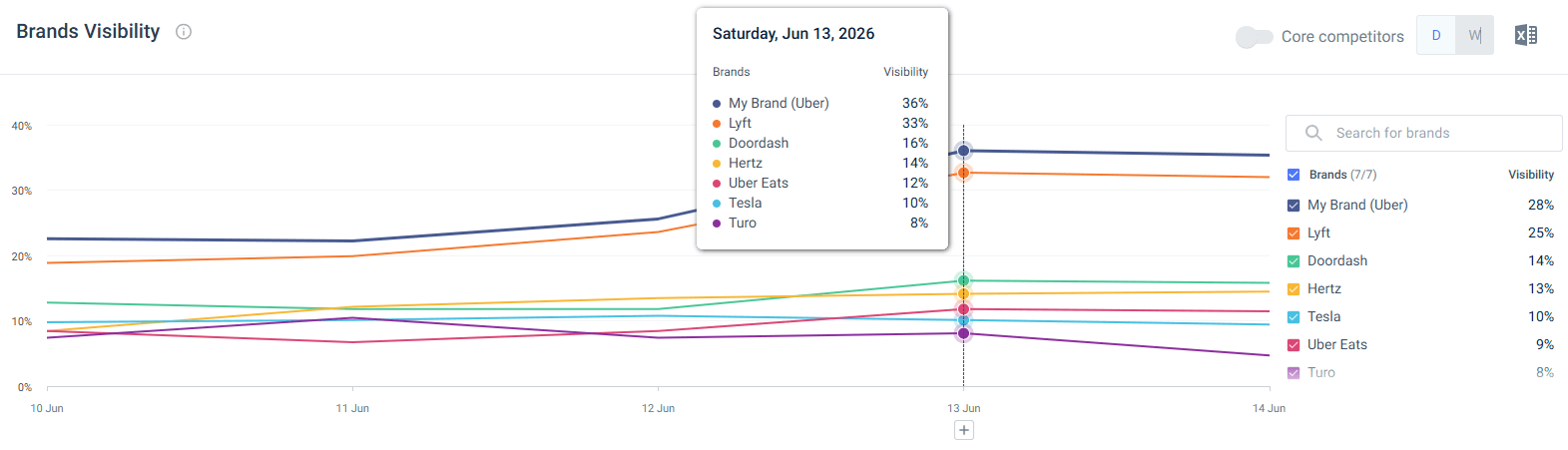
The “top brands” signal in your prompt data shows which competitors are appearing alongside you, or instead of you. Prompts where your direct competitors dominate but you’re absent or weak are high-priority tracking items regardless of what your visibility score looks like. These are the prompts where your brand is losing ground in the conversations your customers are already having.
Used together, these five signals give you a principled basis for evaluating any prompt candidate. A prompt that scores meaningfully on three or more of these signals belongs in your campaign. A prompt that scores on none of them doesn’t.
The framework above is only as good as the data you bring to it. Here’s how the selection process works in practice, using Uber as the example brand and the Ride Trip Planning topic as the focus area.
Before drilling into individual prompts, start with the Brand Overview tab in Similarweb’s AI Brand Visibility tool. This gives you a Topics Summary, a ranked view of every topic in your campaign.
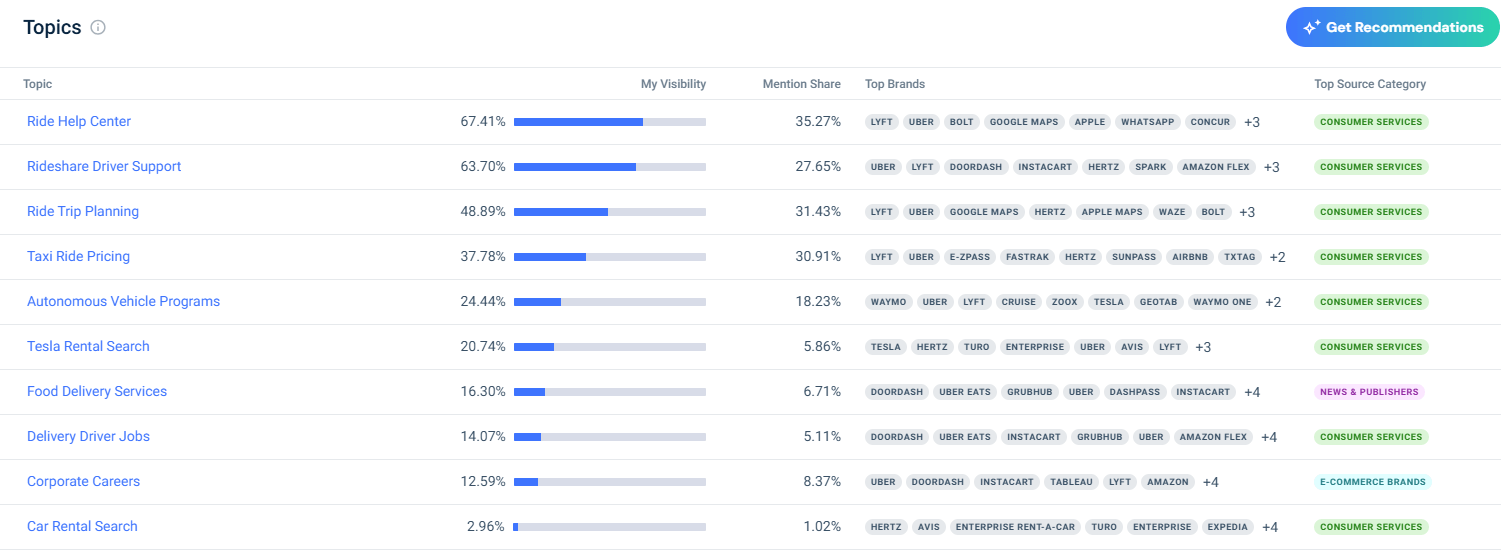
This topic-level view is the filter you apply before you ever look at individual prompts. Choose one or two topics where the strategic case is clear, you’re strong and need to protect, or you’re mid-table and have a legitimate path up, and go deep there rather than spreading attention across all topics equally.
For this walkthrough, I’ll focus on Ride Trip Planning, where Uber sits at 48.89% visibility with Lyft, Google Maps, Hertz, and Apple Maps as the competing brands.
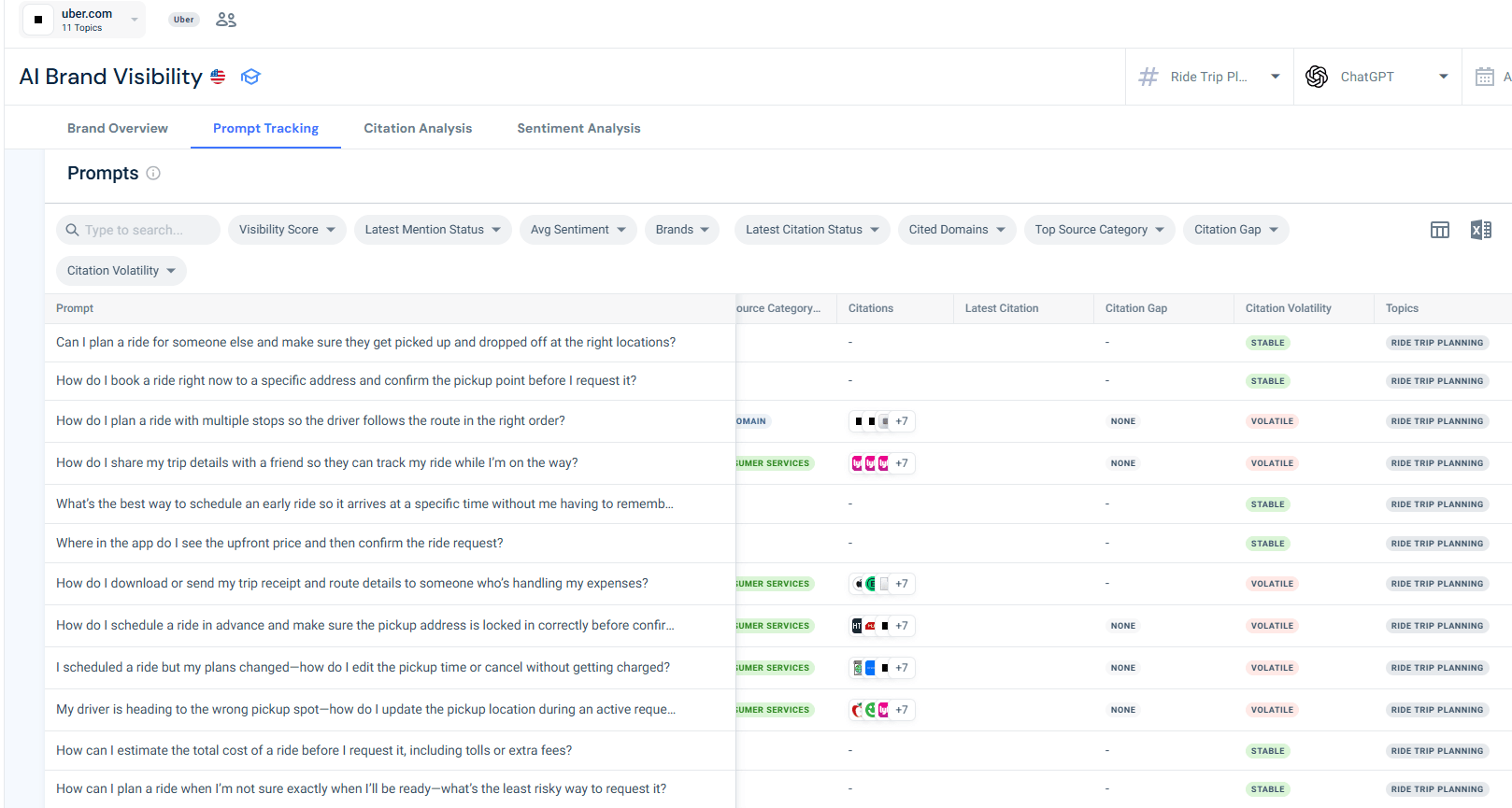
Next, go to the Prompt Tracker view and run a prompt analysis across your topic. The first thing to look at isn’t visibility alone, it’s visibility and sentiment together. And the Ride Trip Planning data makes this concrete immediately.
The sentiment pattern across these 13 prompts isn’t random, it splits cleanly along the type of question being asked. Every prompt where sentiment is positive is relational: planning a ride for someone else, sharing trip details with a friend, planning a ride with multiple stops. These are experience-led questions where Uber’s product narrative is clear and the AI has enough confident content to frame Uber favorably.
Every prompt where sentiment is neutral is transactional: confirming the upfront price, booking to a specific address, scheduling in advance, canceling without getting charged. These are the moments where users need clarity on mechanics, fees, and guarantees, and the AI hedges because the content it’s pulling from hedges too.
The important thing is that Uber isn’t absent from these neutral prompts. It’s at 100% or 80% visibility on all of them. The problem isn’t awareness, it’s that the AI doesn’t have authoritative, specific content to draw from on the transactional questions, so it describes instead of endorsing.
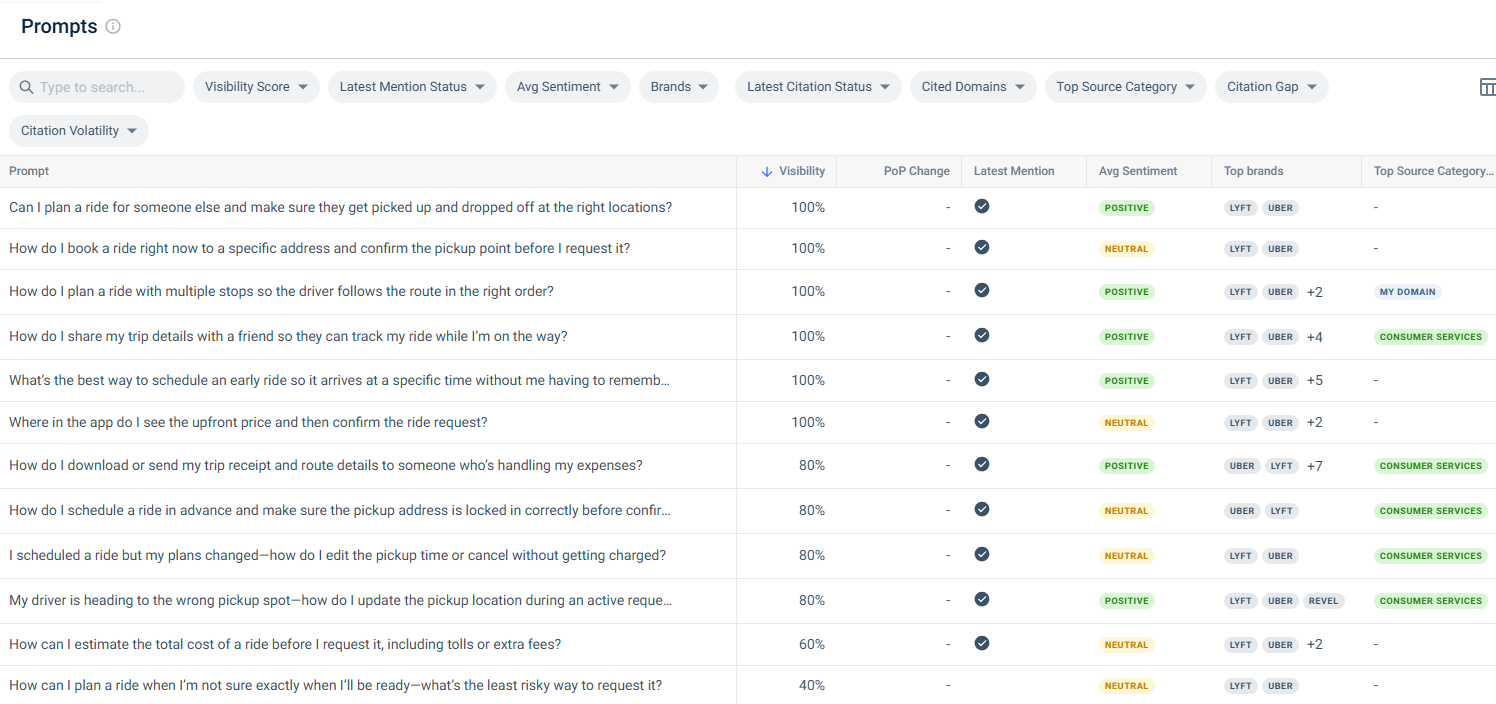
That distinction matters for how you prioritize. The neutral prompts aren’t a visibility problem, Uber is already in almost every response. The gap is in how the content is structured. AI engines need a clear, direct answer on price, cancellation, and scheduling mechanics to frame a brand confidently. If that content exists but buries the answer, restructuring it is the fix. If it doesn’t exist at all, creating it is. Either way, the problem to solve is content clarity.
Analyzing citations is where prompt selection gets most precise. Looking at the citations columns, the prompt set splits into two groups that require completely different approaches.
Six prompts have no citations at all: stable volatility, no citation data, no citation gap flagged. These are prompts where the AI is answering entirely from training data. There’s no external source competition happening, which sounds safe but is actually an opportunity. No citations means no entrenched competitor holding the source slot. If you publish well-structured, authoritative content on these topics before anyone else does, you become the first cited source by default. The playbook here is straightforward: identify which of these prompts connect to a real product moment, create content that answers the question directly and clearly, and get there before the citation landscape opens up and someone else claims it.
The remaining prompts, the four at 80% visibility plus two at 100%, are all volatile with active citations from consumer services sources. Citation volatility marked as volatile means the AI hasn’t settled on a preferred source yet, and the citation gap showing “None” on the 80% prompts means Uber is appearing in responses but not being cited as a source, it’s present in the answer but not driving it. The content likely already exists, but it needs to be restructured so AI engines can extract a clear, citable answer from it. That means direct answers at the top of the page, structured formatting, and explicit answers to the exact question the prompt is asking.
Not every prompt with a visibility gap is worth tracking. A gap only matters if there’s a realistic path to closing it. Cut a prompt when:
Two prompts in the Ride Trip Planning set hit these criteria. Estimating the total cost of a ride sits at 60% visibility but has no citations, no citation gap, and stable volatility, and critically, price estimation is a category-level question that Lyft, Google Maps, and others answer just as well. There’s no Uber-specific angle to own. Planning a ride when you’re not sure when you’ll be ready is the weakest prompt in the set across every signal: 40% visibility, stable, no citations, and the intent is too vague to connect to a specific product moment.
Putting this together into a repeatable process, here’s the scorecard to use when evaluating whether a prompt belongs in a tracking campaign:
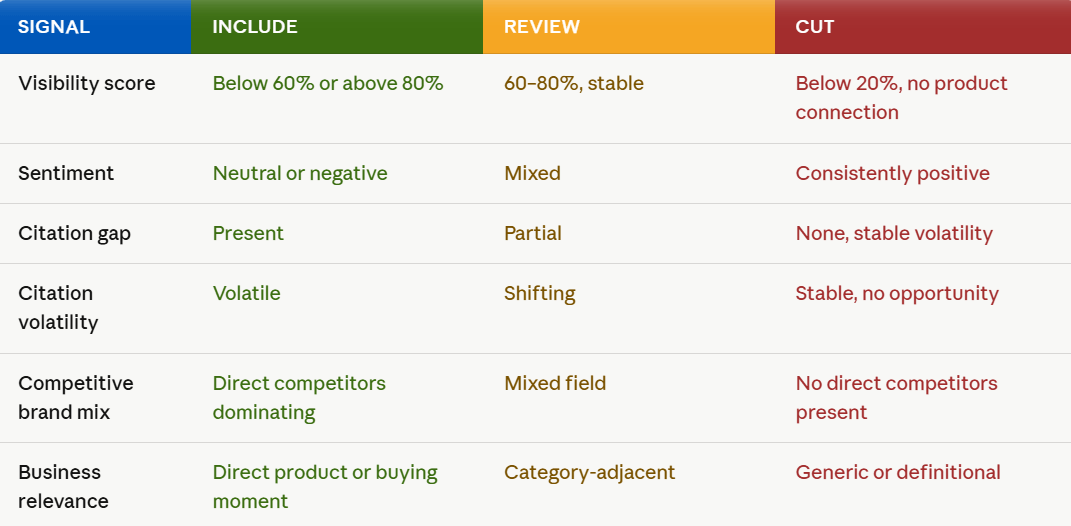
Score each prompt candidate against all six signals. Four or more in the Include column, add it to your campaign. Three signals, include it but assign it a clear owner and a specific action from day one. Two or fewer, hold it until you’ve filled your campaign with stronger candidates.
Prompt selection is the decision that determines whether your campaign produces actionable data or just a dashboard that looks comprehensive.
The Uber analysis surfaces four insights that hold across any brand and any topic.
First, high visibility isn’t always a win. Second, the relational vs. transactional sentiment split is a content signal, not a visibility signal. Third, stable prompts with no citations aren’t dead ends, they’re first-mover opportunities. Fourth, volatile prompts with a citation gap are the most urgent items in any campaign.
The prompts you cut matter as much as the ones you keep. Removing prompts with no citation activity, wrong intent, or no direct product connection isn’t narrowing your campaign, it’s making the remaining data actionable. A smaller, sharper prompt set will always outperform a comprehensive one that no one can act on.
How many prompts should I track per topic?
There’s no universal number, but the right size is determined by how many prompts you can assign a specific action to. If a prompt in your campaign doesn’t have a clear owner and a clear optimization path, it’s taking up capacity without adding signal. In practice, 8–15 prompts per topic is a workable range for most teams.
What’s the difference between a citation gap and citation volatility?
Citation gap tells you whether your brand is being cited as a source in AI responses. Citation volatility tells you whether the sources being cited are stable or actively changing. A prompt can show high visibility with a citation gap and volatile citations simultaneously, meaning your brand appears in responses, no one owns the citation slot yet, and the competition is still open. That combination is the highest-priority situation in any prompt set.
Should I track prompts where sentiment is positive?
Yes, but as stability monitors rather than optimization targets. Positive sentiment at high visibility means your position is strong, the value of tracking those prompts is early warning if something changes. The prompts that need active attention are the ones where visibility is high but sentiment is neutral, particularly on transactional questions where the AI describes your brand instead of endorsing it.
When should I cut a prompt from my campaign?
Cut a prompt when it has no direct product connection, wrong intent, flat signals across the board, or the question is too generic for your brand to own a meaningful share of the answer. A visibility gap alone isn’t a reason to track, there needs to be a realistic path to closing it through content.
How do I know if my existing prompt set needs to be rebuilt?
Go through each prompt in your current campaign and ask whether you can name a specific action based on what the data shows. If the answer is no for more than half of your prompts, the set needs to be rebuilt around the five signals: visibility score, sentiment, citation gap, citation volatility, and competitive brand mix.
What does it mean when a prompt has no citations at all?
It means the AI is answering entirely from training data, with no external sources in play. That’s not a weak position, it’s a first-mover opportunity. No citations means no competitor has claimed the source slot yet. If you publish well-structured content that answers that prompt directly before anyone else does, you become the default cited source. The window closes once a competitor gets there first.
Is prompt selection a one-time decision?
No. AI visibility data shifts as models update, competitors publish new content, and citation landscapes open or close. The two signals that most reliably flag a prompt for reassessment are a period-over-period visibility change of more than 15 percentage points and a shift in citation volatility from stable to volatile or vice versa. When either of those happens, pull the prompt insights view to understand what changed before deciding whether to act or swap the prompt out.
Senior SEO Specialist at Similarweb
Maayan is a senior SEO specialist with 7+ years of experience in SEO. She loves complex research projects, creating SEO strategies and performing technical audits.
AI Search Optimization: Tips, Best Practices, and Techniques That Worked in 2026

Dark Funnel Metrics: What to Measure When Buyers Decide Before They Click

What Happens After AI Recommends Your Brand?
Give it a try or talk to our insights team — don’t worry, it’s free!