



Dark Funnel Metrics: What to Measure When Buyers Decide Before They Click
by Limor Barenholtz21 Min.
Oct 14, 2026
Almost every AEO marketing guide published in the last two years has the same blind spot: it tells you to optimize your blog content, your thought leadership articles, and your educational guides for SaaS. It does not tell you how to optimize your product pages for AI search.
Write better content, structure it for AI extraction, and earn citations. Good advice for a content team. Completely useless for the moment that actually decides whether a buyer puts you on their shortlist.
When a VP of Sales types “best CRM for a 50-person sales team” into ChatGPT, the AI doesn’t only surface the latest article on sales productivity trends. It surfaces your product page, your pricing page, your comparison content, and whatever G2 says about you.
That’s the consideration moment. And most SaaS companies have left their product pages completely unprepared for it.
The numbers make the stakes concrete. Previsible analyzed 1.96 million LLM-driven sessions across 12 months and found that product and tool pages attract 7 to 9 times more AI-referred traffic than the average page. They are already the primary surface AI sends buyers to. They’re just not optimized for it.
As an SEO director working on AI search visibility optimization for a SaaS company, I kept running into this gap. Most of the AEO guidance being published was written for content teams optimizing blog posts. Nobody was talking about what happens to your product pages, the pages that actually drive pipeline, when AI becomes the first stop in the buying journey.
When I started looking at which Similarweb pages were actually earning AI citations, the insight was immediate: it was not the blog posts doing the work.
The pattern is visible at scale. The most AI-visible SaaS product pages are not necessarily the biggest brands. They are the ones whose pages are built for retrieval: static HTML, structured data, and ungated content.
The referral loop compounds this: AI platforms are already sending measurable, growing traffic back to product pages. AI recommends your product. Buyers click through. AI sends them again next time.
This guide covers answer engine optimization practices specifically for SaaS product pages.
Not blog posts, not technical support articles, not your homepage. The pages where buyers make purchase decisions: feature pages, pricing pages, solution pages, integration pages, comparison pages, and developer documentation.
The distinction matters because AEO on a blog post and AEO on a SaaS product page require different schema types, content architectures, and third-party signals. What works for one does not automatically transfer to the other.
Here’s what you’ll learn:
AEO for SaaS product pages is the practice of structuring your product content, feature pages, pricing, comparisons, and documentation so that AI engines can extract, verify, and recommend your software in their answers to buyer questions. Not just cite it as a source. Recommend it as a solution.
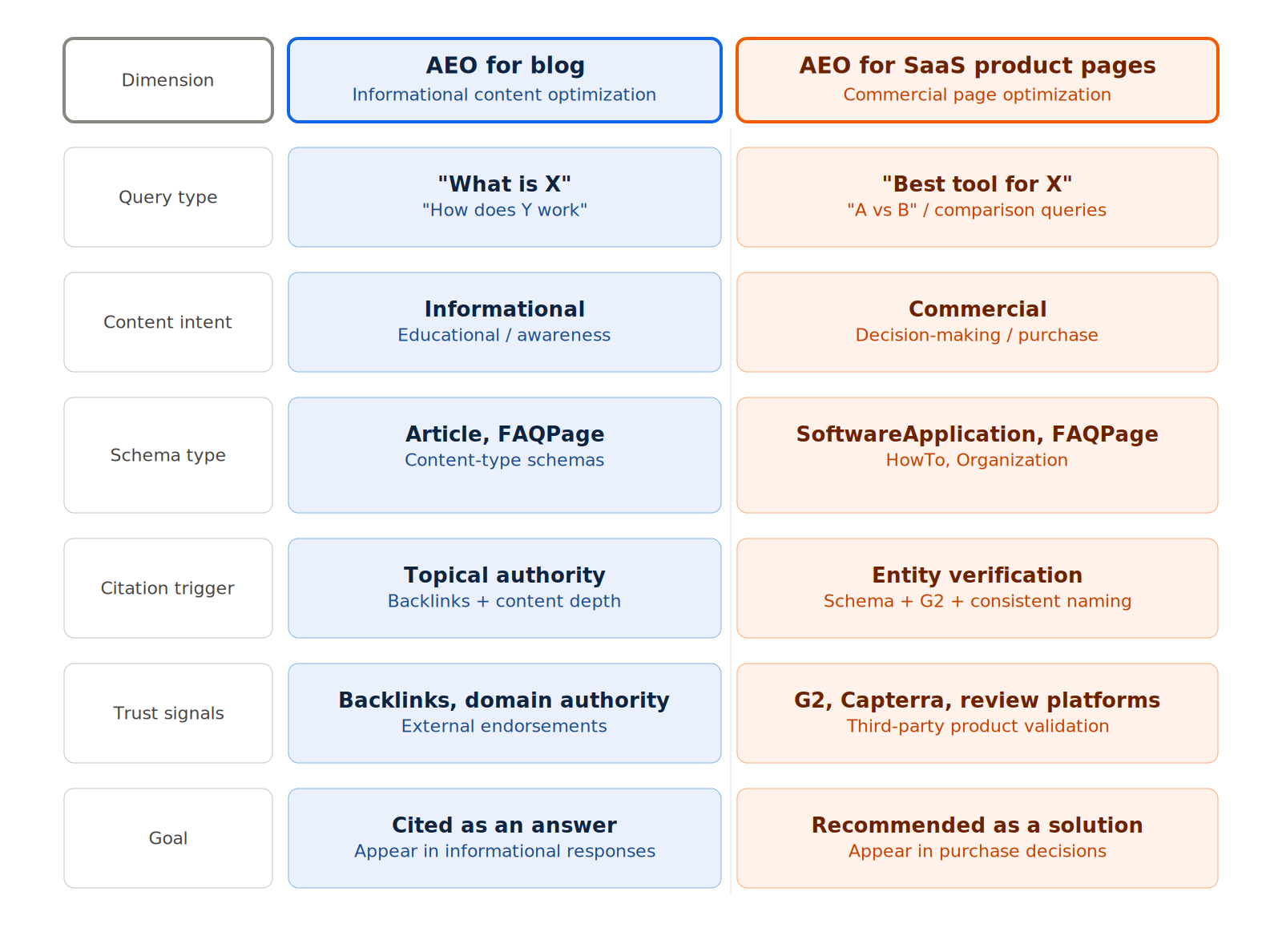
It is distinct from blog AEO because the content intent is commercial rather than educational. The schema type is SoftwareApplication, not Article or FAQPage alone. The citation triggers are entity-verification signals, not topical-authority signals.
The distinction is not semantic. Blog AEO optimizes for being cited as an answer to an informational question. Product page AEO optimizes for being recommended as a solution to a decision-making question. Those are different retrieval mechanisms, different content formats, and different success metrics.
Here is a simplified view of how the two approaches compare across each dimension:
That distinction plays out in actual AI response data. Using Similarweb’s AI Search Intelligence, I tracked 100 prompts about AI research, digital transformation, and machine learning on ChatGPT (February to March 2026) and found that OpenAI brand mentions accounted for only 2.83% of mentions, despite ChatGPT being OpenAI’s own product.
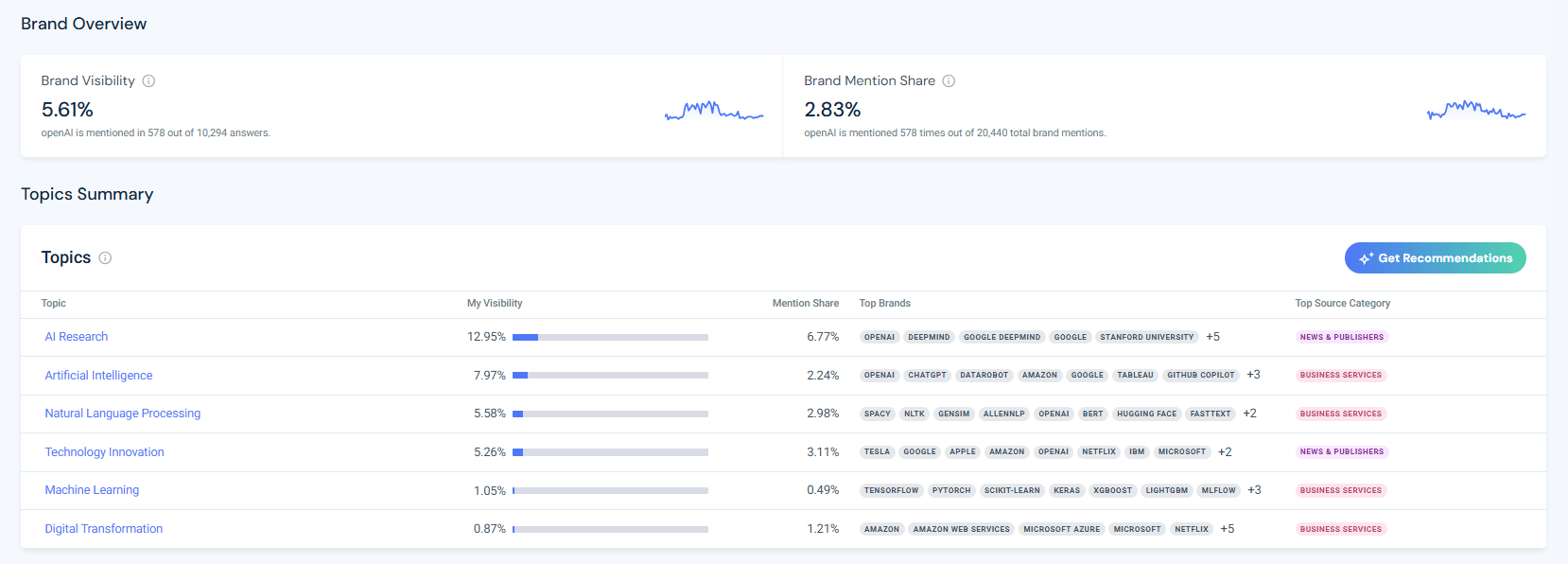
On generic queries about AI ethics, digital transformation, or machine learning challenges, OpenAI is not mentioned at all.
The two prompts where OpenAI does appear are all product- or comparison-related:
Generic AI content generates brand awareness for the category. Structured product pages generate citations for the brand.
Forrester’s 2025 B2B buyer research found that 94% of B2B buyers now use generative AI in their purchasing process, and that it has become the most-cited information source in software research, ranking above vendor websites and sales representatives.
That shift happened fast. And buyers using AI are no longer early adopters, but the mainstream enterprise procurement audience.
Here is the problem that Metricus documented in 2026: they ran the same CRM recommendation query across eight AI systems and found that a market leader, measured by revenue and customer count, appeared in only 23% of AI responses. A competitor with a smaller market share but better-structured content appeared in 78% of responses.
Two platforms did not mention the market leader at all.
The market leader’s pricing page was behind JavaScript. The competitor’s site was plain HTML with pricing visible in the initial render.
Market share does not equal AI visibility. Content structure does.
The buyer who asks ChatGPT for a CRM recommendation and gets three names will likely contact those three. If your product isn’t in that answer, you didn’t lose a click. You lost a consideration. Those are different magnitudes of loss.
AEO for SaaS product pages starts from the same foundation as any other AEO work: your pages need to be technically accessible to AI crawlers, structured for passage-level extraction, and authoritative enough for AI to treat as a credible source. What changes on SaaS product pages is the specific implementation of each layer.
The following sections work through each layer in order of impact.
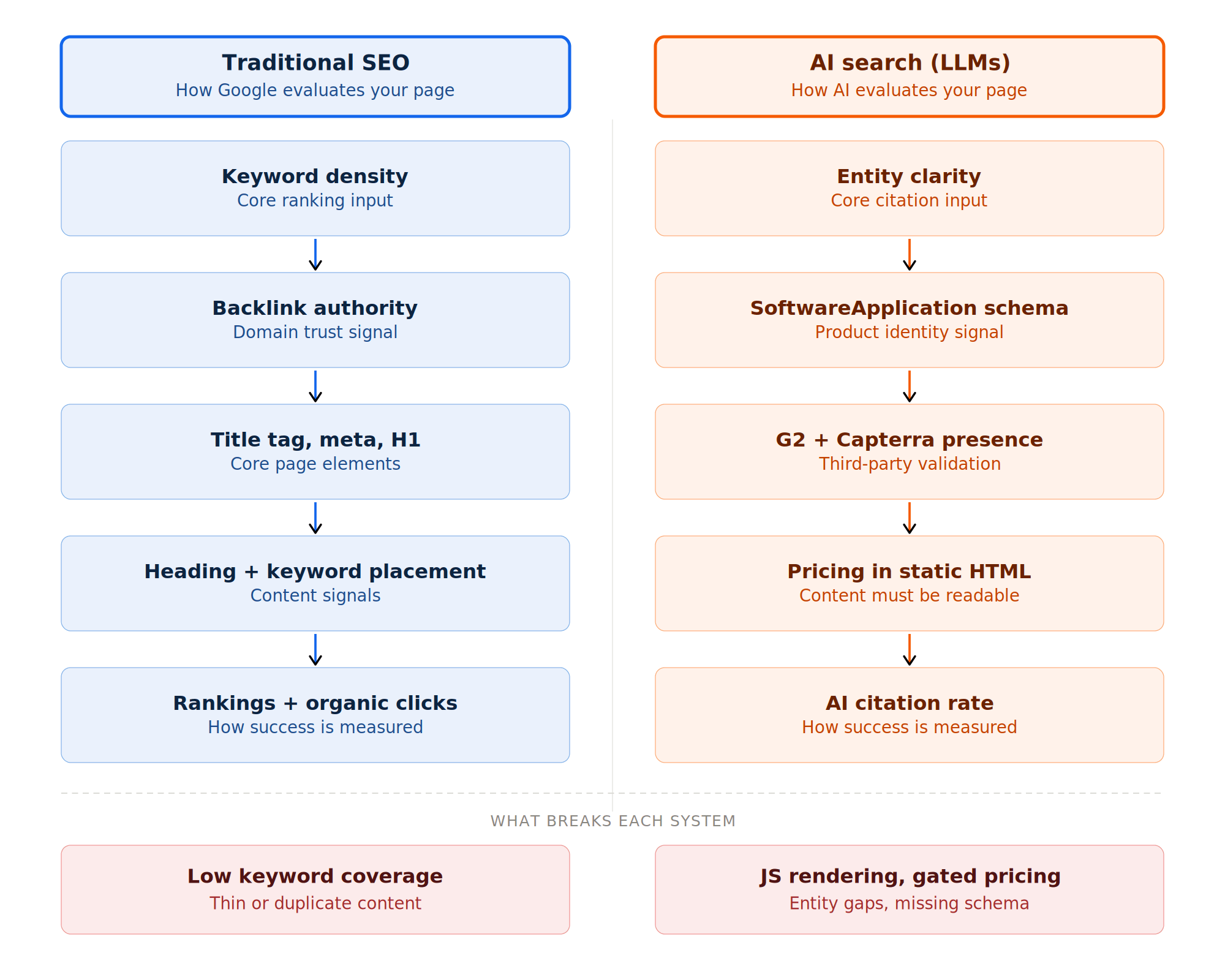
Google evaluates your product page for keyword relevance and backlink authority. An LLM evaluates it for entity clarity: does it understand what your software does, who it is for, what it integrates with, and why it is different from alternatives?
A page that ranks on Google’s first page can be completely invisible to ChatGPT if it relies on JavaScript rendering, lacks the SoftwareApplication schema, or gates its pricing content behind a form.
The evaluation frameworks are different enough that optimizing for one does not guarantee performance in the other. Understanding the specific gaps is where the practical work begins.
| Dimension | Traditional SEO evaluation | AI evaluation |
| Primary signal | Keyword density and backlink authority | Entity clarity and structured data |
| Content structure | Headings, keyword placement, meta tags | Passage-level extraction, atomic sections, BLUF openers |
| Key page elements | Title tag, meta description, H1 | SoftwareApplication schema, ungated content, pricing in HTML |
| Third-party signals | Backlinks from authoritative domains | G2, Capterra review platform presence, comparison content |
| Failure mode | Low keyword coverage, thin content | JS-rendered content, gated pricing, inconsistent entity naming |
| Measurement | Rank tracking, organic clicks | AI citation frequency, brand mention rate, AI referral traffic |
The diagram below shows how those differences play out as an evaluation sequence, including what breaks each system.
AI crawlers, including GPTBot and ClaudeBot, cannot execute JavaScript. If your product page loads its primary content client-side, via React, Vue, or Angular, without server-side rendering, the AI crawler sees an empty shell.
SE Ranking’s November 2025 analysis of 129,000 domains found that pages with a First Contentful Paint under 0.4 seconds averaged 6.7 ChatGPT citations, while pages with FCP over 1.13 seconds averaged just 2.1. That is a 3x citation differential tied directly to load speed and rendering behavior.
For SaaS companies using modern JavaScript frameworks, the fix is a rendering configuration change (SSG, SSR, ISR, or hybrid, depending on content update frequency). The implementation options are covered in detail in the next section.
AI systems build confidence in your product’s identity by cross-referencing what multiple sources say about it. If your website describes your product as a “sales intelligence platform,” your G2 page calls it a “B2B data tool,” and your LinkedIn company description says you provide “revenue intelligence software,” the AI encounters three different entity representations and reduces its confidence in any one of them.
Entity consistency means your product name, application category, core features, use-case framing, and differentiator language are identical across your website, G2, Capterra, TrustRadius, LinkedIn, and Crunchbase. Not similar. Identical in the substantive claims, consistent in naming.
This is not a marketing alignment exercise. It is a direct input into whether AI systems trust your product entity enough to recommend it.
I ran this audit on Similarweb’s own product pages when we started optimizing for AI search visibility. The category description for AI Search Intelligence differed across our website, G2 listing, and LinkedIn. Each version was defensible in isolation.
Together, they gave AI systems three slightly different entity representations of the same product, and entity confidence suffers precisely because of that divergence. Aligning them was the lowest-effort, highest-signal fix we made in the entire optimization process.
The same logic extends to your product page itself. Named customer logos positioned above the feature sections serve as signals of entity association: they tell AI systems which companies use your product and in what context. A recognizable brand associated with your product is a trust endorsement that extends beyond human readers to AI retrieval systems evaluating whether your product is credible enough to recommend.
Optimizing a SaaS product page for AI citation requires seven parallel changes:
Work through these in order. Copy this SaaS AEO checklist to follow the process.
Before working through each lever, here is how all the optimization elements come together on a single page
The annotated wireframe below maps the elements AI crawlers evaluate, the schema types that make each section machine-readable, and the content signals that determine whether your page becomes a citation source or gets skipped entirely. Use it as a reference as you work through the checklist.
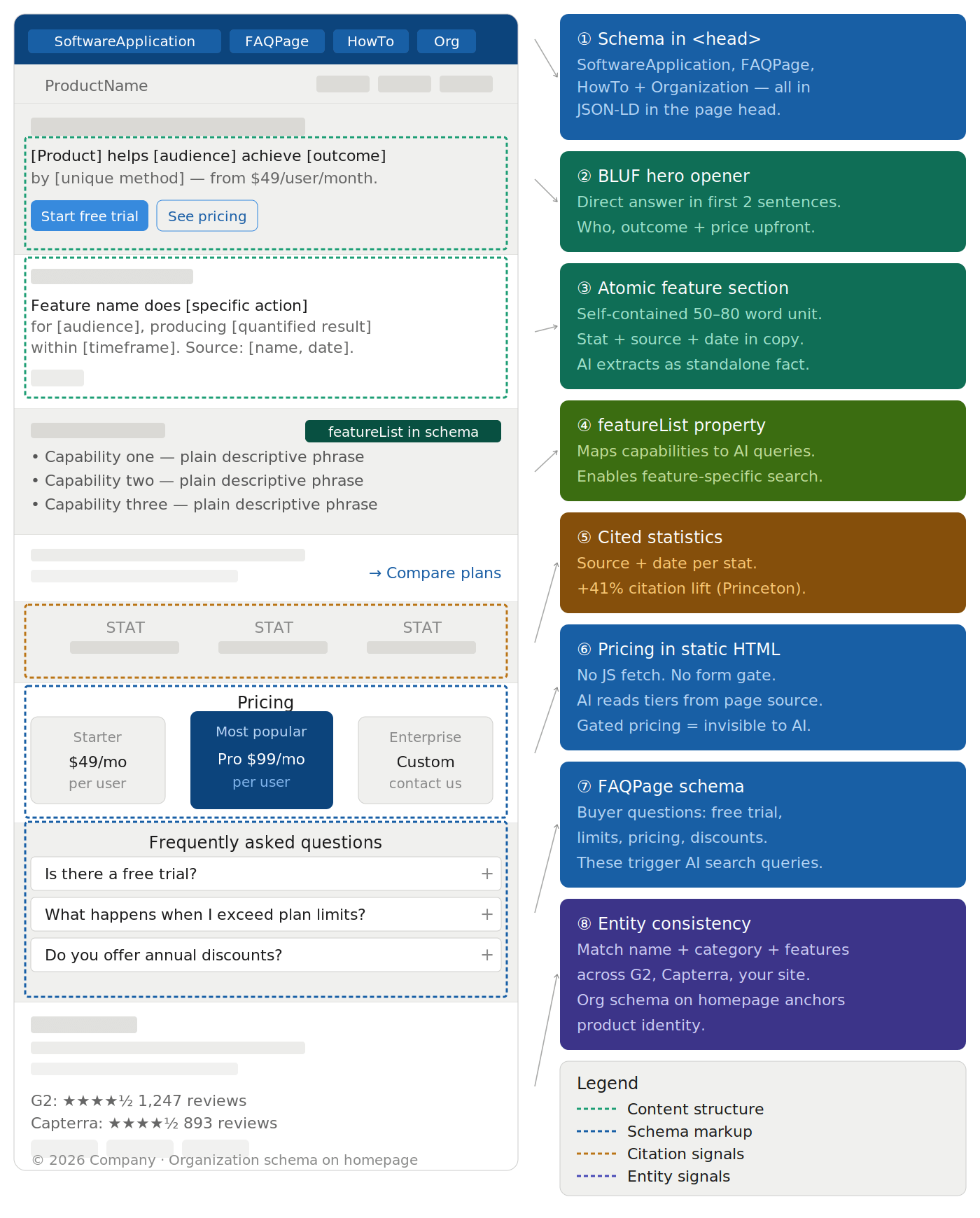
Each numbered element maps to a specific section of this guide:
The seven sections below address each of the seven levers as the implementation question it actually poses, covering everything from technical access and schema markup through to developer documentation.
First, check that AI crawlers can reach your pages, then make sure they can properly see what’s in them. Check your robots.txt for a distinction most SaaS sites get wrong. AI crawlers split into two categories with opposite implications:
BuzzStream’s 2026 analysis of 100 top news publishers found that 71% blocked retrieval bots alongside training bots, inadvertently removing themselves from AI search results. You can safely block training crawlers if content protection is a concern.
A blocked AI crawler means zero AI visibility, regardless of everything else you do.
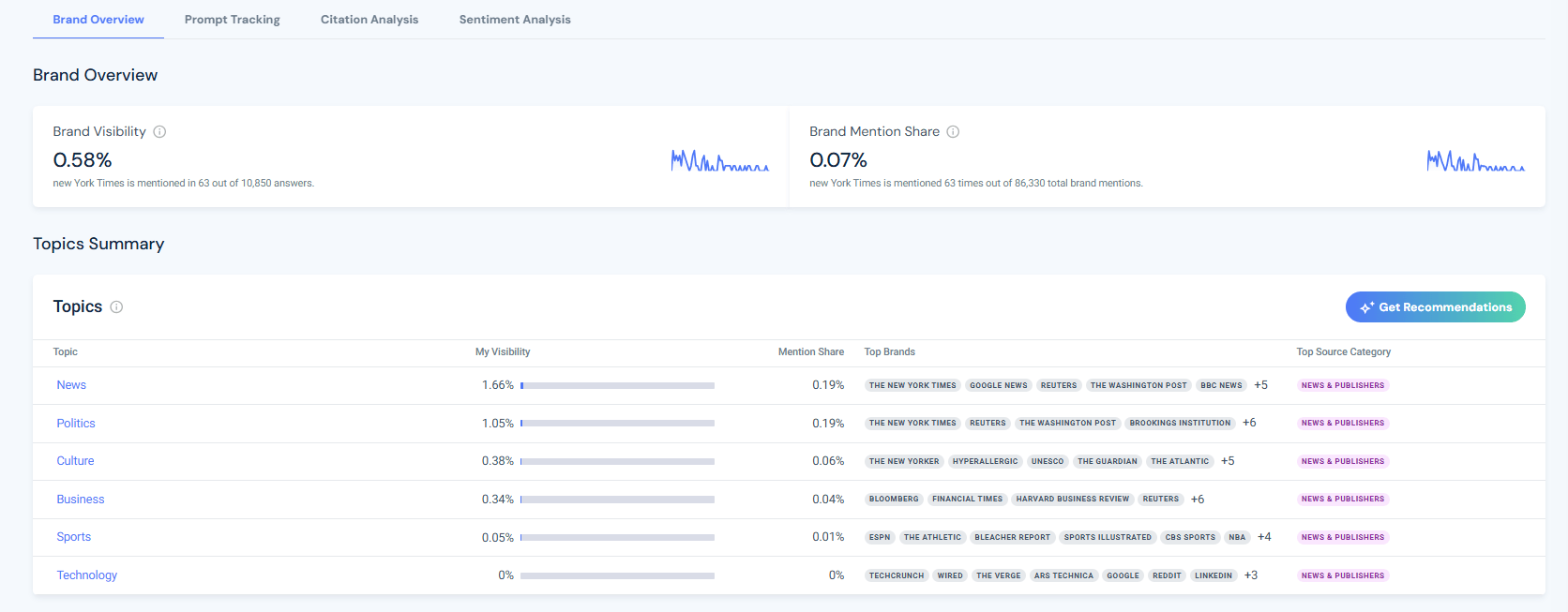
The evidence is in the data. When The New York Times blocked AI retrieval crawlers, its AI brand visibility collapsed. The screenshot above shows what zero AI citation presence looks like in Similarweb’s AI Brand Visibility dashboard: a flat line, regardless of the site’s domain authority or editorial output volume.
The technical fixes above apply to your entire domain, not just product pages. For a site-level AI visibility strategy that includes content architecture and tracking, our guide on adapting your SEO strategy for AI visibility offers the broader picture.
Beyond the robots.txt, confirm that your product pages render their primary content in the initial HTML response.
The fastest diagnostic: open your product page, disable JavaScript in your browser settings, and reload. If your feature descriptions, pricing tiers, and key copy disappear, AI crawlers see exactly what you just saw: nothing.
The fix is a rendering configuration change, not a content rewrite. Modern frameworks support several approaches depending on how frequently your content changes.
Most SaaS sites can close the majority of their AI visibility gap with SSG on product and feature pages alone. The conversation to have with your development team is not whether this is possible, but which strategy fits each page type.
A SaaS product page needs four schema types working together:
Of these four, SoftwareApplication is the one most specific to SaaS and the most consistently absent from product pages in practice. Most SaaS companies either skip structured data entirely or apply a generic Product type, which omits the software-specific properties AI systems use to identify and categorize your product.
The following JSON-LD implementation covers all required and recommended properties for a SaaS product page:
{
"@context": "https://schema.org",
"@type": "SoftwareApplication",
"name": "YourProductName",
"applicationCategory": "BusinessApplication",
"operatingSystem": "Web, macOS, Windows",
"description": "One to two sentences describing what your product does, who it is for, and what primary problem it solves. Write this as a standalone fact, not as marketing copy.",
"url": "https://yourproduct.com/product-page",
"offers": {
"@type": "Offer",
"price": "49",
"priceCurrency": "USD",
"priceSpecification": {
"@type": "UnitPriceSpecification",
"price": "49",
"priceCurrency": "USD",
"unitText": "per user per month"
}
},
"aggregateRating": {
"@type": "AggregateRating",
"ratingValue": "4.6",
"reviewCount": "1247",
"bestRating": "5"
},
"featureList": [
"Feature one as a plain descriptive phrase",
"Feature two as a plain descriptive phrase",
"Feature three as a plain descriptive phrase"
],
"screenshot": "https://yourproduct.com/images/product-screenshot.png",
"softwareVersion": "3.2",
"author": {
"@type": "Organization",
"name": "Your Company Name",
"url": "https://yourproduct.com"
}
}
Place this JSON-LD in the head section of each major product page. Validate it with Google’s Rich Results Test before deploying.
The featureList field is particularly important: AI systems use it to match your product to feature-specific queries (“which tools have [specific capability]”) without parsing your entire page body.
Schema markup handles the first-party signal layer: it tells AI systems what your product is, what it costs, and what it does, directly from your own page source. Done correctly across all four types, it removes the guesswork from AI retrieval.
The model no longer has to infer your product category from marketing copy, estimate your pricing from scattered page text, or decide whether a step-by-step section is a setup guide or a blog post. Each schema type makes one thing explicit and machine-readable that was previously implicit and ambiguous.
That precision is what moves a product page from “content AI might extract something from” to “structured entity AI can confidently recommend.”
Before any other optimization produces results, your entity must be consistent. Run this audit:
Pull your product description from your website, G2, Capterra, TrustRadius, LinkedIn company page, and Crunchbase. Put them side by side.
Check:
Anywhere the descriptions diverge materially, update the third-party listing to match your primary website. AI systems build entity confidence through consensus across sources. Divergence signals unreliability.
Start by treating your G2 and Capterra profiles as structured data sources for AI, not just review pages for human buyers. AI systems pull from these platforms to verify product identity, confirm feature categories, and surface software recommendations.
Presence is effectively a prerequisite: Quoleady’s research analyzing SaaS alternatives queries in ChatGPT found that 100% of software products appearing in responses had a Capterra presence, and 99% had a G2 presence.
But presence alone is not enough. The optimization layer is what most SaaS teams skip.
The pattern I noticed on our own listings: feature tags that had not been updated since the product was first listed, vendor responses that tapered off after the initial launch period, and category claims that no longer matched how we were positioning the product.
For a product like Similarweb’s AI Search Intelligence, which sits at the intersection of several G2 categories, unclaimed tags meant we were invisible to the AI’s query matching for capabilities we actually had. The four actions below address exactly these gaps.
Each section of a SaaS product page needs to be independently extractable. This is the node-architecture principle from GEO applied to commercial pages: every feature section, every use-case block, every benefit statement should make sense as a standalone 50- to 80-word unit without requiring the reader to have read the rest of the page.
In practice:
Applied to product pages: instead of “our customers see improved pipeline velocity,” write “customers using [product] report a median 23% reduction in sales cycle length within 90 days of implementation, based on product usage data from Q3 2025.”
llms.txt is a plain-text file at the root of your domain that signals to AI crawlers which pages represent your most important content. The format was proposed by Jeremy Howard of Answer.AI in September 2024 as a way to give AI systems a curated, readable summary of site structure, addressing the problem that context windows are too small to process most websites in their entirety.
Adoption grew rapidly after November 2024, when Mintlify implemented it across all documentation sites it hosts, bringing Anthropic, Cursor, Vercel, and others on board effectively overnight.
The honest picture of the impact is more nuanced.
No major AI platform has formally confirmed it reads or acts on llms.txt files. The SE Ranking study I mentioned before also found a negligible correlation between the presence of llms.txt and ChatGPT citation frequency.
Mintlify reported AI crawler visits after implementation, with most attributed to ChatGPT, but the sample is too small to establish citation impact. The strongest evidence for the format is indirect: it mirrors how robots.txt and sitemap.xml achieved adoption, with community proposal first and platform confirmation later.
For SaaS companies, the critical distinction is structure. Most llms.txt implementations mirror a blog sitemap, leading with editorial content. SaaS companies should invert this: product pages belong at the top of the hierarchy because they are what AI returns when buyers ask for recommendations. Treat it as insurance, not strategy.
We built and maintain Similarweb’s own llms.txt, with 107 URLs across 12 sections, structured exactly this way: AI search-optimization content and product pages leading, blog content following. The direct citation impact is not measurable in isolation. The structural signal it sends about what our domain is primarily about is the real value.
# Company Name | Product Name
> Brief one-sentence description of what your product does and who it serves.
## Core product pages
- [Homepage](https://yourproduct.com/): Overview, entity description, primary use cases
- [Product: Feature A](https://yourproduct.com/features/feature-a): Detailed description of Feature A with use cases
- [Product: Feature B](https://yourproduct.com/features/feature-b): Detailed description of Feature B with use cases
- [Pricing](https://yourproduct.com/pricing): Pricing tiers, included features, free trial details
- [Security](https://yourproduct.com/security): Compliance certifications, data handling, privacy standards
## Solutions by use case
- [Solution: Use Case A](https://yourproduct.com/solutions/use-case-a): How the product addresses Use Case A
- [Solution: Use Case B](https://yourproduct.com/solutions/use-case-b): How the product addresses Use Case B
## Integrations
- [Integration: Salesforce](https://yourproduct.com/integrations/salesforce): Bidirectional sync, supported objects, setup requirements
- [Integration: Slack](https://yourproduct.com/integrations/slack): Alert configurations, notification setup, use cases
## Comparison pages
- [YourProduct vs. Competitor A](https://yourproduct.com/vs/competitor-a): Feature comparison, pricing difference, ideal use cases
## Documentation
- [API Reference](https://yourproduct.com/docs/api): Full API documentation, authentication, rate limits
- [Getting Started](https://yourproduct.com/docs/quickstart): Initial setup walkthrough
## Blog
- [Blog](https://yourproduct.com/blog): Educational content, industry analysis, best practices
Blog content appears last. Product pages, solution pages, integration pages, comparison pages, and documentation appear first. This hierarchy tells AI systems what your site is primarily about when it retrieves content for recommendation queries.
For SaaS products with a developer audience, API reference documentation, quickstart guides, and SDK documentation are frequently cited by AI when technical buyers ask implementation questions. This is a citation surface entirely unique to developer-facing SaaS that most AEO guidance ignores.
Requirements for developer docs to qualify as AI citation sources:
Developer docs that meet these requirements create a second citation-surface layer that targets technical evaluation queries, separate from the business-buyer queries your main product pages target.
A CTO asking Perplexity “how does [product] API handle rate limiting” and a VP asking ChatGPT “what’s the best sales intelligence tool” both need different answers. If you have both surfaces optimized, you appear in both conversations.
Not all SaaS pages are equal AI citation targets. Previsible’s analysis (2025) found that solution and industry pages had 1.14% AI penetration, and tool and feature pages had 0.95%, both 7 to 9 times higher than the 0.13% site-wide average.
Pricing pages, despite their importance for conversion, lag at 0.46%. Comparison and alternative pages are not isolated in the dataset, but they represent one of the highest-intent query surfaces in SaaS AI discovery, though the data does not isolate them separately.
| Page type | AI session penetration | Primary LLM query type | Top optimization priority |
| Solution and industry pages | 1.14% | “Best [software type] for [industry or use case]” | Use-case framing, SoftwareApplication schema, named customer segments |
| Feature and tool pages | 0.95% | “Which tools have [specific capability]?” | Feature-level schema, featureList markup, BLUF openers per feature |
| Comparison and alternative pages | High signal, not isolated | “[Product] vs. [competitor]” / “alternatives to [product]” | Own the narrative before a third party does |
| Integration pages | High for long-tail queries | “[Product] + [popular integration] use case” | Dedicated page per integration, HowTo schema, ungated setup steps |
| Pricing pages | 0.46% | “How much does [product] cost?” | Ungate pricing in HTML, FAQPage schema on pricing FAQs |
| Developer docs and API reference | High for technical queries | “How to integrate [product] API with [platform]” | Static HTML, ungated, HowTo schema on setup sequences |
| Homepage | ~0.13% average | General brand and category queries | Organization schema, entity clarity, consistent brand description |
The same logic applies beyond the SaaS context. If you want to see how product pages perform in AI engines for ecommerce, our guide to optimizing ecommerce websites for ChatGPT covers the equivalent page-type framework for retail.
When a B2B buyer asks ChatGPT, “What is better, [your product] or [competitor],” the AI synthesizes an answer from whatever comparison content it can find. If you do not own comparison content on your domain, the AI uses competitor-authored comparisons, G2 head-to-head data, and third-party roundups.
You have zero control over how your product is positioned in those sources.
This is something I dealt with firsthand while building comparison content for Similarweb’s Search Intelligence product. Before we had first-party comparison pages, the AI was synthesizing our positioning from third-party roundups and competitor-authored content. We had no visibility into how we were being described, and no ability to correct it. First-party comparison pages changed that.
Once we controlled the source, the positioning followed.
First-party comparison pages let you frame features, use cases, and positioning before the AI synthesizes the answer. This is not about unfair advantage: it is about being a source in the retrieval pool.
Writesonic’s March 2026 study of 50 prompts and 1,161 classified citations found that GPT-5.4 (ChatGPT’s premium model) cited brand websites directly in 56% of responses, with 51% of those citations landing on commercial pages, including product, feature, and pricing pages.
Properly structured product page content is not merely a supporting signal for AI: it is the primary source for the retrieval model most used by serious B2B buyers.
Build a comparison page for every competitor that buyers regularly evaluate you against. Build an “alternatives to [competitor]” page for each competitor whose buyers frequently evaluate you as an alternative. Apply the FAQPage schema to the FAQ section of each. Structure every comparison as a table with clear, factual feature differentials. This is the content the AI retrieves when it answers shortlisting questions.
The Similarweb AI visibility data backs this hypothesis: When ChatGPT answered “How do AI platforms compare in terms of features?” (Feb 2026, Similarweb AI tracking), it generated a feature-by-feature comparison table for OpenAI/ChatGPT that included specific product attributes: “Strong reasoning, coding, multimodal (text/image/audio), memory”, “API, enterprise tools”, “Custom GPTs”.
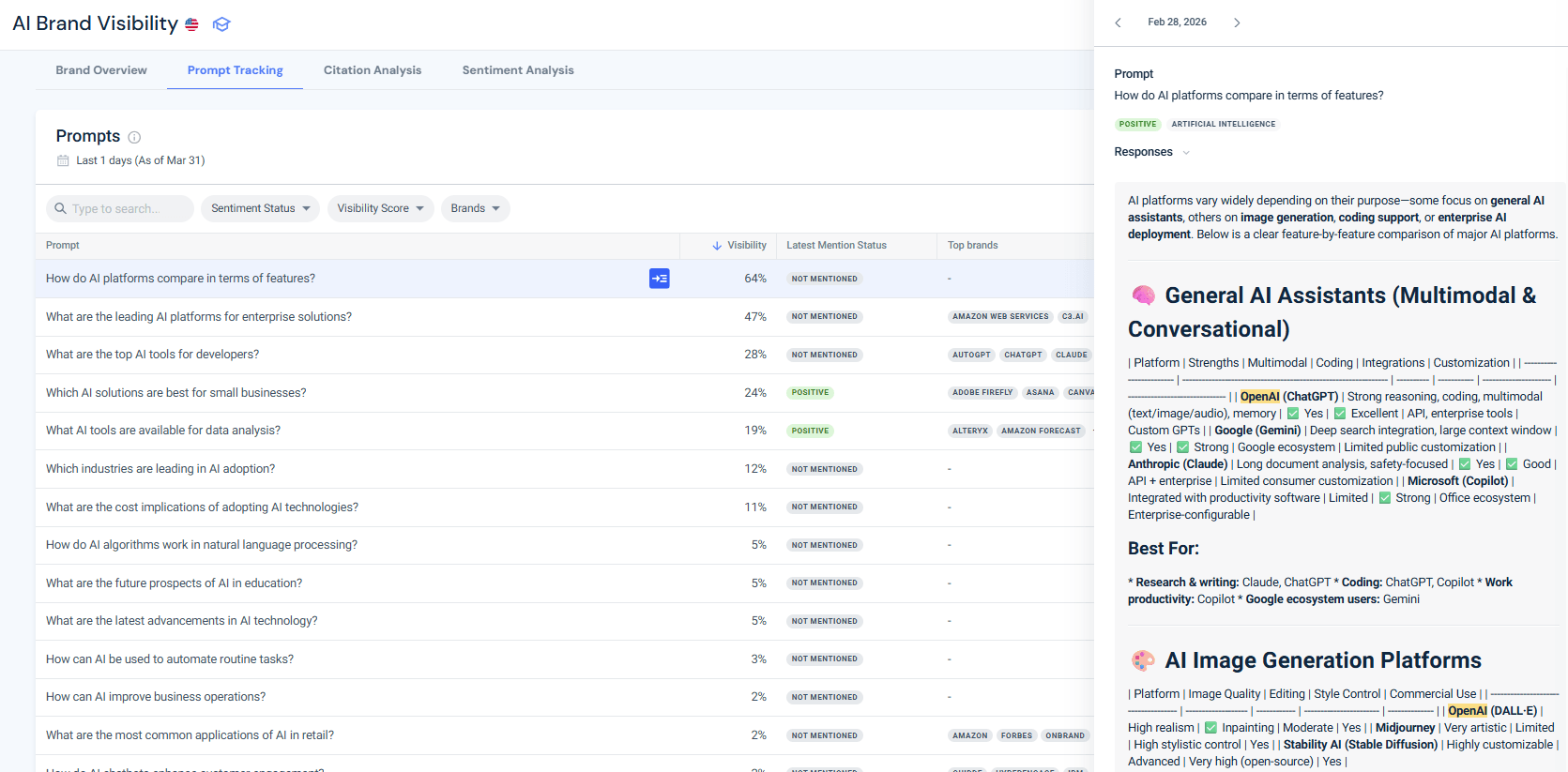
These attributes came directly from OpenAI’s product page content. No external citation was needed because the product features were already well-documented in AI-readable structured content.
The AI built the comparison from first-party product page signals. SaaS companies that document their features clearly, with specific named capabilities in structured formats, appear in AI-generated comparisons by default. Those that don’t leave the AI to guess, or worse, omit them entirely.
37% of B2B buyers now consult AI before purchasing software, according to Metricus’s 2026 B2B AI buyer analysis, with adoption among software buyers running higher. Yet most SaaS pricing pages are either gated behind a form, rendered exclusively via JavaScript, or deliberately vague on pricing tiers.
A pricing page that requires a demo request to see pricing is invisible to AI.
A pricing page that loads its content via a JavaScript fetch request is invisible to AI.
These are not edge cases. They are the default configuration for most mid-market SaaS pricing pages.
The fix is not to expose pricing you were withholding for competitive reasons. It is to render whatever pricing information you show in static HTML so that AI crawlers can read it. If your standard tiers start at $49 per user per month, that should be readable in the page source without JavaScript execution.
Add an FAQPage schema for the common pricing questions:
These are the exact questions buyers ask AI during vendor evaluation, and if your pricing page answers them in structured markup, you appear in those answers.
Integration pages are the most underused AEO surface in SaaS. Each integration your product supports, documented on its own dedicated page with structured content, creates a citation entry point for a long-tail query that your core product page will never surface for.
When a buyer asks, “What sales intelligence tool integrates natively with HubSpot and Slack for a distributed team,” a product page cannot answer that with the specificity AI needs. A dedicated integration page can.
Review platform presence drives AI citation likelihood in large part through integration category listings, the structured, taxonomy-based data that platforms like G2 use to classify which tools work with which. Your own integration pages work on the same principle: each one is a structured, AI-readable declaration that your product belongs in the answer to a specific tool-combination query.
Most SaaS companies treat integration pages as a formality: a logo, a one-liner, and a link to your partner’s documentation. That configuration answers none of the questions AI receives when a buyer asks which tools work together and how they do so.
An AEO-optimized integration page treats the integration as its own product surface, with a clear answer to who benefits, what becomes possible, and how to get started.
One integration page, done well, includes:
You cannot build integration pages for your entire ecosystem at once, and you should not try. Citation potential is not evenly distributed: a small number of high-demand tool combinations drive most integration-related AI queries across any SaaS category.
Start where the query demand already exists, then close the gaps your competitors have covered and you have not.
The referral data validates the model. According to Similarweb AI Traffic data (February 2026), Perplexity referrals to openai.com grew 34% month-over-month, and Claude referrals grew 58% in the same period.
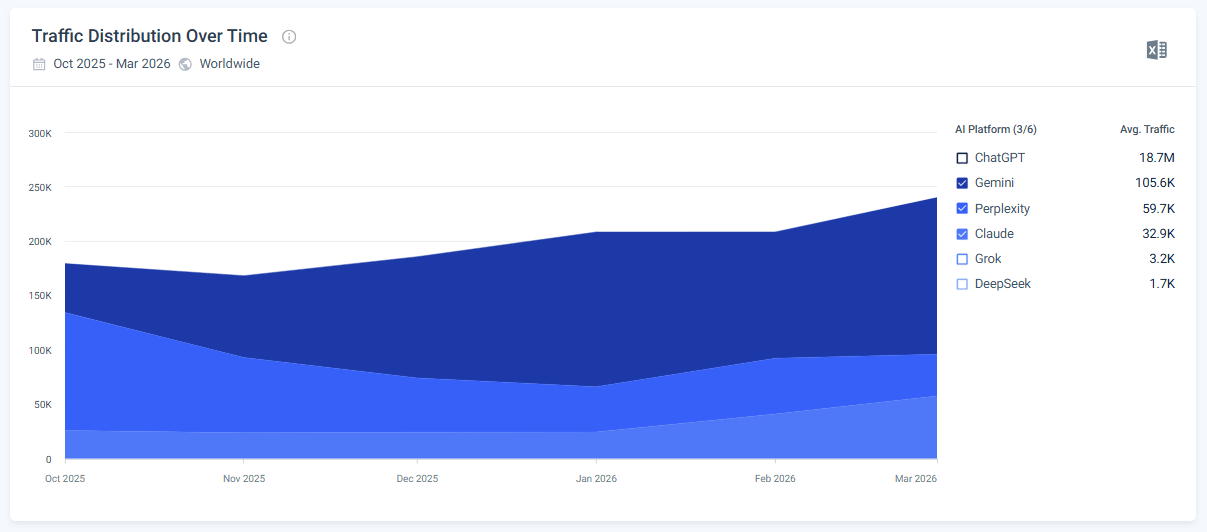
The same mechanism applies to any SaaS product that earns an AI citation: AI platforms surface the product, buyers click through to the cited page, and those referral sessions are measurable in Similarweb’s AI Search Intelligence suite.
Integration pages, because they answer specific tool-combination queries, are particularly likely to be cited as the destination rather than the homepage.
The citation network effect is multiplicative. Ten well-structured integration pages create ten new query types where your product is a candidate. Twenty pages create twenty.
When I look at AI referral data for Similarweb’s own pages in our AI Brand Visibility tool, the pattern holds: pages built around specific tool combinations and use cases consistently attract AI referral traffic at a higher rate relative to their organic search volume than general product overview pages do. The more specific the query the page answers, the more likely AI is to cite it as the destination.
This is the integration page strategy: not just documenting that integrations exist, but making each integration discoverable in AI answers about specific tool combinations.
The GEO and AEO conversation has been dominated by blog content for two years. That made sense when the primary AI citation use case was informational queries: “what is X,” “how does Y work,” “explain Z.” The citation game for those queries is a blog content game.
That moment has shifted. B2B buyers are now asking AI for software recommendations, and the AI is doing exactly what a well-briefed procurement analyst would do: visiting the product page, checking pricing, reading reviews, and comparing features.
The brands appearing in those answers are not necessarily the category leaders.
I track this weekly for Similarweb’s own AI search visibility across our product pages for AI Search Intelligence, Search Intelligence, and related tools. The gap I see most often is not a problem with content quality. It is a structural one: product pages that load behind JavaScript, G2 profiles that have not been touched since launch, no comparison content, no integration pages.
The optimization opportunity exists not because this is hard, but because many teams have not started yet.
The companies appearing in those AI answers share a common profile: their product pages are built in static HTML, their SoftwareApplication schema is complete, their G2 profiles have full feature tags and active vendor responses, and their integration pages make specific tool-combination queries answerable.
The optimization gap is still large enough that moving early matters. No AI system has yet settled on a canonical answer for how to apply AEO specifically to SaaS product pages. Most of the field is still writing about blog optimization. The SaaS companies that structure their product pages for AI extraction now, before this becomes standard practice, will own those recommendation slots by the time their competitors notice the traffic pattern.
Every day that your pricing page renders behind JavaScript, your feature pages lack a SoftwareApplication schema, and your integration pages do not exist, is another day your competitor’s AI-readable product pages are being recommended to your buyers.
Track how often your SaaS product is cited across ChatGPT, Perplexity, Gemini, and Google AI Mode for the recommendation queries that influence your pipeline. Similarweb’s AI Search Intelligence surfaces citation rate, mention rate, AI Share of Voice, and the specific user prompts that drive buyers to your competitors rather than to you.
Why does my SaaS product page rank on Google but not appear in ChatGPT recommendations?
The most common cause is JavaScript rendering. AI crawlers, including GPTBot and ClaudeBot, cannot execute JavaScript, so if your product page loads content client-side, the crawlers will read an empty page. Other causes include gated pricing that AI cannot access to verify, the absence of a SoftwareApplication schema, and entity inconsistencies across G2, Capterra, and your website.
Google runs its own JavaScript rendering pipeline. AI crawlers do not. A page that ranks in Google and is invisible to ChatGPT is operating exactly as its architecture dictates.
How long does AEO take to show results for SaaS product pages?
First AI citations for optimized product pages typically appear within 4 to 6 weeks on Perplexity, which crawls in near real time, and within 2 to 6 weeks for Google AI Overviews after reindexing. ChatGPT takes longer, often 60 to 90 days, because it combines training data with live browsing.
Consistent citation across multiple AI platforms, where your product appears reliably for the buyer queries that matter, takes 3 to 4 months of sustained optimization. Updating existing pages with established authority shows faster results than publishing new pages from zero.
Do SaaS product pages need strong Google rankings before AI will cite them?
No, but SEO rankings accelerate AEO results significantly. AI systems can cite pages outside Google’s top 10 results: BrightEdge research found that 45% of AI citations come from pages not in the traditional top-10. However, SE Ranking’s 2025 study found that the number of referring domains and domain authority are the strongest predictors of ChatGPT citation frequency, and both correlate strongly with organic search performance.
What schema markup should SaaS product pages use for AI search visibility?
The primary schema type for SaaS products is SoftwareApplication, covering product name, application category, operating system support, pricing via the Offers property, aggregate rating, and feature lists. This is the highest-impact schema type for SaaS AI visibility and is absent from the majority of SaaS product pages.
Add an FAQPage schema to any page with a dedicated FAQ section, a HowTo schema to integration and setup pages with sequential steps, and an Organization schema to your homepage to reinforce entity consistency. Implement all markup as JSON-LD in the page head section and validate with Google’s Rich Results Test before deploying.
Should SaaS companies build comparison and alternative pages for AI visibility?
Yes, and it is among the highest-ROI content investments available for SaaS AEO. When a B2B buyer asks ChatGPT to compare your product to a competitor, the AI synthesizes information from whatever sources are available. Without first-party comparison content on your domain, that synthesis relies on third-party reviews, competitor-authored content, and G2 head-to-head data.
First-party comparison pages and “alternatives to [competitor]” pages put you in the source pool for those vendor-evaluation queries. According to Similarweb AI tracking data (February to March 2026), when ChatGPT answered “How do AI platforms compare in terms of features?”, it built the response directly from structured product page content with no external citations required. Structure comparisons as factual feature tables and apply an FAQPage schema.
Do I need to ungate my pricing page for AI to recommend my product?
You need to ensure pricing content renders in static HTML, free from JavaScript fetch calls or form gates. If pricing tiers are loaded client-side or are live behind a “contact us for pricing” wall, AI crawlers return an empty stub and cannot verify or cite your pricing. Whatever pricing you choose to make public should be readable in the initial page source without JavaScript execution.
Add FAQPage schema to cover the questions buyers ask AI during vendor evaluation: free trial availability, per-seat versus flat pricing, annual discount options, and plan limit policies. These are the exact queries that send buyers to AI tools during the consideration phase.
Pricing pages that meet these requirements see substantially higher AI-referred traffic than gated equivalents, per Metricus’ 2026 B2B analysis.
What is llms.txt, and how should SaaS companies structure it differently from a blog site?
llms.txt is a plain-text file at the root of your domain that helps AI crawlers understand your site’s hierarchy and content priorities. Standard implementations list blog posts first, mirroring the editorial sitemap. SaaS companies should invert this: solution pages, feature pages, pricing, integration pages, and comparison pages belong at the top of the file because these are the pages AI retrieves when answering recommendation queries. Blog content appears last.
Note that SE Ranking’s 2025 study found llms.txt has a negligible direct impact on ChatGPT citation frequency; the file guides crawler behavior, not citation ranking. Include it for structural clarity, not as a shortcut.
How do I measure whether my SaaS product pages are being cited by LLMs?
Build a manual baseline first: identify 10 to 15 queries your buyers ask AI when researching your category, test each in ChatGPT and Perplexity, and document whether your product appears, in what position, and how it is described. Add those prompts to Similarweb prompt tracking. Then track two ongoing metrics: AI citation frequency across tracked queries, and AI referral traffic arriving from chatgpt.com, perplexity.ai, and similar platforms.
You can track AI referral traffic by specific product page in Similarweb’s AI Brand Visibility tool, which surfaces which pages attract AI-referred sessions and through which user prompts.
Director of SEO & AI Search at Similarweb
Limor brings 20 years of expertise in SEO and AI Search. She thrives on solving complex problems, creating scalable strategies, and building amazing dashboards.
Dark Funnel Metrics: What to Measure When Buyers Decide Before They Click
What Happens After AI Recommends Your Brand?

ChatGPT Ads CTR by Country: Brazil, Mexico and Japan Out-Click the US by More Than 2x
Give it a try or talk to our insights team — don’t worry, it’s free!