


Most visible social media brands in ChatGPT: Instagram leads at 73% in October 2026
by Maayan Zohar Basteker5 Min.
Nov 17, 2026

AI search optimization advice used to rest mostly on theory. Now there’s new data to check it against. A University of Toronto team tracked 158,099 AI answers and 468,037 citations across two 90-day periods in 2026 (preprint), and other academic teams have tested tactics head-to-head. They measured which page changes go with more citations and mentions, and which only look like they do.
I published a version of this guide in March. It told you to chunk your content, treat schema as the highest-impact fix, and publish an llms.txt file. None of the three held up against the studies, so I rearranged my list. Two things hold up best in the tests:
FAQ blocks, schema markup, and author boxes show no lift once you compare pages within the same website.
This revision sorts every common tip into one of three tiers by what the studies found: Do, Only if, or Skip. Here is what I’ll walk you through: the discipline and what Google calls it, how it differs from SEO, the tips tier by tier with the evidence behind each, and how to measure results.
AI search optimization is the practice of making a website and its content crawlable, retrievable, extractable, and citable in AI-generated answers such as Google AI Overviews, ChatGPT, and Perplexity. Google’s 2026 guidance says optimizing for generative AI search is still SEO, because its AI features retrieve pages through core Search ranking systems.
The term covers answer engine optimization (AEO) and generative engine optimization (GEO) together, and you will also see it called AI search engine optimization or AI SEO. Google’s guidance lists both as terms you may see. It also tells site owners to review third-party AEO and GEO advice against its own guidance.
Retrieval-augmented generation (RAG) and query fan-out decide which pages an AI answer can use. RAG retrieves relevant pages from the index and writes the answer from them, and fan-out fires several related searches at once, so one page can be retrieved for several branches or for none.
| Mechanism | What it does |
|---|---|
| Retrieval-augmented generation (RAG), which Google also calls grounding | Retrieves relevant pages from the index, then writes the answer from what it retrieved |
| Query fan-out | Fires several related searches at once. Google’s example: for “how to fix a lawn that’s full of weeds,” the fan-out might include “best herbicides for lawns,” “remove weeds without chemicals,” and “how to prevent weeds in lawn” |
The citation data fits that: in a Link Builders analysis of 1,329 Google AI Overview citations across 208 US queries about SEO and AI search, 64% of citations went to pages that did not rank on page one for the query.
Eligibility comes first. A page must be indexed and eligible to appear in Google Search with a snippet before any generative AI feature, including AI Overviews and AI Mode, can use it, and indexing is never guaranteed. Everything below assumes your pages have passed that gate.
Takeaway: before you optimize anything, confirm your website pages are indexed and snippet-eligible.
Fan-out sub-queries are divided into seven types: definition (what it is), comparison (how it stacks up against alternatives), how-to (how to do it), use case (who it is for), objection (whether it is worth it), entity expansion (related tools and brands), and metric (how much or how many).
To show you what this would look like, I ran the seed term “project management software” through Similarweb’s Keyword Generator. I selected one sub-query for each of the seven fan-out types and checked each against the data.
Figures are worldwide, for the 28 days to October 18, 2026:
| Type | Sub-query | Searches | Zero-click |
|---|---|---|---|
| Head term | Project management software | 18,400 | 75% |
| Definition | What is project management software | 280 | 78% |
| Comparison | ClickUp vs Asana | 1,700 | 76% |
| How-to | How to use ClickUp | 2,400 | 67% |
| Use case | Project management software for small business | 910 | 78% |
| Objection | Is ClickUp free | 4,500 | 69% |
| Entity expansion | Project management tools | 19,500 | 50% |
| Metric | ClickUp pricing | 19,600 | 38% |
All seven types have measurable demand. Six have 50% zero-click or higher, with the head term at 75%, making them citation plays more than traffic plays: the value is in being the source the answer draws from. Pricing, with 38%, is the exception and still sends real clicks.
SEO and AI search optimization share one foundation: crawlable, indexed, helpful pages. They differ in the unit and the metric. SEO ranks pages and measures clicks. AI search optimization earns passages inside synthesized answers and measures citations, brand mentions, and AI referral traffic.
| Dimension | Traditional SEO | AI search optimization | What Google says |
|---|---|---|---|
| Goal | Rank pages in a list of links | Be retrieved and cited inside a synthesized answer | AI features rely on core ranking systems |
| Unit of optimization | The page | The passage, backed by the page | No need to chunk or rewrite content for AI |
| Success metric | Rankings, clicks, click-through rate | Citations, brand mentions, AI referral traffic | Measure with the Search Console Generative AI performance report |
| Content test | Matches search intent | Answers the fanned-out sub-queries with a point of view others lack | Non-commodity, people-first content matters most |
| Technical floor | Crawlable, indexed, fast | The same, plus eligible for a snippet | Only indexed, snippet-eligible pages qualify |
| Failure mode | Rankings drop | Ranked but never cited | Indexing and serving are never guaranteed |
Stop rewriting content just for AI systems, chasing every long-tail variation, and publishing a separate page for each fan-out variant, according to Google’s guide, which is blunt about all three:
Each one burns hours that better content or a refresh would use.
Takeaway: keep your SEO dashboard. Add two columns next to it: citations by prompt cluster, and AI referral visits.
This section ranks 13 common AI search optimization tips by the evidence behind each: what independent studies measured, how large the effect was, and whether it held up once the website was held fixed. The tips are numbered below, and a summary table follows.
The DOS filter sorts each tip into one of three tiers based on independent tests: Do, Only if, or Skip. Most tip lists rank tips by how plausible they sound, and this one ranks them by evidence.
A note on evidence quality. Experiments show cause, and observational studies show association. The largest study here compared pages within the same website to strip out the effect of site popularity, and its authors say plainly that the results are associations. It also covers a narrow slice: English-language commercial questions about the US market, in two markets, home internet providers and a small group of software vendors for architecture and construction firms.
Within the same website, pages whose title and best paragraph match the questions people ask get more citations: 14.1% more per standard deviation of title match and 15.5% more for best-paragraph match, in a 2026 University of Toronto study of 158,099 AI answers.
| What was measured | Result |
|---|---|
| Title match, within the same website | +14.1% citations per standard deviation, a typical step up in match (95% CI 10.7% to 17.6%) |
| Best-paragraph match, within the same website | +15.5% per standard deviation (95% CI 11.1% to 20.1%) |
| Same measures on third-party pages | +23.6% and +25.7% |
| Replication, niche business-software vendors | +26.4% for title match |
| Data | 158,099 answers and 468,037 citations, two 90-day collections in 2026 |
| ClickUp example (Similarweb campaign, ChatGPT, 28 days to October 19, 2026) | The comparison blog that gained ChatGPT citations has 6 question headings, and the compare page that gained has 10. The comparison blog that lost citations opens with a generic opener |
Retrieval is the mechanism. The researchers replayed the questions through ChatGPT’s search tool via its API, and every one of the 22,315 URLs it cited had first appeared in its own searches. It split each question into about four keyword-style queries and rewrote them on every answer.
In that replay, retrieval explained 32% of citation variation within a website, versus 2.8% for all measured page properties.
Tier: Do
In the categories studied, AI engines drew most citations from earned media, meaning third-party sites, according to a 2025 University of Toronto study. A cited third-party page that names a vendor also makes the answer far more likely to name that vendor.
| What was measured | Result | Source |
|---|---|---|
| Earned-media share of citations, US software | 72.7% for a web-enabled GPT, against 45.4% for Google | Toronto study, 2025 |
| Earned-media share of citations, US automotive | 81.9% against 45.1% | Toronto study, 2025 |
| Citations by source type, live data | News and publisher domains led across ChatGPT and AI Mode, with reviews and user-generated platforms close behind (US desktop, September 2025) | Similarweb’s 2025 Gen AI Landscape report |
| Odds the answer names a vendor when a cited third-party page names it, niche business software | 39.7 times in ChatGPT and 17.7 times in Gemini, against 4.2 and 6.3 in the consumer market | Toronto study, 2026 |
| ChatGPT mentions of brands the question did not name | 46% had no cited page naming them | Toronto study, 2026 |
The live-data row comes from Similarweb’s 2025 Gen AI Landscape report. The effect is larger for small brands, and brand recognition adds a second route to a mention.
This is the mention route, so measure it as mention share (your share of voice), not clicks.
Tier: Do
Google’s AI features can only use pages that are crawlable, indexed, and snippet-eligible, and in the Toronto data, pages whose main text needs JavaScript received 10.6% fewer Gemini citations within the same website.
| Engine | Citations for JavaScript-dependent pages, within the same website |
|---|---|
| Gemini | 10.6% fewer (p = 0.008) |
| ChatGPT | 6.8% fewer (not significant) |
| Perplexity | 2.1% fewer (not significant) |
Our technical GEO guide has the full checklist.
Tier: Do
In a 2023 benchmark, adding quotations, statistics, and cited sources raised visibility in generated answers by roughly 28% to 41%, but a 2025 benchmark found most content-rewrite tactics largely ineffective.
| Study | What it found |
|---|---|
| 2023 GEO study, IIT Delhi and Princeton | The study tested nine content changes against a 10,000-query benchmark and scored them on its 1,000-query test split. Visibility in generated answers rose by up to 40% |
| Same study, computed from Table 1 | Cite sources gained about 28%, statistics about 31%, and quotations about 41% |
| Same study, keyword stuffing | Little to no gain, and about 10% below baseline on Perplexity |
| Same study, test setup | The main test engine was GPT-3.5 over the top five Google results, and an LLM rewrote the test pages |
| ClickUp example | The guide blog that gained ChatGPT citations has a table, 6 percentages, and 10 outbound links, while a guide blog that lost citations has no table, no percentages, and 1 outbound link. The compare page that gained has 18 price figures, and a compare page that lost citations has none |
| C-SEO Bench, NeurIPS 2025 | Most content-rewrite methods were largely ineffective. Traditional methods that improve a source’s rank in the model’s context worked significantly better, and benefits shrank as more sites adopted a method |
Verdict: use statistics because they make claims checkable, not because they guarantee a lift.
Tier: Only if
One analysis by Kevin Indig found 44.2% of ChatGPT citations came from the first 30% of a page, while the Toronto data found that the best-matching paragraph gets picked up wherever it sits.
| Source | What it found |
|---|---|
| Growth Memo analysis by Kevin Indig, February 2026 | 44.2% of 18,012 analyzed ChatGPT citations came from the first 30% of a page’s text, 31.1% from the middle, and 24.7% from the final third (from 1.2 million ChatGPT citations) |
| Toronto study | The best-matching paragraph sat at a median of 45% of the page, in the top quarter for 32% of cited pages and the bottom quarter for 28% |
| Toronto study, controlled test of source order | The small model behind ChatGPT, run without search, cited the same source in 60% of answers when it came first and 43% when last |
The source-order result reflects the order inside the model’s input, which publishers don’t control.
Verdict: Put the direct answer under each question heading because it supports matching the questions people ask, and don’t reorder pages to chase position.
Tier: Only if
Older pages got fewer citations within the same website in the Toronto data, 5.1% fewer per standard deviation of page age, but the result failed one of the study’s five robustness tests.
| Source | What it found |
|---|---|
| Toronto study | Page age went with 5.1% fewer citations per standard deviation within websites. ChatGPT (4.2%) and Gemini (5.2%) were significant, Perplexity was not |
| 2025 arXiv study of 1,100 URLs | Recency metadata was among the strongest predictors of citation, without controlling for the website |
| ClickUp example | A comparison blog that gained ChatGPT citations was updated Apr 12, 2026, while one that lost citations was last modified Jul 4, 2024. A comparison page that gained shows “Last updated September 28, 2026,” while one that lost citations shows no date. One exception: the guide blog that lost citations (Oct 13, 2025) is newer than the guide blog that gained (Jan 18, 2025) |
The second row comes from a 2025 arXiv study of 1,100 B2B SaaS URLs across Brave, Google AI Overviews, and Perplexity.
Verdict: cheap to do, so refresh when facts change and never change the date without changing the content.
Tier: Only if
Author boxes and summary boxes did not measurably change citations within a website in the Toronto data: author boxes went with 4.6% fewer citations and summary boxes with 6.9% more, and neither result was significant.
At equal rank in ChatGPT’s lists, author boxes had 0.77 times the odds of being cited.
Verdict: keep them for reader trust, not for citations.
Tier: Only if
FAQ blocks go with more citations when you compare different websites (18.1% more), but the effect vanishes when you compare pages on the same website (3.4% fewer, not significant), according to the Toronto study.
| Measure | FAQ blocks |
|---|---|
| Across websites | +18.1% citations |
| Within the same website | -3.4% (not significant) |
| Odds of citation at equal rank in ChatGPT’s result lists | 0.93 times |
| ClickUp example | None of the ten ClickUp pages inspected, whether they gained or lost citations, carried FAQPage or HowTo markup |
The gap across websites is why so many guides recommend FAQ blocks. The Toronto authors attribute this to Simpson’s paradox: FAQ blocks appear on 43% of pages in the most-cited quarter of websites and 23% in the least-cited quarter, so the markers take credit for the popularity of the sites that use them.
Verdict: skip FAQ markup as a citation tactic.
Tier: Skip
According to the Toronto study, schema markup attracts more citations when you compare different websites (7.5% more), but the effect vanishes when you compare pages on the same website (5.3% fewer, not significant).
| Measure | schema.org markup |
|---|---|
| Across websites | +7.5% citations |
| Within the same website | -5.3% (not significant) |
| Odds of citation at equal rank in ChatGPT’s result lists | 0.92 times |
| ClickUp example | All four ClickUp blog pages checked carried Article markup, two that gained citations and two that lost them |
The Toronto authors attribute the gap to the same Simpson’s paradox as for FAQ blocks. Google adds that structured data is not required for generative AI search and that no special markup exists for it.
In March, I called schema the highest-impact fix, but the within-site numbers don’t support that.
Verdict: use Article and author markup as hygiene if your CMS provides it.
Tier: Skip
None of these page features passed the Toronto study’s tests for a real effect within a website, and at equal rank in ChatGPT’s lists, list pages and comparison pages carried lower odds of citation.
| Finding | Result |
|---|---|
| Within websites | None passed the study’s tests for a real effect, and their effect curves were flat |
| Brand pages | Tables went with 12.5% more citations and lists with 18.1% fewer, but neither held up across the tests |
| At equal rank in ChatGPT’s lists | Pages with more headings had 1.28 times the odds of citation. List pages had 0.54 times and comparison pages 0.34 times: consulted often, cited rarely |
| ClickUp example | In four of five page types, the page that gained citations was longer than the one that lost them. For example, feature pages had 819 words and 13 H2s versus 350 words and 4 H2s. The comparison blog that gained is shorter than the one that lost citations (2,839 against 3,206 words) |
| Contrasting case: Similarweb’s 2025 Gen AI Landscape report | Walmart’s product pages, with a clear “About this item” bullet section, were cited in 59% of relevant retail responses, while Temu was absent. That is a single comparison, not a controlled test |
Verdict: structure helps readers, and the evidence does not show it moves citations by itself.
Tier: Skip
Google states that Google Search does not use llms.txt and that creating one will neither help nor harm visibility there, and I found no independent controlled test showing a lift on any engine.
I recommended publishing one in March. I must admit I found no evidence that any bots read it, even in our own server logs. If another system you care about reads the file, maintain it. We cover the format in our llms.txt guide.
Tier: Skip
Google says there is no requirement to break content into tiny pieces and no ideal page length, and the Toronto data points the same way: headings, lists, and length did not pass its within-website tests.
I put chunking first on my March list. A paragraph that matches the question did go with more citations, as described above. Our content chunking guide explains where the idea came from and where it stops being useful.
Tier: Skip
Google says seeking inauthentic mentions across the web is less helpful than it seems. Earned coverage, described above, is different because it is authentic by definition, and it is the route the evidence supports.
Lily Ray, VP of SEO Strategy at Amsive, put the risk plainly in Similarweb’s 2026 AI Brand Visibility Index: do not sacrifice long-term organic performance for short-term AI experimentation.
Tier: Skip
The table lists all 13 tips, the tier each earned, and the main finding behind it, so you can compare them side by side before deciding where to spend time.
| Tip | Tier | What the tests found | Source |
|---|---|---|---|
| 1. Title and best paragraph match the questions people ask | Do | Within the same website, +14.1% citations per standard deviation of title match and +15.5% for best-paragraph match | Toronto study, 2026 |
| 2. Third-party coverage | Do | Web-enabled GPT drew 72.7% of US software citations from earned media, versus 45.4% for Google. In a niche market, a cited third-party page naming a vendor raised the odds the answer named it 39.7 times | Chen et al., 2025, Toronto study |
| 3. Crawlable, non-JavaScript content | Do | Pages needing JavaScript got 10.6% fewer Gemini citations within websites (Gemini only. The ChatGPT and Perplexity gaps were not significant) | Toronto study |
| 4. Sourced statistics and quotations | Only if | About 28% to 41% visibility gain in a 2023 benchmark. A 2025 multi-actor benchmark found most rewrite tactics largely ineffective | Aggarwal et al., C-SEO Bench |
| 5. Answer-first openers | Only if | 44.2% of 18,012 ChatGPT citations came from the first 30% of text. In the Toronto data, the best-matching paragraph sits at a median 45% of the page | Growth Memo, Toronto study |
| 6. Visible dates and refreshes | Only if | Page age goes with 5.1% fewer citations per standard deviation but fails one of five robustness tests | Toronto study |
| 7. Author and summary boxes | Only if | Within websites, author boxes -4.6% and summary boxes +6.9%, neither significant | Toronto study |
| 8. FAQ blocks | Skip | Pages with an FAQ block got 18.1% more citations than pages without one when compared across different websites, but 3.4% fewer when compared within the same website (not significant) | Toronto study |
| 9. schema.org markup | Skip | Pages with schema got 7.5% more citations across websites, but 5.3% fewer within the same website (not significant). Google: not required | Toronto study, Google |
| 10. Headings, lists, tables, length | Skip | None passed the study’s robustness tests; at equal rank in ChatGPT, list pages carry 0.54 times and comparison pages 0.34 times the odds of citation | Toronto study |
| 11. llms.txt | Skip (for Google) | Google Search ignores it. I found no independent controlled test showing a lift | |
| 12. Micro-chunking | Skip | Google: not required. Paragraph match, not chunk size, goes with citations | Google; Toronto study |
| 13. Manufactured mentions | Skip | Google: inauthentic mentions are not helpful |
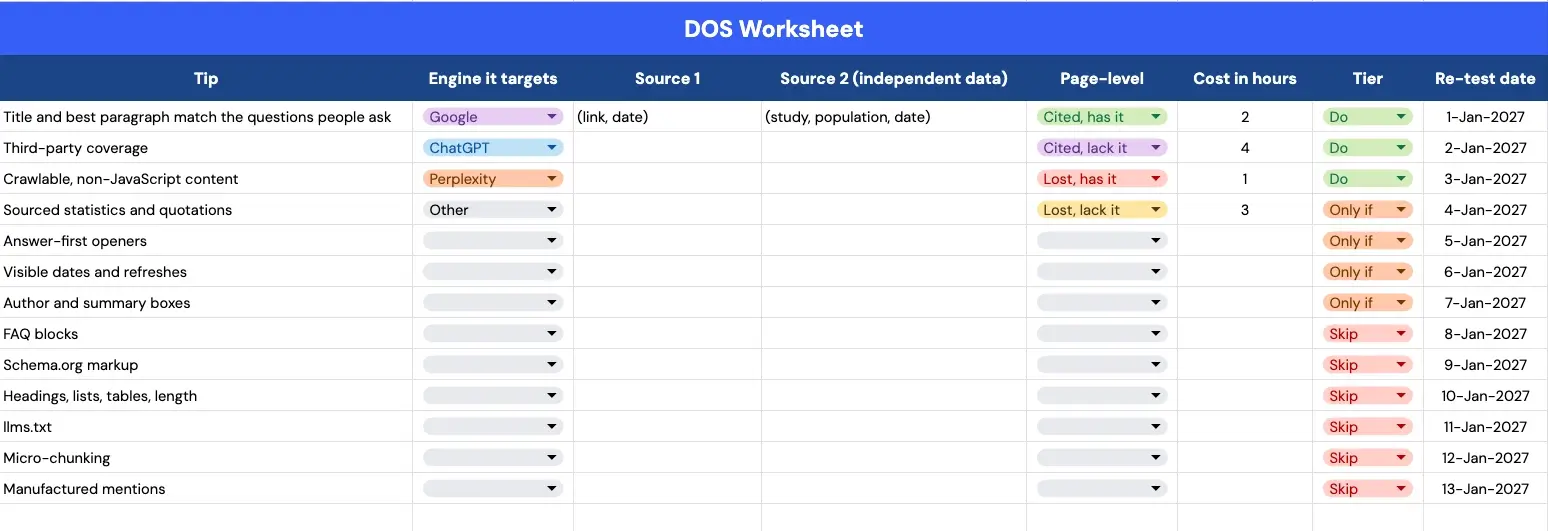
Use this to score any tip before you spend time on it (copy the sheet here).
For the page-level check, compare the URLs that entered and dropped out of your cited set (the new and lost lists in the Citation Analysis tool), and inspect them with our GEO audit checklist.
Measure AI search optimization with five numbers: brand visibility (the share of tracked AI answers that mention you), mention share (your AI share of voice), citation rate (how often AI answers cite your domain as a source), AI referral traffic, and Google Search Console’s Generative AI performance report. Set baselines first.
| Metric | What it measures | ClickUp baseline |
|---|---|---|
| Brand visibility | The share of tracked prompts whose answers mention your brand. Track by topic, not by single prompt. | 31.58%. By topic: Task List Apps 49.44% (rank 2), Project Management Tools 34.36% (rank 2), Time Tracking Tools 10.96% (rank 3), all rising in the period |
| Mention share (AI SoV) | Your mentions as a share of all brand mentions in the tracked answers | 8.62% (2,631 mentions among 30,531 total) |
| Citation rate (domain influence) | How often your domain is cited as a source in AI answers. Similarweb scores it as domain influence | 35.84, against a core average of 8.58 (ChatGPT, October 2026) |
| AI referral traffic | Visits that arrive from AI platforms | September 2026: ChatGPT about 216,900 (72.5% of AI referrals), Claude about 24,300 (8.1%, up 84% MoM), Perplexity about 13,500, Gemini about 13,100 |
| Google’s Generative AI performance report | How content performs in AI Overviews and AI Mode, per Google’s guide. It is the one measurement source for Google’s AI features that comes from Google | Reported in Search Console |
Our guide to GEO KPIs lists the full set of metrics. AI referral figures come from Similarweb AI Traffic tool. Total AI referrals are derived from ChatGPT’s share and are approximate, and small platforms swing widely from month to month, so read trends, not single months.
One finding changes how to read these numbers. In Similarweb’s 2026 Gen AI Landscape report, cited pages and landing pages sit in different places (US desktop, May 2026):
| Measure | Share |
|---|---|
| URLs ChatGPT cited that sat two or three folders deep | 65% (41.7% at depth two) |
| AI referral traffic that landed on homepages | 58.8% |
Cited pages and landing pages do different jobs. Aleyda Solis, founder of Orainti, argues in that report that they should be assessed separately. Report them separately too.
Pick tools by the job they do, not by rank. Four jobs matter: Google-side visibility, referral traffic, brand visibility and citations, and Bing-side visibility. The table below covers each. For the full roundup, see our guide to the top AEO tools.
| Job | What it measures | Tool options |
|---|---|---|
| Google-side visibility | Impressions and clicks in generative AI features | Search Console Generative AI performance report |
| Referral traffic | Visits from AI platforms | GA4, Similarweb AI Search Intelligence |
| Brand visibility and citations | Mention rate, citation share, cited URLs | Similarweb AI Search Intelligence |
| Bing-side visibility | AI performance in Bing | Bing Webmaster Tools |
For Bing, see our guide to using Bing AI Performance for GEO. Google’s guide adds a warning worth repeating: no third-party tool has access to Google’s internal ranking or AI systems, so treat any tool that claims to show them skeptically.
Tips are a commodity: the results page is full of near-identical lists, and I have written a few of them. What is scarce is a tip with evidence behind it, tested on your own pages and measured against your own baseline.
The DOS filter is how I try to stay honest:
This guide retires a few of mine: chunking first, schema as the top fix, llms.txt, and two numbers I had wrong in March, a news-only zero-click figure I had applied to all searches, and a study of 1.2 million citations that I had described as 100 million.
Run the DOS worksheet on your five biggest assumptions this week, and retire the ones that fail. AI search optimization is not a trick layer on top of SEO. It is SEO’s foundations, plus a measurement habit most teams have not built yet. If you want to build it, Similarweb AI Search Intelligence tracks your brand’s visibility, mention share, and cited URLs across AI platforms.
Start with eligibility: pages must be crawlable, indexed, snippet-eligible, and readable without JavaScript. Then make each page’s title and one paragraph answer a question people ask, and earn coverage on third-party sites that AI engines cite. FAQ blocks, schema, and author boxes showed no lift within websites in a 2026 study. Measure with Search Console’s Generative AI performance report.
Get retrieved first: in a 2026 study, ChatGPT cited only pages its own searches returned. Within the same website, pages whose title and best paragraph matched the questions people ask earned about 14% to 16% more citations per standard deviation of match. Third-party coverage also matters, because AI engines favor earned media. No tactic guarantees a citation.
Mostly, it is SEO with a new measurement layer. Google says optimizing for generative AI search is still SEO, because its AI features retrieve pages through core ranking systems. The differences are the unit, which becomes the passage, and the metrics: citations, brand mentions, and AI referral traffic, alongside rankings and clicks.
Not once you compare pages within the same website. In a 2026 study of 468,037 citations, schema went with 7.5% more citations across websites but 5.3% fewer within them (not significant). Google says structured data is not required for generative AI search. Use Article and author markup as hygiene, and skip FAQ markup as a citation tactic.
Not for Google. Google states that Google Search does not use llms.txt and that the file neither helps nor harms visibility there. If another system or agent you care about reads it, maintaining the file is harmless. As a tactic for Google, it earns nothing, so spend the time on content and crawlability.
No reliable benchmark exists. The timelines I found, from days to six months, come from vendor guides, not studies, and Google notes that indexing is never guaranteed. Set a baseline, change a small set of pages, and re-measure after 90 days. Ninety days is a testing convention, not a promise, so compare changed pages against unchanged ones.
Track five numbers: brand visibility, mention share, citation rate, AI referral traffic, and Google’s Generative AI performance report in Search Console. Set baselines first, track by topic rather than single prompts, and report cited pages separately from landing pages. In Similarweb’s May 2026 data, 65% of ChatGPT-cited URLs sat two or three folders deep.
Director of SEO & AI Search at Similarweb
Limor brings 20 years of expertise in SEO and AI Search. She thrives on solving complex problems, creating scalable strategies, and building amazing dashboards.
Most visible social media brands in ChatGPT: Instagram leads at 73% in October 2026

Where Is My Customer? ChatGPT Ads and Google’s Universal Cart Split the Journey Across Platforms

The Lock-and-Refresh Method: How To Track AI Prompts by Funnel Stage
Give it a try or talk to our insights team — don’t worry, it’s free!