



AI Search Optimization: Tips, Best Practices, and Techniques That Worked in 2026
by Limor Barenholtz18 Min.
Oct 22, 2026

Tracking your AI visibility is one thing. Knowing what to do about it is a completely different challenge.
Most teams I talk to are sitting on dashboards full of data, brand mention rates, citation share, competitor benchmarks, and sentiment breakdowns. They know their numbers. But when it comes to actually moving those numbers, most of them are stuck.
Figuring out what to do requires analyzing a huge amount of data, across topics, prompts, competitor mentions, citation sources, and turning all of that into a specific, prioritized content plan. Do that manually and you’re looking at hours of work before you’ve changed a single word on your site.
Similarweb’s AI Optimization Recommendations tool solves this. This is the bridge between visibility data and actual action: specific, data-driven suggestions that tell you what content to create, update, or optimize to show up more in AI answers. And when they’re generated automatically from your campaign data, they cut out the analysis layer entirely.
In this post, I’ll explain why improving AI visibility is hard to do without them, what factors actually drive whether AI mentions your brand, and how Similarweb’s AI Optimization Recommendations tool automates the whole process for you.
Here’s the thing about AI visibility: improving it requires analyzing a lot of moving parts at the same time, and most of those parts are invisible if you’re not looking in the right place.
You need to know which topics users are asking about in AI. Which of those topics your brand appears in, and which it doesn’t. What competitors are doing differently in the topics where they outperform you. Which of your existing pages could cover those gaps. And which topics you have no content for at all.
The hardest part isn’t the analysis itself. It’s that the most important gaps are the ones you can’t see. If your brand is absent from an entire topic conversation, there’s nothing in your analytics to flag it. You can’t see the AI answers your brand isn’t in.
Finding those gaps manually means running prompts across every relevant topic in your category, comparing citation rates against competitors, and doing it regularly enough to keep up as the landscape changes. Then translating all of that into a content plan, which gaps matter most, which pages are closest to fixing them, which topics need new content from scratch.
Most teams don’t have the bandwidth for that. So what actually happens? Either the analysis is shallow, or it’s slow, or both. Pages get updated without a clear connection to the visibility gaps driving the decision. Momentum stalls.
This is the real problem the AI Optimization recommendations tool solves, not just surfacing that gaps exist, but doing the analytical work and handing you a prioritized plan ready to act on.
Before looking at how our tool generates recommendations, it’s worth understanding what we are targeting. There are four things that determine whether AI engines mention your brand, and all four are things you can influence.
Topical coverage is the biggest one, and it’s closely tied to what’s known as AI topical authority. AI engines can only mention your brand in topics where you have relevant content for them to draw from. The more consistently you cover a topic, across your own content, third-party mentions, and user-generated signals, the stronger your topical authority becomes in that space, and the more reliably AI engines associate your brand with it. If you’re not present in a conversation at all, no content addressing the topic, no mentions in relevant third-party sources, you won’t show up, full stop. Most visibility gaps start here.
Content structure determines whether AI can actually extract your answers. AI engines don’t read pages the way humans do, they parse for clear, structured, answer-ready chunks. Pages with question-based headers, direct answers in the first sentence, and structured data are significantly more likely to be cited.
Entity authority is how strongly AI associates your brand with a topic. LLMs build associations between brands and subjects based on everything they’ve seen across the web, your own content, third-party mentions, user-generated content, reviews. The stronger your association with a topic across multiple sources, the more reliably AI engines surface you for related queries. This compounds over time.
Third-party signals what the rest of the web says about your brand, feed directly into how AI perceives your authority. Mentions in industry publications, forums, comparison guides, and review sites all reinforce your brand’s credibility on a topic. AI models trained on a web where your brand is consistently referenced in trusted contexts will cite you more confidently.
Of these four, topical coverage and content structure are where recommendations do their heaviest lifting. They’re also the ones you can move fastest, which is why a good recommendations tool starts there.
AI Optimization Recommendations lives inside the AI Brand Visibility tool, part of Similarweb’s AI Search Intelligence suite.
It connects directly to your AI Brand Visibility campaign, the campaign where you track your brand’s mention rates, citation sources, competitor performance, and prompt-level data, and automatically analyzes all of that to surface a prioritized action plan.
You don’t have to run the analysis yourself. Our tool processes your prompt data, citation patterns, competitor mention rates, and topic coverage gaps, and outputs specific recommendations organized by impact. The automation handles the analytical layer that would otherwise take hours to do manually.
I tested this with Airbnb as an example, and the Strategic tab was the first place I went. What it shows you is topic-level gaps, the conversations your brand isn’t part of, and which competitors are winning instead.
The first thing I noticed for Airbnb was a topic called “Booking Accommodations with Great Views.” Airbnb’s visibility: 0%. Booking.com’s visibility: 17%. Vrbo: 17%. Airbnb doesn’t show up once for this topic in AI answers.
But what I found more useful than the gap itself was the diagnosis. We don’t just show you that Airbnb is behind, we show you why. Booking.com and Vrbo get cited because they offer detailed view verification guidance: maps, satellite imagery, guest photos. Airbnb’s content doesn’t address how to verify a view before booking, so AI engines don’t pull it for those queries.
From there, you get a suggested strategy, not generic advice, but specific actions: clarify room category definitions (oceanfront, beachfront, panoramic), build FAQ content on verifying views using maps and guest photos, add comparison tables distinguishing partial vs. full view quality.
And at the bottom of the panel, I could see the actual prompts users are asking AI, questions like “What are some tips for booking accommodations with great views?”, all marked “NOT MENTIONED” for Airbnb. Those become the content brief directly. No additional research needed.
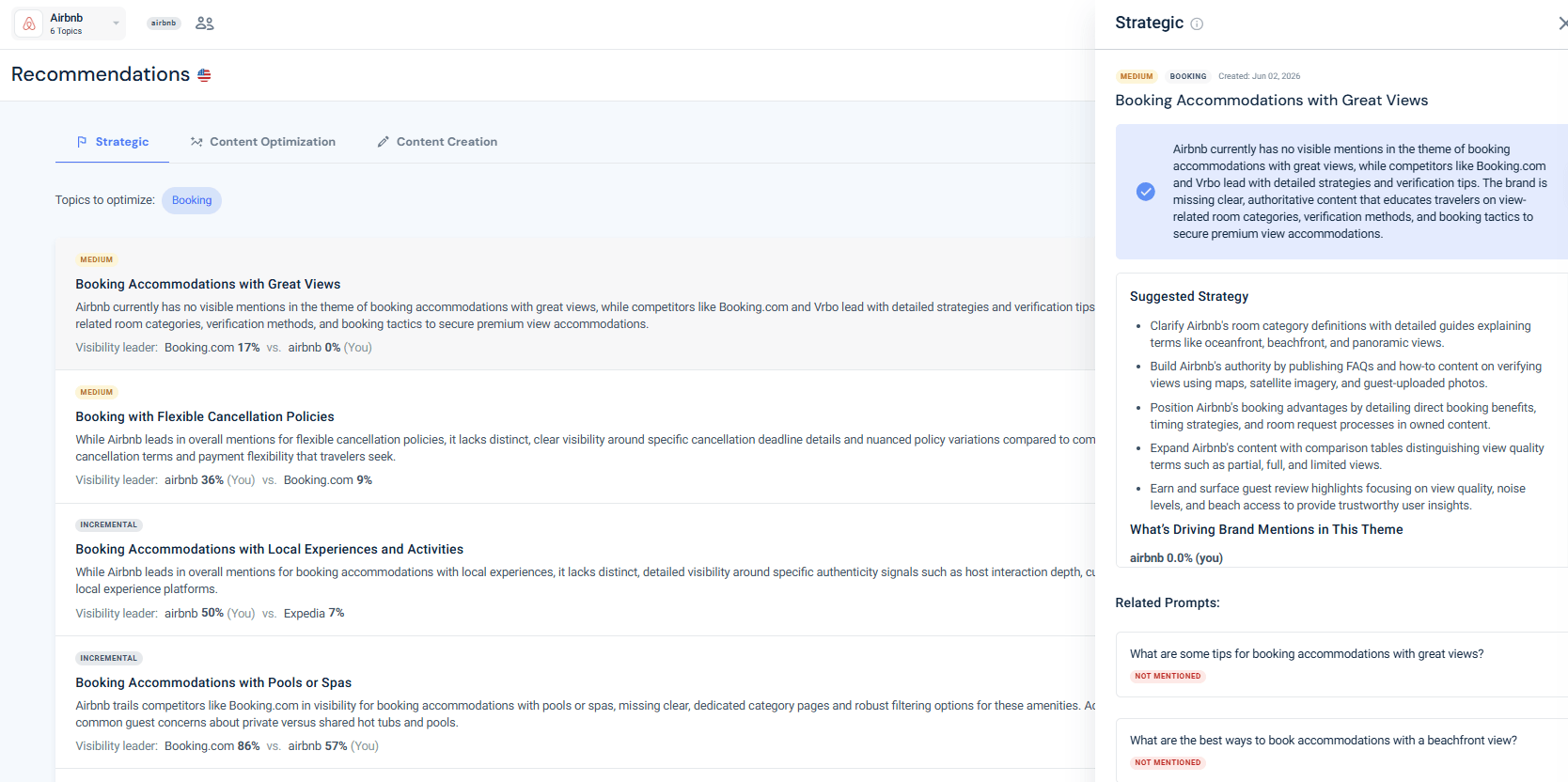
What I’d normally spend hours doing manually, mapping competitor topics, figuring out why they’re winning, identifying which prompts to target, we surface in one panel.
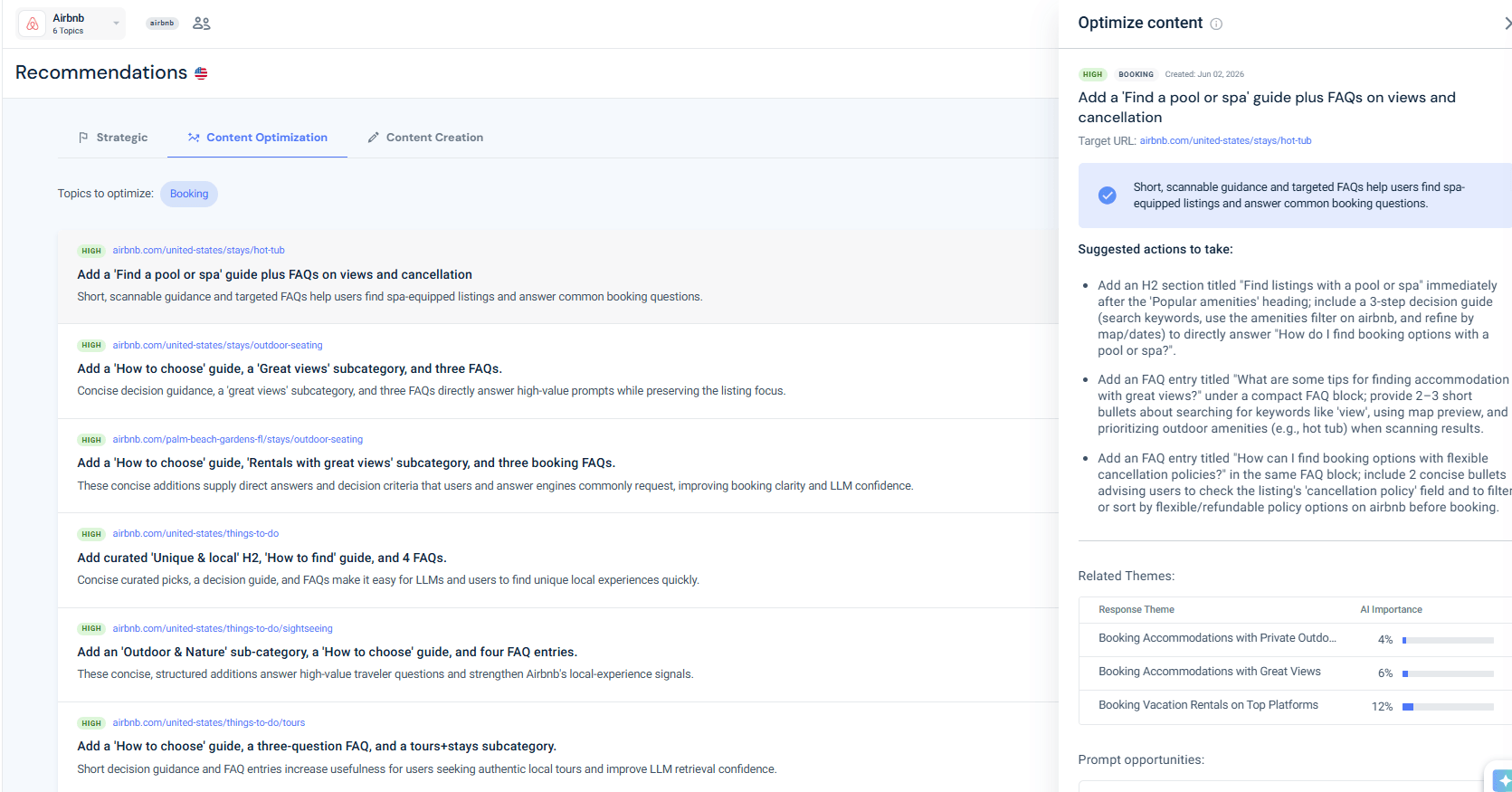
Once I had the topic gaps from the Strategic tab, the Content Optimization tab showed me which existing Airbnb pages could be updated to address them, and exactly what to add to each one. If you’re not familiar with content optimization for LLMs, this is exactly where it happens in practice.
For the page airbnb.com/united-states/stays/hot-tub, there was a HIGH priority recommendation: add a “Find a pool or spa” guide immediately after the “Popular amenities” heading, include a 3-step decision guide, and add two FAQ entries answering “How do I find booking options with a pool?” and “How can I find booking options with flexible cancellation policies?”
That’s not a direction, that’s a brief. I could hand that directly to a writer without any additional research or back-and-forth. We’ve already done the analysis: we looked at the prompt data, the citation patterns, and what competitors have that this page doesn’t, and turned it into a specific editing instruction.
Each card also shows Related Themes with AI Importance scores, so I could see that “Booking Vacation Rentals on Top Platforms” carries 12% AI importance for this topic cluster, which helped me validate that the HIGH priority rating was right. And at the bottom, Prompt Opportunities shows exactly which questions this page could start answering if the updates were made.
The Content Creation tab was the most striking. This is where we surface the topic clusters where Airbnb has no content at all, the conversations where AI never mentions the brand because there’s nothing for it to work with.
For the “great views” topic cluster, the diagnosis was clear: AI currently doesn’t associate Airbnb with view-focused booking guidance. Booking.com and Vrbo are cited because they have filter and verification guidance. Airbnb doesn’t have that content, so it simply doesn’t exist in those conversations.
What I didn’t expect was how detailed the suggested content plan was. It didn’t just say “write about views.” It outlined five specific pieces: a definitive guide to view categories (oceanfront, beachfront, panoramic), an explainer on how to verify a view before booking using maps and guest photos, a comparison piece on view quality terms (full vs. partial vs. panoramic), a data report on what guests actually say about views in reviews, and a verification checklist with host message templates.
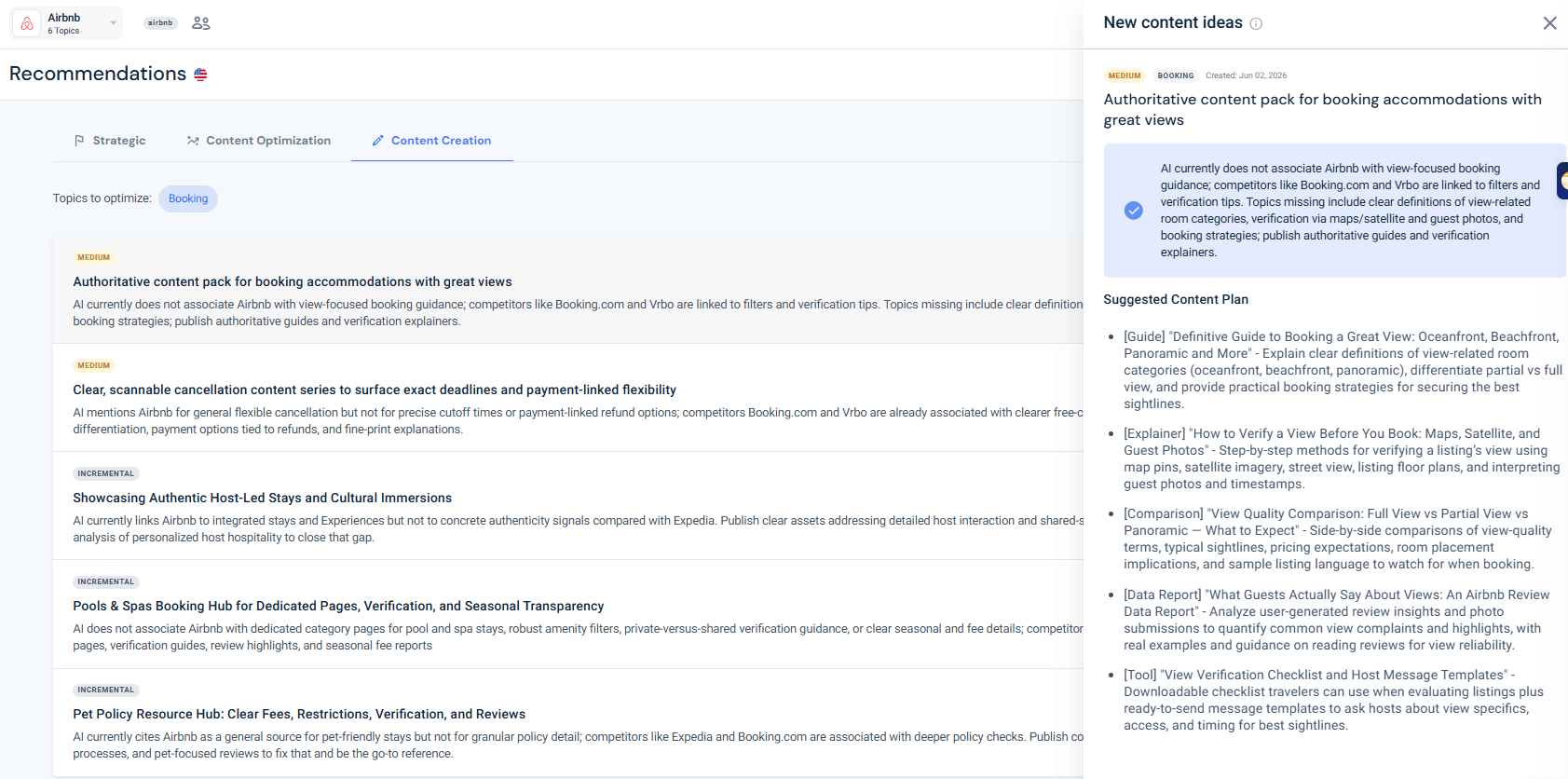
That’s a full content calendar for one topic gap. Instead of starting from scratch, researching the topic, figuring out what competitors have, deciding which formats will earn citations, I started from a data-backed brief that already had all of that figured out.
Our AI Optimization Recommendations tool will surface more actions than you can tackle at once. Here’s how I think about prioritization.
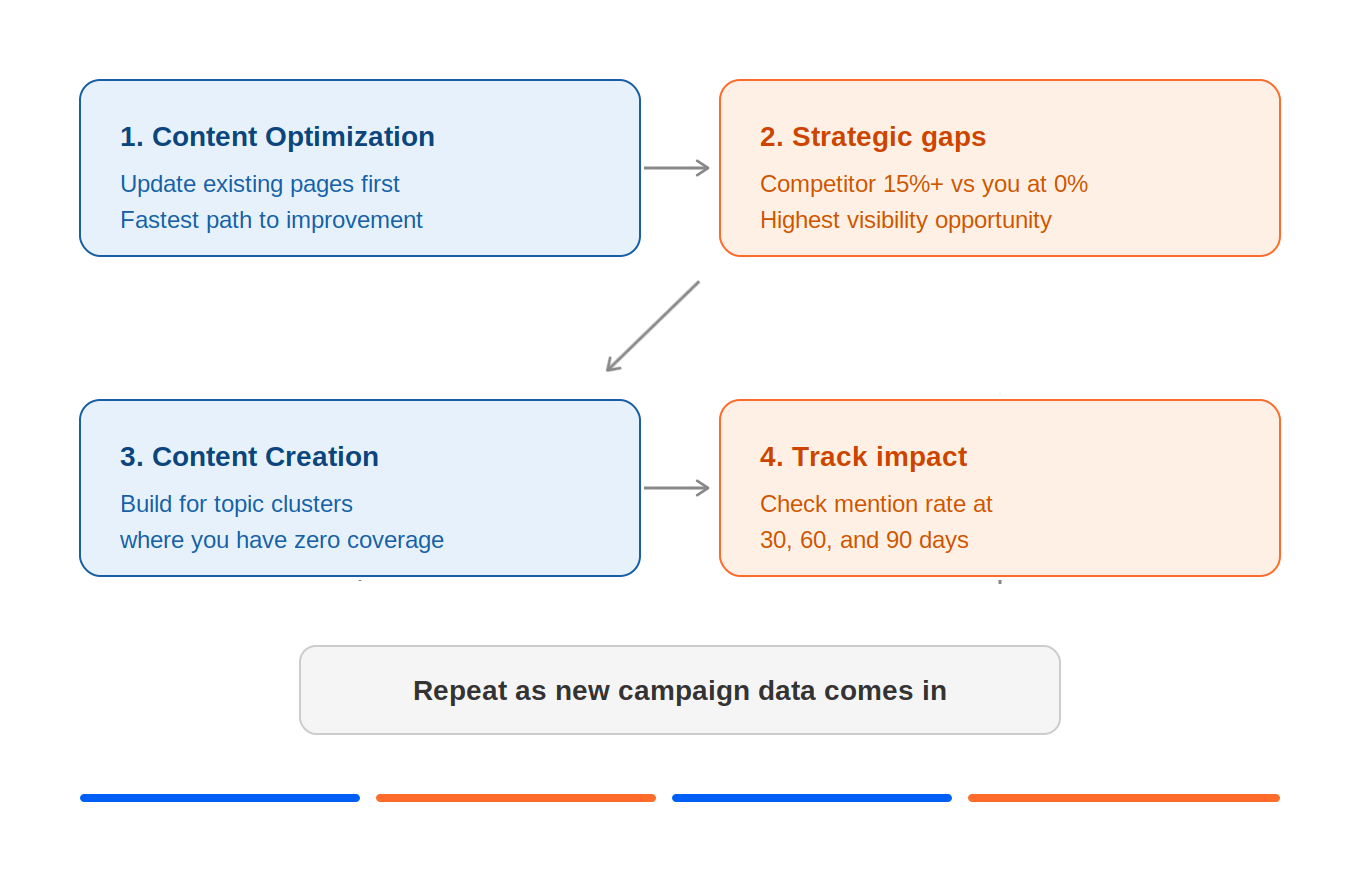
Updating existing pages is faster than building new content. HIGH priority items in this tab are usually the best first action, the recommendations are specific, the pages already exist, and the path from recommendation to published change is short. You’re not starting from zero.
Look for topics where a competitor is at 15%+ mention share and you’re at or near 0%. These gaps usually need new content (which the Content Creation tab covers), but the Strategic tab tells you which ones to prioritize. High competitor visibility + zero presence on your side = the biggest opportunity.
When a whole topic area has no coverage, use the suggested content plan as a starting brief. You don’t have to build everything at once, focus on the content formats that address the highest-volume prompts first.
After publishing or updating content, check your AI Brand Visibility campaign to see if your mention rate for that topic has moved. AI engines re-evaluate content on their own schedule, so changes aren’t instant, but the data will show you whether the actions are working. This feedback loop is what makes the whole system self-improving over time.
In order to improve AI visibility, it requires knowing which conversations you’re missing from, why competitors are winning them, and exactly what to change at the topic level, the page level, and the content creation level.
That analysis has always been possible. What’s changed is that you no longer have to do it manually. Our AI Optimization Recommendations tool processes your prompt data, citation patterns, and competitive gaps automatically and hands you a prioritized plan. The goal is to spend less time figuring out what to do and more time actually doing it.
If you haven’t set up an AI Brand Visibility campaign yet, that’s the starting point. Once your campaign is running and you have a few weeks of data, the AI Optimization Recommendations tool will have enough to work with. From there, start with the Content Optimization tab for fast wins, use the Strategic tab to find your most costly gaps, and let the Content Creation tab give you a data-backed brief for everything you need to build.
What are AI recommendations in the context of AEO?
AI recommendations are specific, prioritized actions, generated from your AI brand visibility data, that tell you what content to create, update, or optimize to improve how often AI engines mention and cite your brand. Rather than giving you a performance report, they give you an action plan: which topic gaps to close, which pages to update, and what net-new content to build.
How does the AI Optimization Recommendations tool fit into my existing content workflow?
AI Optimization Recommendations is designed to slot directly into your content workflow rather than replace it. Instead of spending hours manually pulling data, analyzing competitor gaps, and building briefs from scratch, the tool automates that entire analytical layer for you. The output, whether it’s a page-level editing instruction or a full content plan for a new topic, is specific enough to hand straight to a writer or content team, cutting out the back-and-forth that normally slows the process down. The result is a faster, more repeatable workflow where your team spends more time executing and less time figuring out where to start.
How is using a tool different from doing this analysis manually?
Manual analysis means running prompts across every relevant topic, comparing citation rates competitor by competitor, auditing your existing content against the gaps you find, and then deciding what to prioritize. That’s hours of work before you’ve changed anything on your site, and it goes out of date quickly. A tool like AI Optimization Recommendations does that analysis automatically from your live campaign data and surfaces the output as specific, ready-to-act recommendations.
What data does AI Optimization Recommendations analyze to generate recommendations?
It analyzes your AI Brand Visibility campaign data: brand mention rates by topic, competitor visibility share, prompt-level citation patterns, and citation source breakdown. It cross-references where you appear, where competitors appear instead of you, and which content types are earning citations in your category, then maps all of that to specific pages and content gaps on your site.
Do I need an active AI brand visibility campaign to use AI Optimization Recommendations?
Yes. AI Optimization Recommendations is powered by your campaign data, so you need a running campaign in Similarweb’s AI Brand Visibility module before recommendations are populated. A few weeks of tracked prompt and citation data is enough to start getting useful output.
Which tab should I start with?
Start with Content Optimization for the fastest wins, those are specific page-level edits to content you already have, specific enough to hand directly to a writer. Move to the Strategic tab to identify the topic gaps where competitors are most dominant. Use Content Creation when you need to build from scratch for topics where you have no coverage at all.
Can AI Optimization recommendations replace my content strategy?
No, and they’re not designed to. AI Optimization Recommendations tells you where your AI visibility gaps are and what content actions to take to close them. Your content team still decides how to execute, what tone to use, which formats fit your brand, and how to integrate recommendations into your broader content calendar. Think of it as the brief, not the strategy.
Senior SEO Specialist at Similarweb
Maayan is a senior SEO specialist with 7+ years of experience in SEO. She loves complex research projects, creating SEO strategies and performing technical audits.
AI Search Optimization: Tips, Best Practices, and Techniques That Worked in 2026

Dark Funnel Metrics: What to Measure When Buyers Decide Before They Click

What Happens After AI Recommends Your Brand?
Give it a try or talk to our insights team — don’t worry, it’s free!