
What is RAG (Retrieval-Augmented Generation)? A Marketer's Guide
by Shai Belinsky9 Min.
Oct 01, 2026

AI competitive analysis is the practice of tracking how your brand performs in AI-generated answers relative to your competitors, across platforms like ChatGPT, Gemini, Perplexity, and Google AI Mode. The tool you use to do this determines how much you can actually act on that data: whether you can see which prompts competitors are winning, which sources are driving their citations, and whether any of that visibility is translating into real traffic.
This guide covers the five most relevant platforms for AEO competitive intelligence: what each one does well, where it falls short, and which teams it’s actually built for.
These are the five best AEO competitor analysis tools in 2026:
The only AEO strategy tool where AI search data comes directly from real user behavior.
Best for: Enterprise and mid-market teams that need real data to build AEO strategy and measure AI within their broader digital performance against their competitors.
Similarweb AI Search Intelligence is a dedicated AEO platform that goes beyond monitoring to answer the harder questions: which prompts competitors are winning, which sources are driving their citations, and whether any of that visibility is translating into real traffic. It brings competitive analysis directly into AI search, so instead of just tracking your own visibility, you can benchmark against named competitors, see where they’re winning, and understand exactly what’s driving the gap.
Real-user prompt data, not synthetic queries
Similarweb derives prompt insights from actual user interactions, not guesses or synthetic prompts.
Competitive AI share of voice across up to 10 competitors
The AI Brand Visibility tool benchmarks you against named competitors simultaneously, by topic, by AI platform (ChatGPT, Gemini, Perplexity, Google AI Mode), and over time. See exactly which competitor is dominating a topic cluster, how your relative position is shifting, and where you stand on AI share of voice against each named competitor, tracking those shifts at a level of granularity, across topics and platforms, that no other tool can match.
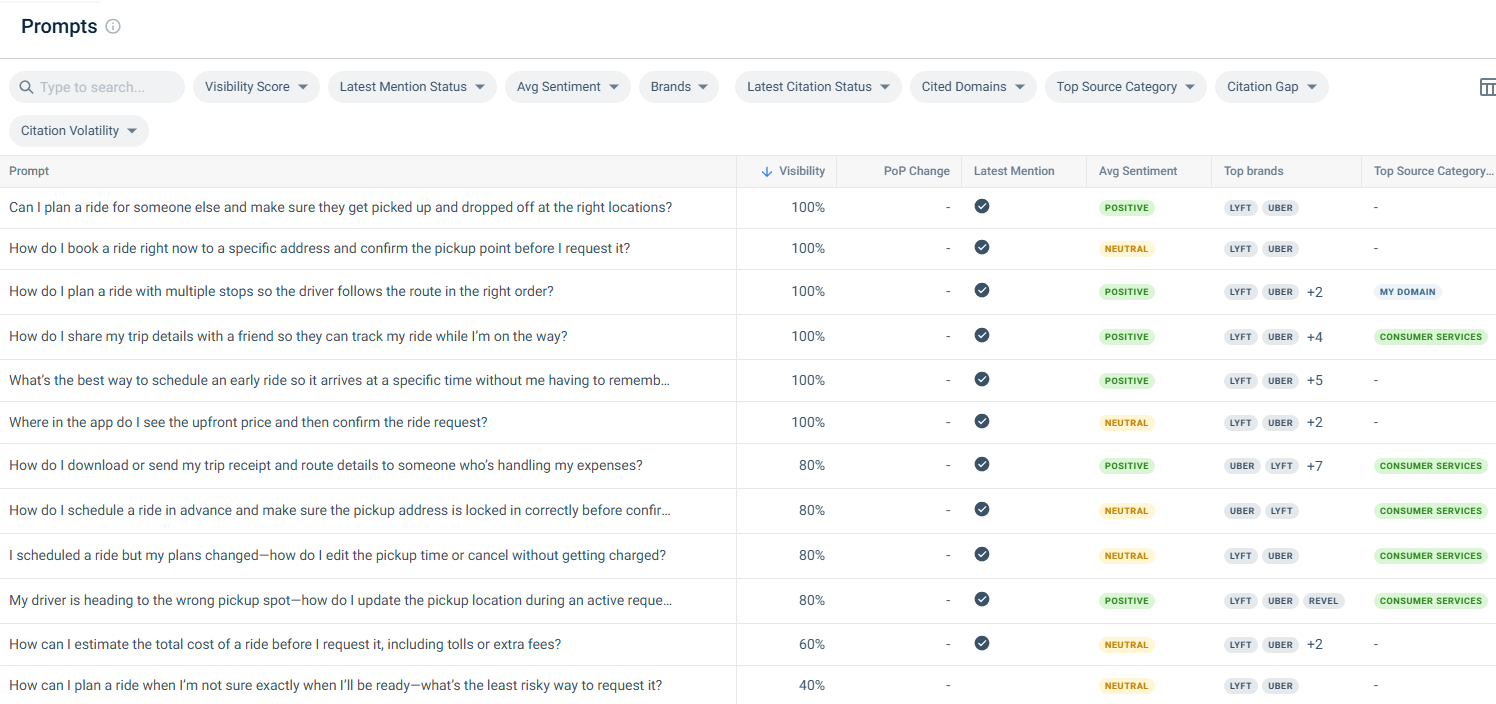
Prompt-level win/loss analysis
The Prompt Analysis tool surfaces the real queries users are entering about your category, shows which brands were mentioned, and flags where a competitor’s visibility score is high while yours is zero.
Citation intelligence at URL level
The Citation Analysis tool shows which specific URLs and domains are cited in AI answers in your category, ranked by influence score. You can see the exact third-party sources reinforcing a competitor’s AI presence, which becomes a PR and partnership roadmap.
Sentiment comparison by competitor and topic
The Sentiment Analysis tool shows how AI characterizes your brand vs. competitors on specific topics: positive, neutral, or negative. A competitor with lower visibility but stronger positive sentiment on pricing-related prompts is winning a different battle than your mention count shows.
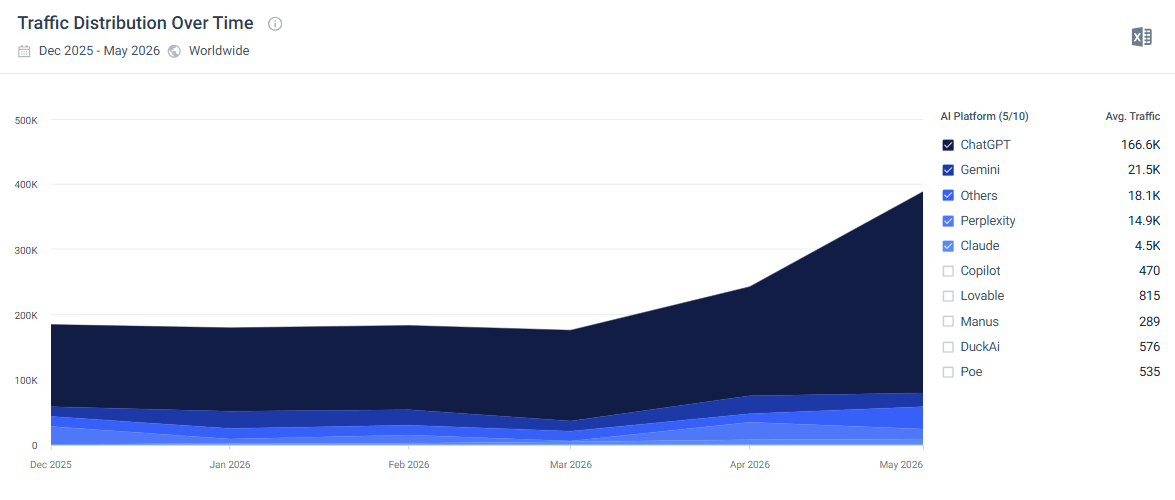
AI traffic attribution you can actually trust
The AI Traffic Tracker tracks actual referral visits from ChatGPT, Gemini, Perplexity, Claude, Copilot, and DeepSeek to your site, closing the loop between AI visibility and real business outcomes.
Unified SEO + AEO intelligence
The Rank Tracker and Competitor Keyword Analysis tools identify which keywords trigger AI Overviews and whether your content or a competitor’s appears in them. Zero-click rate data might indicate whether a query is a citation play or a traffic play.
Learning curve
The depth of data available means there’s more to configure and interpret compared to simpler point solutions.
Similarweb is built for teams that need to report competitive AI performance to leadership, not just confirm their brand exists in AI answers. The traffic attribution layer is what turns AEO data into a business case. Without it, high visibility scores are a number without a revenue connection.
Pricing:
An action- and workflow-oriented platform, built to help teams operationalize insights.
Best for: Tech-savvy SEO teams and engineering-led growth teams that need granular AEO analytics and wide AI engine coverage.
Profound is a pure-play AEO platform focused on granular tracking and technical metrics. It covers a wide range of AI engines and is built for teams whose primary need is technical depth.
Technical AEO features
Features query fan-out analysis, agentic activity tracking, and front-end data capture that mirrors exactly what a real user sees on their screen.
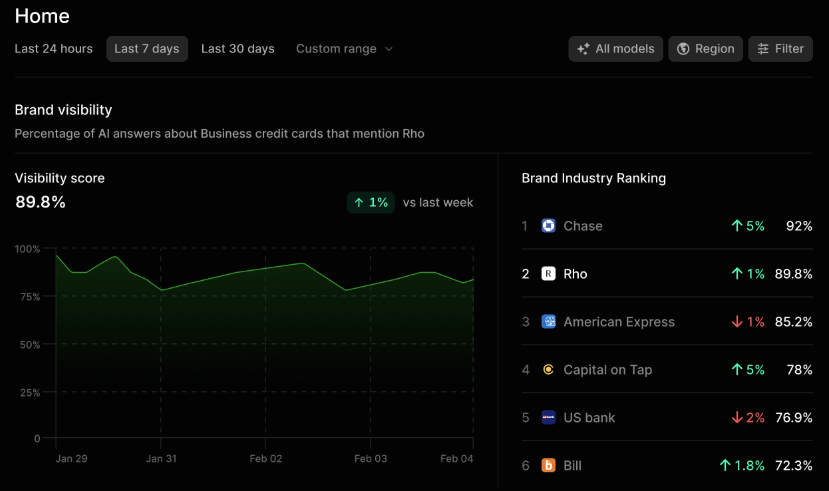
Fast, easy-to-use competitive benchmarking
Visibility patterns across markets, regions, and product lines with competitive share-of-voice data.
No AI traffic attribution
Profound shows visibility scores and competitor mention data, but it can’t tell you whether that visibility is driving website visits or downstream business outcomes.
AEO-only, no SEO or web context
It cannot connect AI visibility to traditional SEO performance, web traffic, or paid search, which limits how actionable the competitive gaps it surfaces actually are.
No data ownership
Profound sourcess prompt data externally rather than owning its baseline data, a meaningful consideration for enterprise teams making significant budget decisions.
Teams that need technical AEO data and engine coverage, and whose primary workflow is AEO-specific research rather than cross-channel competitive intelligence.
Pricing: Starts around $500/month for single-platform tracking.
A lightweight entry-level AEO tracker for small teams beginning their AI visibility program.
Best for: SMBs, freelance consultants, and small teams wanting an accessible starting point for basic AI mention tracking.
The platform tracks whether your brand appears in AI answers and how often.
Low barrier to entry
Setup is straightforward with no need for a dedicated SEO or data analyst.
Basic mention tracking
Covers the foundational AEO use case: tracking whether your brand is mentioned across major AI platforms and providing a visibility starting point.
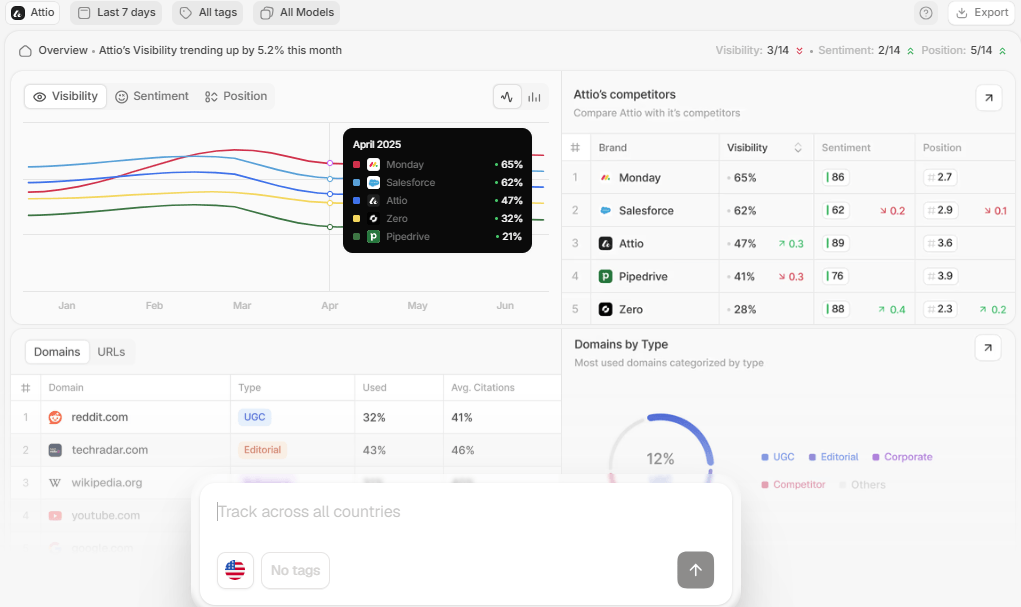
Limited competitive analysis capability
Peec AI lacks multi-brand competitive slicing, custom competitor benchmarking, and the enterprise-grade customizability needed for serious competitive programs.
Data reliability constraints
It lacks the scale of a global contributory data network. For brands making significant budget decisions on AI visibility data, this is a meaningful limitation.
No AI traffic attribution
Like most point solutions, it provides visibility data without any connection to downstream traffic or business outcomes.
SMB-only scale
No multi-brand management, no role permissions, no API access. Teams with multiple brands or enterprise reporting requirements will quickly outgrow it.
Solo consultants and small teams who need to demonstrate basic AI visibility before committing to a larger platform. A useful first step, not a long-term competitive intelligence solution.
Pricing: Starts around $29/month.
An SEO-native content optimization platform with AEO tracking layered on, powerful for writing, limited for competitive intelligence.
Best for: Content writers, agencies, and SEO copywriters focused on producing and optimizing high volumes of blog content.
Surfer AI built its reputation on on-page content optimization: telling writers which keywords to include, how to structure sections, and what format helps content rank. That core capability remains its strongest suit. Following its acquisition by a major SEO platform, Surfer now positions lightweight AEO tracking as part of its offering, valuable for content-first teams, but not a substitute for dedicated competitive intelligence.
Strong on-page content optimization
For teams producing high volumes of blog content, Surfer’s keyword recommendations and content structure guidance grounded in ranking data remain genuinely useful.
Integrated content workflow
The AEO Tracker surfaces brand mentions and citation data inside the same workspace as content creation, reducing context-switching for teams whose primary job is writing.
AEO features are an add-on, not a core capability
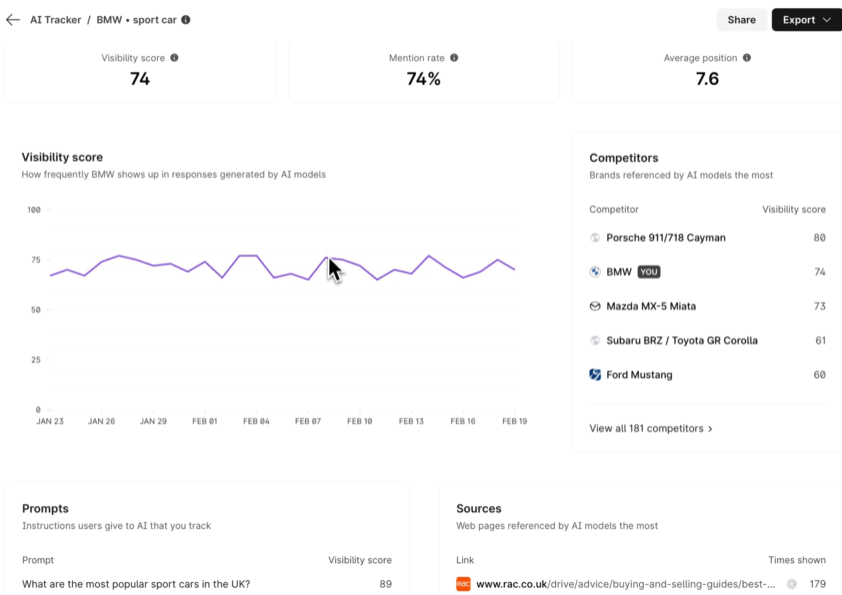
Surfer’s AEO tracking is a lightweight layer on top of an SEO platform. It cannot track real conversational prompts at scale, map competitive AI share of voice against named competitors, or produce the citation gap analysis that AEO competitor analysis requires.
Writing tool, not strategy tool
Surfer can tell you how to optimize a specific page. It cannot tell you your market AI share of voice across ChatGPT and Gemini, which prompts competitors are winning, or how AI referral traffic from those wins affects competitor site performance.
No AI traffic attribution
Cannot connect AI visibility data to downstream traffic or revenue outcomes.
Content and SEO teams who need to produce large volumes of AI-optimized content and want AEO considerations integrated into their writing workflow. Best used alongside a dedicated AEO intelligence platform rather than as a replacement for one.
A no-code content operations platform that automates AI-optimized content production at scale.
Best for: Programmatic SEO teams, marketing operations leaders, and agencies that want to automate bulk content creation and page refreshes.
The platform connects AI visibility data to content production workflows. When a prompt gap is identified, a topic where competitors appear and you don’t, it routes those gaps directly into content creation at scale.
Content production at scale
When a prompt gap is identified, AirOps can trigger content creation or refresh workflows across hundreds of pages simultaneously, with Brand Kits to maintain voice consistency and Human Review checkpoints before anything publishes.
Opportunity Engine
Surfaces prompts where competitors appear, but you don’t, and routes those directly into actionable production workflows, closing the loop between insight and execution.
Tracks key AEO metrics
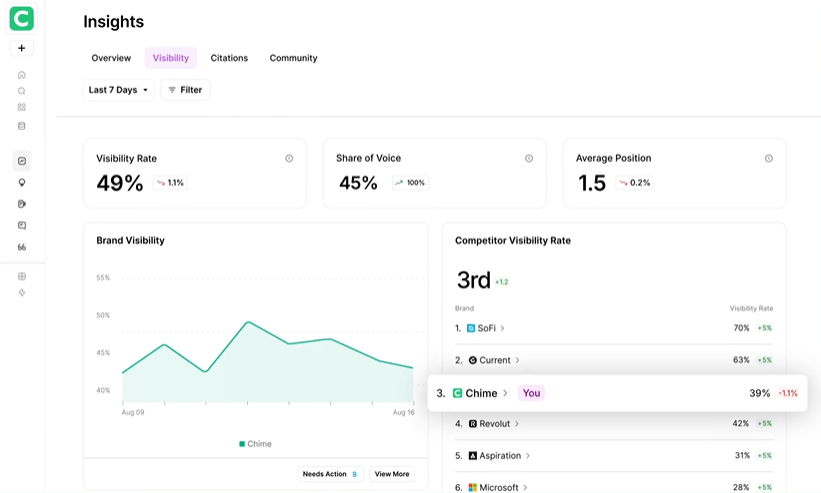
Mention rate, AI share of voice, citation rate, sentiment, and average position across ChatGPT, Gemini, Perplexity, Google AI Mode, and Google AI Overviews.
Content engine, not intelligence platform
AirOps tells you how to generate more content. It lacks the independent data ownership to tell you whether that content is actually moving competitive AI share of voice or generating downstream traffic. A factory is only as good as its blueprint.
Synthetic prompt data
AirOps relies heavily on querying AI models via prompts rather than measuring raw user search patterns. For teams making significant budget decisions on AI visibility data, this is a meaningful methodological gap.
No native traffic intelligence
It cannot connect changes in AI visibility to downstream conversion and market share shifts against competitors.
Teams where the bottleneck is content production rather than competitive intelligence. AirOps works best as the execution layer that sits downstream of a platform.
Pricing: Free tier available (Solo plan: 100 tracked prompts, ChatGPT insights). Paid tiers for larger prompt volumes and multi-platform coverage.
Each tool on this list serves a different need, from content production at scale to granular technical tracking. But if the goal is true AEO competitor analysis: knowing which prompts competitors are winning, why they’re winning them, and whether that visibility is driving real traffic, Similarweb AI Search Intelligence is the only platform built to answer all of those questions in one place.
It’s the only tool that combines real-user prompt data, competitive AI share of voice across up to 10 competitors, citation intelligence, sentiment analysis, and AI traffic attribution, without needing to stitch together multiple point solutions. For teams that need to turn AI visibility into a business case, that’s the difference that matters.
Similarweb AI Search Intelligence is the most complete AEO competitor analysis platform in 2026. It is the only tool that combines competitive AI share of voice against named competitors, prompt-level win/loss data, citation source intelligence, sentiment comparison, and AI traffic attribution in a single system. Other tools in this list cover specific parts of the AEO picture, but none connect AI visibility to downstream traffic or provide the full competitive benchmarking layer that Similarweb delivers.
AEO monitoring tracks whether your brand appears in AI answers and at what rate. AEO competitor analysis adds the relative dimension: it shows how your mention rate compares to named competitors on the same prompts, identifies which queries they’re winning that you’re not, and surfaces the citation sources and content structures behind their advantage. Monitoring answers “are we visible?”, competitor analysis answers “who’s beating us, where, and why?”
Profound, Peec AI, Surfer AI, and AirOps all show visibility scores and mention rates but have no connection to downstream traffic data
Most cannot. Profound, Peec AI, Surfer AI, and AirOps all show visibility scores and mention rates but have no connection to downstream traffic data. Similarweb links AI brand visibility to actual AI referral traffic, letting you see whether a competitor’s higher visibility is translating into site visits, and whether your own AEO investment is generating a measurable return.
Five capabilities define a serious AEO competitive program: competitive AI share of voice by topic against named competitors; prompt-level win/loss data showing which specific queries competitors win; citation source analysis revealing which third-party domains drive competitor AI mentions; sentiment comparison showing how AI characterizes your brand versus competitors; and AI traffic attribution connecting visibility to actual site visits.
It depends on your team’s needs. Some organizations use a combination, for example, a content execution tool like AirOps or Surfer AI alongside a competitive intelligence platform like Similarweb. But for teams that need a single system covering visibility tracking, prompt-level analysis, competitive benchmarking, citation intelligence, and traffic attribution, Similarweb is the only platform that covers all of those needs without requiring additional tools.
Start with visibility, are you showing up in AI answers for the prompts that matter in your category? Track brand mentions across ChatGPT, Perplexity, Gemini and others to see frequency, position, and who you’re competing with. The second signal is branded search: when AI visibility increases, branded search typically follows, which is where integrated SEO capabilities matter. The third is AI referral traffic, whether AI platforms are actually sending users to your site. Monitoring all three together gives you a complete picture of whether your AEO efforts are working.
Senior SEO Specialist at Similarweb
Maayan is a senior SEO specialist with 7+ years of experience in SEO. She loves complex research projects, creating SEO strategies and performing technical audits.
Give it a try or talk to our insights team — don’t worry, it’s free!