



AI Search Optimization: Tips, Best Practices, and Techniques That Worked in 2026
by Limor Barenholtz18 Min.
Oct 22, 2026
For the past 20 years, small businesses fought for visibility on search engines like Google. Rankings meant traffic. Traffic meant leads.
Discovery is evolving.
In addition to traditional search engines, more users are turning to answer engines. Instead of clicking through blue links, users now ask ChatGPT, Perplexity, Gemini, and other AI tools for direct answers. They get summaries, recommendations, and product suggestions, often without ever visiting a search results page.
This shift is changing how businesses think about visibility, often referred to as Generative Engine Optimization (GEO).
I claim that GEO isn’t just for tech giants with huge marketing budgets. In fact, small and mid-sized businesses (SMBs) may have a structural advantage.
In the AI era, visibility is no longer about who has the biggest domain authority. It’s about who provides the clearest, most trustworthy answer.
Short answer: Yes.
A bit longer answer: You can often win.
AI engines are designed to reduce uncertainty. When generating answers, they lean toward sources that are:
Large brands often publish broad, generalist content. A national chain might write “The Ultimate Guide to Plumbing”, but it won’t go deep into “Cost of sewer line repair in Austin, TX (2026 update).”
A small local plumbing company can.
When you act as a topic authority in a defined niche or geography, you provide the kind of high-confidence data AI engines crave. The model doesn’t need the biggest brand. It needs the clearest, most relevant answer.
That’s your opening.
Big brands move slowly. New page update may need to pass through legal reviews, brand compliance checks, too many product marketing managers, and internal approvals. Adopting new formats can take months.
A small business?
You can:
GEO rewards iteration. The faster you adjust your content to match how AI engines surface answers, the stronger your position becomes.
Speed is a competitive advantage.
AI engines don’t reward size. They reward usefulness.
If someone asks:
The model isn’t looking for the biggest corporation. It’s looking for the most relevant and well-supported answer.
Small businesses can dominate long-tail prompts that big brands ignore. And those long-tail prompts often convert at a much higher rate.
You don’t need a six-figure budget to compete. You need structure, clarity, and focus.
Here’s where to start.
Schema markup (especially JSON-LD) is one of the simplest GEO wins.
Adding structured data like:
acts like a cheat sheet for AI systems. It clearly defines:
This structured clarity increases confidence. And confidence increases the chance of citation.
AI engines prioritize content that gets to the point.
Use the Inverted Pyramid. Answer the core question in the first two sentences. Don’t bury it in fluff.
Instead of:
“At ABC Roofing, we’ve proudly served the community since 1998…”
Start with:
“Roof replacement in Denver typically costs between $8,000 and $15,000, depending on materials and home size.”
Then expand.
This format aligns perfectly with how AI extracts and summarizes content.
Create content like:
These are the exact prompts users type, or speak, into AI tools.
Own them.
AI engines increasingly weigh mentions from:
You don’t need a PR agency.
You need to be genuinely helpful.
Take a few minutes a day to answer questions. Share your expertise. Be transparent about who you are. Over time, these mentions act as social proof signals that AI models incorporate into their responses.
Thumb rule for commenting in these communities and not getting banned – Helpful participation > promotional spam.
AI systems are trained to assess trust.
Clear signals matter:
These elements reinforce E-E-A-T:
Experience, Expertise, Authoritativeness, Trust.
The more human and verifiable you appear, the more likely AI engines are to treat you as a reliable source.
Here’s what many SMBs don’t realize:
AI visibility compounds.
AI models are iterative. When a business consistently serves as a reliable source of answers, it becomes part of the system’s working knowledge.
Once you’re cited repeatedly for:
You become a trusted reference point.
That trust carries forward.
Most small businesses are still focused entirely on traditional SEO. Very few are optimizing for AI answer engines.
That means the field is open.
If you define the answer today, you shape how AI systems frame your industry tomorrow.
Wait two years, and you’ll be competing against dozens of optimized players. Act now, and you can set the standard.
Understanding how AI platforms treat your brand requires more than assumptions. Similarweb’s AI Search Intelligence is designed to help businesses measure and act on their presence in AI-driven discovery.
AI Search Intelligence is built around two core modules:
Together, they help you understand visibility first, impact second.
Similarweb’s AI Brand Visibility tool shows how visible your brand is in AI-generated answers for the topics that matter most to your business.
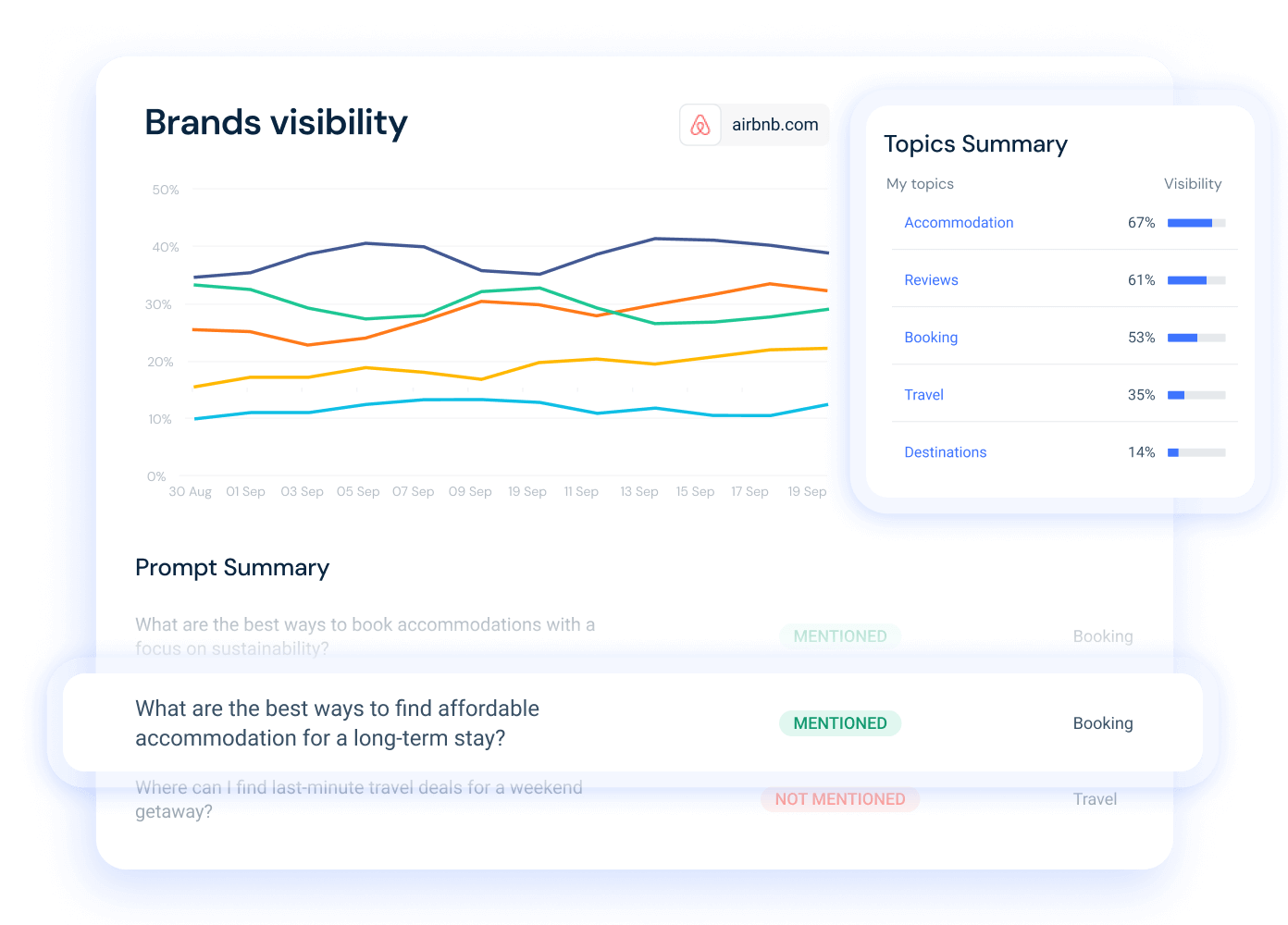
With it, you can:
The tool includes:
Similarweb’s AI Traffic tool measures how much traffic AI platforms actually drive to websites.
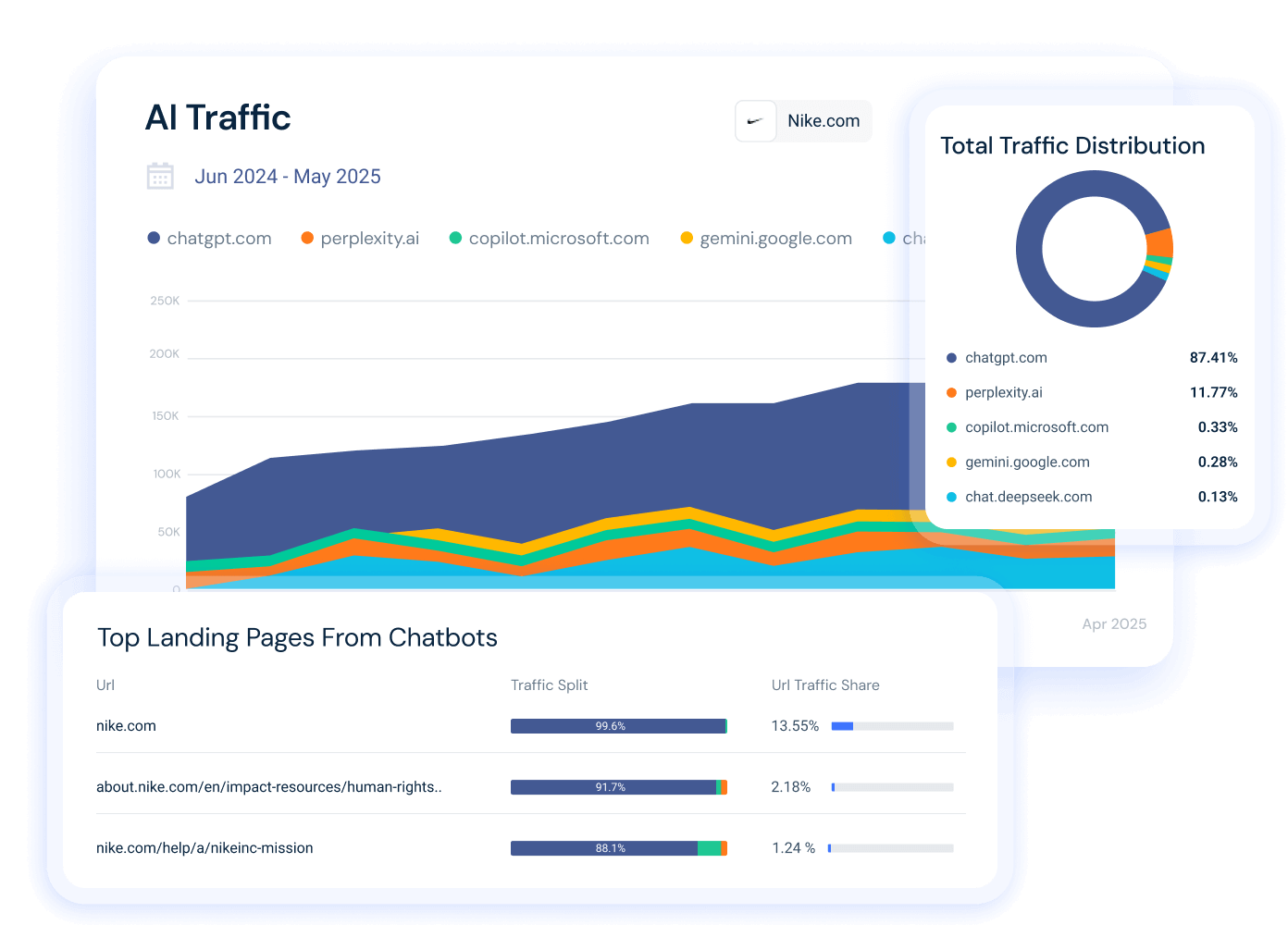
With AI Traffic, you can:
This helps answer a critical question: Is AI replacing lost search traffic, or not?
To illustrate how this works in practice, let’s look at 1tomplumber.com
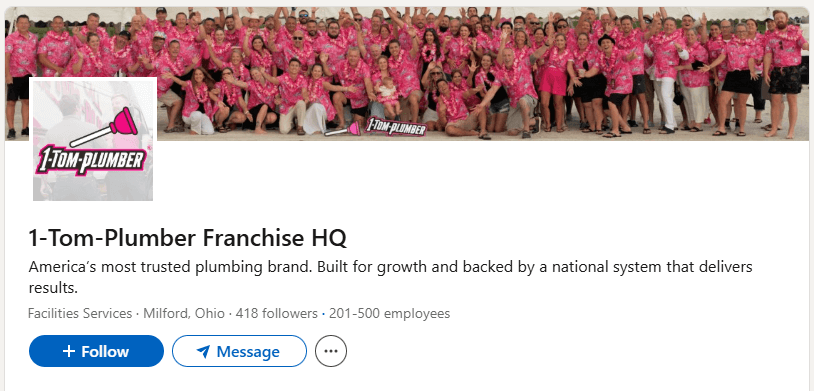
I took a few minutes to find a small company for this example until I found one. They are a plumbing franchise, and their LinkedIn page shows they have 200–500 employees, so they fit the definition of a small business in the U.S.
Over the past 12 months, their U.S. web traffic has trended downward, but still have substantial traffic for a small business.
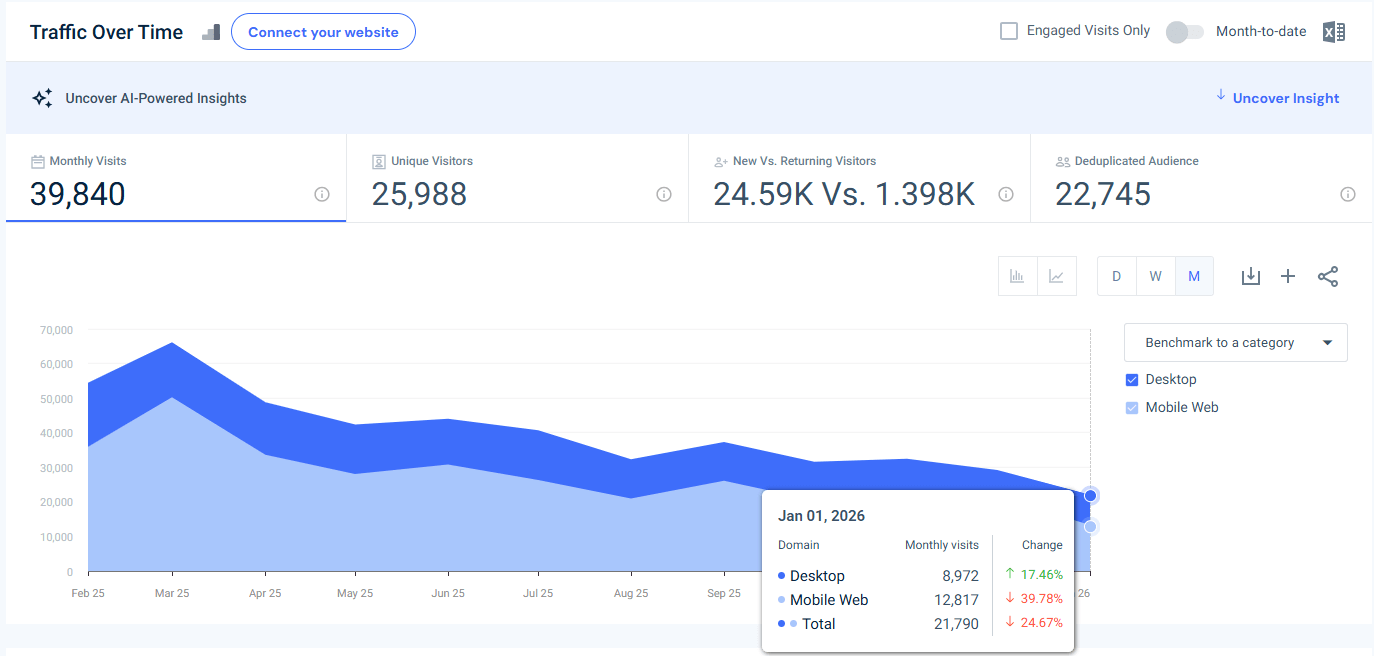
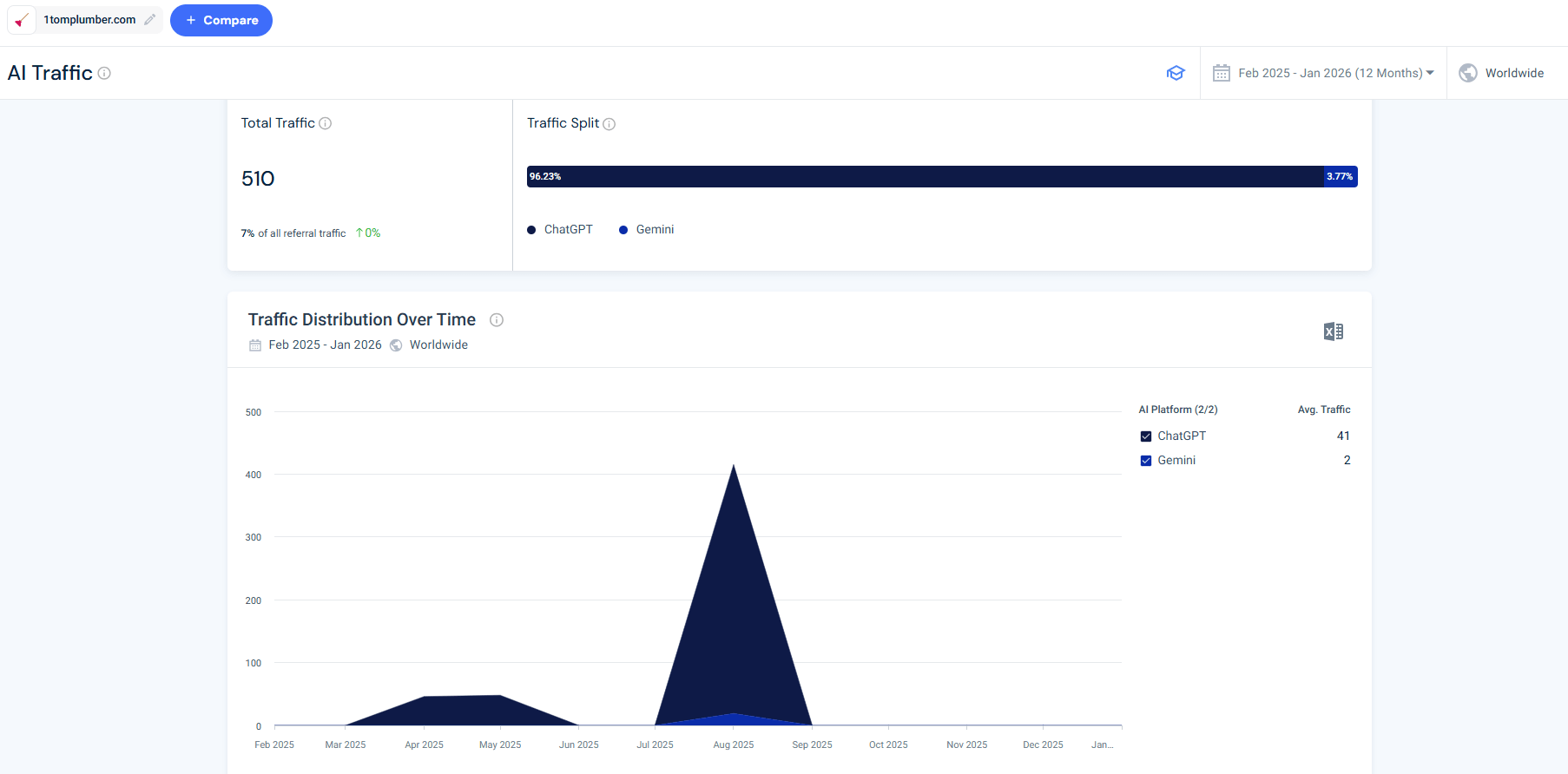
However, when reviewing Similarweb’s AI Traffic data, there is no meaningful increase in AI-referred traffic offsetting that decline. In other words, traffic lost from traditional search is not being replaced by AI discovery.
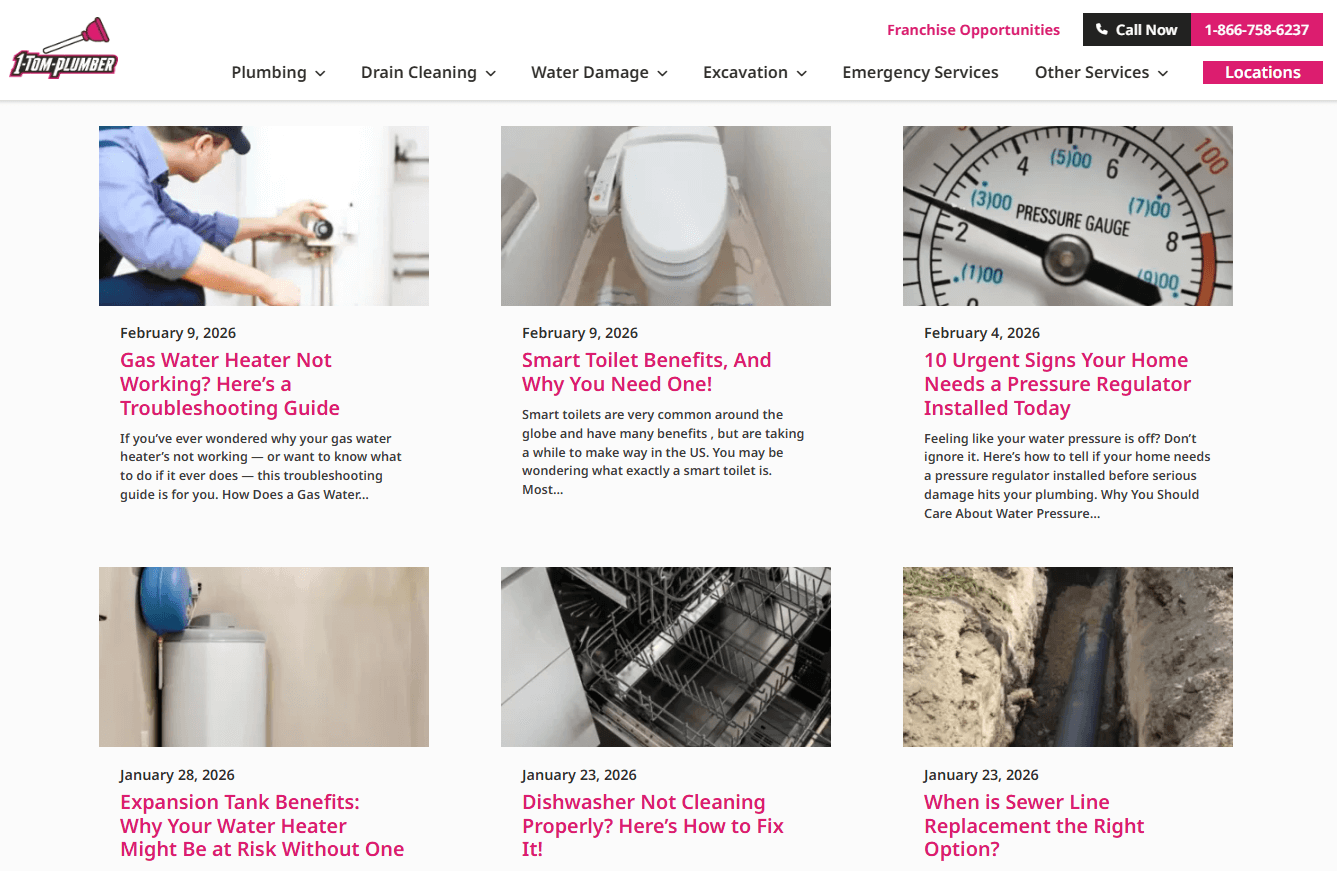
On-site, they appear to have a structured SEO strategy. They publish blog content regularly and have well-built service landing pages.
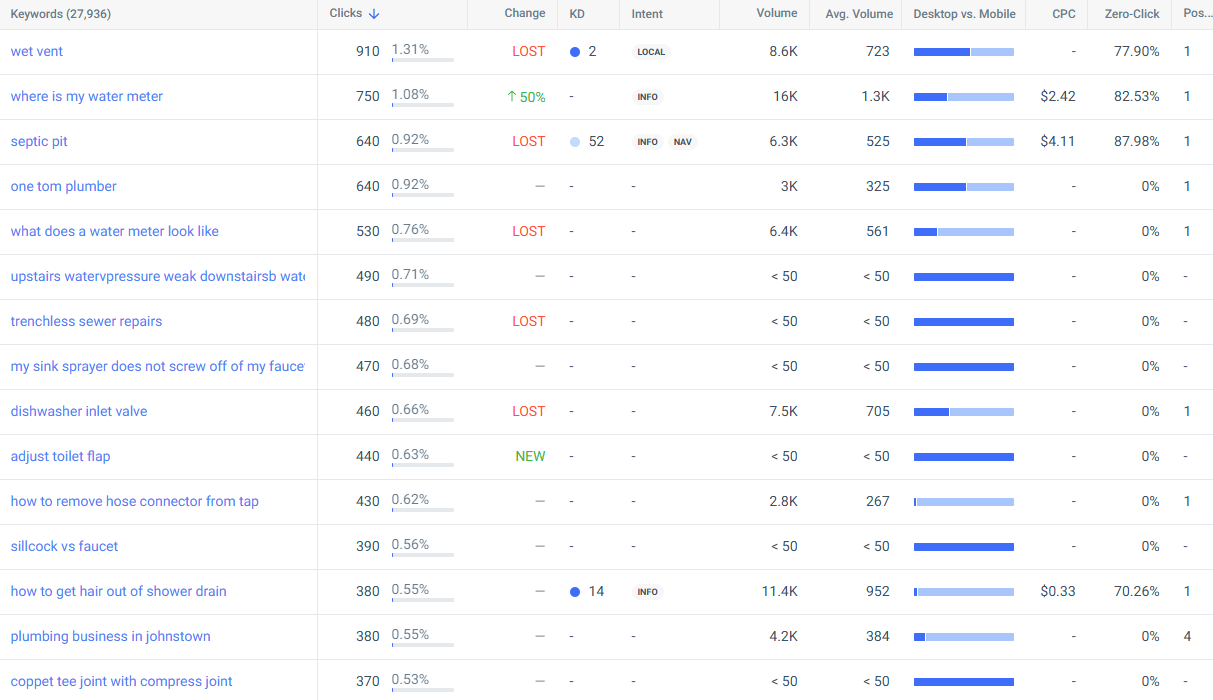
And they rank well for a range of non-branded keywords:
However, when I opened an AI Brand Visibility campaign for their core topics, the results show 0% brand visibility in AI-generated answers.
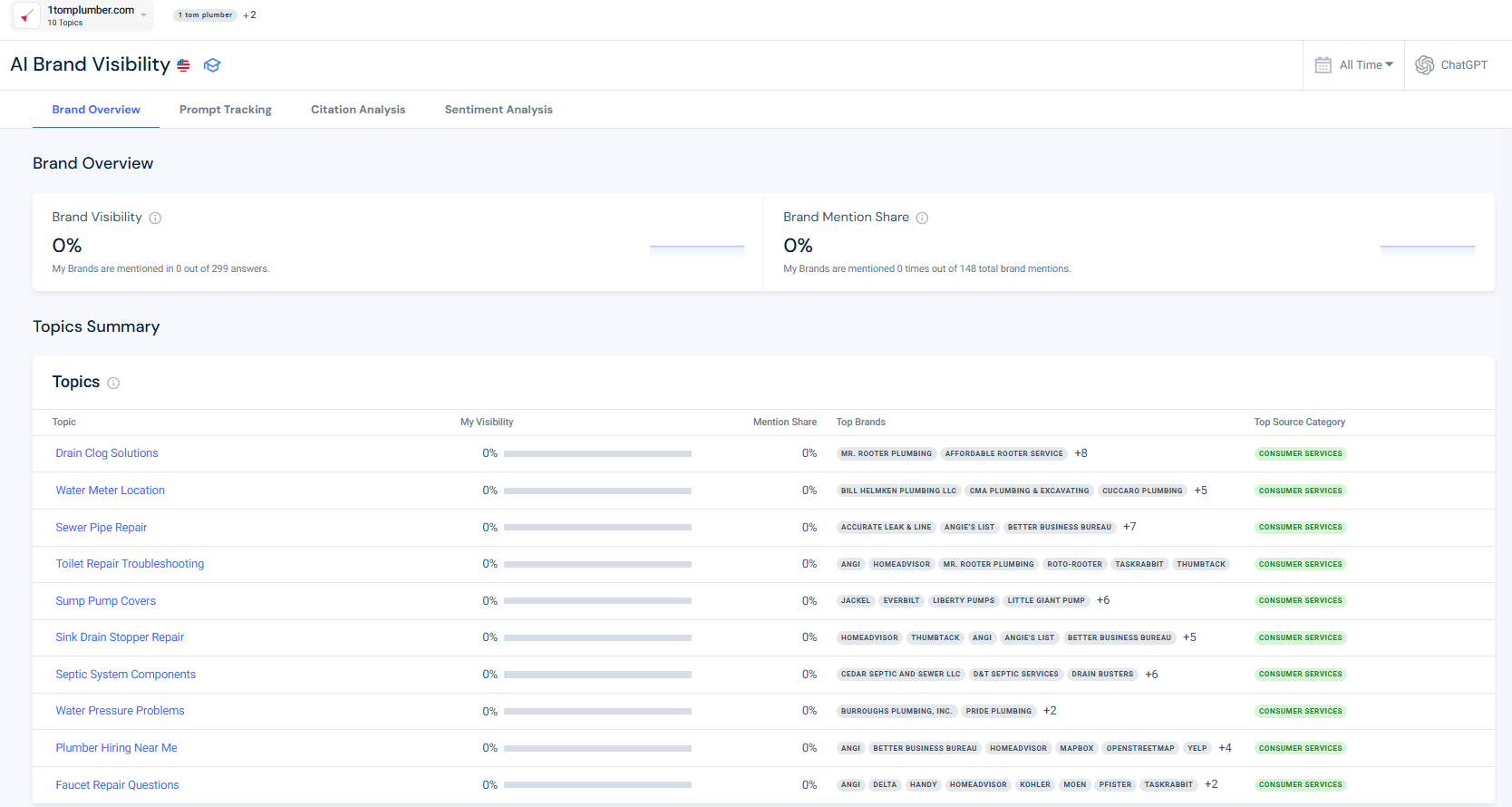
This means that while they are optimized for search engines, they are largely absent from AI-driven answers.
What Prompt Analysis reveals
Looking in our AI Prompt Analysis tool at prompts related to local plumbing services (for example, users asking for reputable plumbers for drain clogs), AI answers tend to cite:
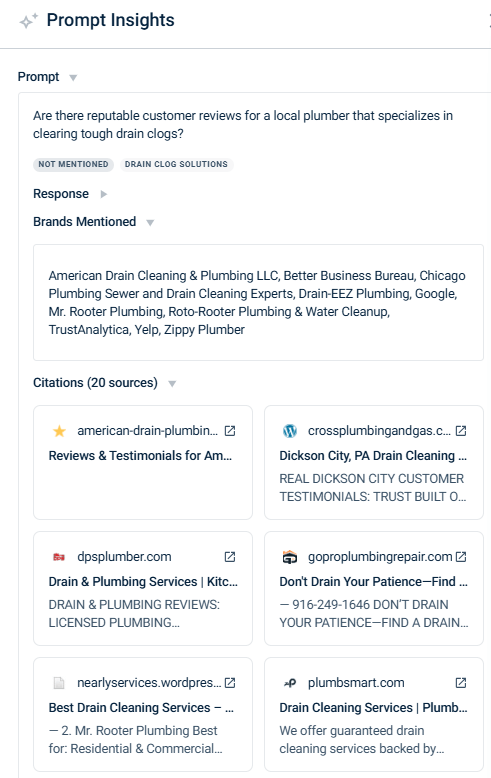
1 Tom Plumber does not appear in these answers.
The recommendation here is practical: review the competitor websites and third-party sources that are being cited. Analyze how they structure content, how clearly they answer service-related questions, and what types of sources AI seems to favor.
This can guide both:
What Citation Analysis reveals
Interestingly, the AI Citation Analysis tool shows that 1 Tom Plumber does have at least one URL with a relatively strong Influence Score within a tracked topic.
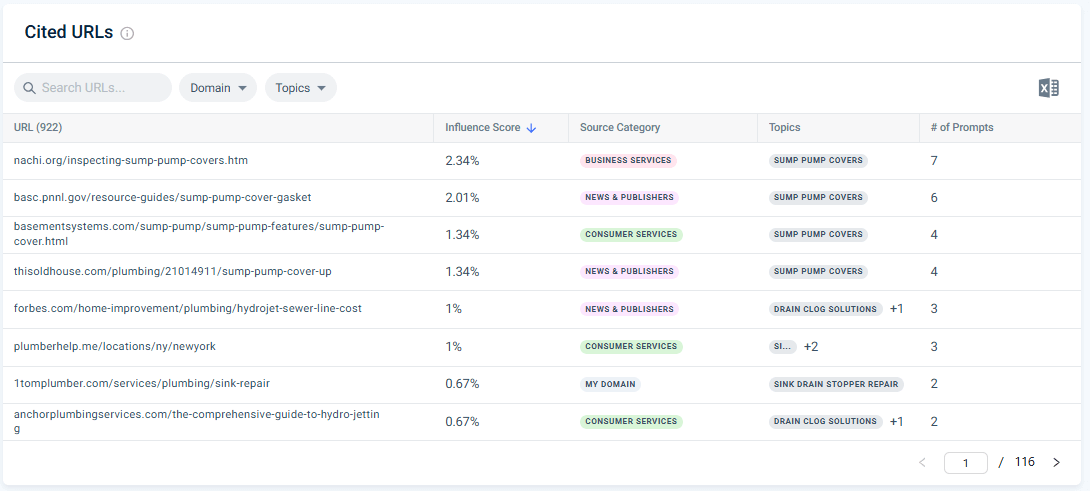
This suggests an opportunity.
Rather than spreading effort thinly across dozens of pages, they could:
Improving a page that AI already references can be more efficient than starting from zero.
GEO isn’t necessarily a budget battle.
It’s a relevance battle.
In the AI era, the small business that provides the clearest, most authoritative answers can compete effectively, regardless of size.
If you want to understand how your brand appears in AI-driven discovery, and where you’re missing opportunities, AI Search Intelligence provides the data to act with confidence.
AI Search Intelligence is available starting at $99 per month (billed annually), making it accessible for smaller teams that want structured visibility into how AI platforms represent their brand. See our pricing page for more details.
How long does it take to improve visibility in AI answers?
There is no fixed timeline. In most cases, improvements happen gradually as content is updated, cited more frequently, and referenced by trusted sources. Businesses that focus on clear answers, strong local signals, and credible third-party mentions typically see changes over several weeks to a few months rather than overnight.
Does GEO replace traditional SEO?
No. Traditional SEO still drives significant traffic and remains critical. GEO complements SEO by helping you appear in AI-generated answers. The strongest strategy is to align both: rank well in search and be structured clearly enough for AI systems to reference.
What if my business doesn’t have a blog?
You don’t need a large blog to compete. Well-structured service pages, strong FAQs, clear pricing explanations, and detailed location pages can all contribute to AI visibility. Depth and clarity sometimes matter more than publishing volume.
Should franchises handle GEO at the national or local level?
Ideally both. National sites can build authority around broad topics, while local franchise pages should focus on city-specific services, pricing context, and local proof (reviews, case examples, certifications). AI often surfaces answers that combine national credibility with local relevance.
How should a small business prioritize topics to track?
Start with revenue-driving services and high-intent customer questions. Focus on topics that directly influence purchasing decisions rather than broad informational queries. Over time, expand into adjacent topics where competitors dominate AI answers.
How do I know if AI traffic is meaningful for my small business?
Look beyond raw traffic numbers. Evaluate whether AI-referred visitors land on high-conversion pages, stay engaged, or complete key actions. Even modest AI traffic can be valuable if it reflects high intent and strong conversion potential.
Senior SEO Specialist
Shai, with 10+ years in SEO, holds a Bachelor’s and an MBA. He enjoys TV shows, anime, movies, music, and cooking.
AI Search Optimization: Tips, Best Practices, and Techniques That Worked in 2026

Dark Funnel Metrics: What to Measure When Buyers Decide Before They Click

What Happens After AI Recommends Your Brand?
Give it a try or talk to our insights team — don’t worry, it’s free!