
Marketing Funnel Fragmentation: Why AI Broke Attribution
by Limor Barenholtz20 Min.
Sep 17, 2026

Picture the loop a reader is now stuck in. They ask ChatGPT a question. ChatGPT summarizes an article for them, the same way Google’s AI Overviews do at the top of a search results page. That article’s own summary, the TL;DR you wrote at the top, was already a summary of the piece. The reader gets a summary of a summary and never opens your page at all.
That’s the real tension behind TL;DR sections in 2026. A short recap at the top of an article genuinely helps some readers and, done well, gives AI systems something clean to extract. Slapped onto every article as a reflex, it can also train readers to stop reading, and it hands generative engines an easy shortcut around your actual content.
By the end of this piece, you’ll know what a TL;DR is, how it’s different from a key points section, when it earns its place on the page, and when it’s just noise dressed up as optimization.
One data point to start: 44.2% of ChatGPT citations come from the first 30% of a page’s content, according to an analysis of 18,012 verified citations by growth advisor Kevin Indig. Placement at the top of an article matters more than most writers assume.
A TL;DR (“too long; didn’t read”) is a short summary, usually 40 to 100 words or 3 to 5 bullets, placed near the top of an article so a reader or an AI system can grasp the core answer without reading the full piece.
The term started as internet shorthand, often a little sarcastic, for content too long to bother with. It’s since become a standard element: a compressed, standalone version of the article’s main point, written last so it reflects what the piece argues rather than what the writer assumed going in.
A good TL;DR answers one question: if someone reads only these two sentences, what do they walk away knowing? Everything else is expansion.
The label itself doesn’t matter, and there’s no requirement to add a heading that literally says “TL;DR”.
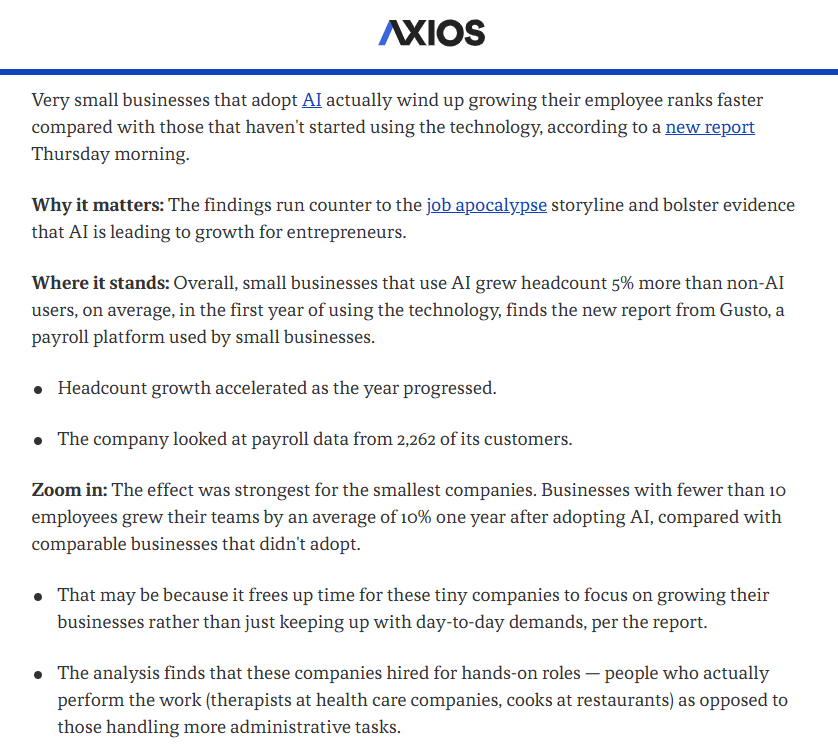
Axios, for example, built its entire format around this idea without ever writing “TL;DR”: nearly every story opens with “Why it matters” or “The big picture,” a structured summary before the deep dive. What makes something a TL;DR is the job it does, stating the core point up front, not the specific word above it.
A TL;DR is a short narrative recap, written as flowing sentences. A key points (or key takeaways) section is an itemized, extractable list, with each point standing on its own. Both usually sit near the top of an article, right after the intro; the real difference is format and job, not position.
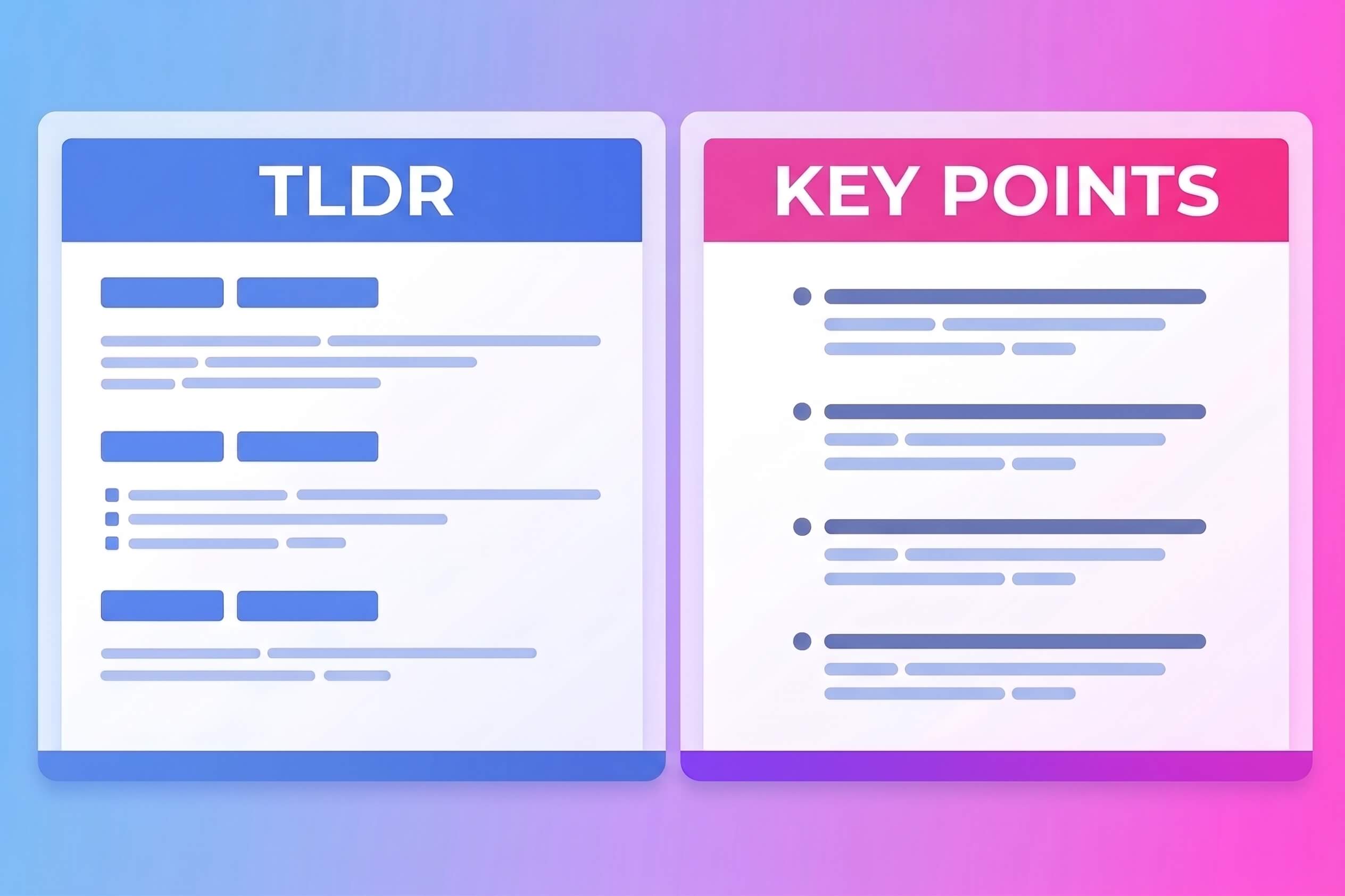
A TL;DR compresses the whole argument into a few sentences a reader skims before deciding whether to continue. A key points list breaks the argument into discrete, separately citable facts, more useful once someone wants to scan or reference specific parts of the piece without reading the connecting narrative.
When TL;DR fits better: the article makes one central argument or answers one specific question, and the reader’s main decision is whether to keep reading at all.
When key points fits better: the article covers several distinct, independently useful facts or steps, the kind of content where a reader (or an AI system) might want to cite item 3 without needing items 1, 2, 4, and 5.
| Dimension | TL;DR | Key points / key takeaways |
|---|---|---|
| Position | Near the top, right after the intro | Also usually near the top; occasionally repeated as a recap at the end |
| Structure | 2 to 4 sentences or 3 to 5 bullets, read as a unit | Itemized list, each point independently useful |
| Job | Helps the reader decide whether to keep reading | Helps the reader scan or cite specific facts |
| Best fit | Single-argument pieces, opinion or analysis | Multi-step guides, listicles, data round-ups |
Many articles benefit from both: a TL;DR to earn the read, and a key points list right after it (or repeated at the end) so specific facts are easy to scan back through or extract from.
AI systems favor content they can extract and cite without needing to read the whole page. A TL;DR gives them exactly that: a short, self-contained chunk near the top that states the answer plainly. Done consistently across a site’s most important pages, not just one article, that adds up to a real, measurable lift in AI visibility, not just a better shot at any single citation.
This matches how AI search behaves in practice. Indig’s citation analysis found that content concentrated in the first third of a page gets cited nearly twice as often as content buried further down. For a deeper look at how AI systems select which passages to cite, the short version is that most of them rely on some form of retrieval, pulling relevant passages from an existing index rather than reading a page start to finish. Google’s own guide to optimizing for generative AI features confirms this without endorsing any specific format.
A TL;DR written well gives that retrieval step a clean target. Three things separate a citation-worthy TL;DR from a throwaway one:
None of this requires special markup. Structured, front-loaded writing is doing the work, not a label that says “TL;DR.”
Overusing TL;DR sections can train readers to stop reading past the top of the page, and once AI systems summarize your TL;DR anyway, you’ve optimized for a reader who never reaches your actual content.
I think that’s a real risk, not one to wave away with a caveat.
A TL;DR on every single article, regardless of length or complexity, teaches readers a habit: skim the box, skip the rest. That habit already exists without any encouragement: Nielsen Norman Group’s long-running eyetracking research on how people read on the web found that 79% of users always scan a new page rather than read it, and only 16% read word-by-word. A TL;DR on top of that scanning behavior can tip a reader from “skims, then reads the interesting part” to “reads the box, closes the tab.” Over time, that erodes the thing that made the article worth citing in the first place, whether that’s nuance, a worked example, or a counterargument the summary can’t hold. If every piece on a site opens with a boilerplate recap, readers (and AI systems generating their own recap of your recap) start treating the full article as optional. The summary becomes the product, and the actual reporting or analysis becomes overhead nobody reads.
Google has been explicit that there’s no special format requirement here. Its own guidance, cited above, states directly that its systems don’t require content to be broken into smaller pieces to be understood, and that there’s no special schema or markup needed to appear in AI Overviews or AI Mode. A TL;DR isn’t a ranking trick. It’s a formatting choice that either serves the reader or doesn’t.
Adding a TL;DR to every post regardless of length or topic is the problem, not TL;DR itself. A 400-word how-to post rarely needs one; a reader can absorb the whole thing in the time it takes to read a summary. A 2,500-word analysis piece with one central, non-obvious argument benefits from one, because it respects the reader’s time to state the conclusion up front and still rewards them for reading the reasoning.
The test worth applying before adding one: would this TL;DR say something a reader can’t get just as fast from the headline and subheads alone? If not, skip it.
TL;DR is one structural tactic among several for making content extractable to AI systems. Each solves a slightly different extraction problem.
A TL;DR handles exactly one job: the very top of the page. It doesn’t substitute for structuring the rest of the article the same way. An article with a strong TL;DR and six dense, unstructured paragraphs after it is still hard for both readers and AI systems to use. Treating TL;DR as the whole strategy, rather than one piece of a broader generative engine optimization approach, leaves the rest of the page just as hard to extract as it was before.
Since this is a citation play, not a click play, I wouldn’t test it with rank tracking or bounce rate. What I’d actually check is whether the page gets pulled into AI answers more often after the change.
Before you rewrite or add a TL;DR to a page, get its baseline: how often it currently shows up in answers from AI Mode, ChatGPT, Gemini, and Perplexity. I use Similarweb’s AI Citation Analysis tool for this, since it tracks citations by domain, by page, and by topic, so you can isolate whether a specific structural change actually moved anything.
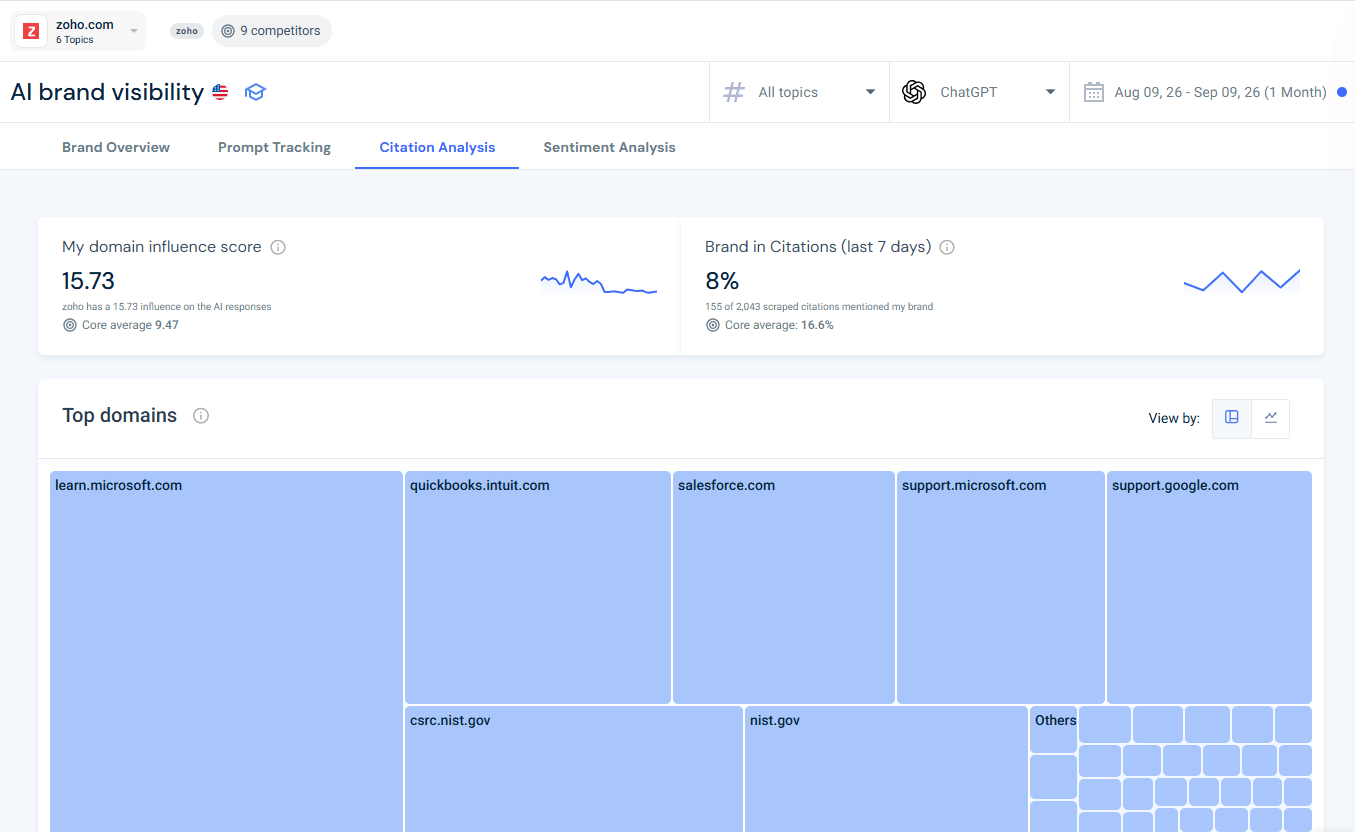
Give it a few weeks, then check the page’s Influence Score again. If the score’s up and citations for that page have increased, the TL;DR earned its place. If nothing’s moved, that’s real evidence the page didn’t need one, or that something else, placement, specificity, page authority, is the actual blocker.
My recommendation is to treat this as a phased rollout rather than a one-time decision. Start with a handful of key pages you’d expect to benefit most, confirm the lift is real, then expand to the rest of that topic cluster before rolling it out across your entire site. Adding TL;DR everywhere at once is exactly the blanket approach I’ve argued against above, and it skips the one step that tells you whether it’s actually working.
My take: TL;DR is a tool for the moments your article has earned a shortcut, not a permanent shortcut for every article you write. Use it when a piece makes one dense, non-obvious argument worth stating plainly up front. Skip it when the headline and subheads already do that job.
If you’re tracking how your own content shows up across ChatGPT, Gemini, and AI Overviews, Similarweb’s AI Search Intelligence tools break down which pages get cited and why, so you can see whether a change like this is having any real effect.
After. Write the full piece first, then summarize what it argues, not what you planned to say before drafting. A TL;DR written first tends to restate your outline instead of your conclusion, which is a weaker, vaguer summary than one written from the finished piece.
No, keep them separate. A meta description is written to earn a click from a search results page, usually 145 to 155 characters, and its job is to entice. A TL;DR is written for someone already on the page, and its job is to deliver. Reusing meta description copy as a TL;DR usually reads as vague marketing language instead of an actual answer.
Not meaningfully. All three favor the same underlying qualities, front-loaded, self-contained, specific, rather than platform-specific formatting. Write one clear TL;DR for human readers first; there’s no evidence that tailoring length or phrasing per AI platform improves citation odds, and doing so just multiplies maintenance work for no measurable gain.
Writing it as a teaser instead of an answer. A line like “this article covers three ways to think about TL;DR sections” tells a reader nothing they can use. A useful test: if someone read only the TL;DR and nothing else, would they walk away knowing something specific? If not, it’s a hook dressed up as a summary.
Senior SEO Specialist
Shai, with 10+ years in SEO, holds a Bachelor’s and an MBA. He enjoys TV shows, anime, movies, music, and cooking.
Give it a try or talk to our insights team — don’t worry, it’s free!