



AI Search Optimization: Tips, Best Practices, and Techniques That Worked in 2026
by Limor Barenholtz18 Min.
Oct 22, 2026

AI engines, much like search engines, have data. A lot of data. Data is good and gets you so far in sorting lists, but it falls short when it comes to a real understanding of users’ or searchers’ needs. It lacks the “human experience.”
This isn’t just a theory. Google formalized it in December 2022 by adding “Experience” to its E-E-A-T quality framework, explicitly recognizing that firsthand human experience is a quality signal that algorithms alone cannot replicate.
In 2024, Google launched its Perspectives filter to surface forums, videos, and discussion boards in search results, specifically because those formats provide the human context that its algorithms miss.
In the same year, Google signed a $60 million annual licensing deal with Reddit for access to its conversation data, precisely because user discussions contain experience signals that web crawling alone does not capture.
Conclusion: To compensate for what their models lack, AI and search engines rely on UGC.
A SALT.agency study analyzing hundreds of thousands of AI citations found that backlinks show moderate correlation with ChatGPT and Perplexity citations but little to no correlation with Google AI Overviews, and that 18.5 percent of domains with a domain rating above 80 still fell into the lowest quartile for AI citations.
Pages that are always cited and pages that are never cited can have nearly identical domain authority scores.
The signals that do matter, experience markers, entity-dense specifics, and independent verification, are exactly what user-generated content provides at scale. Yet most SEO teams still treat UGC as a social media tactic rather than what it has become: a primary infrastructure layer for answer engine optimization.
Here is what that looks like in practice. When someone asks ChatGPT, “What are the top-rated humidifiers for allergy sufferers?” the AI doesn’t pull its answer from Dyson’s product page. It pulls reviews from rtings.com, Goodhousekeeping.com test results, and niche user-review sites.
Dyson gets mentioned with positive sentiment across AI engines, but the citation trail leads entirely through third-party user-generated content. Not a single link points to dyson.com.
This pattern repeats across almost every product category I tracked. According to Similarweb AI visibility data from a campaign tracking Dyson across home appliance prompts, the brand earns positive AI mentions for vacuum cleaners and humidifiers, where user reviews and YouTube teardowns are abundant, but goes completely unmentioned for robot vacuums and carpet cleaners, where its UGC footprint is thinner.
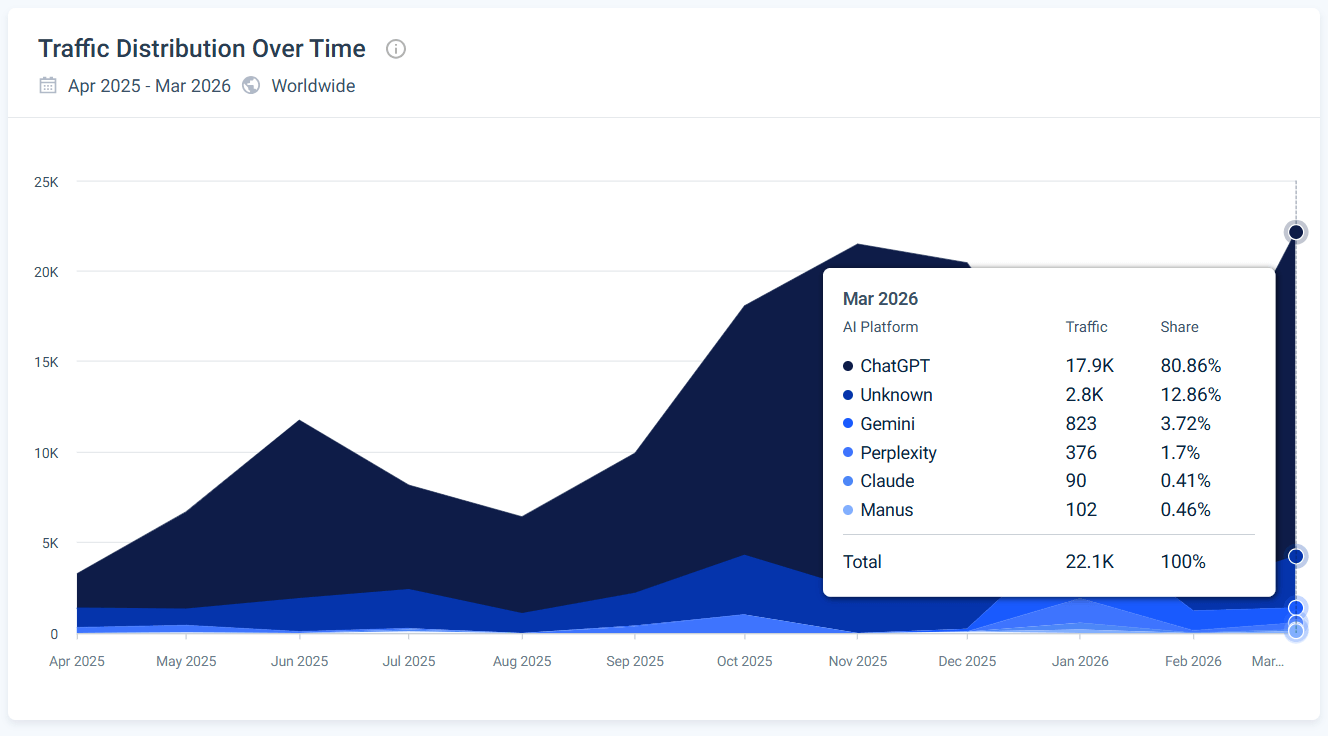
Meanwhile, ChatGPT is Dyson’s single largest referral source, sending approximately 18K desktop visits per month to dyson.com, according to Similarweb referral data (March 2026). Gemini and Perplexity contribute an additional 1.5K visits combined.
In this article, I’ll research why AI engines prefer user-generated content over brand-produced content, the correlation between successful UGC campaigns and AI visibility lift, and which UGC types map to which AEO outcomes (with a framework you can use immediately).
You’ll get a five-step playbook for building a UGC strategy optimized for AI visibility and measuring whether it’s working, using Similarweb’s AI visibility tools.
User-generated content for AEO is any content created by users, not brands, that AI engines can retrieve, parse, and cite when synthesizing answers.
This includes:
This definition is narrower than the marketing definition of UGC. In marketing, user-generated content includes Instagram posts, TikTok videos, and branded hashtag campaigns.
Those are valuable for engagement and social proof, but AI engines largely can’t retrieve them.
Answer engines need text-based, crawlable, entity-dense content hosted on indexed platforms. A TikTok unboxing video has marketing value. A Reddit thread with 47 comments comparing Dyson V15 battery life across different floor types has an AEO value. The distinction matters because it changes where you invest.
Google added “Experience” to its E-E-A-T quality framework back in December 2022, long before AI search became mainstream. But the same signal that Google decided to reward turns out to be exactly what AI engines prioritize, too: content from people who have actually used a product, rather than from people who researched it.
A brand’s product page says the vacuum has “powerful suction.” A user’s two-year review on YouTube says, “I’ve used this on two levels of my 2,800-square-foot home for two years and never run out of battery.” The second statement carries an experience signal that AI engines can verify and trust. It names a specific use case, a timeframe, and a measurable outcome.
That is what gets cited.
This is also why the AEO value of UGC is fundamentally different from its traditional SEO value.
In traditional SEO, UGC helped with keyword diversity and freshness signals. In AEO, UGC provides the verification layer that AI engines require before confidently recommending a brand. Without it, the AI hedges or omits your brand entirely.
The difference between AEO and GEO is relevant here: AEO focuses on being present in the answer (mentions, AI Overviews, zero-click results), while GEO focuses on earning linked citations in generative AI responses. UGC contributes to both, but through different mechanisms.
The SEO value of user-generated content is well established: reviews and forum threads naturally introduce long-tail keyword variations, generate fresh crawlable content, increase dwell time, and attract organic backlinks.
None of that has changed.
What has changed is that the same content now also serves as the retrieval layer AI engines use to validate and cite your brand. A single well-structured Reddit thread can rank on page one, get cited in a Perplexity response, and appear in a Google AI Overview simultaneously.
The AEO dimension does not replace UGC’s SEO benefits. It compounds them. That compounding effect is what makes UGC one of the highest-leverage content investments available right now: you are not choosing between SEO and AEO value.
You are getting both from the same source material.
AI engines cite user-generated content over brand-produced content because UGC provides three signals that large language models prioritize during retrieval: high entity density, independent verification of claims, and firsthand experience markers that brand content structurally lacks.
Research by Kevin Indig, published in February 2026, found that text cited by AI engines has an entity density of 20.6%, nearly three times higher than that of typical web content, at roughly 7 percent. Entity density refers to the concentration of specific names, brands, products, numbers, and places in a given passage.
User-generated content is naturally entity-dense because real users reference specific models (“Dyson V15 Detect Absolute”), specific conditions (“3-bedroom house with two dogs and hardwood floors”), and specific outcomes (“battery lasted 45 minutes on boost mode”). Brand content, by contrast, tends toward generalized claims: “powerful suction for any home.”
This matters for AEO because LLMs extract facts at the paragraph level. A paragraph packed with named entities gives the model more retrievable, quotable material than a paragraph of marketing copy. When the AI synthesizes an answer to “best vacuum for large home,” it gravitates toward the content that offers the most specific, verifiable data points.
Brand content is inherently self-interested, and AI engines treat it accordingly. A product page claiming “best-in-class filtration” is a marketing assertion. A review on rtings.com reporting measurable filtration test results across multiple units is verification.
In the absence of third-party proof, AI engines are less likely to confidently recommend a product.
Think of it as a verification gap: AI treats marketing copy as a “claim”, and user reviews as “verification”. Without that third-party verification layer, the AI either hedges its recommendation or drops your brand entirely.
The Dyson example illustrates this precisely. According to Similarweb AI visibility tracking, when AI engines respond to “what are the top-rated humidifiers for allergy sufferers,” the citations point to review sites like rtings.com, Goodhousekeeping, and niche allergy-focused review platforms, not to dyson.com.
Dyson earns the positive brand mention because those third-party sources verified its product quality. The brand’s own site contributed zero citations.
The scale of this shift is substantial. An AirOps analysis of 5.5 million AI-generated answers found that UGC and community platforms collectively drive nearly half of all citations in AI search, with Reddit alone earning citations in approximately 22 percent of answers across all models.
AI models can distinguish between content written from firsthand experience and content written from research alone. Temporal markers (“after six months of daily use”), specificity of complaints (“the dustbin latch broke on day 47”), and comparative references (“I switched from a Shark Navigator and noticed immediately”) are all experience signals that increase citation probability.
User-generated content contains these signals by default. Brand content almost never does.
This confirms the structural shift away from traditional SEO authority signals. As the SALT.agency research and Kevin Indig’s findings both show, backlinks and domain authority are among the weakest predictors of AI citation behavior. The signals that actually drive citations are content characteristics: entity density, experience markers, and independent verification, all of which are abundant in UGC and scarce in brand content.
These patterns vary by platform. According to Lily Ray’s research, Perplexity cites Reddit in 46.7 percent of responses, and Google AI Overviews cite it in 21 percent. ChatGPT is different: Kevin Indig’s analysis found that Reddit represents only 5.3 percent of ChatGPT citations, with corporate and editorial content dominating instead.
This means a UGC-for-AEO strategy should be platform-aware: Perplexity rewards Reddit and community participation heavily, Google AI Mode moderately, and ChatGPT least. Your platform priority depends on where your audience searches.
Different types of user-generated content drive different AEO outcomes. Product reviews improve citation eligibility for commercial queries. Reddit threads build entity-level authority for informational queries. YouTube transcripts provide retrievable how-to content that AI engines can quote directly.
Understanding which type to prioritize for which goal is the difference between a UGC strategy and a UGC-for-AEO strategy.
| UGC type | Platform examples | AEO outcome | Best for query type | Entity density | AI citation rate |
| Product reviews | rtings.com, Consumer Reports, G2, Capterra | Citation eligibility for brand recommendations | Commercial (“best X for Y”) | Very high (specs, comparisons, scores) | High: review sites are among the most-cited domains by LLMs |
| Reddit/forum threads | Reddit, Quora, Stack Exchange | Entity-level authority; consensus signal | Informational (“is X worth it,” “X vs Y”) | High (specific models, prices, use cases) | Very high: Reddit appears in 46.7% of Perplexity citations, 21% of Google AI Overviews |
| YouTube video reviews | YouTube (transcripts) | Retrievable how-to and demonstration content | How-to (“how to set up X”) | Medium-high (product names, steps, visual descriptions) | High: YouTube is the #2 most-cited source after Reddit |
| Community Q&A | Brand forums, support communities, specialized forums | Troubleshooting and long-tail coverage | Support (“X not working,” “how to fix Y”) | Medium (symptoms, error messages, solutions) | Medium: cited for specific technical queries |
| Social reviews (structured) | Google Business reviews, Trustpilot, Yelp | Local and service brand validation | Local and trust (“best X near me”) | Medium (locations, service details, dates) | Medium: influences sentiment, not always directly cited |
The strongest proof that UGC drives AEO outcomes comes from comparing categories within the same brand.
Dyson’s humidifier line has deep UGC coverage. The rtings.com Dyson PH04 review includes measured performance data across multiple test scenarios. The Live Science review of the Dyson AM10 aggregates real user feedback, noting that reviewers praised the humidifier for clearing up health issues related to allergies and dry air.
Goodhousekeeping.com includes Dyson in its tested humidifier roundups. These are exactly the UGC-type sources that appeared in the AI citation lists when I checked the prompt “what are the top-rated humidifiers for allergy sufferers” using Similarweb AI visibility tracking.
Result:
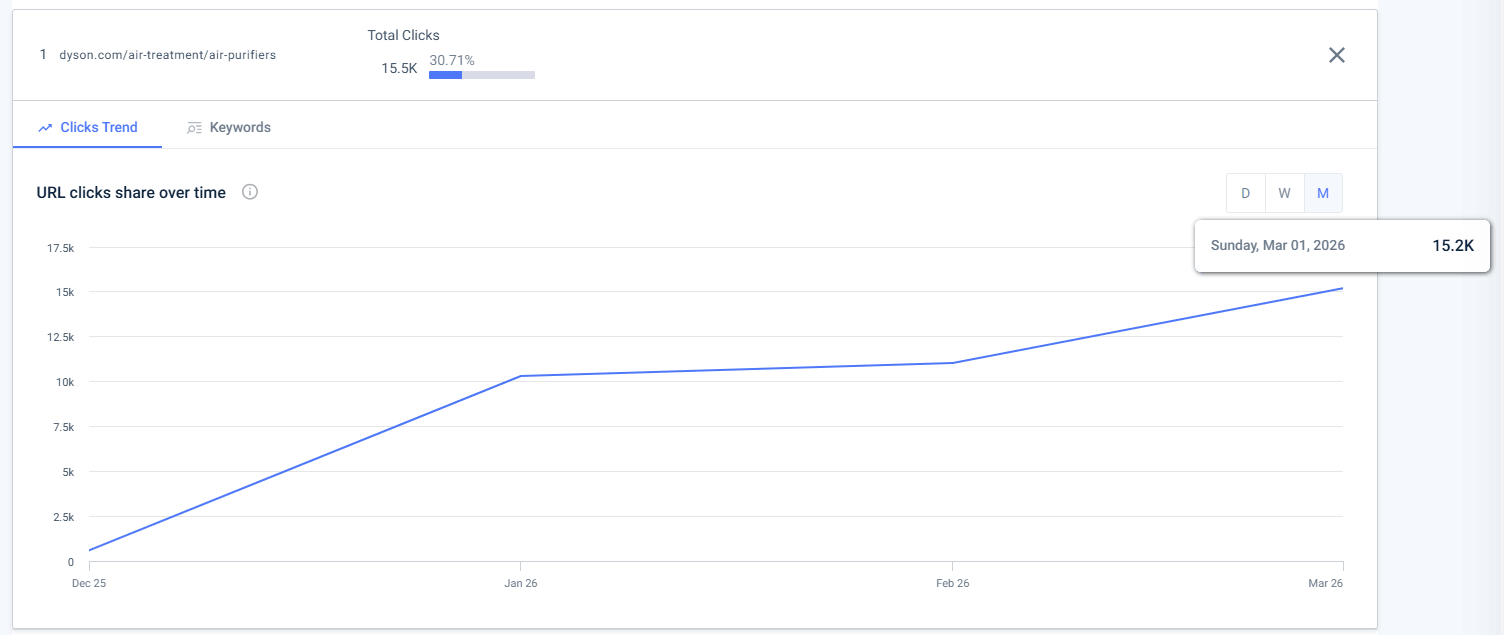
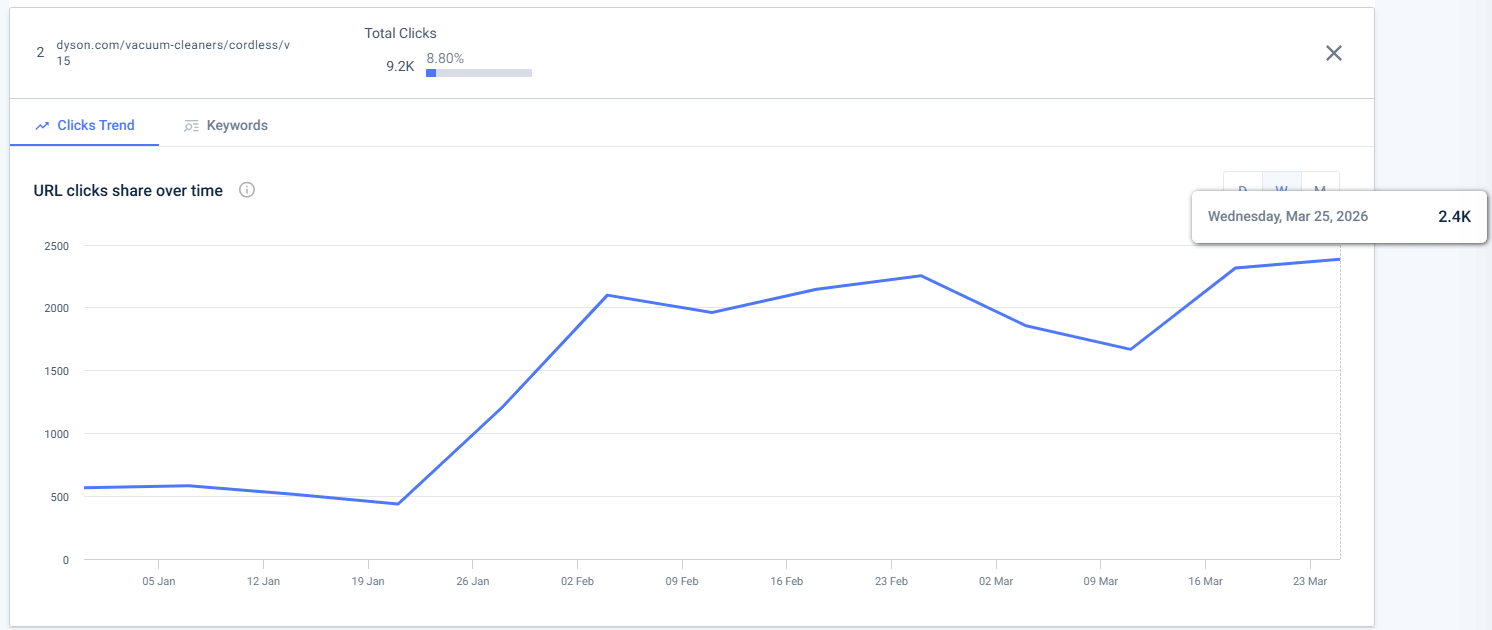
The Dyson V15 Detect has one of the deepest UGC ecosystems in consumer electronics. YouTube hosts hundreds of real-user reviews, including long-term use assessments like Melissa Maker’s two-year review on the Clean My Space channel, which covers battery longevity, real-world suction performance, and specific issues encountered over 24 months of daily use in a 2,800-square-foot home.
CNN Underscored’s hands-on testing, user forums discussing V15 versus V12 tradeoffs, and comparison threads across home-cleaning subreddits compound this coverage.
Result:
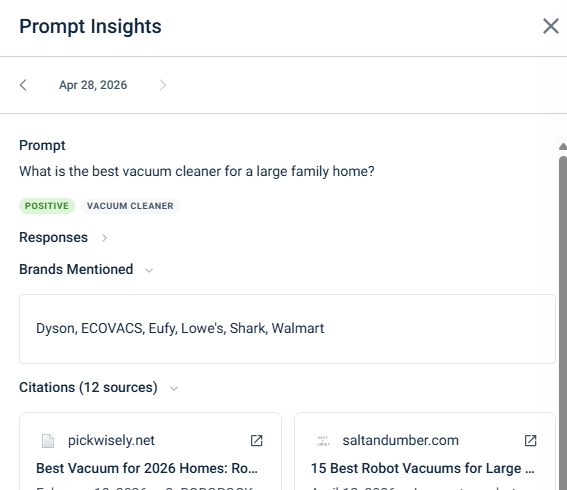
For the prompt “What are the best robot vacuums for small apartments?” Dyson was not mentioned by any of the three LLMs. The citations instead pointed to iRobot, Eufy, Roborock, and Ecovacs.
Dyson’s presence in the robot vacuum market has been limited (its 360 line never gained the market traction of its cordless vacuums), and that smaller product footprint means fewer purchases, fewer reviews, and a thinner UGC layer for AI engines to draw from.
The image below shows Dyson’s AI visibility across engines compared to its competitors. The gap in categories like robot vacuums is visible, and based on the data in this article, thin UGC coverage is a significant contributing factor.
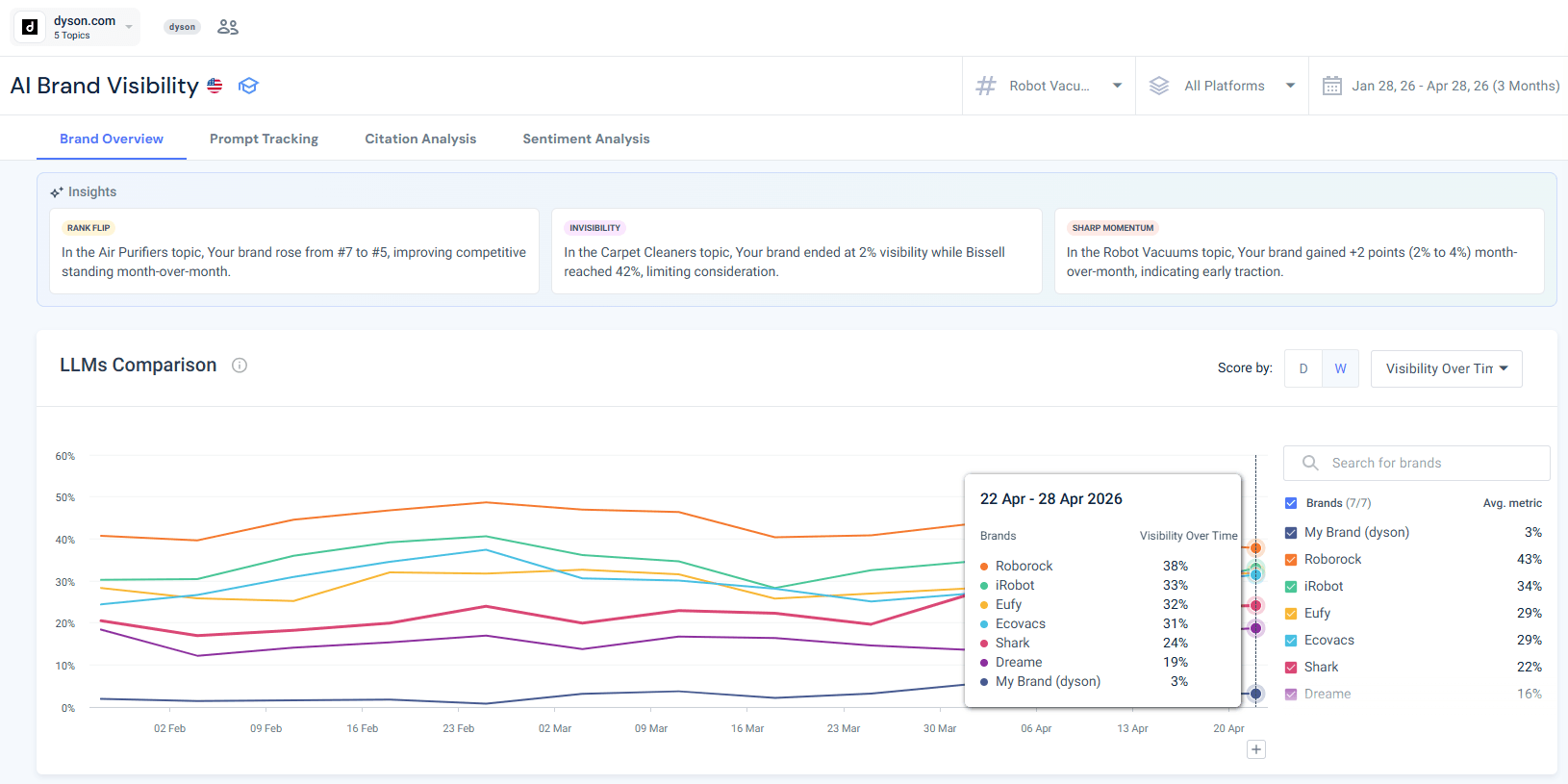
The brands that dominate robot-vacuum AI answers are the ones with thousands of Reddit comparison threads, YouTube teardowns, and review-site ratings in that subcategory.
The pattern is clear even if the causation is not single-variable: product presence drives UGC volume, UGC volume feeds AI retrieval, and AI retrieval determines which brands get mentioned. A strong backlink profile and high domain authority do not shortcut this chain.
Building a UGC strategy for answer engine optimization requires five steps: audit your current AI citations, then analyze your landscape to identify citation gaps. Next, identify retrieval gaps where UGC is missing, engage internal experts on priority platforms, structure your UGC efforts to maximize entity density, and track impact using AI visibility metrics.
This is not a social media campaign. It is an authority infrastructure play.
Before creating any content, find out which sources AI engines are already citing for your category’s key prompts. Use Similarweb’s AI citation analysis tool to track which domains appear in AI-generated responses for your target queries.
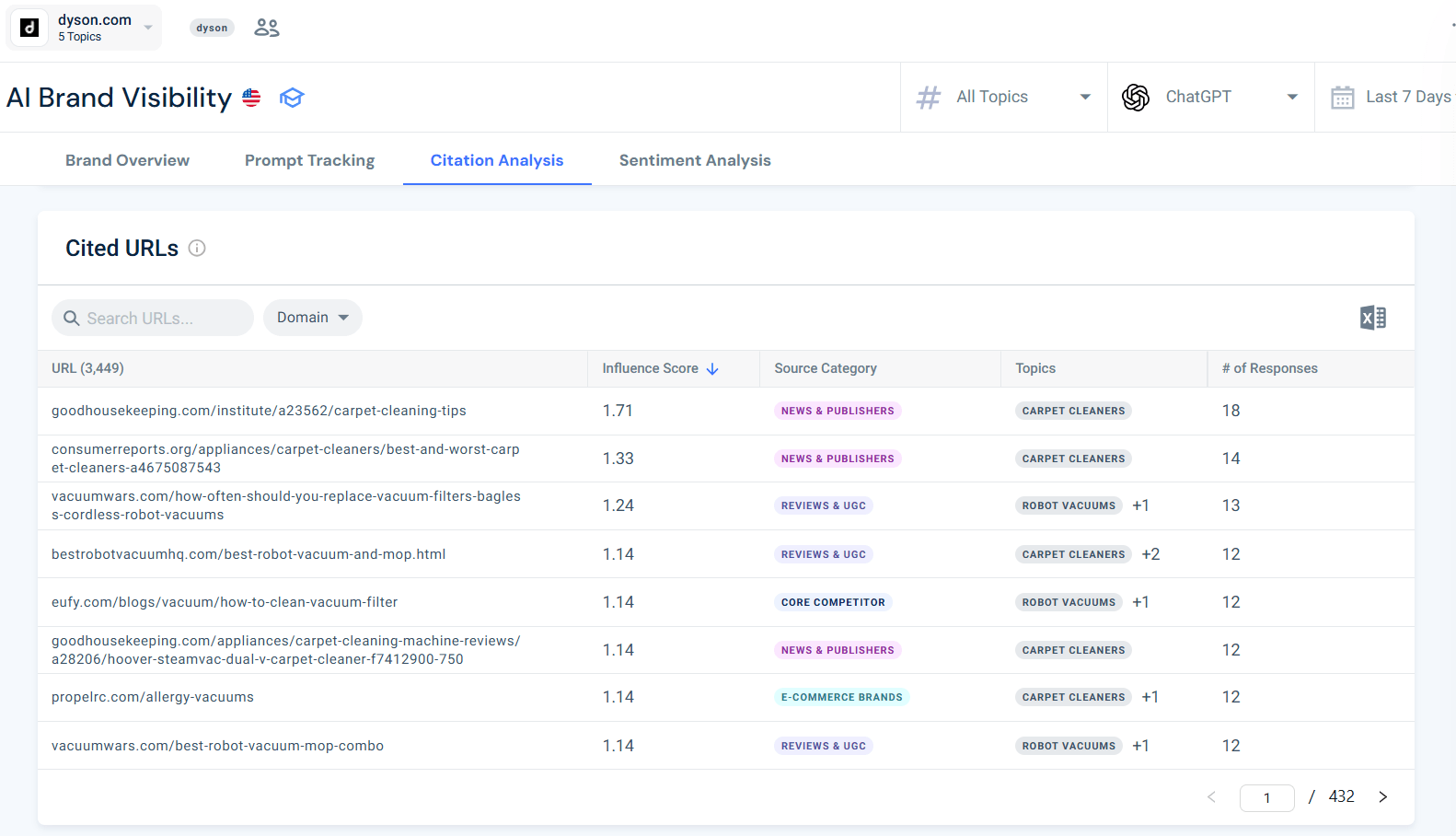
Map the citation sources by type:
This tells you which UGC channels are already influencing the AI’s answers in your space.
Cross-reference the citation audit against your brand’s UGC footprint. Analyze prompts where your competitors are mentioned, but you aren’t, and check whether the difference is in UGC density.
The Dyson robot vacuum example is instructive: Dyson had no UGC gap in vacuums or humidifiers, but the gap in robot vacuums was immediately clear in the AI visibility data.
Your retrieval gaps are the prompts where you’re invisible. Map them.
The most effective UGC for AEO comes from genuine participation, not manufactured campaigns. Have your product specialists, engineers, or subject matter experts participate authentically in relevant subreddits, answer questions on Quora or Stack Exchange, and contribute to community discussions where they have real expertise.
The key word is genuine.
Reddit in particular punishes overt brand promotion. What works is the approach taken by companies like Datadog and Zapier: employees who participate as knowledgeable humans who happen to work at the company, building posting history over months before the product is ever mentioned.
Not all UGC is equally useful for AEO. A one-sentence review (“Great product!”) has zero AEO value. A structured review that names the product model, describes the use case, quantifies a result, and compares it to an alternative has high AEO value.
You can influence this by designing review forms that prompt for specifics:
These structured prompts produce entity-dense UGC that AI engines can parse and cite. The principle behind content chunking applies here: each piece of content should be independently retrievable and self-contained.
This is where most UGC strategies fail: they launch without measurement. Track AI visibility to identify whether your brand-mention rate is increasing for prompts where you activated UGC.
Track citation sources to see whether the specific platforms where you invested (Reddit, review sites, YouTube) are appearing in AI responses. Measure AI referral traffic to see whether citations are converting to site visits.
The goal is not social media engagement. It is citation eligibility.
Measuring UGC impact on AI visibility requires shifting from traffic attribution to influence tracking. The question is not “did this Reddit post drive clicks?” The question is “did your brand’s citation rate and AI mention frequency increase across the topic clusters where you activated UGC?”
| Metric | What it measures | Why it matters for UGC-to-AEO |
| Brand mention rate | How often your brand appears in AI responses for tracked prompts | Direct measure of whether UGC is translating to AI visibility |
| Sentiment distribution | Positive, neutral, or negative framing when mentioned | UGC quality check: are reviews helping or hurting? |
| Citation source tracking | Which domains AI engines cite for your topic prompts | Tells you which UGC platforms are influencing the AI |
| AI referral traffic | Visits from ChatGPT, Perplexity, Gemini, Google AI Mode | Revenue-adjacent: measures the actual traffic UGC-driven citations generate |
| Zero-click rate for target keywords | % of searches answered without a click | Determines whether to optimize for citations (high ZC) or clicks (low ZC) |
When evaluating your target keywords, pay attention to zero-click rates. For keywords where the majority of searches are answered directly in the AI response without a click, traditional website metrics will not capture your UGC impact.
In those cases, citation tracking and brand mention rates become your primary KPIs, not organic clicks.
The higher the zero-click rate in your category, the more your measurement framework needs to shift from traffic attribution to influence tracking
Using the Dyson data as a benchmark: a brand with strong UGC coverage should expect to see positive AI mentions for prompts in its core categories, with third-party review sites and community platforms appearing in the citation lists.
The downstream signal is AI referral traffic. Dyson receives approximately 22,000 monthly desktop visits from AI platforms combined, with ChatGPT as the single largest referral source at 60.4 percent of incoming referral traffic, according to Similarweb data. That traffic exists because UGC on sites Dyson doesn’t own convinced the AI to recommend them.
For brands starting from zero UGC-to-AEO measurement, the baseline is simple: track your brand mention rate across prompts in your category (Similarweb will provide those from its own database, or you can insert your own tracking prompts if you have them), record which sources the AI cites, and measure AI referral traffic to your site.
Run the audit monthly. The trend line shows whether your UGC investments are translating into AI visibility.
User-generated content is not just a marketing tactic you layer on top of your brand strategy. It is the primary source of the experience, verification, and entity-density signals that AI engines need before they will recommend your brand.
Every brand has a website, product pages, and marketing copy. The brands that show up in AI answers are the ones whose customers have created a parallel layer of content across review sites, Reddit, YouTube, and community platforms. That layer is what AI engines actually retrieve and cite.
The Dyson data makes this concrete. The same brand, with the same domain authority and backlink profile, gets positive AI mentions in categories where UGC is dense and goes completely dark in categories where UGC is thin. The AI referral traffic that follows is a direct consequence of content Dyson does not own and did not create.
In a world where 83 percent of searches for topics like this end without a click, the only way to capture value from those searches is to be the source the AI cites. User-generated content is how you earn that citation.
To audit which UGC sources are currently shaping AI answers in your category and track whether your brand is being mentioned, use Similarweb AI Search Intelligence to map citation sources, monitor brand mention rates, and measure AI referral traffic over time.
Does user-generated content actually help with answer engine optimization?
Yes. UGC provides firsthand experience, entity density, and independent-verification signals that AI engines prioritize when selecting sources to cite. Similarweb AI visibility data shows that brands with dense UGC coverage earn positive AI mentions in their category, whereas the same brand goes unmentioned in categories with thin UGC. The effect is measurable and category-specific.
Which UGC platforms do AI engines cite most frequently?
Reddit is the most-cited UGC platform, appearing in 46.7 percent of Perplexity responses and 21 percent of Google AI Overviews, according to research by Lily Ray (2025-2026). YouTube ranks second. Other frequently cited platforms include rtings.com, Consumer Reports, G2 (for B2B), and Quora. UGC and community platforms collectively drive nearly half of all citations in AI search, according to an AirOps analysis of 5.5 million AI-generated answers. The most cited domains by LLMs skew heavily toward experience-based content.
How is UGC for AEO different from UGC for traditional SEO?
In traditional SEO, UGC helped with keyword diversity, freshness signals, and backlink generation. In AEO, UGC serves as the verification layer that AI engines need before recommending a brand. AEO-valuable UGC must be text-based, crawlable, entity-dense, and hosted on indexed platforms. A viral TikTok has marketing value but minimal AEO value because AI engines cannot retrieve and parse its content at the paragraph level.
Can B2B brands use UGC for answer engine optimization?
Yes. B2B UGC takes different forms: G2 and Gartner Peer Insights reviews, technical discussions on Stack Overflow, LinkedIn posts with specific data, and GitHub community contributions. Similarweb referral data (March 2026) shows HubSpot receives approximately 83,000 monthly desktop visits from Claude.ai and 56,000 from ChatGPT. Its extensive G2 review presence, community forums, and YouTube tutorial ecosystem contribute directly to this AI visibility.
How do I measure whether my UGC strategy is improving AI visibility?
Track three metrics monthly: brand mention rate across 10 to 20 category-relevant AI prompts, citation source mapping to identify which platforms are driving mentions, and AI referral traffic from ChatGPT, Perplexity, Gemini, and Google AI Mode to your site. Similarweb AI Search Intelligence provides all three. The trend line across months is more meaningful than any single snapshot.
What are the risks of UGC for AEO?
The primary risk is negative UGC shaping how AI engines perceive your brand. AI engines synthesize a consensus from all available content, including critical reviews and unresolved complaints. The solution is not suppression but volume: ensure enough entity-dense, positive, experience-rich content exists to outweigh negative signals. Monitor your brand’s AI sentiment and respond constructively to negative UGC on public platforms.
How long does it take for UGC to influence AI visibility?
Expect a 3 to 6-month timeline for measurable impact. AI engines continuously reindex and reweight their sources, but building meaningful UGC density across review sites, Reddit, and YouTube requires sustained effort. Early indicators include seeing your UGC platforms appear in AI citation lists for tracked prompts. The compounding effect accelerates after the initial period as more content reinforces entity associations.
Director of SEO & AI Search at Similarweb
Limor brings 20 years of expertise in SEO and AI Search. She thrives on solving complex problems, creating scalable strategies, and building amazing dashboards.
AI Search Optimization: Tips, Best Practices, and Techniques That Worked in 2026

Dark Funnel Metrics: What to Measure When Buyers Decide Before They Click

What Happens After AI Recommends Your Brand?
Give it a try or talk to our insights team — don’t worry, it’s free!