What is RAG (Retrieval-Augmented Generation)? A Marketer's Guide
by Shai Belinsky9 Min.
Oct 01, 2026
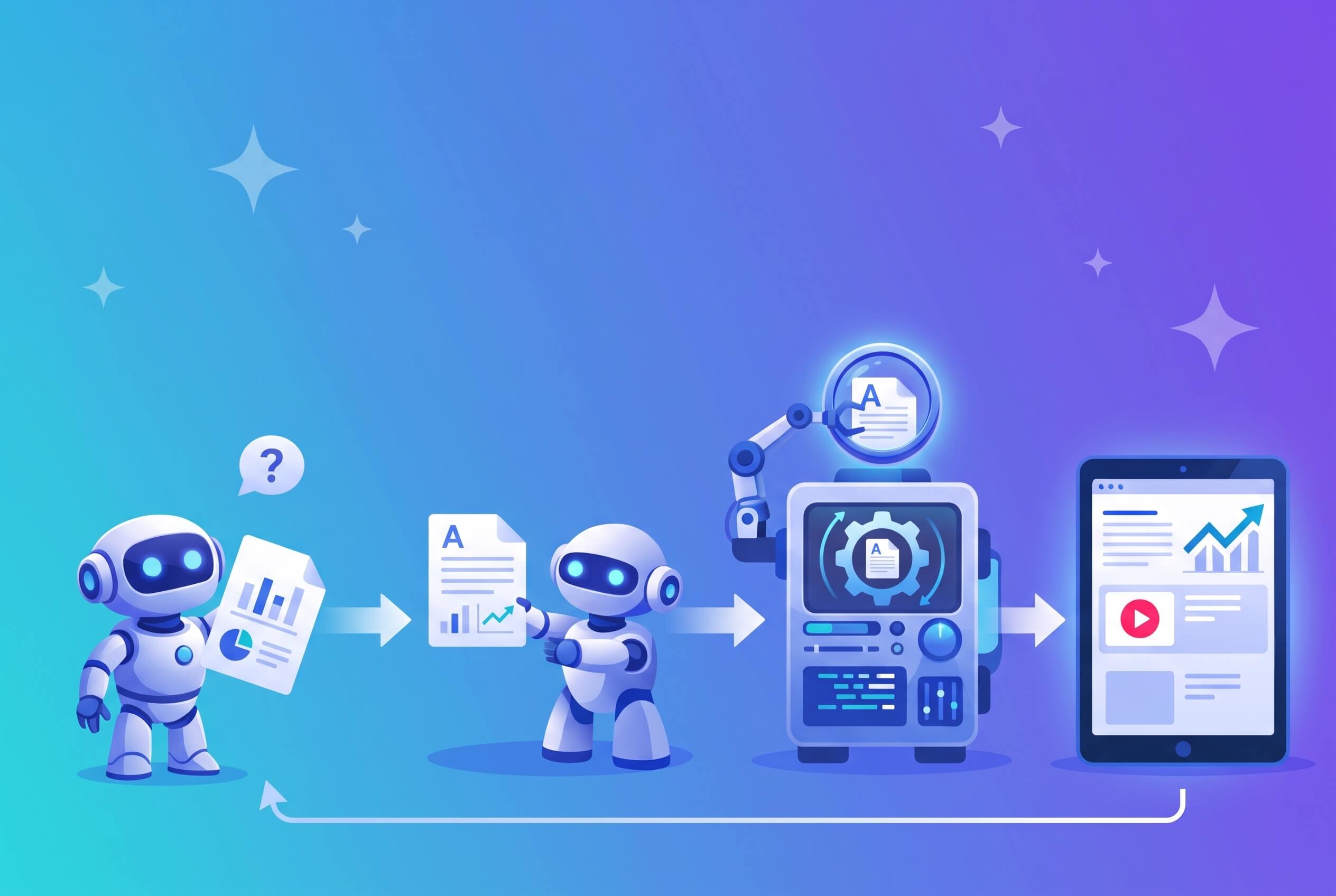
Agentic search is an AI that does the searching for you. Not “looks something up and writes a summary” AI, which we have had for two years now, but AI that plans a research process, runs it across the live web, makes judgment calls about what it finds, and takes action on the result. The user provides intent. The agent does the work.
AI is the front door now. According to Similarweb’s 2026 AI Stats, 35% of US consumers use AI search at the product discovery stage compared to 13.6% who still start with traditional search. At the evaluation stage, the gap is 32.9% versus 15%. So if you are still tuning your funnel for the user-arrives-on-homepage-and-reads-your-pitch flow, you are optimizing for the minority case.
Agentic search is the next layer of this shift: the version where the AI agent doesn’t just answer the question. It does the research, makes the judgment, and (increasingly) acts on it. By the time a human sees the output, your brand has already won or lost.
In this article, I’ll walk through what agentic search is, how it differs from AI search and traditional search, and what it looks like in practice across four escalating levels of complexity. Then I’ll lay out the four jobs your brand has to do to be findable, understandable, validated, and actionable for AI agents.
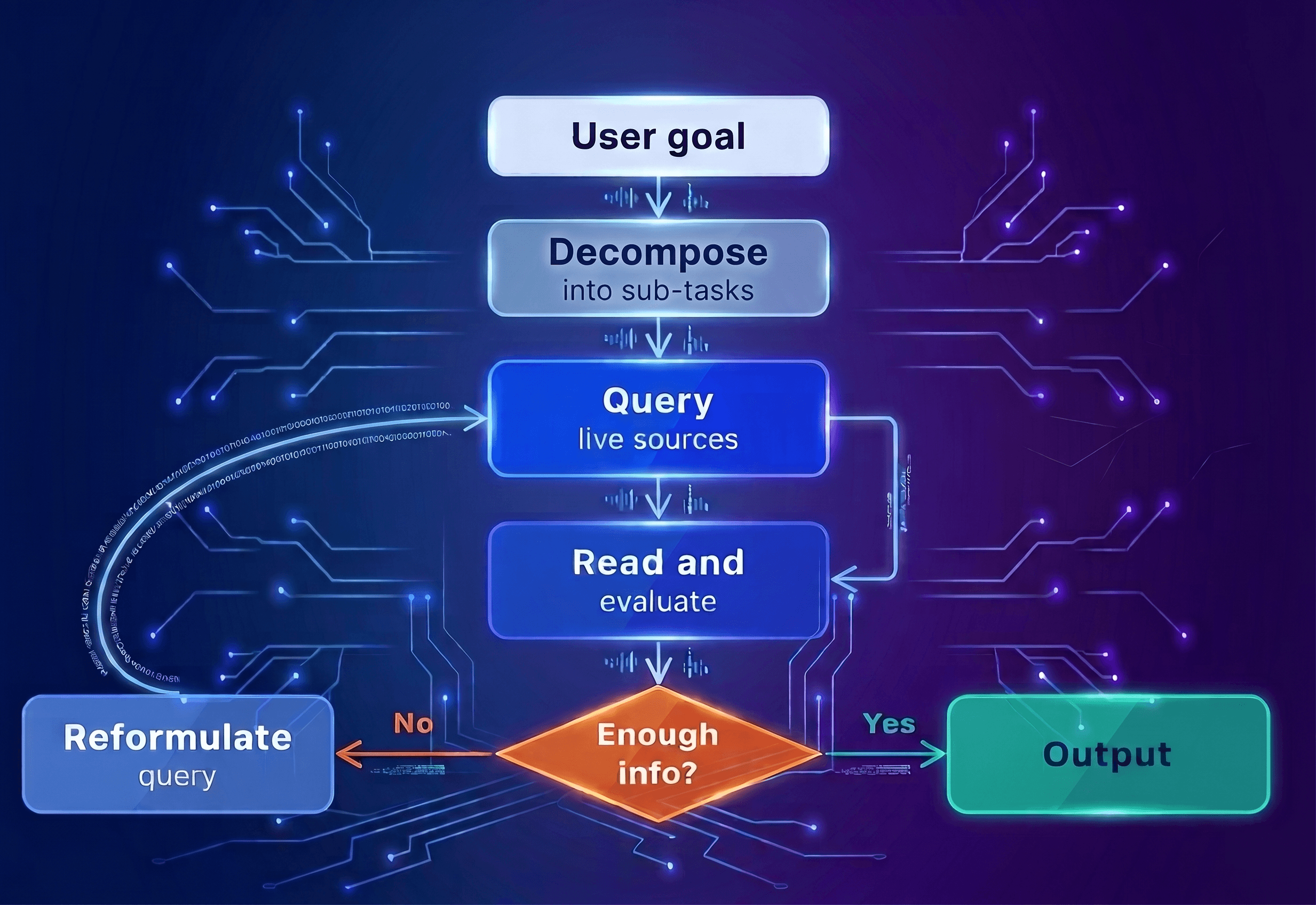
Most AI search you’ve used works in one shot: query in, answer out. Agentic search works in a loop. The agent decomposes the goal into sub-tasks, queries live sources, reads what it finds, decides whether it has enough information, reformulates if not, and only stops when it can answer or act. The output you eventually see may be a recommendation, a structured plan, or a completed transaction. The work that produced it happened across multiple cycles, not in a single shot.
The mechanics matter because they explain why brand visibility behavior changes. Researchers at Google and NYU published SAGE in January 2026, a framework for training deep-search agents that quantifies what “multi-step” actually means. SAGE-generated questions average 4.9 search steps per query, with some requiring up to seven distinct retrieval operations. Earlier agent training datasets averaged 1.3 to 2.7 steps.
The architecture of agentic search assumes that a single query is rarely enough to answer a question.
That assumption changes what content needs to do. If an agent takes five search steps to evaluate a B2B tool, it is reading five different pages, comparing five different framings, and synthesizing across them. Your homepage is one input. Your G2 reviews are another. A comparison post from an industry publication is a third. The agent corroborates across them. Inconsistency at any step degrades the agent’s representation of you.
The defining trait of an agent, separate from a chatbot or an AI search feature, is the ability to take action without returning to the user at every step. Anthropic calls this loop the foundation of its Model Context Protocol, the standard that lets AI agents connect to external tools and data sources. The action layer is what makes the search agentic, not the volume of sources consulted.
Three different machines, three different jobs. Traditional search returns a list of links and leaves the evaluation work to you. AI search composes an answer from sources and decides whether your brand gets cited at all. Agentic search researches you across multiple sources, compares you to competitors, makes a judgment call, and may take action (book, buy, schedule) before a human sees the result.
All agentic search is AI search. Not all AI search is agentic. The distinction matters because each one tests a different aspect of your brand.
The cleanest way to see the difference is to map them side by side.
| Dimension | Traditional search | AI search | Agentic search |
|---|---|---|---|
| User input | A keyword query | A natural-language question | A goal or task |
| What the system returns | A ranked list of URLs | A synthesized answer with cited sources | A decision, a plan, or a completed action |
| Where evaluation happens | On your website, by a human | Inside the AI model, sometimes with a citation | Across multiple sources, by the agent, before the human sees it |
| Number of retrievals | One | One to two | 4.9 average, up to 7+ (per Google SAGE, January 2026) |
| Brand surfaces tested | Your site | Your site + cited sources | Your site, third-party reviews, comparison content, transactional infrastructure |
| Success metric for the brand | Click | Mention or citation | Inclusion in the agent’s decision |
Two things in that table matter:
Both have the same implication: the brand surfaces that the agent touches are not always surfaces you control.
The category boundary between AI search and agentic search is also worth being precise about, because the terms are getting used interchangeably. AI search is the broader category, the entire ecosystem of AI-shaped discovery, from Google AI Overviews to ChatGPT responses to Google AI Mode answers. Agentic search is the subset where the AI does not just compose answers. It researches, decides, and may act. The action layer is what makes a search agentic, not the use of AI.
Agents do different amounts of work depending on what the user asks them to do. The four levels below run from the simplest agentic behavior (a one-shot composed answer) to the most complex (delegated transactions), and the further down the list you go, the more your brand’s outcome depends on sources you do not control.
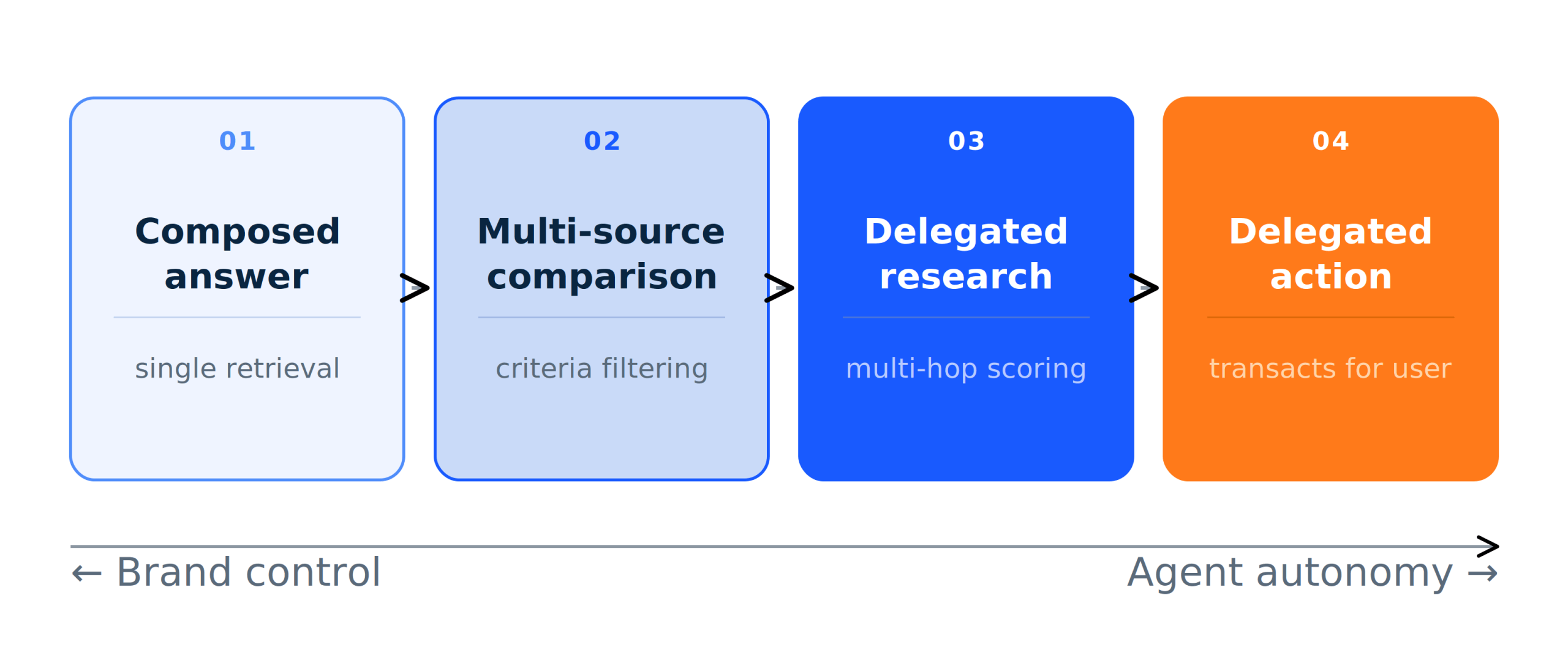
To make the spectrum concrete, follow one scenario across four levels: a small team is researching project management software for a remote engineering team of ten.
The user asks ChatGPT: “What is the best project management software for a remote engineering team of ten?”
The agent searches the web, reads comparison articles, pulls pricing and feature data from review platforms, and synthesizes a recommendation in a single response. This is the most common form of AI search behavior today.
It is technically agentic (the AI is choosing what to retrieve and what to include), but the loop is short. The user reads the answer and decides what to do next.
If your product never enters the candidate set, nothing else matters. This is also the part of the spectrum where 95% of AI optimization advice online ends. We are going further.
The user asks Google AI Mode: “Compare these three project management tools for a remote engineering team of ten. Budget under $200 per month, must integrate with GitHub and Slack, must support sprint planning.”
Now the agent is cross-referencing your pricing page against review platforms, against integration directories, against feature comparison content. It is judging you against named competitors using information from sources you do not control. The user’s criteria are explicit, meaning the agent filters against them at each retrieval step.
If your homepage says “starts at $99 per user” and a comparison article from six months ago says “$79 per user,” the agent has to pick one. It usually picks the more recent independent source. Which is to say: the third-party article you forgot existed is now editing your pricing page.
The user asks Perplexity, with deep research enabled: “Research the top five project management tools for a remote engineering team of ten. Score each on pricing, feature fit, integration depth, and review sentiment. Build a recommendation with reasoning.”
This is the multi-hop SAGE pattern in production. The agent is running multiple search loops, visiting dozens of sources, and synthesizing across them. It might take three to five minutes. The output is a structured comparison, not a paragraph.
Agent platforms now include this behavior, including deep research modes in ChatGPT, Gemini, and Google AI Mode, as well as dedicated agentic browsers like Perplexity’s Comet.
Whether independent sources consistently validate your positioning.
The agent is doing what a procurement researcher used to do, except in five minutes instead of five days, and without giving you the chance to clarify or correct. Review platforms, comparison content, expert articles, and community discussions all become inputs to the decision.
The brand with the most consistent story across sources wins. The brand with the most contradictory or stale story loses. Most of what determines the outcome lives outside your own site.
The user asks the agent: “Sign me up for a free trial of the recommended tool, configure it for a team of ten engineers, and add the integrations to GitHub and Slack.”
The agent is no longer recommending. It is doing. It navigates the signup flow, fills in the form, completes the OAuth handshake, and configures the integrations.
The user provides the credit card or confirmation at the final step (in most current implementations), but everything else happens inside the agent. ChatGPT’s agent mode and Shopify’s agentic storefronts already operate at this level for narrow tasks. The infrastructure for fully autonomous transactions is being built through protocols like Google’s Universal Commerce Protocol, Visa’s Trusted Agent Protocol, and Mastercard’s Agent Pay.
Whether the agent can actually complete the transaction with your brand.
If your signup form is broken behind JavaScript, the agent moves to the next option. If your OAuth flow requires a captcha, the agent stops. If your pricing page does not match your checkout page, the agent flags a discrepancy and pauses.
The brand that wins at Level 4 is the brand that is the most operationally functional, not the most marketed. That is going to be uncomfortable for many teams.
Composed-answer AI search has already changed who gets cited and who gets clicked. Agentic search changes something more structural: who gets into the candidate set in the first place, and how that set is decided.
From where I sit, four things change about how brands get picked, and they are not the things most teams are preparing for:
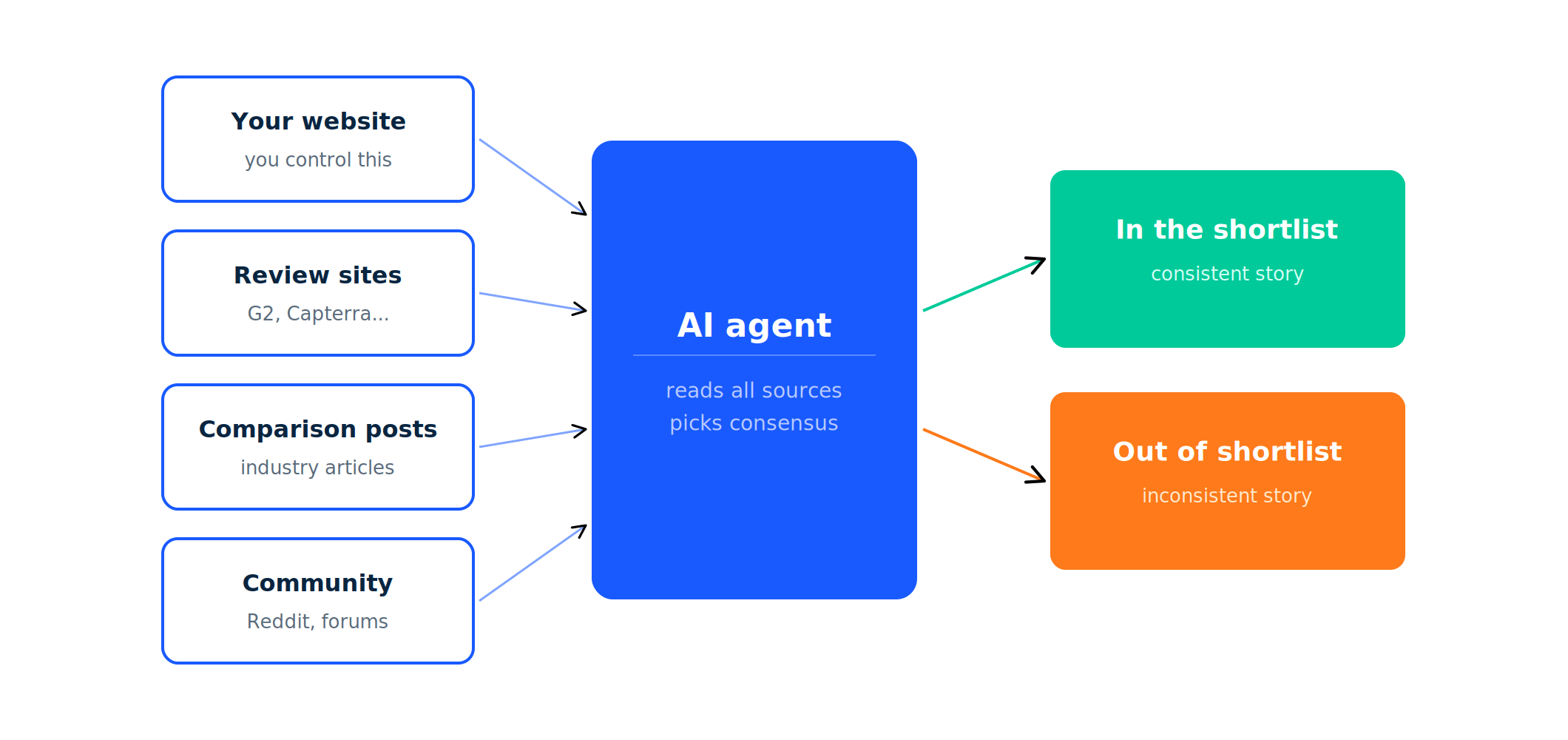
An agent conducting multi-step research (the 4.9 search steps the SAGE paper measured and referenced earlier) is reading your homepage, your G2 profile, a comparison article from an industry publication, and probably a Reddit thread or two. Then it picks the version of your brand that has the most agreement among them.
If your own positioning matches the third-party framing, you win. If your homepage says one thing and the third-party articles say another, you lose, even when both descriptions are technically true. Your story is now decided by consensus, and the consensus is being drawn from places you do not control.
AI Overviews still send users to pages and let them pick. A delegated-research agent does not. It returns a ranked recommendation with reasoning, usually three to five options in order, with the agent’s confidence in each.
And here is the part most marketers underestimate: users typically accept the ordering. They are not re-ranking the agent’s output, they are scanning the top three. If you are not in the top three, the click does not happen, and there is no second chance to show up in a related query. You were out of the consideration set before the user saw anything.
Composed answers cite their sources. Agents build internal scoring rubrics on the fly (“score each on pricing, feature fit, integration depth, review sentiment”) and rank you against named competitors using those rubrics.
You never see the rubric. You never see the scores. You do not have a Search Console for this, and the SEO instinct to diagnose a loss and fix the page does not apply, because there is no log of what the agent decided or why.
Composed-answer AI does not care if your signup form works. A delegated-action agent (Level 4 in the spectrum above, running on infrastructure like MCP, UCP, and the Trusted Agent Protocol, covered later) does.
If your form requires interactions the agent cannot complete, if your OAuth flow has a captcha, if your pricing page contradicts your checkout page, the agent abandons the transaction and moves to the next option. Your checkout is now a brand visibility surface, not just a conversion surface. And nobody on your conversion team has been told.
Add these four up, and the pattern is clear: under agentic search, you are no longer being chosen by users reading your content. You are being chosen by an agent that reads everyone’s content at once, scores it against criteria you cannot see, and recommends whichever brand looks most coherent across the surfaces it can reach.
At every level of the agentic spectrum, an AI agent must do four things with your brand. It has to find you, understand you, validate you, and (increasingly) act on you. Each one tests a different layer of your brand surface, and each one has a different team responsible for the fix.
I call this the FACT framework: Find, Analyze, Corroborate, Trigger. It is not an acronym you need to memorize. It is a diagnostic for figuring out where you are exposed.
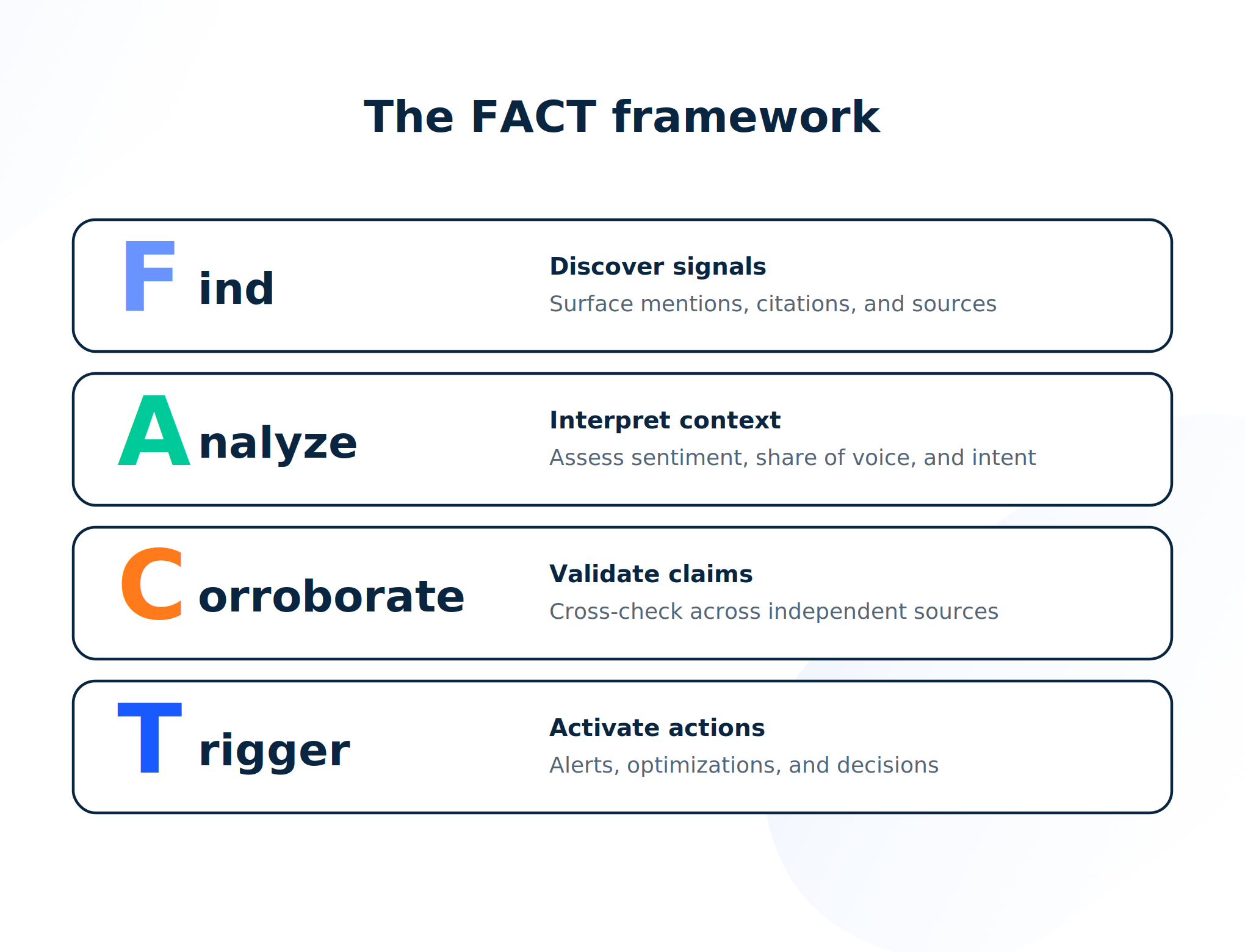
| FACT layer | What the agent is testing | Where the work happens | The question to ask |
|---|---|---|---|
| Find | Whether the agent can discover and crawl your content | Technical SEO, structured data, AI crawler allowlists | If an agent searched for what we do, would our content be in the candidate set? |
| Analyze | Whether the agent can extract a coherent picture of your offer | Product pages, entity clarity, machine-readable pricing, and features | If an agent compared us to two competitors, would that accurately represent us? |
| Corroborate | Validate whether independent sources support your positioning | Review platforms, comparison content, PR, community presence | If an agent checked third-party sources, would they agree with how we describe ourselves? |
| Trigger | Whether the agent can complete a task with your brand | Forms, checkout flow, OAuth, MCP/UCP readiness, machine-readable availability | If an agent tried to take action with our business, could it? |
Each layer maps to a different question, a different owner, and a different failure mode.
The find layer fails when AI crawlers cannot reach or parse your content. The most common causes are JavaScript-rendered content with no server-side fallback, robots.txt blocks on AI user agents (GPTBot, ClaudeBot, PerplexityBot, Google-Extended), and missing or misconfigured structured data.
The fix is technical: render content server-side, explicitly allow AI user agents, and serve clean schema markup. None of this is new SEO advice. It is the same checklist applied to a broader set of crawlers.
The analysis layer fails when your pricing, features, and positioning are not extractable in plain HTML or are contradicted by other content on your own site.
If your homepage describes you as “the enterprise platform for X” and your pricing page describes you as “self-serve software for Y,” the agent has to pick one. Pages that score well on this layer state who the product is for in plain language, list features as machine-readable bullets or tables, and put pricing in HTML (not a JavaScript widget or a “contact sales” gate, unless the gate is the offer).
This is also where the citation pattern research becomes operational. The Princeton GEO-Bench study found that adding quantified statistics to content improved LLM citation rates by up to 41%, while keyword stuffing performed below baseline.
The takeaway for the ‘analyze’ layer is that the content most likely to be extracted accurately by an agent is the content with named numbers, dates, and sources. Write that way on the pages you control.
The corroboration layer is the one most brands underinvest in, because it is the one they control the least. Agents corroborate. They read your site, then read what others say about you, then pick the version of the story with the most support across sources.
If five comparison articles describe you as “expensive but powerful” and your own positioning is “affordable and easy,” the agent will lean toward the third-party framing, especially if the articles are newer than your site copy.
The trigger layer is the newest and the most consequential at scale. It tests whether the agent can complete a transaction with your brand at all. If your signup form is buried behind a captcha, your checkout requires interactions the agent cannot perform, or your booking flow is rendered entirely in JavaScript, the agent will skip you and move to the next option.
The infrastructure for agent-mediated transactions is being built right now: Anthropic’s Model Context Protocol gives agents a standard way to call your tools, Google’s Universal Commerce Protocol gives them a standard way to complete purchases, and the Visa Trusted Agent Protocol is building the verification layer that confirms an agent is acting on behalf of a real authorized user.
Most brands are at Level 1 or 2 of agentic exposure today. The trigger layer is the one most teams have not started on. It is also the one with the longest implementation timeline, which is why it is worth starting now.
When I run this audit on a brand, I do it in roughly an afternoon, and none of the manual steps require a tool you don’t already have. If you have access to Similarweb’s AI Search Intelligence suite, four of the five steps run at scale and continuously rather than as a one-time check.
Open ChatGPT, Perplexity, Google AI Mode, and Gemini in four tabs. Pick the three queries your highest-intent customers would actually ask (not your dream queries, the real ones). Run them in each platform. Is your brand in the answer?
If not, you have a find problem. Check your robots.txt for AI user agent blocks, check your structured data, and check whether AI crawlers can actually reach your key pages.
To run this continuously across hundreds of queries rather than just one at a time, Similarweb’s AI Brand Visibility tracks your brand’s presence across the four major engines on a recurring schedule.
Ask the same four platforms: “Compare [your brand] to [competitor].” Read the result carefully. Is your pricing right? Are your features described correctly? Is your positioning what you want it to say?
Where the agent gets it wrong is where your Analyze layer is failing. Fix the source of the wrong information, not just the agent’s summary.
Similarweb’s AI Prompt Analysis record the actual response text per prompt across engines, so you can see exactly how each AI describes your brand instead of running comparison queries by hand.
Look at the sources the AI engines cite when they discuss your category. If your category has a “best [category] tools” article that ranks well in Google and gets cited by ChatGPT and Perplexity, and you are not in it, that is a corroborate gap. The fix is not to write a “best of” article on your own site. The fix is to be in the third-party article. Earn placement.
Similarweb’s AI Citation Analysis shows which URLs AI engines are pulling from across your tracked prompts, along with citation influence scores, so you can identify the third-party content influencing your category’s AI answers.
Try to complete your highest-priority conversion path using a browser automation agent or a manual test that mimics agent behavior.
Document every place the flow breaks. Those are your trigger-layer fixes.
For a quick automated baseline, Cloudflare’s free Is It Agent Ready tool scores your site on agent discoverability, content accessibility, bot access control, and transactional capabilities like MCP and OAuth support. For deeper testing, the practical options are browser automation frameworks like Playwright or LLM-driven browser libraries like Browser Use and Anthropic’s Computer Use, all of which you script yourself.
Set up a baseline measurement of your AI Share of Voice (or brand mention share) for the queries that matter to your business. Track it monthly. The number to watch is not whether your AI referral traffic grew, but whether your share of voice in relevant AI responses grew. Here is how the tooling maps to each layer:
Layer 1 (Find): Similarweb’s AI Brand Visibility dashboard shows mention share at the brand and category levels over time, measuring whether you are getting picked into AI responses at all.
AI Traffic Tracker shows the corresponding referral traffic, a downstream signal of Find-layer success. The two together tell you whether you are being recommended and whether the recommendations are converting to visits.
Layer 2 (Analyze): Similarweb’s AI Sentiment Analysis points you toward the prompts and topics where your brand is being misrepresented, AI Prompt Analysis shows the actual response text so you can see what is wrong, and the CLEAR framework for AI misinformation walks you through fixing it.
Layer 3 (Corroborate): The citation analysis tool inside the AI Brand Visibility suite shows which third-party URLs the AI engines are pulling from when they describe your category, surfacing the comparison articles, review sites, and community sources you need to win placement in.
Layer 4 (Trigger): The Cloudflare and browser automation tools mentioned in step 4 are the current options.
The audit will tell you which layer is your weakest. The fix order is the order in which the agent tests: find, then analyze, then corroborate, then trigger. There is no point optimizing for delegated action when you are not in the candidate set.
The funnel did not break. It moved. The discovery, evaluation, and shortlisting that used to happen over multiple visits to your site now happen within an AI agent in a single session. The user shows up at the end to confirm or adjust the agent’s decision.
You either made the shortlist or you did not.
This is a measurement problem and a compliance problem before it is a content problem.
On measurement: If you are reporting AI search performance using referral traffic, you are measuring the small leak of users who happen to click through, not the actual flow of users who got their answer inside the AI. Brand mention share, citation share, and sentiment in AI responses are the leading indicators. Visits are trailing and increasingly noisy ones.
On compliance: Agentic search runs on a stack of emerging standards (llms.txt, Markdown content negotiation, MCP, OAuth flows, agent-readable schema), and most sites today implement few, if any, of them. Adopt them now, and you are early. Wait, and your site simply will not work with the agents your customers are already using.
It is also a brand-surface problem before it is a brand-voice problem. The agent reads your site, your reviews, your comparison articles, and your transactional infrastructure. The version of your brand that surfaces is the one the agent constructs from all those sources. Inconsistency is the failure mode. Coherence is the moat.
If you want to know where you stand right now, Similarweb’s AI Search Intelligence will show you which brands are getting mentioned in your category, in which AI platforms, with what sentiment, and how that has changed over time. That’s your baseline. The FACT audit is how you turn that baseline into a fix list, one layer at a time.
The brands that invest in agentic search optimization now, across the find, analyze, corroborate, and trigger layers, will be the ones with a compounding advantage by the time the market catches up.
What is agentic search?
Agentic search is AI that retrieves, evaluates, and acts on information on users’ behalf. The agent decomposes a goal into steps, gathers information from multiple sources, compares options, and may take action like booking or purchasing before a human is involved in the final decision.
How is agentic search different from AI search?
AI search is the broader category that includes any search experience powered by AI, from Google AI Overviews to ChatGPT responses. Agentic search is the subset in which AI does not just compose an answer, it researches across sources, evaluates options against criteria, and may take action. All agentic search is AI search. Not all AI search is agentic.
How does agentic search work?
An agentic search system decomposes a user’s goal into sub-tasks, queries multiple live sources, cross-references findings, evaluates options against criteria, and either returns a synthesized answer or completes an action. Google SAGE research (January 2026) found that agents average 4.9 search steps per query, with complex tasks requiring up to seven distinct retrieval operations.
What are examples of agentic search in action?
The most common examples today are the deep research modes in ChatGPT, Gemini, and Perplexity, which run multi-step research loops across dozens of sources. Perplexity’s Comet browser, ChatGPT’s agent mode, and Google AI Mode’s agentic capabilities extend this to delegated actions: signing up for trials, comparing vendors, or completing transactions on the user’s behalf.
Is agentic search the same as RAG?
No. Retrieval-augmented generation (RAG) retrieves from a pre-built index of documents ingested at a point in time. Agentic search queries the live web at the time of reasoning and reads pages as they currently exist. Production AI agents often use both RAG for stable internal documents and agentic search for open-web content, along with real-time signals like current pricing or availability.
What does agentic search mean for SEO?
SEO foundations get more important, not less. Authority, structured content, entity clarity, and technical health are what AI agents use to find, understand, and validate brands. What changes is the emphasis: brands now need to be machine-readable across third-party sources, not just their own site, because agents corroborate across sources before making a recommendation.
What is agentic search optimization?
Agentic search optimization is the practice of making your brand findable, analyzable, corroborated, and actionable for AI agents. It extends traditional SEO and GEO to cover the full stack an agent consults: your site, third-party reviews, comparison content, and transactional infrastructure, because agents evaluate all of them before making a recommendation.
How do I optimize my brand for agentic search?
Run the FACT audit. Test whether AI agents can find your content, analyze your offering, corroborate your positioning via third-party sources, and trigger action on your brand through transactional infrastructure. Fix the layers in order. Then measure brand mention share in AI responses, not referral traffic, to track progress.
Director of SEO & AI Search at Similarweb
Limor brings 20 years of expertise in SEO and AI Search. She thrives on solving complex problems, creating scalable strategies, and building amazing dashboards.
Give it a try or talk to our insights team — don’t worry, it’s free!