



ChatGPT Ads CTR by Country: Brazil, Mexico and Japan Out-Click the US by More Than 2x
by Maayan Zohar Basteker7 Min.
Oct 08, 2026

Your brand is being described by AI engines thousands of times a day: A user asks an AI engine about your product or brand, or seeks alternatives to a competitor of yours. The LLM confidently answers, describing your brand, your product features, and the pros and cons vs. your competitor.
The problem? A nontrivial share of those descriptions may be wrong:
That user who asked the AI engine about your product takes the wrong answer as fact, makes a decision, and you never see them. You just know you were mentioned, maybe even positively, but no one tells you if that mention was accurate.
Most existing advice on this problem treats the question as binary. Is your brand mentioned in AI answers? Yes or no. That’s not always enough.
The “mentioned or not mentioned” problem is easier to solve: build entity signals, add some structured data, and get cited. The harder, more expensive problem is that your brand is mentioned, frequently, accurately enough to look fine on a dashboard, and meaningfully wrong on the specific topics that matter to your buyers, your investors, or your defensibility.
The stakes are not hypothetical. In February 2024, the British Columbia Civil Resolution Tribunal ruled in Moffatt v. Air Canada that the airline was liable for misleading information its chatbot gave a passenger, rejecting the company’s argument that the chatbot was “a separate legal entity.” In October 2025, Deloitte Australia refunded approximately $290,000 to the Australian government after its consulting report was found to contain fabricated citations generated by GPT-4o. Two different versions of the same principle: companies are on the hook for AI representations of their products, policies, and analysis, including representations they did not write themselves.
Brand managers who used to worry about misquotes in the trade press now need to worry about misquotes in the model that synthesizes it.
This article uses the CLEAR framework to identify and fix misrepresentations of a brand. A 7-type taxonomy of how AI misrepresents brands and what causes each type. The realistic truth about what platform-level reporting can and cannot fix. And a measurement model that pairs sentiment shifts with topical-property traffic so you can tell whether a fix actually landed.
This is the fourth framework I have built for this issue. The three that came before it broke on contact with the data, usually because they treated sentiment as a single number instead of a topic-level distribution, or because they declared a fix complete the moment owned content went live without ever auditing whether AI actually re-cited it. CLEAR is what survived so far.
Throughout, I use Spotify as the illustrative case. Not because Spotify is doing something unusual, but because the dynamics are universal and the brand has enough scale and breadth of topics to show every step of the framework in action with real numbers. The same workflow applies to a B2B SaaS company tracked across two LLMs as it does to a consumer platform tracked across four.
AI brand misinformation is when an AI engine confidently produces wrong, outdated, or fabricated information about a brand and presents it as fact. It includes wrong pricing, deprecated features described as current, competitor positioning misattributed to your brand, fabricated origin stories, and quietly negative characterizations that compound over time.
This is a different problem from AI invisibility, where the brand simply does not appear, and it needs a distinct workflow. This article assumes your brand is already showing up.
The scale of the problem is well documented in primary research. The 2025 HalluLens benchmark, published at ACL 2025 by Bang et al., introduced a formal taxonomy that distinguishes extrinsic hallucinations (where generated content deviates from the training data) from intrinsic ones, and demonstrated meaningful hallucination rates across state-of-the-art models, including the GPT and Claude families.
For SEOs, the relevant takeaway is that hallucination is not a bug being patched out next quarter. It is a feature of how these systems work: the same architecture that produces helpful answers also produces the wrong ones.
AI gets brands wrong because large language models are probabilistic systems that generate the statistically most plausible next answer, not facts retrieved from a database. The model synthesizes plausible answers from training data and live retrieval, weighted by source authority and the frequency of consensus. When the signal about your brand is thin, stale, or contradicted across sources, the model produces a plausible-but-wrong answer.
When live retrieval is layered on top, the model may pull in fresh web content, but that content may itself be stale, biased, or contradicted by other sources that the model also weighted heavily.
OpenAI’s September 2025 paper Why language models hallucinate, by Kalai, Nachum, Vempala, and Zhang, makes the architectural argument explicitly: hallucinations persist because training and evaluation procedures reward guessing over acknowledging uncertainty. Models that say “I don’t know” score worse on benchmarks than models that produce confident, plausible answers. The incentive structure rewards confidence even when the underlying information is thin.
The implication for SEOs is uncomfortable. The reason your brand is being misrepresented is not that the model “got something wrong” in the way a journalist might get a fact wrong. It is the statistical signal about your brand in the training data and in live retrieval that the model sees, pointing it toward a plausible (but incorrect) answer.
Until the underlying signal shifts, the model will keep producing the same plausible-but-incorrect answer. I have watched teams spend a quarter trying to “talk to the model” through prompts, examples, and feedback channels. None of it moved the output. The output moved when the underlying source content moved, and not before.
The same dynamic shows up in retrieval-augmented systems. Stanford’s RegLab study of commercial legal AI research tools, even ones specifically designed with retrieval grounding, found Lexis+ AI hallucinating on approximately 17% of queries and Westlaw’s AI-Assisted Research hallucinating on approximately 33%.
RAG does not eliminate the problem. It changes the surface area where the wrong signal enters. This is why platform-level reporting is necessary but insufficient as a fix mechanism. The model is not the patient. The signals feeding the model are.
AI brand misinformation falls into seven distinct types. Each has a different root cause, a different path to resolution, and a different realistic timeline.
The cleanest way to operationalize a fix is to first classify what type of misinformation you are dealing with, because applying the wrong fix produces no movement and burns your team’s credibility.
I learned this the slow way.
Early in this project, I treated every misrepresentation as a content gap and threw owned content at it. About a third of those efforts produced zero measurable shift, because the underlying issue was an identity error or a deprecated-feature problem, not a content-density one.
Classification first, then the fix.
| Type | What it looks like | Root cause | Fix path |
|---|---|---|---|
| 1. Outdated facts | Wrong pricing, dead features described as current, old leadership cited as current | Stale training data, owned content is outranked by older third-party sources | Update owned pages, outreach to high-authority sources to refresh |
| 2. Fabricated details | Invented founders, fake features, made-up partnership dates | Sparse signals, the model fills gaps with statistically plausible guesses | Strengthen entity signals, add Organization and Product schema |
| 3. Competitive misattribution | A competitor’s feature gets attached to your brand, or vice versa | “Brand A vs Brand B” content patterns build false associations | Build explicit differentiation pages, clean up comparison content |
| 4. Missing products | Brand is recognized; specific products are not | Product-level content density is too low | Build product-level entity pages with structured data |
| 5. Deprecated features cited as current | Sunset features still described as live | Old press releases, third-party docs, and review sites have not updated | Outreach to source publishers, redirect or annotate old owned content |
| 6. Geographic or identity errors | Wrong HQ, wrong leadership, wrong industry category | Conflicting NAP data across directories; weak Knowledge Graph signals | Listings management, NAP enforcement, sameAs schema |
| 7. Negative reputation amplification | A minority negative narrative dominates AI output despite mostly positive reality | Negative narrative is concentrated in high-authority sources or viral threads | Defensive GEO, reputation rebuild through owned content density |
Spotify currently has visible examples of at least three of these types running simultaneously, which is part of why the brand makes such a useful case study.
The Discovery Mode pricing narrative is a Type 1 outdated-facts problem. Some podcast monetization details show up as Type 5 deprecated-features-as-current. And the broader “is Spotify’s royalty model fair to artists” framing is a textbook Type 7, where a high-authority negative narrative dominates AI output even when owned content is technically accessible.
This taxonomy is not a substitute for the HalluLens extrinsic-versus-intrinsic split. HalluLens is a measurement framework for AI researchers. This is an operating framework for SEO teams and brand managers. Both are needed for different purposes.
AI engines synthesize brand data from training corpora that are dominated by third-party sources: review sites, news, comparison pages, forums, podcasts, industry blogs, weighted by source authority and consensus frequency. Your homepage is in the mix, but it is not weighted higher just because it is yours. A high-authority third-party article can outweigh your own website because AI treats independent voices as more credible than self-description.
This is easy to identify using the Similarweb AI Search Intelligence, as I did in my example on Spotify. Further down the article (when we get to Step 2), I’ll show you how negative sentiment increased week over week in one of Spotify’s tracked topics. What changed behind the scenes was not whether Spotify was cited at all, but which sources were citing it, and we will look at exactly what shifted between the periods.
For a brand operating at Spotify’s scale of US web attention, the point is that this kind of citation shift is a real, measurable shift in narrative control, and it only becomes visible when you are systematically tracking brand mentions in AI search across all four major engines rather than spot-checking one of them.
Three implications follow.
CLEAR is a five-step framework for identifying and correcting brand misrepresentation in AI, and the most reliable workflow for addressing brand misinformation in AI without waiting for platform-side correction tools that do not yet exist.
A useful audit starts with a stable set of tracking-optimized prompts, not occasional manual checks.
Similarweb’s AI brand visibility tool automates this process, saving manual runs across four engines for a 50-prompt set that would otherwise take an afternoon per cycle.
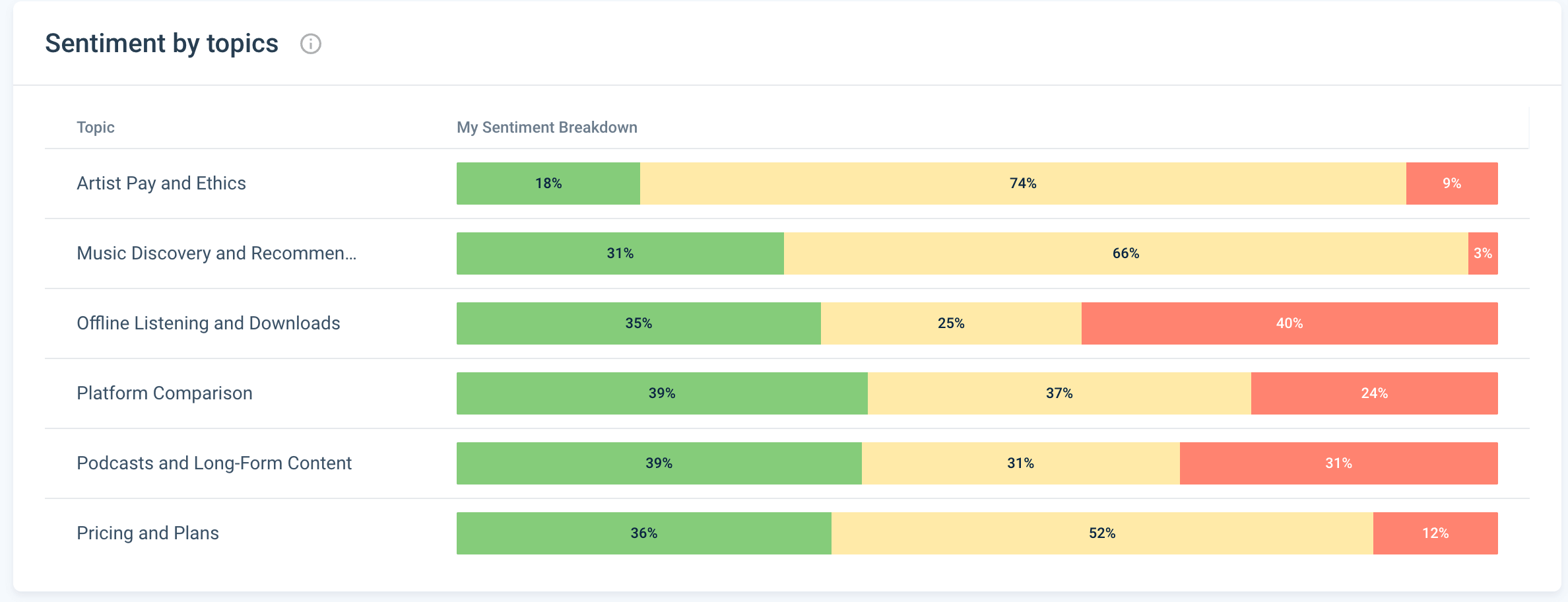
For the Spotify campaign tracked in Similarweb, the tracked prompts span six topic clusters:
Across all four LLMs from May 17 to 23, 2026, Spotify is mentioned in roughly 87 out of 100 tracked responses.
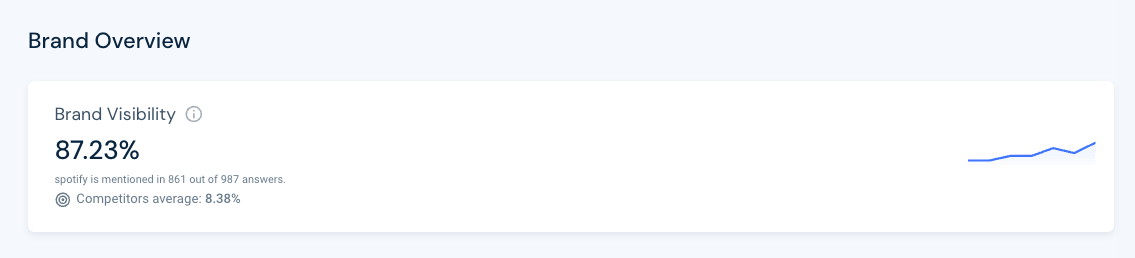
Brand visibility, in other words, is not the problem. The brand-level “87% visibility” is reassuring noise. The fixable issues only become visible when you decompose by topic.
The Catalog step has one critical design rule: the prompt set must stay stable across audits. Re-running with different prompts each week produces movement that is methodological rather than real.
Lock the set, version it, and only revise when you have a deliberate reason. I have sat through too many “the numbers are moving!” meetings that turned out to be the prompt set quietly drifting. Treat the prompt group the same way a researcher treats a survey instrument: if you change the question, you have changed the experiment.
Brand-level monitoring will tell you Spotify is visible. Topic-level monitoring will tell you where the brand is winning and where it is losing.
The way I work this step is to start with the topic-level sentiment view and look for any topic where the week-over-week delta is large enough to be unusual. Small drifts of a few percentage points are noise. Double-digit moves are a signal.
When I looked at the week-over-week data across the six tracked Spotify topics, one of them stood out: Podcasts and Long-Form Content, where negative sentiment jumped from 20% to 31% in a single week.
That is the kind of delta that earns a deeper look.
The trigger is sentiment. The diagnosis is in the citation layer underneath it. The next question is not “why is sentiment down” in the abstract, but which specific sources gained or lost influence over how the model is answering questions on this topic, because that is where the fix has to land.
Here is what locating looks like with actual data from the Similarweb AI visibility campaign tracking Spotify, week-over-week, May 10-16 vs May 17-23, 2026.
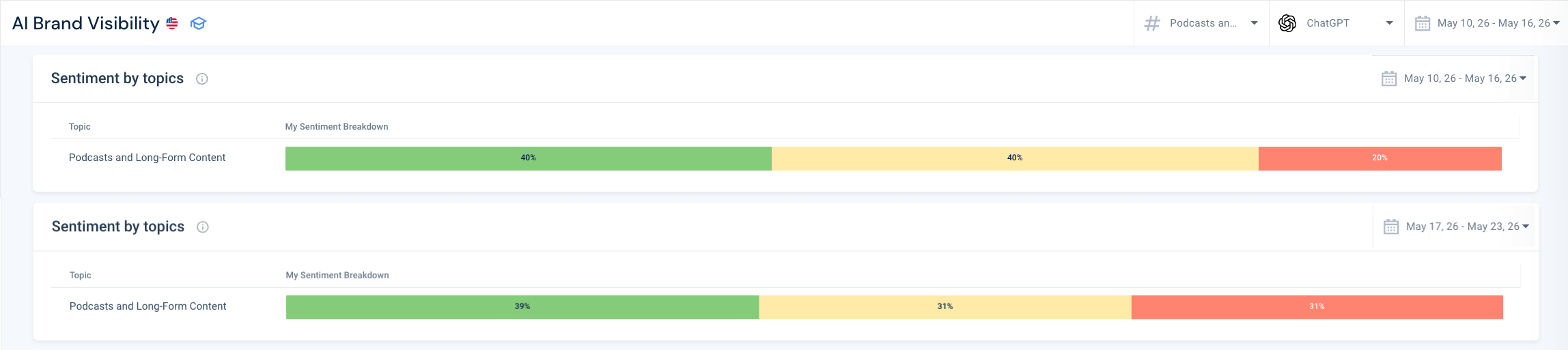
Negative sentiment is rising week over week at the expense of both neutral and positive sentiment. To put this change in numbers:
| Topic | Negative Week 1 | Negative Week 2 | Δ Negative |
|---|---|---|---|
| Podcasts | 20% | 31% | +11 pp |
Next, I dug into the Podcasts topic and investigated where the negative sentiment could be coming from. I used the citation analysis tool to check which are the most-cited websites on Spotify’s podcasts topics and identify changes that could affect Spotify’s brand sentiment.
I did this by examining which specific domains and communities are gaining or losing influence on the topic. I found that, on the topic of Podcasts, the citation analysis tool shows three moves that explain the shift in sentiment.
| Cited source | Domain influence Week 1 | Domain influence Week 2 |
|---|---|---|
| support.spotify.com | 35.7 | 21.4 |
| forum.plex.tv | 21 | 35.7 |
| talk.tidbits.com | 16 | 23 |
How did this shift influence sentiment towards Spotify in AI?
When I dug into it, I saw that the three prompts driving the sentiment change were operational power-user questions (heavy podcast listening, Premium ad behavior, queue management).
On those questions, LLMs prefer websites that already discuss the use case in detail. Forum.plex.tv and talk.tidbits.com are full of Mac power-users comparing podcast apps. The Pocket Casts and Overcast subreddits debate these features daily. Spotify’s own support documentation answers the questions, but in a single-product voice rather than a comparative one. An LLM model, when answering a comparison question, reaches for venues already structured comparatively.
The Plex and tidbits threads barely mention Spotify directly, yet the model drew on them anyway, which is how a negative comparative framing entered the Spotify response set without Spotify being the subject of the source content.
There is a diagnostic worth naming here: sentiment shifts in two distinct patterns, and they call for different remediations.
Owned content loses ground to third-party sources, and sentiment moves with it. This is a common case, and the response is well understood: update owned content, conduct outreach to the third-party sources that gained share, and rebuild citation density.
The mix of third-party sources turns over, and the new mix is operated by communities with different loyalties. The owned content situation may not have changed much, but the change is in which third-party venues the model is now reaching.
Spotify’s Podcasts topic is a textbook case of Pattern 2, and the mechanism behind it is exactly what the “why” paragraph above describes: when the prompt is comparative, the model reaches for venues structured comparatively, even when those venues barely mention the brand directly.
Pattern 2 requires a different response than Pattern 1.
Updating owned content does not solve it, because the model is not citing your owned content less, it is citing different third-party venues that ignore you. The fix is to make sure the new venues either include you on accurate terms or are themselves contextualized by stronger upstream sources (Wikipedia, industry analyst coverage, press) that the model also reads.
Both patterns can occur on the same topic at the same time, which is why locating means looking at the venue mix and not just the owned-versus-third-party split.
Similarweb’s AI citation analytics is the tool used for this step: surface which URLs are being cited, on which prompts, by which engine, and watch how citation share and domain influence move week over week.
There is no “submit a correction” button at OpenAI, Anthropic, or Google that will reliably edit how a specific brand is represented in a specific model within a useful timeframe.
We reached the same conclusion from the opposite direction in our negative GEO article: when competitors or bad actors try to inject false brand narratives into AI output, the only durable response is also at the source layer. The fix has to land where the model is actually reading.
Before the four sub-actions that represent this step, a quick note on Pattern matching: The four moves below are the durable Pattern 1 playbook: rebuild owned content, refresh the third-party sources that gained share, clean up comparison content, and fix entity infrastructure.
These actions are also the foundation for Pattern 2, but Pattern 2 adds a fifth move that Pattern 1 does not require: outreach to the community venues that replaced your owned content in the citation set, even when those venues barely mention your brand directly. If your Locate step surfaced a Pattern 2 shift, the digital PR and community outreach work expands accordingly.
With that framing in place, let’s get to the actions themselves, in priority order:
For Spotify’s Podcasts problem, that is, creators.spotify.com and any podcast-creator-facing pages on artists.spotify.com. Owned content needs to address the specific framing that AI responses are currently using incorrectly, rather than generic topic coverage.
If a model is wrong about how Spotify’s podcast revenue split works, an owned page that explicitly states the current split, the change history, and the source of truth gives the model something high-authority and recent to cite.
Outreach to the high-authority third-party sources that AI is citing on the deteriorating topic. If a music industry publication is the highest-authority source driving the wrong framing, a single correction or update there can move more downstream model output than weeks of owned content work.
Lead with facts and a verifiable correction. Do not lead with marketing language. Editors update articles when the correction is clear, sourced, and easy to verify. They do not update articles in response to PR-flavored objections to framing.
The single most reliable outreach email I have ever sent was three sentences: here is the claim in your article, here is the source proving it is now wrong, here is the corrected fact with a citation. No relationship-building, no preamble.
Editors are busy. They will update the copy when it’s cheap for them to do so.
Type 3 competitive misattribution often arises from “X vs Y” content in which the comparison is sloppy or out of date. Your team has more leverage here than you usually use.
Comparison pages on your own domain, white papers, and category pages should be explicit about the boundary between your product and competitors, not vague enough to let AI confuse the two.
Fix Wikipedia, the Knowledge Graph, and the structured-data layer in parallel. These do not directly edit LLM training data, but they shift the entity signals that future training and retrieval will weigh.
Wikipedia in particular is a disproportionately high-leverage source: it gets crawled, cited, and ingested into training data more reliably than almost any other web property of its size.
Source-level edits propagate to model output on the timelines in the 7-type taxonomy. Retrieval-side fixes (Perplexity, Google AI Mode) often appear within days because those systems perform live retrieval.
Training-data fixes for AI engines show up on next-major-update timelines (sounds familiar, anyone?), which means weeks to months.
A successful fix is not declared on sentiment movement alone. The audit pairs three signals:
The Spotify case provides a clean illustration of what to look for.
Going into the deterioration week, the Podcasts topic had 20% negative sentiment, and the citation set was anchored on Spotify-owned reference sources (support.spotify.com had a domain influence score of 35.7).
Following the deterioration week, the topic had 31% negative sentiment, support.spotify.com’s domain influence had dropped to 21.4, and competitor-platform community forums had risen to fill the gap.
If a fix landed by the 30-day audit, we would expect to see the negative-sentiment share drop back toward the Week 1 baseline AND the domain-influence score of owned reference sources recover. If owned reference sources stay low and the negative-sentiment improvement is modest, the fix landed on the wrong layer, and the domain-replacement problem is unresolved.
To make this decision simple, you can use the audit decision matrix below
Every audit lands in one of four states, depending on how sentiment and traffic moved together:
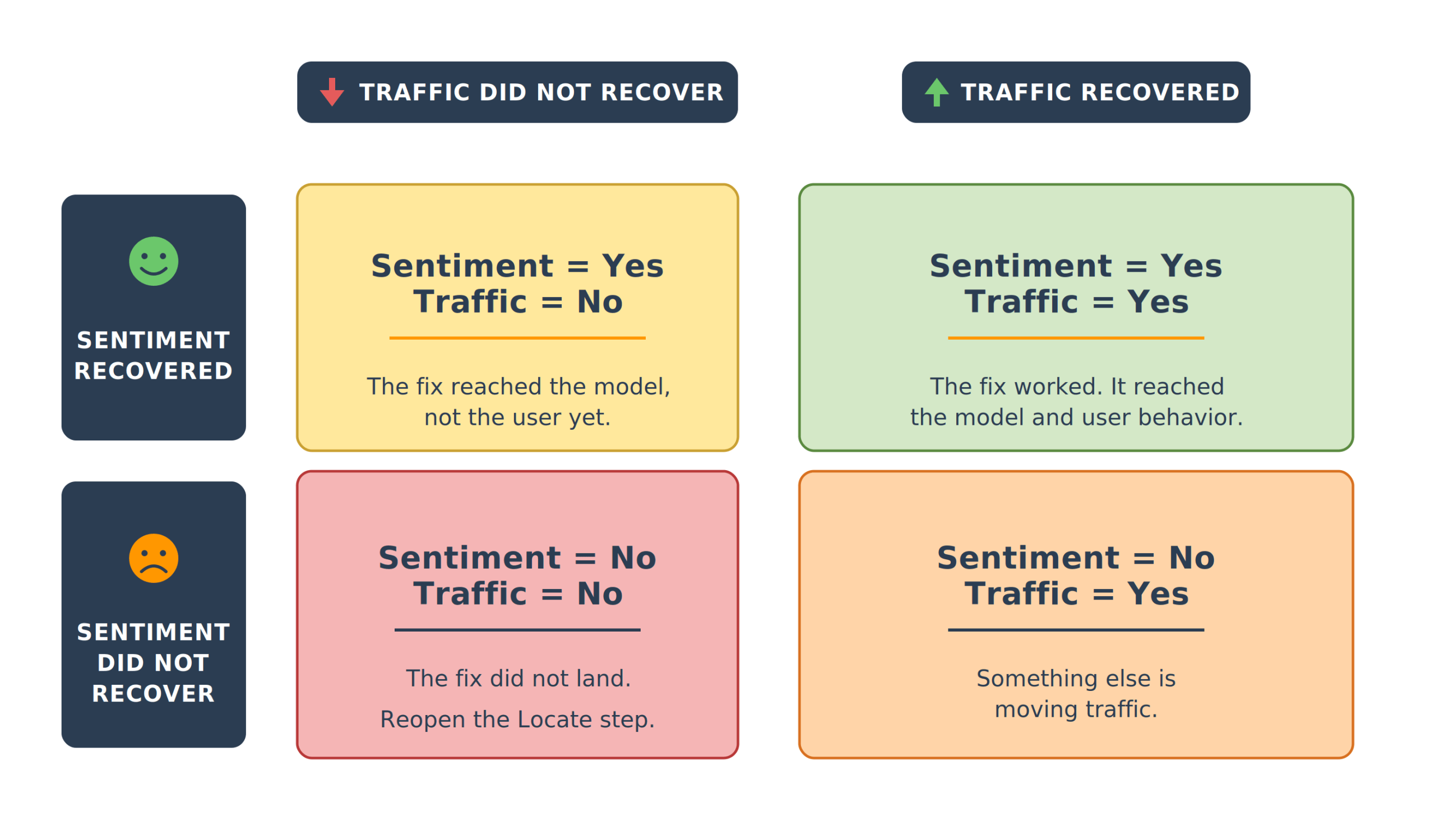
Pairing matters because either signal alone is a vanity metric. Sentiment per topic, isolated, can drift on small samples. Traffic per page, isolated, is confounded by seasonality, news, and unrelated product changes. The pair is the audit.
Splitting the traffic side further into AI-referred traffic specifically tightens the signal: if a fix moves both your topic-level AI sentiment and the slice of daily traffic that arrived via ChatGPT, Perplexity, Gemini, or Claude, the chain is connected end to end.
The unglamorous truth is that most teams skip the 30/60/90 audit and declare victory the moment owned content goes live. That is how you end up running the same fix three times on the same topic and wondering why nothing budges.
The audit exists to tell you whether the work landed. Skipping it means you are guessing.
Owned content density is the durable defense. Topics where Spotify wins in AI citation share are topics where Spotify has invested in growing content coverage over the years. Topics where Spotify loses are topics where owned coverage is thin and third-party publications fill the gap.
Reinforcement has three production layers.
In May 2026, Google deprecated FAQ rich results in Search. The visible FAQ dropdowns disappeared from search results on May 7, the Search Console rich result report and Rich Results Test support are scheduled for removal in June 2026, and the Search Console API support follows in August 2026.
The SEO industry split immediately into two camps: One side was saying that schema is over-optimization theater that Google has now confirmed it does not reward, so strip it out. Another side saying schema is more important than ever in the AI era, and you should be doubling down.
My position is closer to the second one, but for different reasons. I held this position well before any schema was tracked in GSC, and the only way to see success was through actual SERP changes.
The reason is that a schema is a structured data type. It is the format machines find easiest and fastest to read. It’s best suited for serving all the information you want to any engine before it starts parsing the body HTML. Clean, structured text. Yummy.
And yes, it works for AI engines as well. An LLM crawling your page does not need to parse your rendered HTML, infer your entity relationships from prose, or guess how your founding date relates to your leadership team or how your price relates to your product variant. The schema block tells it directly.
Even without hard proof that any specific schema type lifts AI citation share, the underlying logic of why machines would prefer machine-readable data over inferred-from-prose data is sound enough to act on. Rich result CTR in classic Google Search is no longer the case for schema. Machine-readability for the systems that now answer queries on top of Google is.
The sameAs property in Organization schema is doing particular work here. It is the entity-disambiguation signal AI systems use to confirm the brand is the same brand referenced elsewhere across Wikipedia, LinkedIn, Twitter, Crunchbase, and authoritative directories. That single property is one of the cheapest defenses against Type 6 identity errors.
With that argument settled, the implementation rule is straightforward: every owned page on a tracked topic should include every schema type that genuinely matches its content. A product page uses the Product or SoftwareApplication schema. A pricing page uses Offer and PriceSpecification. A page with real, on-page questions and answers uses FAQPage. A page with reviews uses Review and AggregateRating. A breadcrumb navigation uses BreadcrumbList. And so on.
Match the schema to what the page is, not to what SERP feature you wish you could earn.
The relevance qualifier is a major factor in the decision framework: Adding a schema that does not match the page content is what gives the entire discipline a bad name.
That is the over-optimization the search industry has been rightly criticized for, and it is exactly what Google has been steadily deprecating across rich result types.
Audit every directory, every public profile, and every press release for naming, address, and category consistency. Conflicts here become Type 6 misinformation later.
Maintain an llms.txt and a parallel set of .md versions of your most important pages. This method has not yet proven consistent success, so it falls into the “doesn’t hurt” category. These files provide AI crawlers with a clean, canonical source of truth that is easier to ingest than a JavaScript-rendered web page.
The point of Reinforce is to make sure your owned content is actually winning citations, which is downstream of how AI brand mentions form in the first place: the model picks the most authoritative-feeling, easiest-to-parse source it can find, and entity infrastructure is what makes you that source.
The framework is only as useful as what a working SEO team would do with it on Monday morning. Here is the worked example, using the actual Similarweb AI visibility data on the Podcasts and Long-Form Content topic.
A note before this section: I am not telling Spotify what to do, and nothing here suggests their SEO team is doing anything wrong. This is a “what would I do” walkthrough based on my own practitioner perspective and experience.
Three prompts in the campaign are driving the negative-sentiment shift across the four LLMs:
All three are high-intent operational questions from podcast power-users evaluating Spotify against dedicated podcast apps like Pocket Casts, Overcast, and Apple Podcasts. These are the exact decision queries that determine whether a heavy podcast listener uses Spotify for the use case or switches to a dedicated app.
This is the operative finding.
Spotify-loyal subreddits (r/spotify, r/truespotify, r/SpotifyPremium) collapsed from six unique URLs cited in Week 1 to one in Week 2. The Plex and tidbits threads, when read directly, barely mention Spotify at all, yet the model still drew on them to answer prompts about Spotify, which is how the negative framing entered the response set.
That is the entire story. Spotify’s owned content did not get worse. It got deprioritized because the models reached for venues operated by competing podcast-app communities, where the user query intent matched the community’s existing comparison content better than Spotify’s first-party product documentation.
The fix is not “write more content.” The fix is to make Spotify’s owned pages structurally legible as canonical sources for podcast-app comparison questions, and to coordinate digital PR with the third-party venues where these comparisons actually happen, so the upstream sources those communities cite include Spotify on accurate terms.
Audit the three deteriorating prompts manually across Perplexity, ChatGPT, Gemini, and Google AI Mode. Capture full response text and citation list.
Update the support.spotify.com podcast articles on queue management, episode marking, and auto-download behavior with explicit, current, and comparable detail. Use the same structural format (step-by-step, last-updated date) that the model is rewarding in competitor-app forum threads. Add relevant schemas.
Update creators.spotify.com pages on Premium podcast ad behavior with clear, current, last-updated documentation, since this is one of the three prompts where domain influence dropped from 35.7 to 21.4.
Build a new owned page at newsroom.spotify.com or creators.spotify.com: “Spotify for heavy podcast listeners: queue, downloads, and discovery.” This directly answers the “10+ shows per week” prompt, which currently returns zero owned citations on three of the four LLMs.
Outreach to third-party venues that currently dominate the negative-sentiment citation set. Provide updated factual corrections on Spotify’s actual feature set, current behavior, and recent product updates. Not all forums accept outreach, but a single corrected thread in one of them can move downstream model output more than three months of owned blog publishing.
File platform reports for the three deteriorating prompts. Document timestamps. Re-run the prompts on Perplexity 48 hours later to check for retrieval-side updates.
The 30-day window targets retrieval-side recovery and citation share rebuild. Re-pull the three deteriorating prompts at day 7, day 14, day 21, and day 30.
Track domain influence for Spotify-owned reference sources (support.spotify.com, creators.spotify.com) across the four LLMs, and watch whether the competitor-app forum venues (forum.plex.tv, talk.tidbits.com) start to lose share as the updated owned content gets re-crawled.
Expected directional movement: domain influence recovery as the updated owned pages get re-crawled, sentiment improvement, and subreddit mix shifting back toward Spotify-named subs if the owned content is genuinely better than the competitor-forum alternatives.
The Type 3 competitive misattribution work runs in parallel. Audit the existing creators.spotify.com and support.spotify.com pages for any vague comparisons to dedicated podcast apps that AI could misinterpret.
Tighten differentiation. Build out dedicated comparison pages for “Spotify vs. Pocket Casts” and “Spotify vs. Overcast” on the queue, downloads, and discovery use cases, because the absence of canonical owned comparison content is exactly the gap that competitor-app forum threads are filling.
The 90-day window targets training-data propagation for ChatGPT, Gemini, and Claude. Source-level fixes published in week 1 will not appear in ChatGPT or Gemini until the next model update cycle.
The work this quarter is structural:
Re-run the original three deteriorating prompts. Expected state if the fixes worked:
If any of those three signals fail to recover, the fix did not land where it needed to land. Reopen the Locate step and trace which specific domain sets moved and which did not.
The whole point of CLEAR is that it gives you a falsifiable answer at 90 days. Either citations, sentiment, and a recovered domain mix, or not. Vague optimism is not a deliverable.
Each major AI platform offers feedback channels. None of them guarantees a fix. The realistic position is that platform reporting is supplementary to source-layer correction, not a substitute for it.
Thumbs down the response and add categorized feedback. The report is logged for future training and evaluation cycles. No individual reply, no guaranteed fix on the specific issue you reported. Useful as a documented step in your workflow, not as a fix mechanism.
Open the “…” menu on the response, choose Report, and pick a category. Because Perplexity’s design relies on live retrieval, a report can trigger re-retrieval, and source updates published in parallel can appear in responses within hours to days.
This is the only platform where reporting is plausibly a same-week lever.
Thumbs-down the Overview, choose “Report a problem,” pick a category. Reports route to search quality, and specific Overviews can be suppressed on specific queries. Timeline is variable, from days to weeks, and suppression is query-specific rather than brand-wide.
Each provider maintains a separate channel for demonstrably harmful or defamatory content. These are not for general inaccuracy. Timelines run weeks to months, and the bar is high.
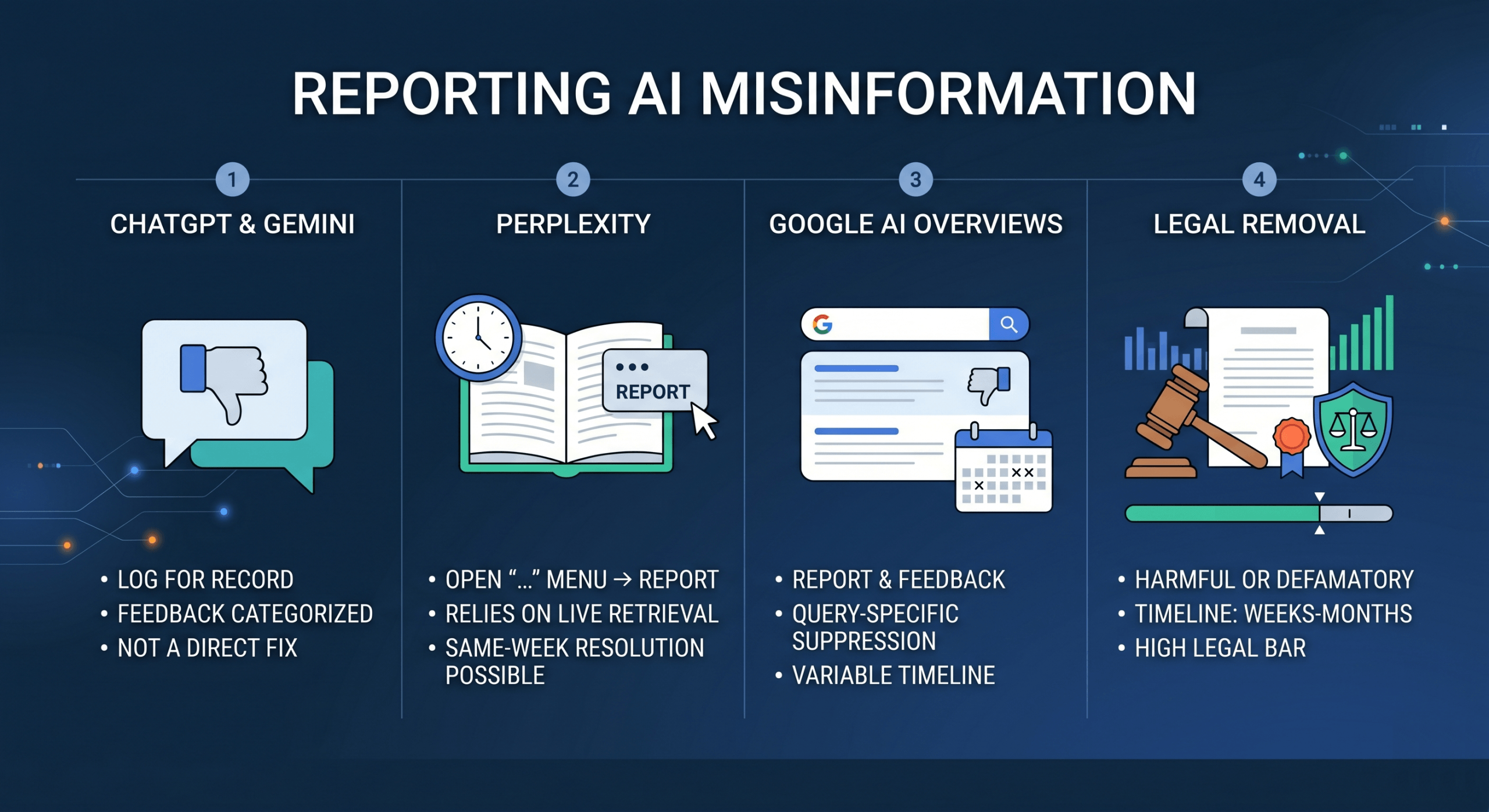
There is no submit-a-correction button. The platforms do not maintain a “wrong information about brands” pipeline that turns reports into reliable, fast fixes.
Reports get aggregated into training and evaluation, which means they affect future models on future training cycles. They do not guarantee that the specific wrong characterization you reported on Tuesday will be different next Tuesday.
Two practical exceptions:
Both are real levers. Neither is a general-purpose correction mechanism.
The actionable takeaway is that platform reporting should be a documented step in your fix workflow (file the report and document the timestamp), but the substantive work is source-level edits and entity reinforcement.
AI corrections work when topic-level sentiment improves, and topical-property traffic stabilizes or grows over a 30 to 120-day window. The audit rests on four paired metrics: sentiment per topic, error rate per tracked prompt, owned-domain influence in citations, and daily average traffic to the matching owned property.
Single-metric measurement is misleading, and single-prompt checks are unreliable because LLM outputs vary across sessions and platforms.
The Spotify dataset already shows what the common distribution looks like. On topics where Spotify is winning, sentiment is positive or stable-neutral, and traffic to the matched topical property is stable or growing. On topics where Spotify is losing or has recently deteriorated, sentiment is negative or trending negative, and topical traffic is either flat or declining.
For an SEO team operating this measurement model, four things matter:
Stable prompt set across audits: You cannot detect movement on a moving target. If your prompts shift between audits, any change in sentiment you see is at least partly methodological rather than real.
Re-pull at 30, 60, and 90 days: Sentiment can shift in either direction across the gap. One pull is a snapshot. Three pulls are a trend. The 30-day window captures retrieval-side fixes, the 60-day window captures mid-cycle propagation, and the 90-day window captures training-data updates, depending on the model release cadence.
Pair sentiment with topical traffic in the same time window: The two should move together if the fix is real and connected to user behavior. If sentiment improves but traffic does not, the fix may have reached the model but not the user. If traffic improves but sentiment does not, then something other than the AI correction is driving traffic, and the original problem remains unresolved.
Track citation share, not just sentiment: Citations are the leading indicator. Sentiment lags citation movement by days to weeks, because once the cited sources shift, the model’s synthesis shifts with them. A team that monitors only sentiment is reading the lagging indicator and reacting late, which is precisely why the GEO KPI set for any serious program puts citation share alongside sentiment rather than treating sentiment as the headline number.
AI brand misrepresentation is fixable. Not by submitting a correction form, not by talking to the model, and not by waiting for OpenAI or Google to ship a brand-corrections feature that isn’t on any public roadmap. It is fixed at the source layer, where the model actually reads: owned content, third-party publications, Wikipedia, structured data, and the entity infrastructure that signals to AI which version of your brand is the real one.
That work is the SEO team’s responsibility, but SEO doesn’t do it alone. The Catalog and Locate steps are owned by SEO. The Edit step pulls in content, digital PR, product marketing, and sometimes legal. The Reinforce step touches engineering, listings management, and whoever maintains your Wikipedia presence.
The job of the SEO strategist is to know which lever moves which signal, then route the work to the team that owns that lever and audit whether it landed.
CLEAR is the operating workflow for that coordination. Catalog the prompts. Locate the topic-level shifts. Edit the sources. Audit at 30, 60, and 90 days with paired sentiment and citation data. Reinforce with the entity infrastructure, so the same problem does not recur. The point is to check as many signal boxes as possible, because AI engines weigh all of them, and missing any one of them leaves a gap that another source fills for you. Expect results by 120 days.
If I have one piece of practitioner advice to leave you with, it is this: stop treating AI brand misinformation as a dashboard problem and start treating it as a strategy problem you own and orchestrate. The teams getting this right are not the ones with the prettiest scorecards. They are the ones who decided, on a Monday, which three topics they were going to fix this quarter, and then actually fixed them.
How do I correct AI about my brand?
You cannot directly edit how an AI model represents your brand. The reliable correction path is to update the sources the model cites, including your owned content, third-party publications it weights highly, and entity signals like Wikipedia, Knowledge Graph entries, and structured data on your site. Platform-level reports are supplementary, not primary, because they affect future training cycles rather than current outputs.
How is being misrepresented in AI different from being invisible in AI?
Invisibility means your brand does not appear in AI responses where it should, which is a discovery and entity-recognition problem. Misrepresentation means your brand does appear, often frequently, but the description is wrong, outdated, or misleading. The fixes are different. Invisibility needs entity signal building and content depth. Misrepresentation needs source-level corrections and citation-share repair on specific topics.
How much does AI brand misinformation cost businesses?
Hard numbers for AI brand misinformation specifically are still emerging because most enterprises do not yet measure this cost directly. The closest signals come from adjacent enterprise AI cost incidents: Deloitte Australia refunded approximately $290,000 to the Australian government in October 2025 after its consulting report contained fabricated GPT-4o citations, and the Moffatt v. Air Canada ruling held a company liable for its chatbot’s wrong information to a customer. For brand misrepresentation specifically, the cost compounds further downstream: prospects who got wrong information about your product never become leads, deals lost to a competitor whose AI representation was more accurate, and reputational damage that goes undetected for months. The teams quantifying this earliest are the ones tracking AI sentiment per topic in parallel with the affected pages’ traffic.
Does AI brand misinformation actually hurt my traffic?
The honest answer is that the cleanest signal we can isolate week-over-week is in the AI layer itself: when sentiment deteriorates on a topic, the citation mix in AI responses shifts in measurable ways. The downstream traffic question is harder because traffic in any given week is moved by seasonality, news, and unrelated product changes, but the upstream signal in AI responses is direct and falsifiable: if AI is increasingly recommending against your brand on a topic where your prospects are making purchase decisions, the commercial impact arrives on a longer timeline than a single week of analytics will show.
Why can’t I just submit a correction to OpenAI, Google, or Anthropic?
No major AI platform maintains a brand-correction pipeline that turns individual reports into reliable, fast fixes on specific outputs. Reports get aggregated into future training and evaluation, which affects future models, not current responses. The only platform where reports can land quickly is Perplexity, because its live-retrieval architecture re-pulls sources when the underlying content changes.
Can I sue an AI provider for misrepresenting my brand?
For demonstrably defamatory or harmful content, yes. Most major AI providers have legal removal channels for those specific categories. For general inaccuracy, the existing precedent is currently against the deploying business, not the model provider. The 2024 Moffatt v. Air Canada decision held the airline liable for its chatbot’s wrong information, regardless of who built the underlying AI. The legal exposure usually sits with the company that deploys the AI, not the company that built it.
How long does it take for AI to update wrong information about my brand?
It depends on the type of misinformation and the AI engine. Retrieval-based engines like Perplexity and Google AI Mode can update within hours to days when underlying sources change. Training-data-driven outputs in ChatGPT, Gemini, and Claude update on model-release cycles, which are typically weeks to months. The 7-type taxonomy in this article provides realistic timelines for each misinformation type. Most fixes take 30 to 120 days to fully propagate.
Which AI engine is most likely to get my brand wrong?
It depends on the type of misinformation. Live-retrieval engines like Perplexity and Google AI Mode are more likely to surface stale or biased third-party content because they pull current web pages at query time, which means a high-ranking, outdated article can dominate the answer. Training-data-driven outputs in ChatGPT, Gemini, and Claude are more likely to surface fabricated details or outdated facts from training data that has not been refreshed. The same brand can be described accurately on one engine and incorrectly on another in the same week. The fix path is also engine-specific: retrieval-side errors respond to source updates within days, whereas training-side errors require model update cycles.
Director of SEO & AI Search at Similarweb
Limor brings 20 years of expertise in SEO and AI Search. She thrives on solving complex problems, creating scalable strategies, and building amazing dashboards.
ChatGPT Ads CTR by Country: Brazil, Mexico and Japan Out-Click the US by More Than 2x
What is RAG (Retrieval-Augmented Generation)? A Marketer's Guide

Gen AI Glossary: The Must-Know AI Search Terms
Give it a try or talk to our insights team — don’t worry, it’s free!