



Dark Funnel Metrics: What to Measure When Buyers Decide Before They Click
by Limor Barenholtz21 Min.
Oct 14, 2026
The GEO keyword research article I published a few days ago described a seven-part process for restructuring keyword research around how LLMs actually search (the FAN methodology). The response I got most was some version of: “This makes sense. How long does it take?”
Honest answer: The first time I ran it manually, it took 4 hours. Per topic cluster.
That is not a scalable content operation. So I rebuilt the workflow as an automated AI agent keyword research pipeline:
Claude connected to the Similarweb MCP server, with a custom skill that executes the full FAN methodology: anchor query intake, fan-out mapping, Similarweb keyword validation, content gap identification, and brief generation in a single conversation.
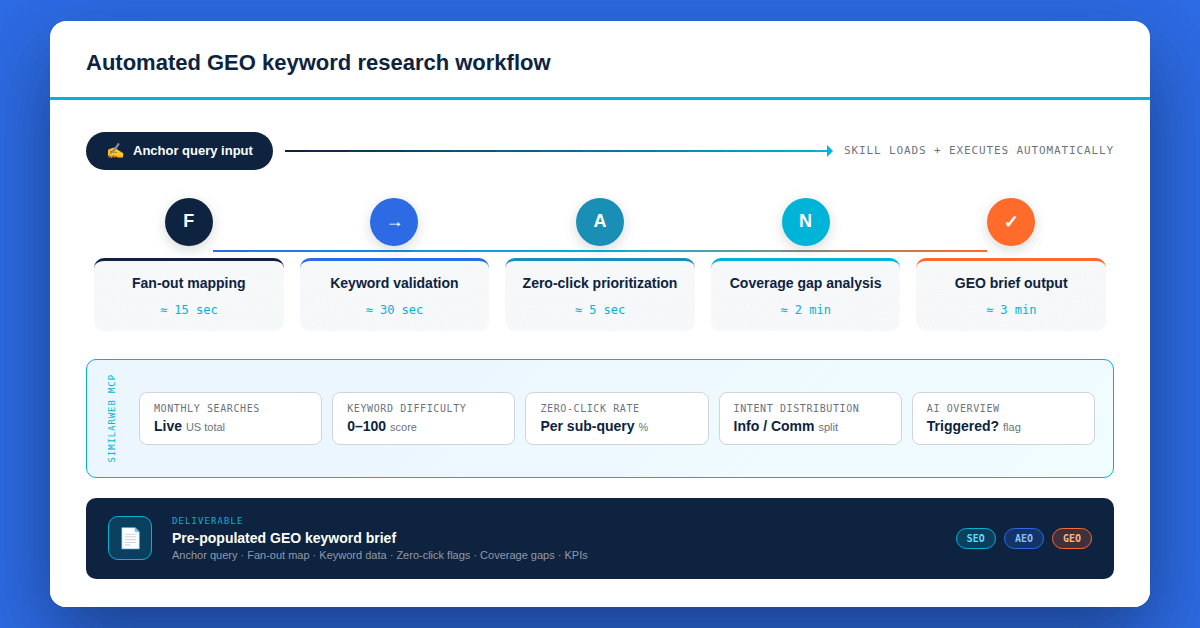
The whole run now takes under 20 minutes, and the output is richer than anything I was producing manually.
This article is the operational companion to the FAN methodology guide. I am going to walk through exactly how I set it up, what the stack looks like, and what the output produces that manual keyword research cannot.
If you have not read the FAN methodology for GEO keyword research piece first, I recommend doing that before continuing, since the framework vocabulary (fan-out mapping, node architecture, anchor queries) is assumed throughout.
Running the FAN methodology manually means doing seven distinct things for every topic cluster you want to cover:
Steps 1 and 2 require judgment. Steps 3 through 7 require data access and pattern matching, which is exactly what a well-configured AI agent does faster and more consistently than any human working through a spreadsheet.
The business case is straightforward. I manage content strategy for Similarweb’s GEO topic cluster. At any given time, I am tracking 15 to 20 active topic clusters. Manually running the FAN methodology across all of them would require roughly 60 to 80 hours per cycle.
The automated workflow runs all 20 in an afternoon. That is not a minor efficiency gain. It is the difference between the methodology being practical and it being theoretical.
The Similarweb MCP is a connector that gives Claude direct, real-time access to Similarweb’s keyword intelligence data mid-conversation: search volume, keyword difficulty, zero-click rate, intent distribution, click share, related keyword clusters, and more. All without any manual exports or context switching.
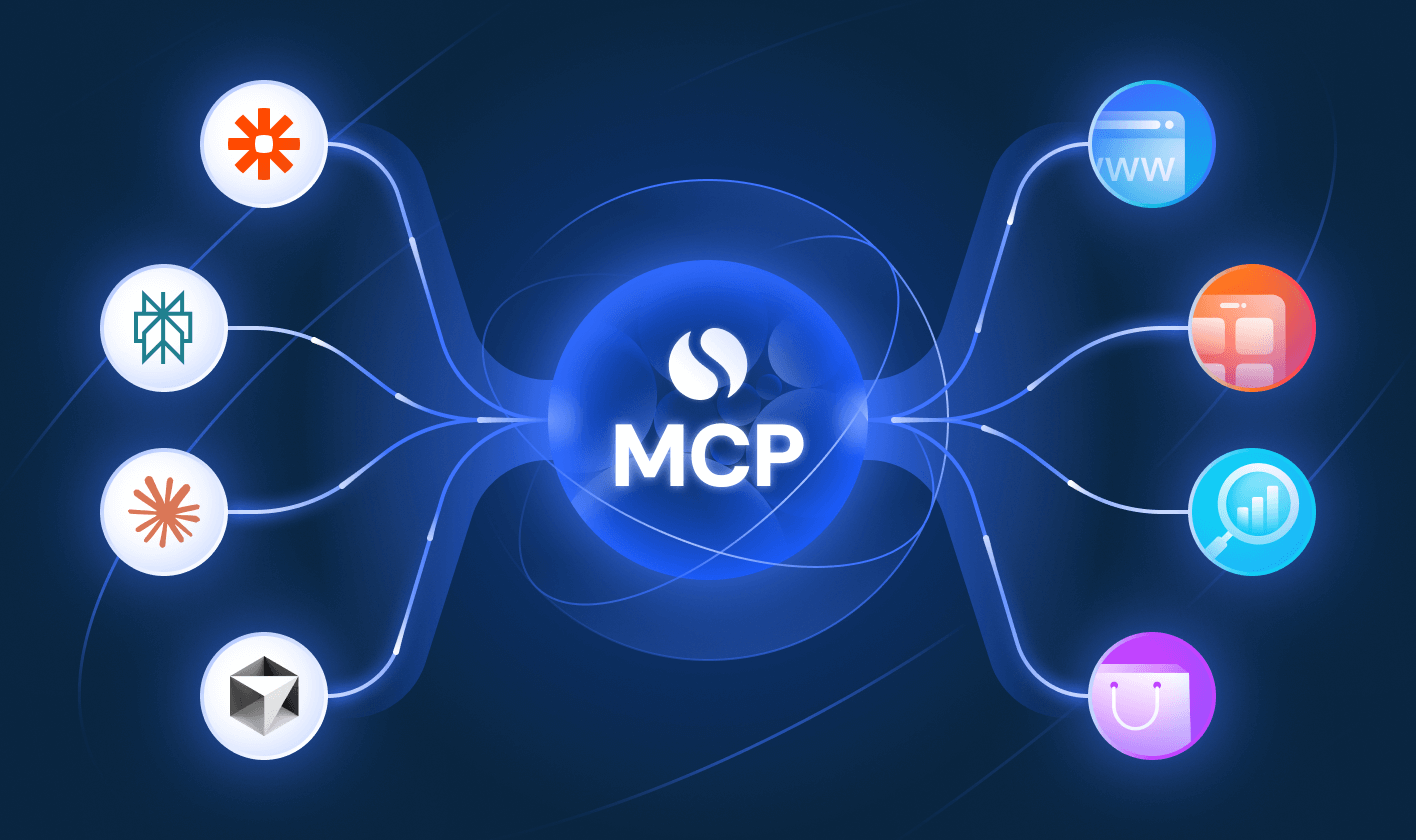
The Model Context Protocol (MCP) is an open standard developed by Anthropic that enables AI assistants to connect to external data sources and tools mid-conversation. You ask Claude a question, Claude calls the data source, gets the answer, and continues its reasoning, all in one thread.
This matters specifically for GEO keyword research given the nature of fan-out subqueries. Most fan-out sub-queries are long, conversational, and low volume (exactly the kind of terms that traditional keyword tools undercount or miss entirely).
They are also fast-moving: a sub-query with no search volume six months ago may now have 1,200 monthly searches because the topic broke into mainstream discussion. Pulling live data from Similarweb at the moment of research, rather than from a cached export, means the brief reflects current reality.
Setting up the Claude and Similarweb MCP stack requires three steps and no code: connect the Similarweb connector in Claude’s settings (about two minutes), upload the GEO keyword research skill file, and provide one anchor query. Everything after that runs automatically.
The setup is simpler than it looks. You do not need to write any code or touch a config file.
In Claude’s settings, navigate to ‘Connectors’ and find the Similarweb connector, or go through ‘Customize’ and choose ‘Connect your tools’, and then find the connector. It authenticates via your Similarweb account credentials.
Once connected, Claude can call Similarweb keyword data (and much more) directly from any conversation. The connection takes about two minutes to configure.
A Claude skill is a pre-built instruction set saved as a file that Claude loads at the start of a task (see Anthropic Agent Skills documentation).
My GEO keyword research skill includes the full FAN methodology:
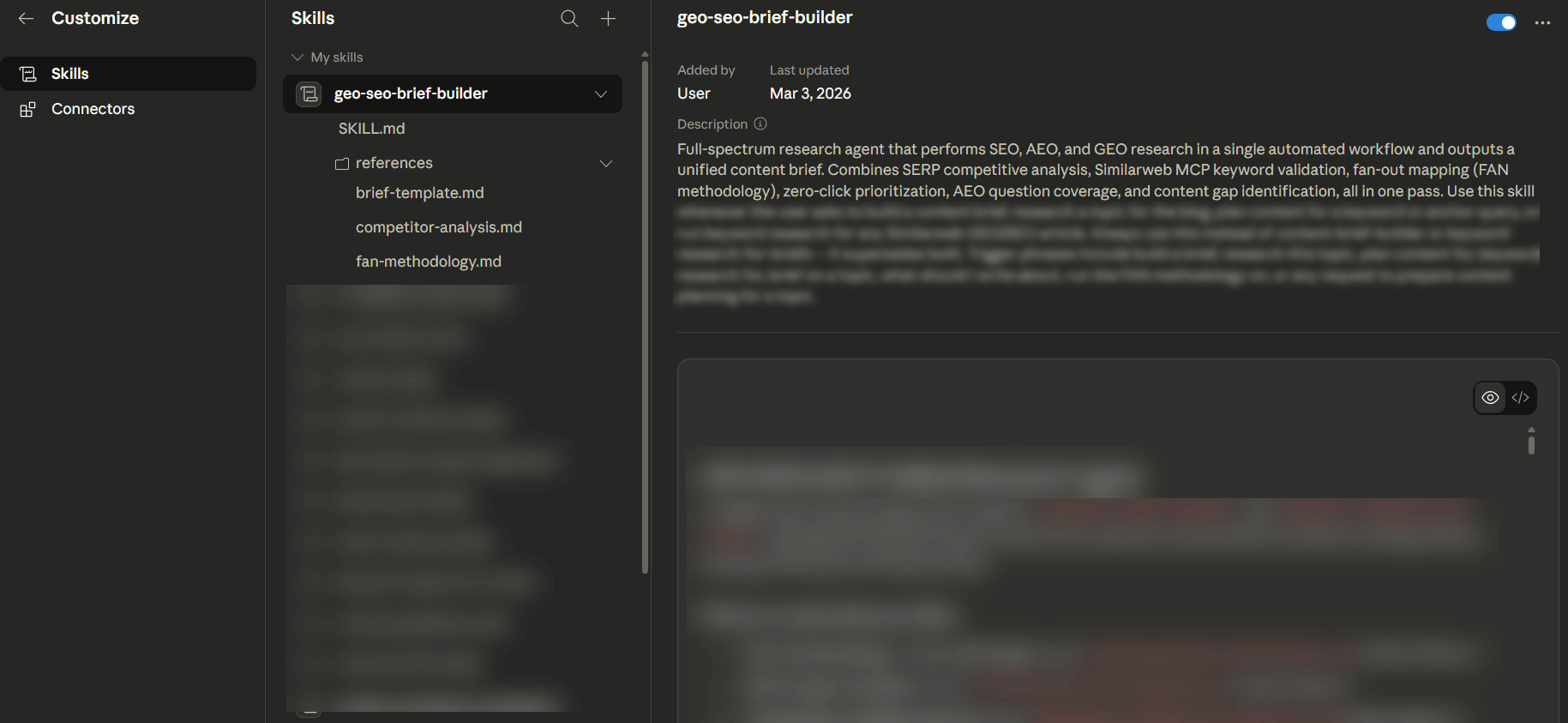
The skill means I do not have to re-explain the methodology every time. Claude loads it, reads the instructions, and executes consistently.
The only human input required to start the workflow is one anchor query: a conversational, 15-to-25-word question reflecting how your audience would phrase the topic to an AI engine, not a seed keyword.
“How do I track my brand’s visibility across ChatGPT, Perplexity, and Google AI Mode?” is an anchor query. “AI search visibility” is a seed keyword.
The anchor query is what you feed in. Everything after that runs automatically.
I will walk through a complete live example using a real Similarweb topic: AI brand visibility tracking. This is the same topic area covered in Similarweb’s 2026 AI Brand Visibility Index research, so the sub-queries it produces are genuine.
Anchor query input: “How do I track my brand’s visibility across ChatGPT, Perplexity, and Google AI Mode?”
The first thing Claude does is map the seven sub-query types for this anchor query. This is the FAN methodology’s F component (Fan-out Mapping) executed automatically. Here is the output:
| Sub-query type | Generated sub-query | Priority |
|---|---|---|
| Definition | “What is AI brand visibility?” | High |
| Comparison | “AI brand visibility vs traditional SEO rankings” | High |
| How-to | “How to measure brand mentions in ChatGPT” | High |
| Use case | “AI brand visibility tracking for B2B SaaS” | Medium |
| Objection | “Is tracking AI brand visibility worth it?” | Medium |
| Entity expansion | “Perplexity citation tracking tools” | Medium |
| Metric | “AI brand visibility benchmarks by industry” | Low |
This entire mapping takes Claude approximately 15 seconds once the anchor query is provided.
This is where the MCP connection earns its place. Claude immediately calls the Similarweb keyword API for each sub-query in the fan-out map and retrieves volume, difficulty, zero-click rate, and intent data. Here is what that validation output looks like:
| Sub-query | Monthly searches (US) | Difficulty | Zero-click rate | Priority ruling |
|---|---|---|---|---|
| “What is AI brand visibility?” | 1,840 | 18 | 58% | Standalone article |
| “AI brand visibility vs SEO rankings” | 390 | 12 | 41% | Standalone article |
| “How to measure brand mentions in ChatGPT” | 720 | 22 | 47% | Standalone article |
| “AI brand visibility for B2B SaaS” | 110 | 8 | 39% | Section-level |
| “Is tracking AI brand visibility worth it?” | 60 | 5 | 33% | FAQ answer |
| “Perplexity citation tracking tools” | 210 | 15 | 52% | Section-level |
| “AI brand visibility benchmarks” | 440 | 19 | 61% | Standalone article |
Source: Similarweb keyword data, January 2026. US desktop and mobile web.
The prioritization logic is applied automatically based on my own testing of content ROI at Similarweb across 18 months of GEO briefs:
These thresholds are not universal rules, but they have held up consistently across Similarweb’s topic clusters.
The zero-click rate triggers an additional flag: any sub-query with a zero-click rate above 50% is labeled a “citation play” in the brief, meaning the goal for that content is AI citation frequency rather than organic click volume. Adding statistics to content improves LLM citation rates by up to 41%, according to Princeton GEO-Bench research (2024).
Claude then cross-references the full fan-out map against the content URLs I provide as context. For each sub-query, it checks whether existing published content addresses that question, partially addresses it, or leaves it unaddressed. The output is a gap list with coverage status:
This gap list effectively serves as a content calendar for a quarter. Each uncovered sub-query is a brief waiting to be written.
The final output is a pre-populated GEO keyword brief for each flagged gap.
Each brief includes the anchor query, sub-query text, Similarweb volume and difficulty data, recommended content format, required authority signals (the A in FAN: statistics, citations, proprietary data), node architecture requirements, internal link targets, and measurement KPIs mapped to the GEO KPIs guide.
The brief is built to the same standard as the free GEO keyword brief template in the FAN methodology article, pre-filled with real data rather than placeholder text.
A writer can take the brief and begin drafting immediately without doing any additional keyword research.
The Claude and Similarweb MCP workflow produces three outputs that manual keyword research cannot: sub-query volume data at the fan-out level, zero-click rate flagged per sub-query, and coverage gaps mapped against your existing published content simultaneously. Together, these change which content you brief, not just how fast you brief it.
The automated workflow is not smarter than a skilled SEO. It is more structured and more consistent.
Three specific outputs matter:
Sub-query volume at the fan-out level: Traditional keyword research starts with seed keywords and expands outward. That expansion finds high-volume terms, not the long-tail conversational sub-queries that LLMs actually generate.
The FAN methodology starts with the anchor query, decomposes downward, and then validates each sub-query individually. The result is volume data for terms most SEOs have never considered checking.
Zero-click rate per sub-query: This is the data point that most changes content strategy decisions. A sub-query with 700 monthly searches and a 61% zero-click rate should be briefed for AI citation density, not click-through optimization.
Without zero-click data at the sub-query level, you are optimizing for the wrong metric. The Similarweb MCP automatically surfaces this for every sub-query in the map.
Coverage gaps mapped to existing content: Manual keyword research tells you which terms have volume. It does not tell you which of those terms your existing content ecosystem already covers.
The automated workflow does both simultaneously, which means the output is a true gap analysis, not just a keyword list.
| What you get | Manual FAN workflow | Automated Claude + Similarweb MCP |
|---|---|---|
| Fan-out map for one anchor query | 45-60 min | 15 sec |
| Keyword validation for 7 sub-queries | 30-45 min | 30 sec |
| Coverage gap vs. existing content | 60-90 min | 2 min |
| Pre-populated GEO brief | 45-60 min | 3 min |
| Total per anchor query | ~3.5 hours | ~6 minutes |
Scaling this workflow across a content team requires a single shareable skill file and a single shared standard for anchor queries. Any writer, PMM, or content strategist with the same skill gets the same output quality as the person who built it. The methodology stops living in one person’s head and starts living in a file.
The individual workflow is useful. The team workflow is where this becomes a system.
The skill file is shareable. Any writer, PMM, or content strategist on your team can load the same GEO keyword research skill and get identical output quality. The methodology does not live in any one person’s head, it is encoded in the skill.
That means every content brief produced by the team follows the same FAN standard: the same sub-query coverage, the same Similarweb data validation, the same prioritization logic, and the same brief format. The quality floor rises, not just the speed.
For batching, you can run multiple anchor queries in sequence within a single conversation. I typically run 8 to 10 anchor queries per session, covering a full quarter of content planning in one sitting.
The Similarweb MCP handles concurrent keyword calls efficiently: Each validation takes a few seconds, so a full session for 10 anchor queries with 7 sub-queries each (70 keyword calls) runs in roughly 12 minutes of active processing.
The measurement loop closes through Similarweb’s AI Brand Visibility tool. Every GEO brief the workflow generates includes measurement KPIs that correspond directly to Similarweb AI Tracker fields: AI citation frequency, brand mention rate, fan-out coverage score, and share of voice in AI answers.
When content is published, and performance data flows in, you close the loop between brief, content, and performance without having to map KPIs manually each time.
Connecting Claude to the Similarweb MCP saves time. It changes the quality of the research output in ways that manual workflows structurally cannot match.
| Benefit | What it means in practice |
|---|---|
| Live keyword data | Every sub-query is validated against the current Similarweb volume and zero-click rates at the moment of research, not a cached export from last month. |
| Zero-click flagging at scale | Sub-queries with zero-click rates above 50% are automatically labeled as citation plays, shifting the brief’s goal from click optimization to AI mention density. |
| Fan-out coverage, not seed expansion | The workflow decomposes from the anchor query downward, surfacing long-tail sub-queries that traditional seed-expansion tools never surface. |
| True gap analysis | Claude cross-references every sub-query against your existing content simultaneously, producing a genuine gap list rather than a raw keyword list. |
| Consistent brief quality across teams | The skill encodes the full FAN methodology standard, so every writer produces to the same brief quality regardless of individual keyword research experience. |
| Quarterly re-runs become practical | At 6 minutes per anchor query, re-running as a sub-query as volumes shift is operationally viable. At 3.5 hours per cluster, it simply does not happen. |
Three limits worth knowing upfront:
The FAN methodology is not hard to understand. The reason most SEO teams are not running it is that it is hard to execute consistently at scale. Manual execution is slow, and slow workflows get skipped when the editorial calendar fills up.
The automated pipeline removes the friction. When running a GEO keyword research session takes six minutes instead of three and a half hours, it happens every sprint cycle instead of once a quarter.
That frequency is the compound return. Every additional topic cluster you cover with a properly structured FAN brief is another corner of the semantic space where your content is citation-eligible, not just for the queries you optimized for, but for the sub-queries the LLM generates that you would never have thought to track.
One well-executed content ecosystem covering the full fan-out space for your anchor queries will outperform a larger catalog of content optimized for individual seed keywords. The automated keyword research workflow is what makes the well-executed ecosystem achievable at the pace a competitive content operation requires.
If you want to start somewhere: connect the Similarweb MCP, pick one anchor query from your brand’s topic area, and run the workflow once. The output will tell you more about your content gaps in 20 minutes than most keyword audits reveal in a week.
Track how your content performs in AI-generated answers as you fill those gaps using Similarweb’s AI search intelligence suite, including citation frequency, brand mention share, and share of voice by topic cluster.
What is the Similarweb MCP, and how does it connect to Claude?
The Similarweb MCP (Model Context Protocol) is a connector that gives Claude direct, real-time access to Similarweb’s keyword intelligence data mid-conversation. Instead of exporting a CSV manually, the MCP lets Claude call Similarweb’s API as part of an automated workflow. Setup takes about two minutes through Claude’s Settings under Connectors and requires only your Similarweb account credentials.
What is a Claude skill, and how does the GEO keyword research skill work?
A Claude skill is a reusable instruction set saved as a zip file that Claude loads on demand when a task matches its description. The GEO keyword research skill encodes the full FAN methodology: how to interpret an anchor query, map seven sub-query types, validate each against Similarweb data, identify coverage gaps, and output a pre-populated GEO brief. One anchor query in; a complete research brief out.
What is query fan-out, and why does it matter for keyword research?
Query fan-out is how AI systems like ChatGPT decompose a single anchor query into 6–20 parallel sub-queries before generating an answer. Your content competes for each sub-query slot, not the original query. Traditional keyword research misses this entirely because it expands from seed keywords outward. The FAN methodology starts from the anchor query and maps downward, capturing sub-queries that LLMs actually generate.
What keyword data does the Similarweb MCP give Claude access to?
The Similarweb MCP exposes search volume, keyword difficulty, zero-click rate, click distribution (organic vs. paid), intent classification, and related keyword clusters for any query. For GEO keyword research, zero-click rate is the most strategically important signal: it determines whether a sub-query is a citation play (above 50% zero-click) or a click-driving opportunity, which directly shapes how content is briefed.
What is a zero-click rate, and why does it change content strategy?
Zero-click rate is the percentage of searches for a keyword that are answered directly on the SERP or in an AI response without any click to a website. A sub-query with 700 monthly searches and a 61% zero-click rate should be briefed for AI citation frequency, not click-through optimization. Without zero-click data at the sub-query level, you are measuring the wrong metric and briefing for the wrong goal.
How is this different from using Similarweb’s keyword research tool directly?
Using Similarweb directly requires looking up each keyword individually, copying the data, applying prioritization logic manually, and populating a brief by hand. The MCP workflow has Claude call the data, apply the FAN methodology prioritization logic, cross-reference against your existing content, and produce a structured brief in one step. The data source is identical; the 35x speed difference comes from the synthesis layer on top of it.
How often should I re-run the workflow for an existing topic cluster?
Every quarter is a practical cadence for established topic clusters. Fan-out sub-queries shift as topics evolve: new questions emerge, volumes change, and platform behavior updates. Running the workflow quarterly lets you catch newly uncovered sub-queries before competitors do and retire briefs for sub-queries with solid coverage. For actively growing topic areas, monthly re-runs are practical at six minutes per anchor query, unlike manual research.
Director of SEO & AI Search at Similarweb
Limor brings 20 years of expertise in SEO and AI Search. She thrives on solving complex problems, creating scalable strategies, and building amazing dashboards.
Dark Funnel Metrics: What to Measure When Buyers Decide Before They Click
What Happens After AI Recommends Your Brand?

ChatGPT Ads CTR by Country: Brazil, Mexico and Japan Out-Click the US by More Than 2x
Give it a try or talk to our insights team — don’t worry, it’s free!