What is RAG (Retrieval-Augmented Generation)? A Marketer's Guide
by Shai Belinsky9 Min.
Oct 01, 2026

You publish a well-written explainer. A competitor copies it, rewords it, and posts their own version a month later. In traditional search, you might still outrank them on domain authority and backlinks. In AI search, the model has little reason to pick either page. Both say the same thing, so it picks whichever one is easiest to pull from.
That’s the problem original data solves. When you publish a number nobody else has, an AI engine can’t get it from your competitor. It has to come back to you, cite you, and keep coming back every time someone asks a related question.
I want to show you why AI search rewards original data specifically, walk through what happened when we published one of our own research reports, and give you a checklist for packaging your own data so it gets picked up the same way.
Original data as a GEO moat means publishing proprietary research, survey results, or first-party numbers that only exist on your domain. Because no other page can supply that exact figure, the model has to credit the source that owns it every time the topic comes up.
This matters because of how generative engines answer questions. Most AI search tools, including Google’s AI Overviews and ChatGPT’s search mode, use retrieval-augmented generation, or RAG. The model retrieves candidate pages from an index, then builds an answer from what it finds, as our guide to generative engine optimization explains. If ten pages say roughly the same generic thing, the model treats them as interchangeable. If one page has a number that the other nine don’t have, that page becomes the source the model leans on.
Google’s own guidance on generative AI search makes a similar point from the other direction: content that’s unique, useful, and hard to copy is what shapes visibility over time, more than any formatting trick. Original data can’t be generic by definition. That also makes it one of the fastest ways to build the E-E-A-T signals that search engines and AI systems both look for.
AI engines reward original data because their main job is picking the source with the most specific, verifiable claim. A small brand with one real number can out-cite a large brand with well-written but generic content, simply because the model has nothing else to point to.
Our information gain guide goes into the mechanics in more depth, but the short version is this. Consensus questions, like “what’s the capital of France?”, get answered by whichever source is most authoritative. Advice and analysis questions, like “what’s the best approach to X?”, get answered by whichever source adds something the model didn’t already know. Original data is the fastest way to add something new.
This isn’t just a theory. Researchers ran a study built around a benchmark of 10,000 queries to test which content changes actually move the needle on AI citation. Adding citations, quotations, and statistics to a page boosted its visibility in generative engine responses by more than 40% across the queries they tested. Vague, well-written prose with no numbers in it was the baseline everything else was measured against. It came last.
Here’s the practical version: a vague claim like “this drives more traffic” won’t get quoted. A specific number attached to a real source and date will.
Recently, we published The Downstream Impact of AI Visibility, a research report that tracked real user journeys after a ChatGPT brand recommendation.
The report is built around numbers that don’t exist anywhere else:
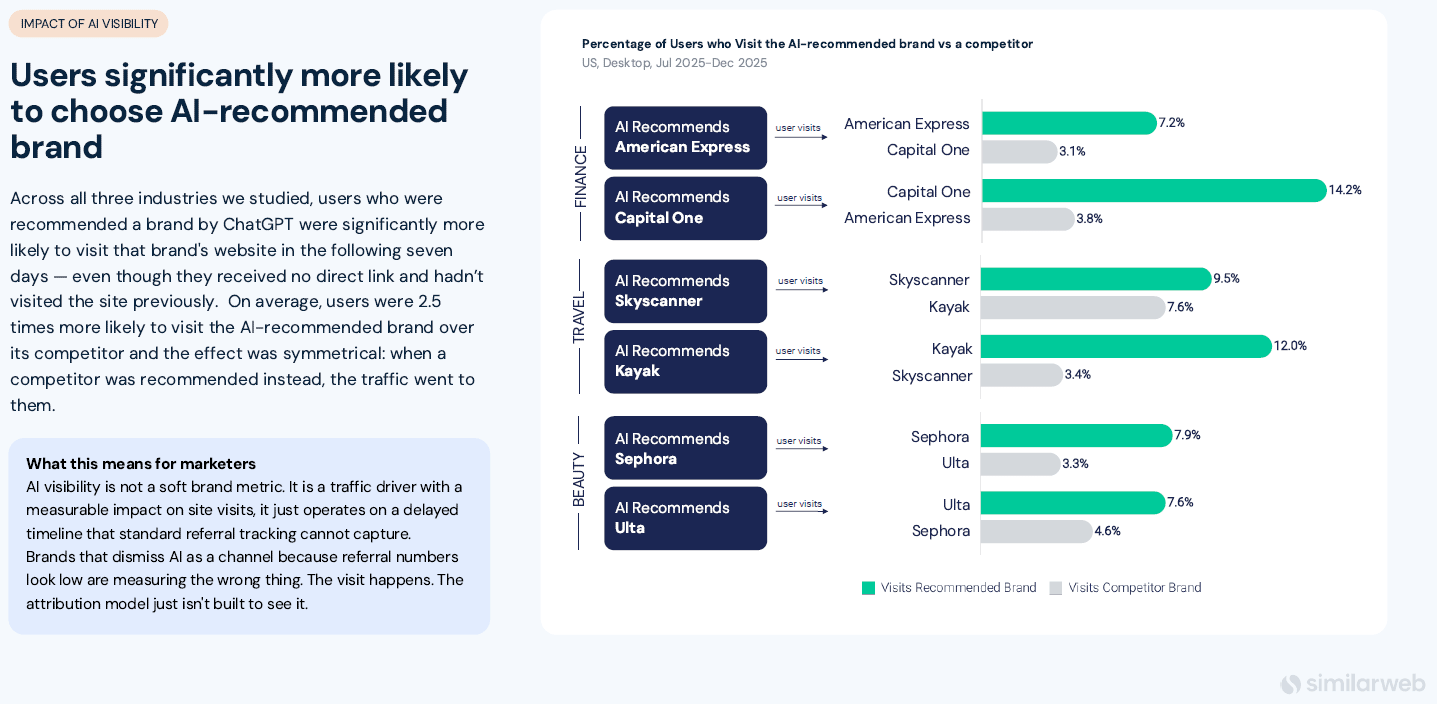
Users recommended a brand by ChatGPT were 2.5 times more likely to visit that brand’s site within seven days than a competitor’s
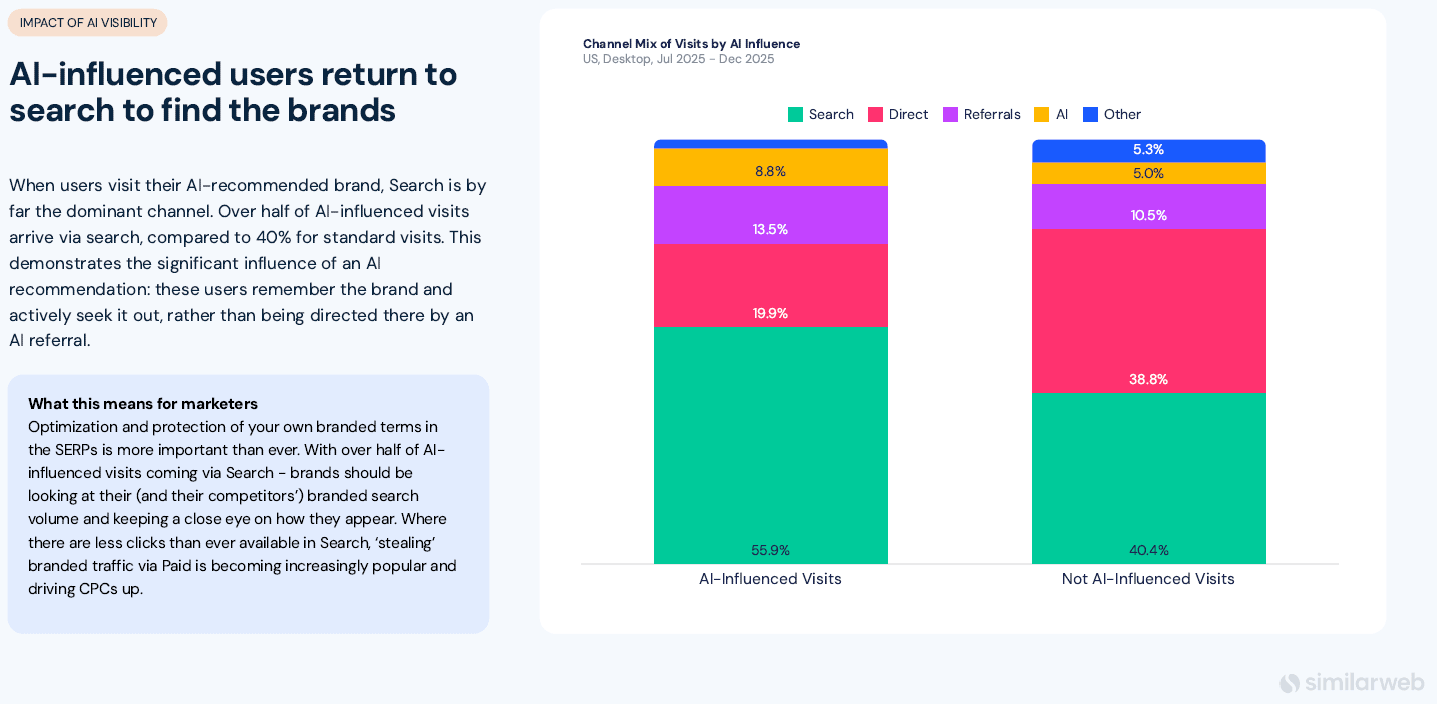
55.9% of those AI-influenced visits arrived through search rather than a direct AI referral
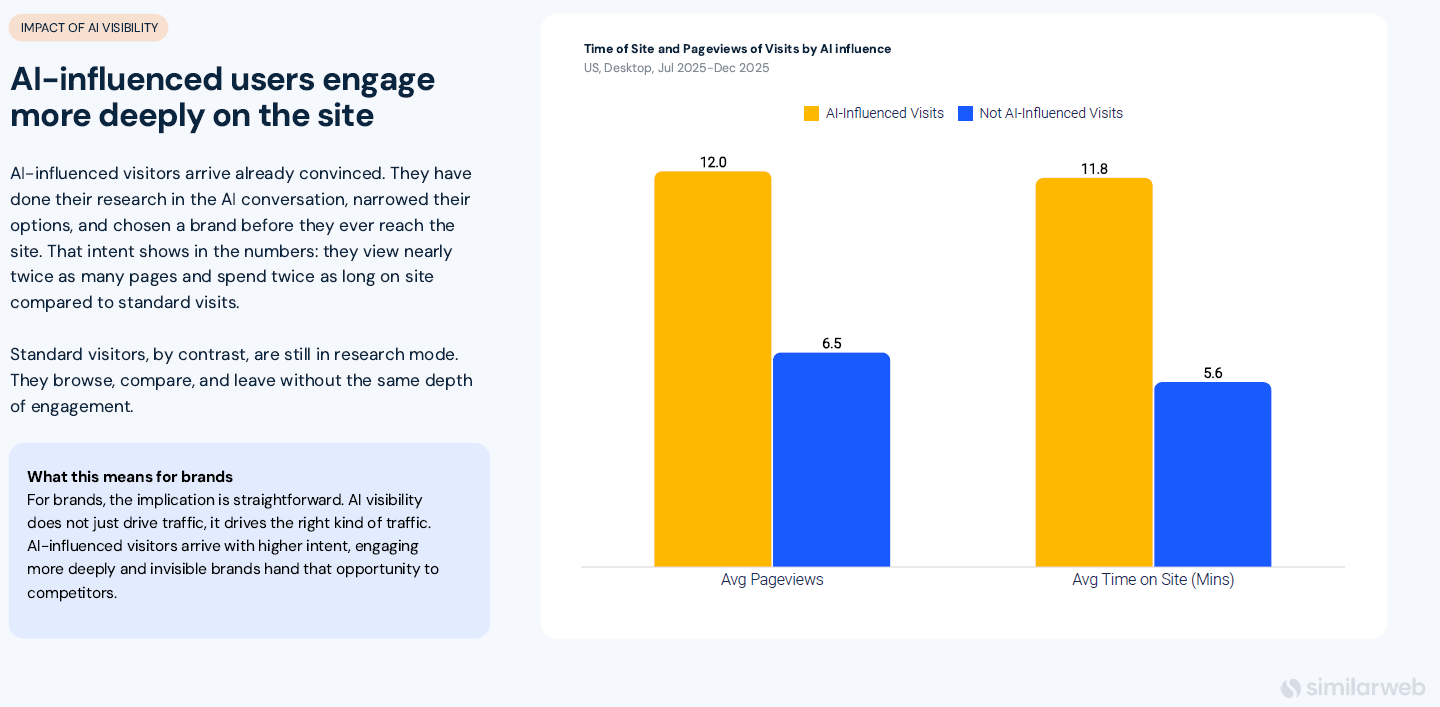
AI-influenced visitors viewed roughly twice as many pages and spent roughly twice as long on a site as visitors who weren’t influenced by an AI recommendation
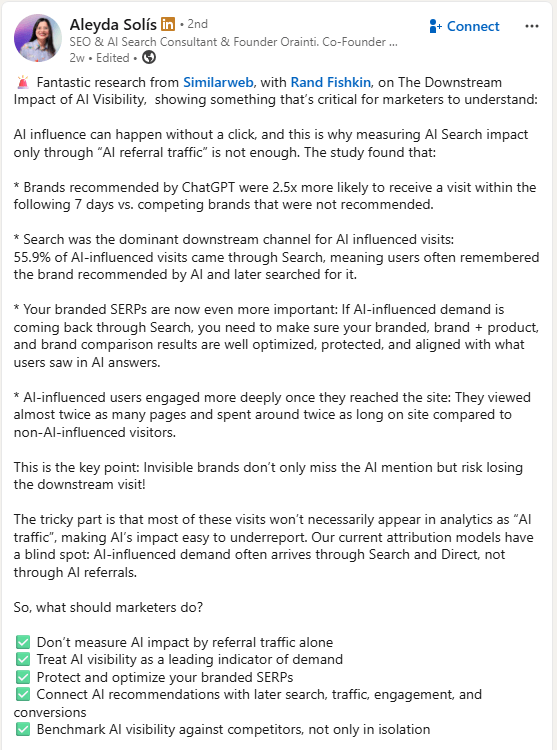
Once those numbers existed, they stopped being ours alone to use, the beginning of what’s sometimes called LLM seeding. SEO consultant Aleyda Solís summarized the findings for her LinkedIn audience, pulling out the 2.5x visit-lift stat and the finding that AI-influenced visits skew toward search rather than referrals.
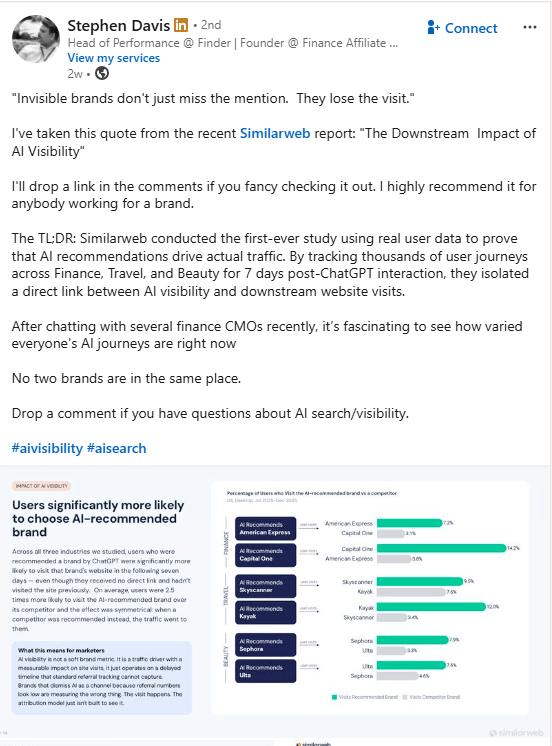
Performance marketer Stephen Davis quoted the report’s own line, “invisible brands don’t just miss the mention, they lose the visit,” and recommended it to his network.
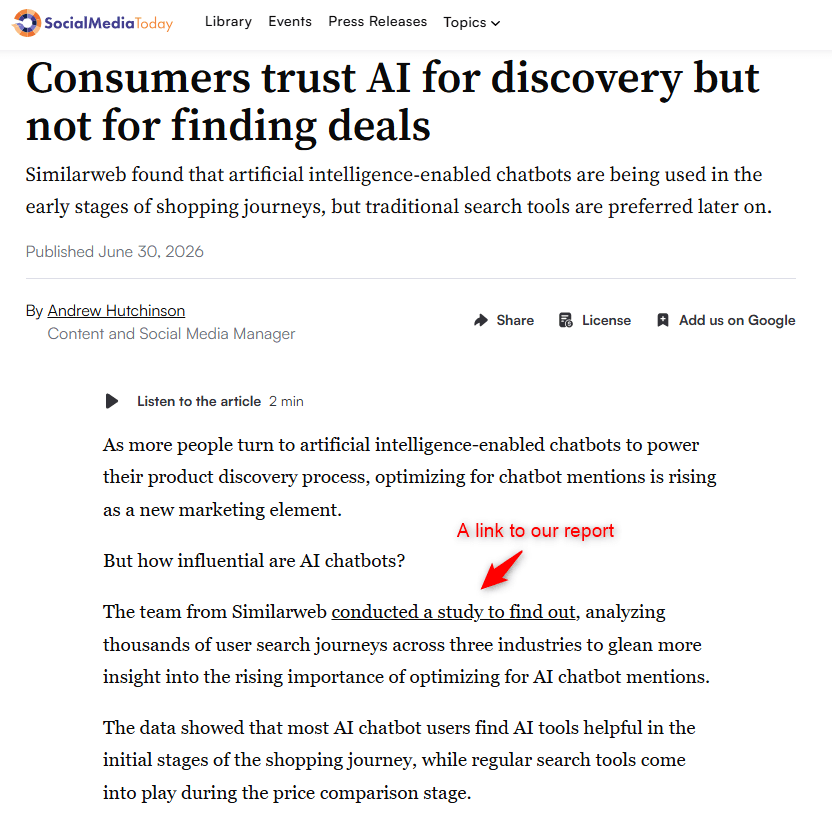
From there, the same data got picked up by trade press. Social Media Today, Search Engine Land, and Search Engine Journal each covered the same dataset in their own words.
To see whether any of this actually turned into AI citations, not just backlinks and social shares, I checked our own AI Brand Visibility tool. Specifically, I looked at the AI Citation Analytics view on one of the campaigns we use to track our own AI visibility across AI-related topics. The Downstream Impact of AI Visibility report showed up as a cited URL across several of the prompts we track, with an influence score of 0.87, close to our highest-scoring pages and well above most other URLs in that same campaign.
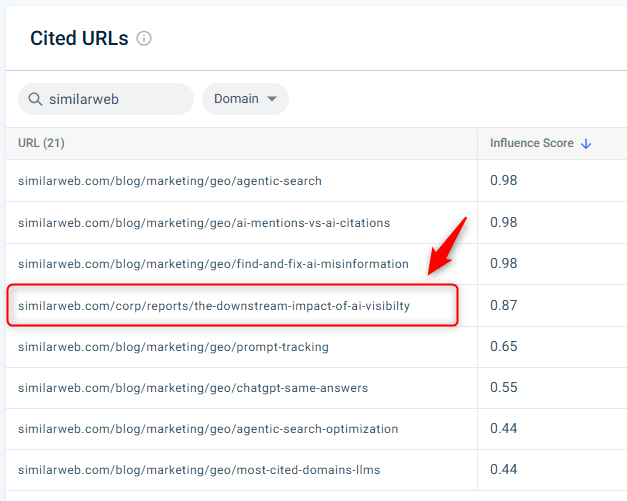
That’s the moat in one paragraph. A proprietary number gets published once. It gets cited by name across LinkedIn and trade publications. Now it sits on half a dozen domains an AI engine already trusts, all pointing back to the same original source, and our own citation tracking shows it actually getting cited inside AI answers, not just mentioned. That’s one report in one campaign, not proof that every dataset repeats this exact pattern, but it’s the clearest example we have of the mechanic working end to end. A generic post about “the importance of AI visibility” would never have started that chain. It’s the numbers that travel.
Publishing a number isn’t the same as making it citable. AI engines extract at the passage level. A statistic buried in paragraph six of a report won’t get pulled out, even if the report itself is strong. To be citable, a data point needs to be structured for extraction, not just present on the page.
Here’s the difference in practice:
| Published but not citable | Structured to be cited |
| “Our research found that AI recommendations have a real impact on traffic.” | “Users were 2.5 times more likely to visit a brand within seven days of a ChatGPT recommendation than a competitor’s, per the Downstream Impact of AI Visibility report.” |
| Statistics appear mid-paragraph, several sentences into a section | Statistics open the section or sit in a table, standing alone |
| No date or sample is attached to the number | Number includes population, time window, and source (“US, Desktop, Jul-Dec 2025”) |
| One mention of the finding, buried in a PDF | The finding repeats in the report, a supporting blog post, and a shareable social summary |
A quick checklist for packaging original data so it earns citations:
A single report is a one-time citation spike. A repeatable moat comes from running the same measurement on a schedule, so your domain becomes the default source for that number every time it updates. We publish a new one every few months, including the 2025 Generative AI Landscape and the 2026 Generative AI Brand Visibility Index, each built around numbers that didn’t exist before we published them.
Start with a metric you already track internally that nobody outside the company has published. It doesn’t need to be dramatic. A conversion rate segmented in a specific way, or a behavior tracked over a fixed window, works fine. Publish it with the source, sample, and date attached, following the checklist above.
Then track whether it actually gets picked up. Our AI citation share metric shows you what percentage of AI answers on a topic cite your domain versus a competitor’s, which is the direct measure of whether your data is functioning as a moat or just sitting on a page.
Re-run the same measurement on a fixed schedule, quarterly or annually, whichever matches how fast the underlying number moves. Each new edition gives AI engines a fresher version of the same citable fact. It also gives journalists and analysts a reason to reference the update, which restarts the citation chain described above.
Original data works as a GEO moat because it gives AI engines something no competitor’s page can supply: a specific, attributable fact. The report covered here shows what that looks like once it’s out in the world: cited by name on LinkedIn, picked up by trade press, and referenced back into our own content long after publication. If you want to see whether your own content is earning that kind of citation or losing it to a competitor, Similarweb’s AI Search Intelligence is the place to start measuring it.
It varies by platform. Engines that crawl in something close to real time, like Perplexity, can surface a new report within days. Engines that rely more on periodic web indexes, like ChatGPT’s search mode, tend to take longer, often several weeks, especially before the earned citations from press and social posts have had time to accumulate.
Gating blocks AI crawlers along with everyone else, so it works against the citation goal described in this article. If lead capture matters more to you than AI visibility for a given report, gating still makes sense. Just know you’re trading citation reach for leads, not getting both.
You can’t fully prevent this, but you can tilt the odds. Repeat your source name and report title in every version you publish (the report itself, the blog recap, the social post) so the instances pointing back to you outnumber the ones that don’t.
It works better for niche topics, if anything. A big, competitive category already has dozens of sources fighting for the same citation. A narrow topic with almost no existing coverage is much easier to dominate with one solid, original number.
A case study proves that an outcome happened for one customer. A data report shows a pattern across many. AI engines treat the second as generalizable evidence they can cite for a broad question, while a single case study is harder to generalize from.
No. Start with a metric you already track internally, something in your product analytics or customer data that nobody outside the company has published. You don’t need a formal panel study to begin, just a real number with a source and date attached.
Senior SEO Specialist
Shai, with 10+ years in SEO, holds a Bachelor’s and an MBA. He enjoys TV shows, anime, movies, music, and cooking.
Give it a try or talk to our insights team — don’t worry, it’s free!