



AI Search Optimization: Tips, Best Practices, and Techniques That Worked in 2026
by Limor Barenholtz18 Min.
Oct 22, 2026

In March 2025, a Microsoft Bing product manager told a conference audience that schema markup helps Microsoft’s LLMs understand content. In May 2026, Google published its first official guide to optimizing for generative AI features and listed “overfocusing on structured data” among the things site owners can ignore. Both statements are accurate. Neither says what most schema pitches claim: that adding markup earns you more AI citations.
So does schema markup help you get cited by AI? The evidence is thin. Schema helps search engines understand your pages, but we have not seen a test showing that this makes AI cite them, least of all for pages AI cannot see yet.
In this article, you will learn which AI platforms read your schema and when, which schema types are still worth adding even without proof of a citation lift, and how to test whether markup moves citations on your own pages.
This index-time versus answer-time split explains why the debate never resolves. One camp says schema matters for AI and points to what search engines do with markup. The other says it does nothing and points to what chatbots do when they read a page. Each is describing a different moment, so each is right.
Microsoft has said schema helps the LLMs behind Copilot, and Google’s guide recommends continued use of structured data for rich result eligibility. The same guide says structured data is not required for generative AI search and that no special schema.org markup exists for it, so this support is for understanding, not a promise of citations. It also covers Google Search’s AI features only, and says nothing about ChatGPT or Claude.
In October 2025, searchVIU tested ChatGPT, Claude, Perplexity, Gemini, and Google AI Mode with a product price placed only in JSON-LD. None of the five systems extracted it. Hidden Microdata and RDFa were ignored too. A chatbot fetching your page live reads the text a visitor would see, not your markup.
Put the two together: schema may help the search index behind an AI product understand your page, but a chatbot that fetches the same page will read only the visible text. Neither moment shows that markup makes AI choose your page as a source.
| Moment | AI system | Read your schema? | Evidence |
| Index time | Microsoft Copilot | Yes | A Microsoft product manager, March 2025 |
| Index time | Google AI Overviews and AI Mode | Not confirmed | Google’s guide says no special markup is needed and recommends structured data for rich results |
| Answer time | ChatGPT, Claude, Perplexity, Gemini | No structured parsing in the test | searchVIU live-fetch test, October 2025 (Google AI Mode was also tested, with the same result) |
Takeaway: Any fact you put in the schema should also appear in visible text. If a price, author, or date lives only in JSON-LD, the live-fetch evidence says chatbots will not see it. So do AI platforms read schema? Only some do, and we have not seen evidence that any of them cite you because of it.
Add Organization with sameAs links, Article with a named author, and Product data where you sell products. We have not found evidence that any schema type earns AI citations, but schema still matters for AI: it states facts that machines can read without guessing. Schema is one small part of AI search optimization, so treat it as a foundation, not a strategy.
Here is why it still matters, even without proof of a citation lift:
The types below state three facts that any answer about a brand depends on: who you are, who wrote a page, and what you sell.
| Schema type | Fact it states | Match it in visible text |
| Organization with sameAs | Who you are, and which profiles are yours | Brand name, description and profile links on your site |
| Article with Person author | Who wrote the page and when | Visible byline, publish date and updated date |
| Product and Offer | What you sell and for how much | The price and availability shown on the page |
| FAQPage | Questions and answers | The visible FAQ section |
Takeaway: Add the few types that state who you are, who wrote the page, and what you sell. They will not buy you citations, but they give machines clear facts to work with. Keep them accurate and match them in visible text.
Since the published evidence is thin, your own pages are the only place to get a real answer. You do not need this test to justify adding Organization or Article markup, which we recommend for clarity. You need it only if you want to know whether markup moves citations on your site.
The test is simple: add schema to a group of pages, keep a matched control group without changes, track the same prompts for four to six weeks, and compare URL-level citations between groups.
Here is how to run it with Similarweb’s AI brand visibility tool:
Open the Prompts view and filter by Latest citation status: Not Cited. This lists the tracked prompts where your brand is not currently cited, along with the domains AI cites instead. Each prompt’s topic points to pages on your site that cover it, and those pages are your uncited candidates. Confirm a page is uncited by searching its URL in the Cited URLs table (see step 4).
Aim for 30 to 50 prompts that map to 10 to 20 test pages and 10 to 20 control pages, matched on topic, traffic, and baseline citations, with the same share of uncited pages in each group. Our guide to choosing which AI prompts are worth tracking helps you pick them, and AI prompt analysis is where you track them across platforms.
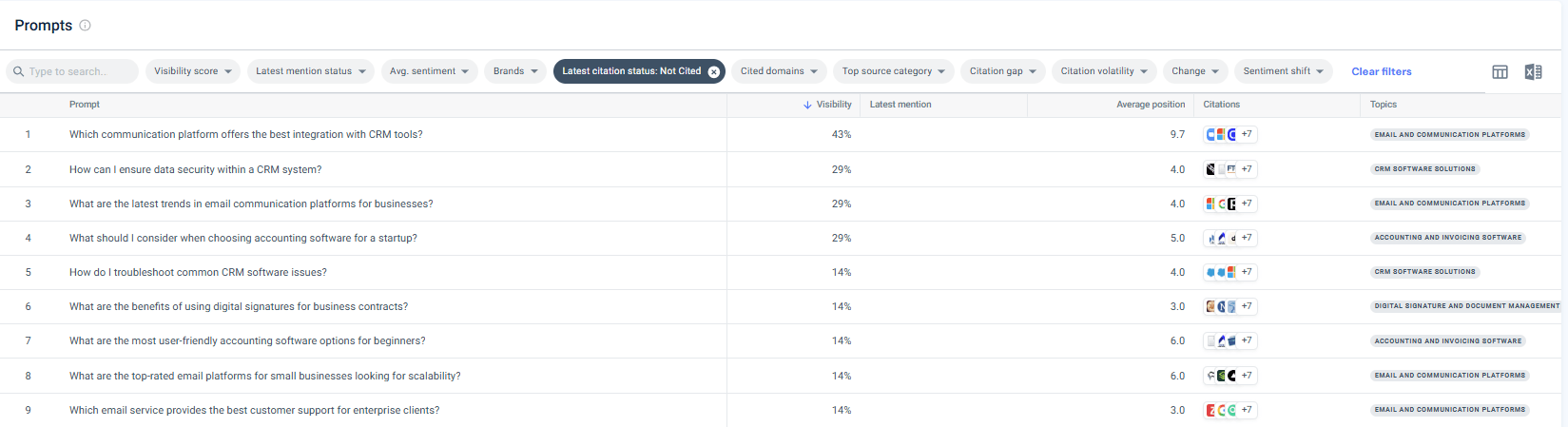
Before you change anything, track every prompt for two weeks. Because answers vary from run to run, judge each prompt by its average visibility and position over the period, not a single run, and export the table so you have a fixed baseline to compare against. Then agree what difference between the test and control groups will count as a win, before you look at any results.
Put the JSON-LD directly in the page’s HTML rather than adding it later with a tag manager, so every crawler receives it. Change nothing else on either group: no edits to copy, links, or titles. Our technical GEO guide covers the wider rendering checklist.
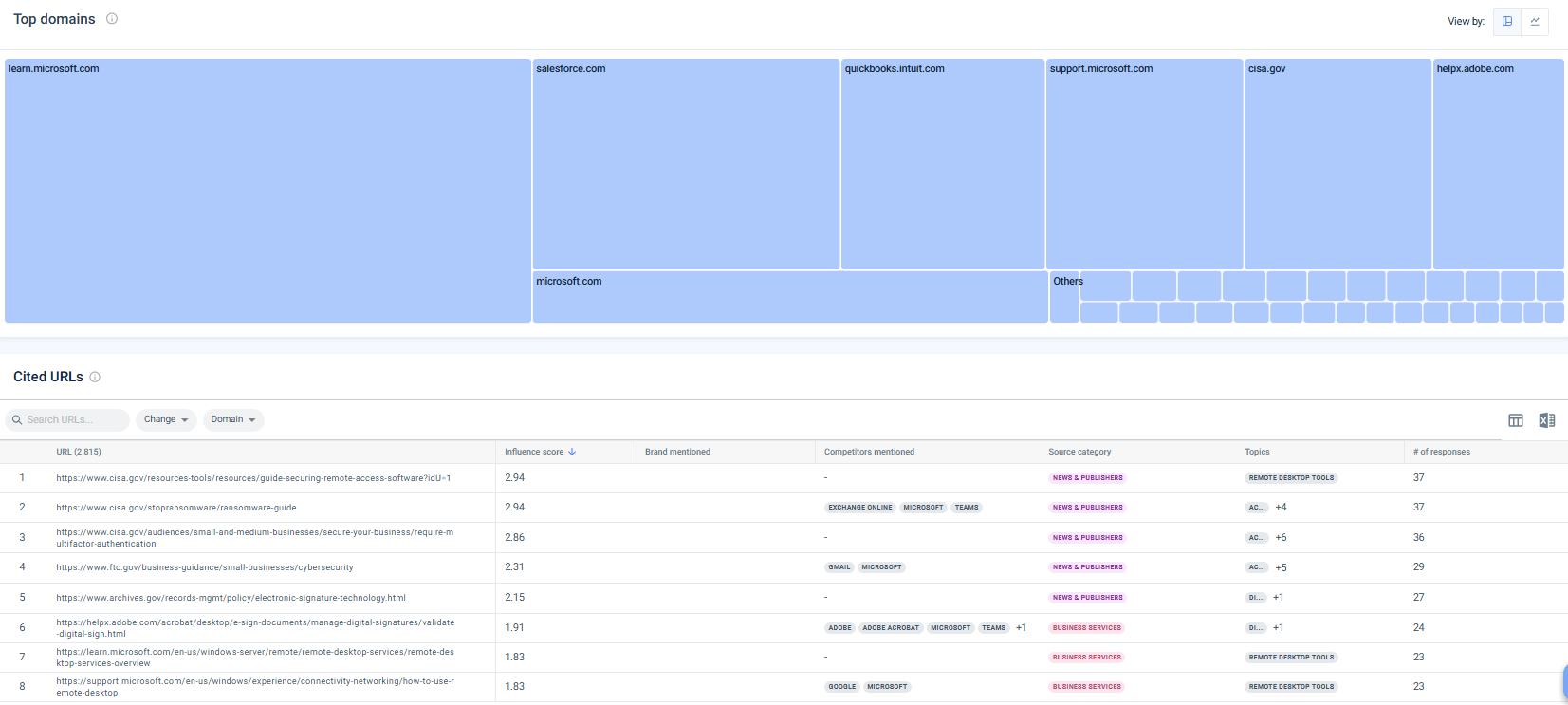
Open the AI citation analysis tool and go to the Cited URLs table. Search each test and control URL to check whether it appears, how many responses cite it, and its influence score. Use the Change filter to compare movement over time, then compare the change in the test group against the change in the control group, measured against the threshold you set in step 2.
The Top domains view above the table shows which domains AI cites most for your topics, so you can see who holds the answers you are trying to earn.
Schema markup for AI search labels what a page is, who wrote it, and what you sell. Microsoft says it helps its LLMs understand content, Google’s guide says no special markup exists for its AI features, and chatbots that fetch your page live read the visible text instead.
We haven’t seen evidence that any platform cites you because of it, but we also haven’t seen a test that rules it out, least of all for pages AI cannot see yet.
That is why the advice has two parts. Add the few types that state who you are, who wrote the page, and what you sell, because clarity is worth having. Then test whether markup moves citations on your own pages, because your data is the only evidence that settles it.
Schema tells machines what your page is. Your content still has to convince them it is worth citing.
No published test shows that it does. In a live-fetch test, ChatGPT didn’t extract a price that existed only in JSON-LD, suggesting it reads visible page content rather than parsing markup when it fetches a page. Microsoft says schema helps its LLMs understand content, but that is a different step from choosing what to cite.
In a live-fetch test, they did not. searchVIU placed a price only in JSON-LD, and none of ChatGPT, Claude, Perplexity, Gemini, or Google AI Mode extracted it. Microsoft says schema helps its LLMs, and Google has not said its AI features use it. Put every important fact in visible text.
No. Google’s May 2026 guide says structured data is not required for generative AI search, and there is no special schema.org markup to add. Google still recommends structured data as part of overall SEO because it supports eligibility for rich results. A page must be indexed and eligible to show a snippet to appear.
Start with Organization with sameAs links and Article with a named author, and add Product markup where you sell products. No type has been shown to earn AI citations, so the value is stating who you are, who wrote a page, and what you sell. Match every fact in visible text, which is what chatbots read.
No. Valid markup that matches your visible content causes no harm, and Microsoft says schema helps its LLMs understand content. Remove only markup that is inaccurate, contradicts the page, or duplicates another block. Audit before you delete, and spend the time you save on original, well-organized content.
Senior SEO Specialist at Similarweb
Maayan is a senior SEO specialist with 7+ years of experience in SEO. She loves complex research projects, creating SEO strategies and performing technical audits.
AI Search Optimization: Tips, Best Practices, and Techniques That Worked in 2026

Dark Funnel Metrics: What to Measure When Buyers Decide Before They Click

What Happens After AI Recommends Your Brand?
Give it a try or talk to our insights team — don’t worry, it’s free!