What is RAG (Retrieval-Augmented Generation)? A Marketer's Guide
by Shai Belinsky9 Min.
Oct 01, 2026
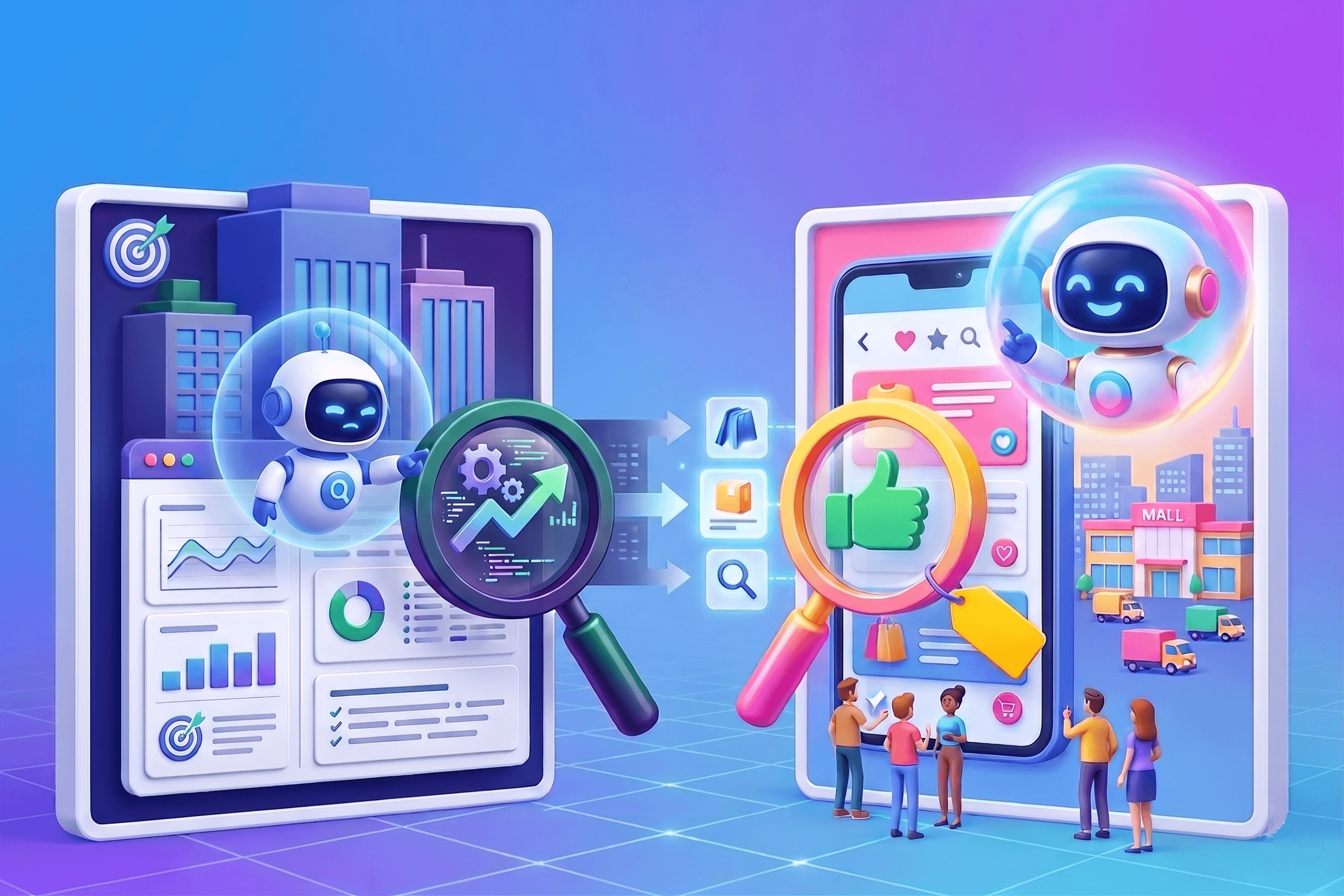
B2B and B2C brands are both investing in AI search visibility, but are they actually optimizing for the same thing?
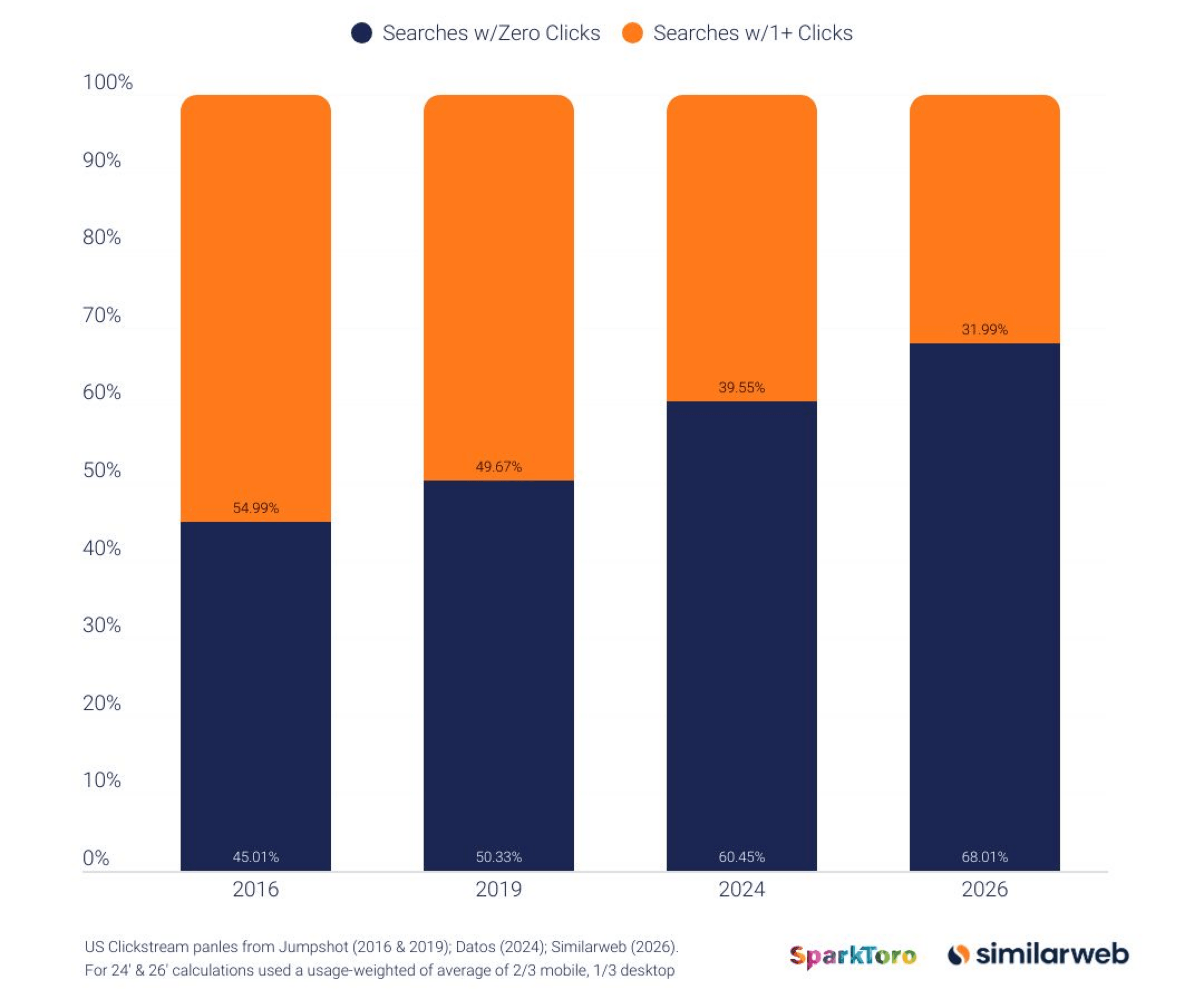
Rand Fishkin’s research using Similarweb’s data found that zero-click rates have reached 68%, with an overall increase of 23 pp since 2016.
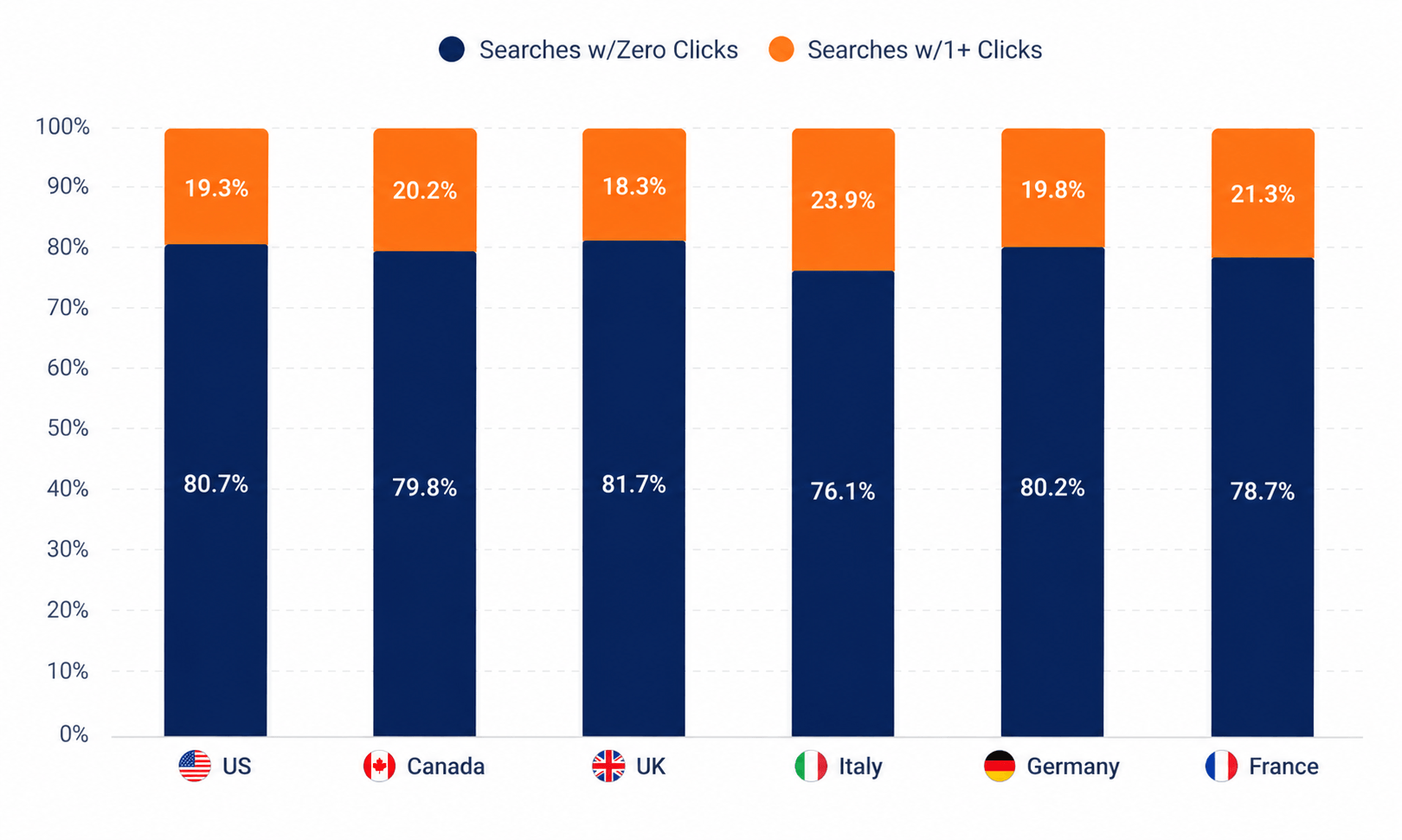
Then, I did a deep dive into the data and found that desktop searches (where enterprise buying decisions are made) result in an external click only 20.4% of the time. For B2B marketers worldwide, the zero-click marketing reality is closer to 80%.
The consideration stage, where your brand is included or excluded from a shortlist, is increasingly taking place in AI chat windows rather than on websites.
That raises a practical question: What does B2B AI visibility actually require compared to B2C AI visibility?
In this article, I break down the strategic differences between B2B and B2C AI visibility, with specific optimization tactics and a measurement framework for each.
Yes and no: the buyers have become more similar, but the decision context hasn’t. A B2B buyer researching software uses the same ChatGPT account they use to plan a vacation. They write long, conversational prompts, embed personal context, and expect synthesized answers. So does a B2C consumer shopping for a mortgage or a medical device. Same tools, same behavior, same expectation.
What hasn’t changed is the context of the decision. B2B purchasing means spending someone else’s money, answering to multiple stakeholders, working within compliance and technical constraints, and making a choice the whole team will live with for years.
That context shapes everything: what goes into the prompt, what a useful answer looks like, and what sources the AI needs to cite to be credible. A B2C consumer buying running shoes is answering for themselves. The decision is personal, fast, and reversible.
Same platform. Very different decision architecture. And that difference is what makes a single AI visibility strategy insufficient for both.
I use B2B and B2C as shorthand throughout this article because they’re useful categories. But the underlying variable is decision complexity, and the frameworks that follow are really about that.
Both B2B and B2C AI search optimization best practices start from the same technical foundation: crawlability, entity clarity, schema markup, and traditional SEO as the entry requirement for LLM retrieval eligibility. None of that changes depending on your audience. What changes is the buyer behavior you’re optimizing for, and that difference starts with query length.
ChatGPT prompts average 60 words. Google searches average 3.4 words. Google AI Mode sits in between at 10.4 words (Similarweb, 2025 Generative AI Landscape report).
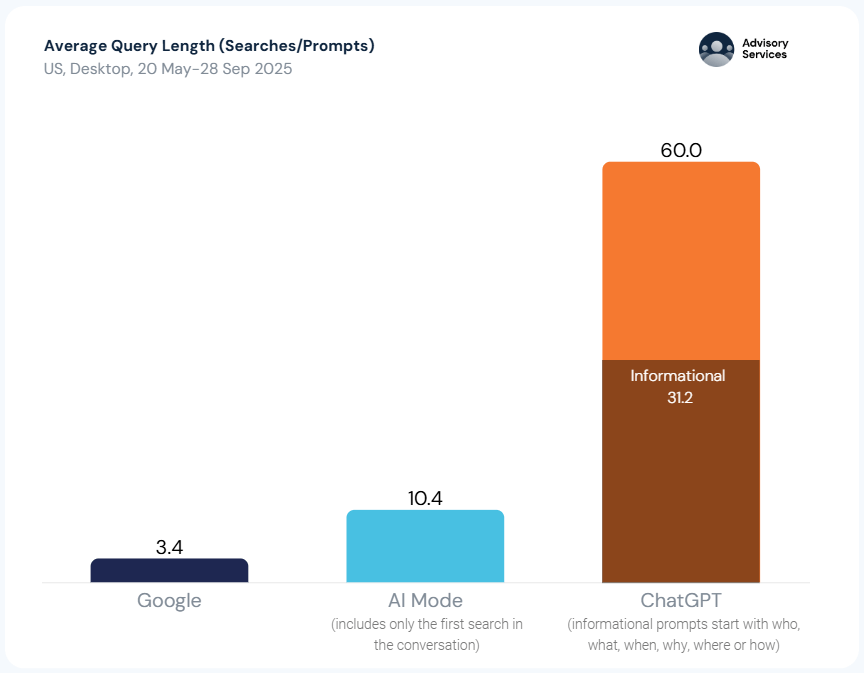
That 17x gap between traditional search and conversational AI already changes the optimization target.
But prompt length alone doesn’t explain the B2B/B2C divergence. Both audiences have become much more verbose in their queries. The difference is what they put in those extra words.
A Stella Rising survey of 524 active LLM users asked respondents to write the actual prompts they would use for an everyday consumer task (January 2026). 60% of prompts were phrased as questions, 80% were six words or longer.
The top patterns:
That last finding is the one I find most useful. A prompt like “which training shoe models are best for people who overpronate during gym cardio segments” is textbook Transactional Discovery: personal context embedded, category open, waiting for a recommendation.
When I look at Nike’s data in the AI prompt tracking tool for this type of query, Nike is cited by three of the four LLMs we track, with positive sentiment.
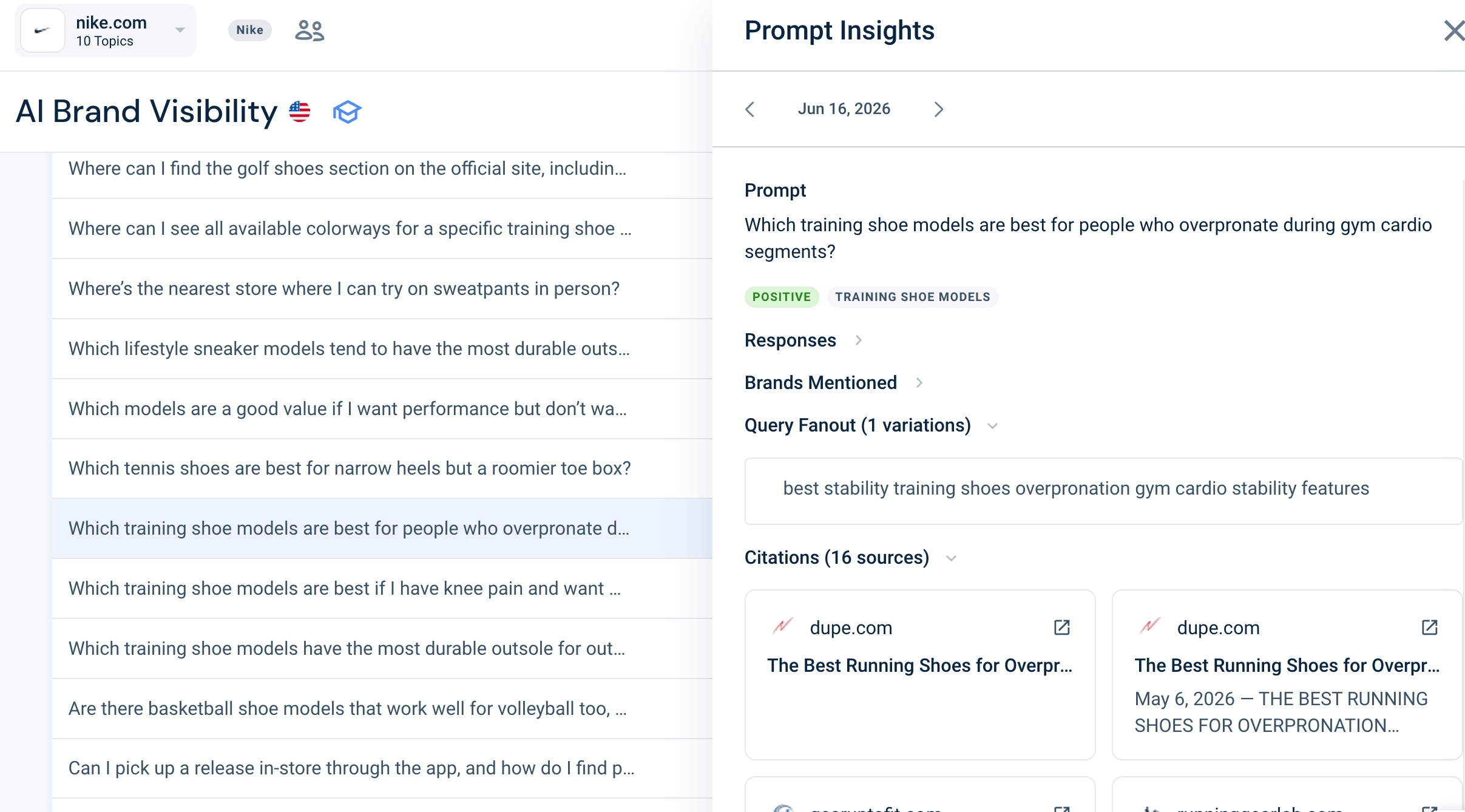
The buyer surfaced their need, and the AI matched a brand to it. That is how B2C AI visibility works at the prompt level.
A representative example from the Stella Rising survey: “Find me 10 new and in style tennis shoes that are comfortable while also being affordable, show me pictures, prices, and the best location to obtain them.” The buyer has stated their evaluation criteria up front and expects the AI to do the synthesis.
A B2B buyer doesn’t ask “What’s the best CRM?” They ask: “What CRM integrates with Snowflake, supports multi-region compliance for EU and US data residency, and can be implemented by a team of two admins in under six months?”
That prompt is a pre-qualification document. The evaluation criteria are embedded in the query itself, not something the buyer discovers through the response. They already know what they need. They’re running vendors through a filter.
The difference shows up clearly in Similarweb AI Search Intelligence data: Monday.com appears in most of the prompts tracked across project management, collaboration, and productivity topics. However, the nature of that visibility varies sharply by prompt intent.
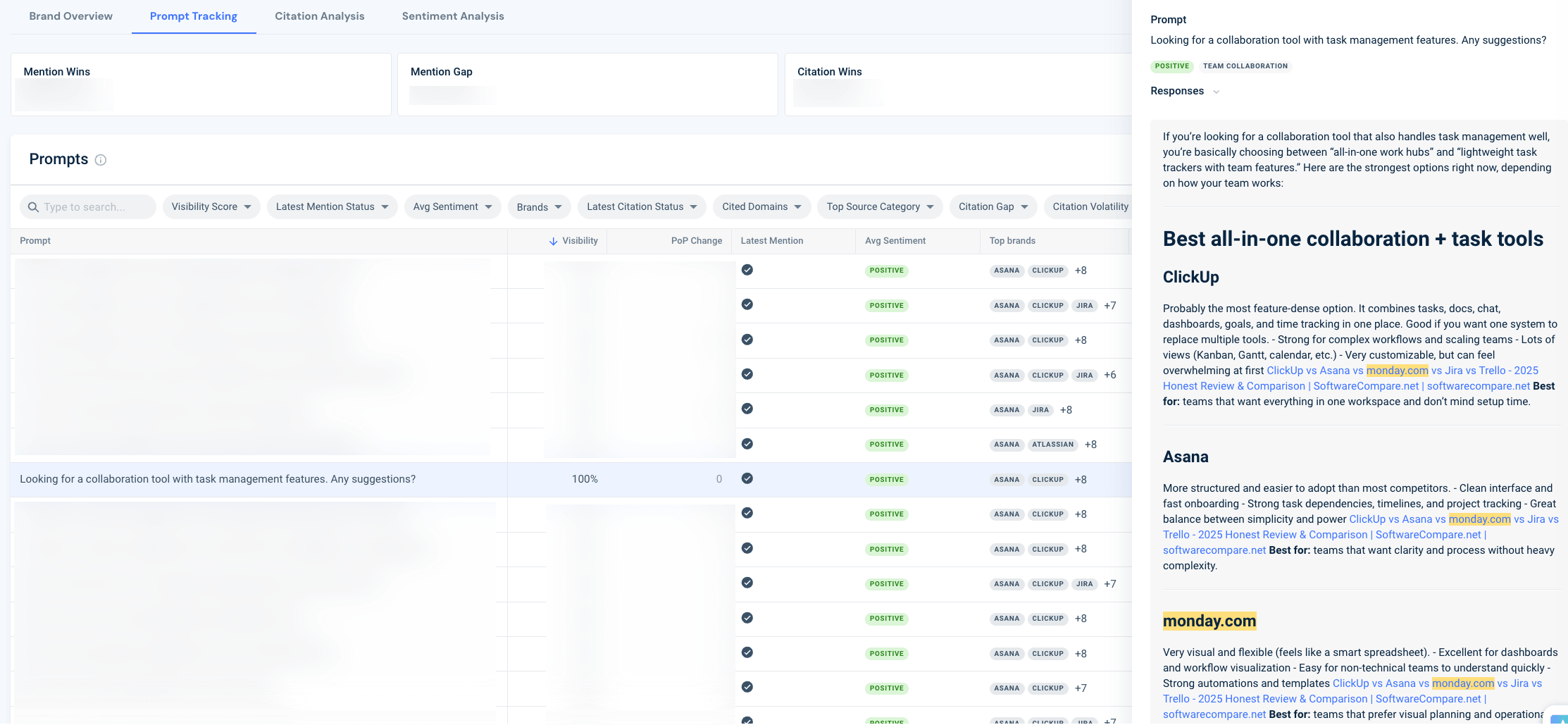
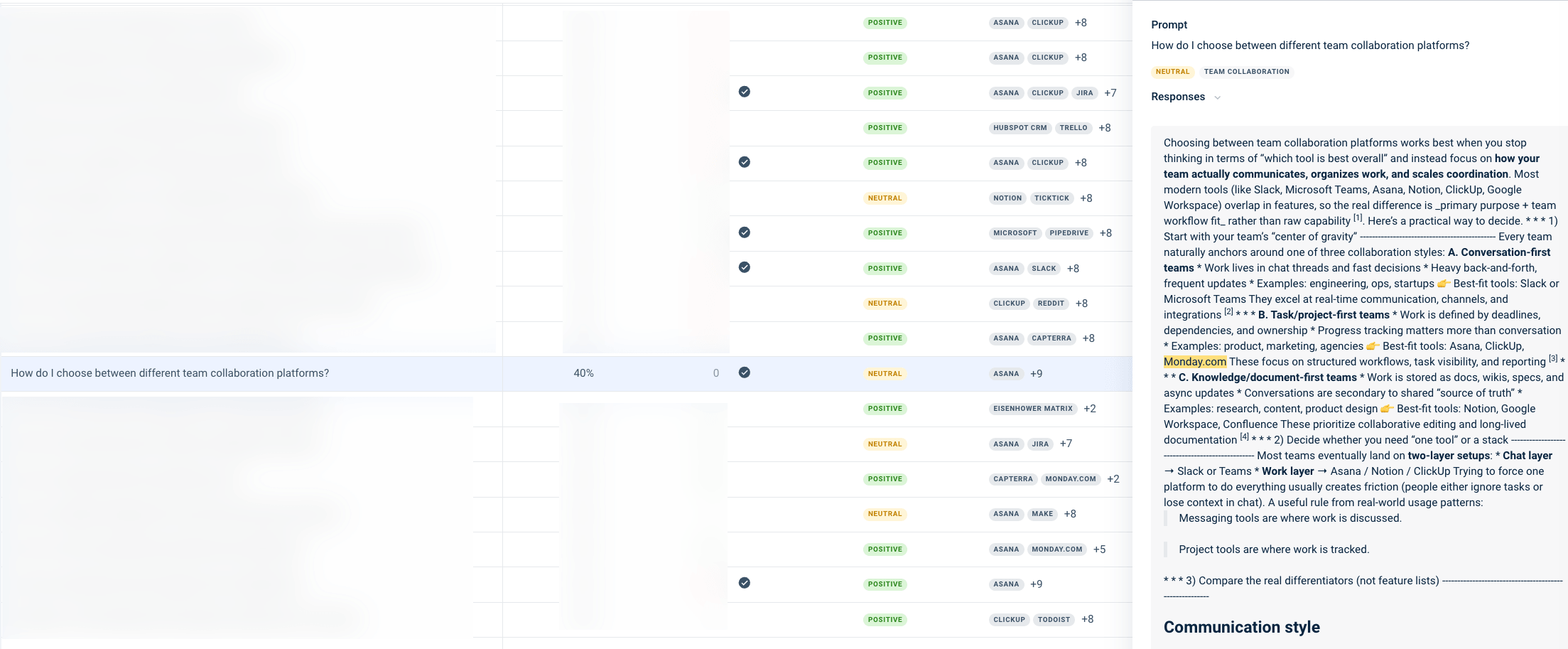
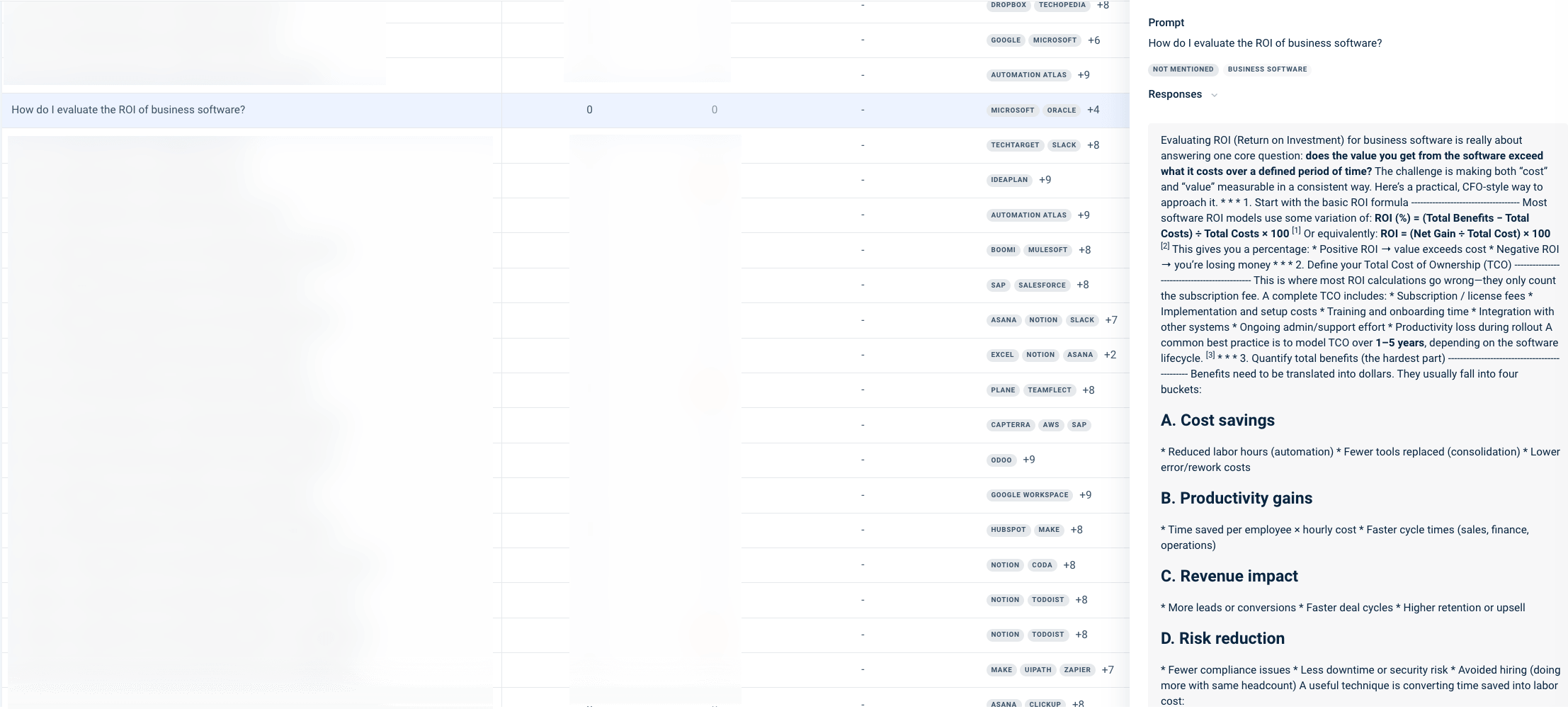
The prompt intent, not just the topic, determines whether a B2B brand gets recommended or merely listed.
The difference comes down to two distinct prompt behaviors I like to call: Transactional Discovery (B2C) and Consideration Architecture (B2B):
This changes how you need to think about content.
AI dominates the purchase journey from the very first stage: According to Similarweb’s 2026 Downstream Impact of AI Visibility report, 35% of users say AI tools are most useful at discovery, compared to 13.6% for search engines, and that lead holds through research, comparison, and evaluation, only narrowing at the final “finding where to buy” step.
For B2B, where the typical buying decision involves 13 internal stakeholders and 9 external influencers, and 51% of software buyers now start their research in AI chatbots, the shortlist is being built in AI before your sales team enters the picture. If you’re not in that conversation, you’re not on the list.
The second thing worth knowing is how to optimize for it. Research by Peec found that over 90% of phrasing variations around the same intent surface similar brand mentions across 37K AI responses.
The optimization unit is the intent cluster, not the keyword variant. You don’t need to cover every phrasing of “best CRM for EU-compliant SaaS.” You need to own the intent cluster around compliance-aware CRM evaluation. That cluster has entirely different content requirements than a generic “best CRM” query.
Owning a cluster means being the brand AI engines consistently associate with that specific problem. Different buyers will phrase it differently, but they’re asking the same underlying question. If your content answers it thoroughly and specifically, AI engines learn to surface you for all of them. You don’t need a separate page for each phrasing. You need one authoritative answer.
That’s the B2B prompt picture. The B2C side looks different, and understanding where B2C brands win in AI visibility tells us a lot about what B2B brands are up against
Similarweb’s 2026 AI Brand Visibility Index tracked brand citation patterns across six consumer-facing sectors: Finance, Travel, Consumer Electronics, Beauty, Fashion, and News. I found that three patterns showed up consistently across all of them.
AI visibility isn’t evenly distributed across a category. A small group of brands accounts for most mentions, while everyone else is largely absent from the conversation. In Consumer Electronics, Apple scores 100 on the Brand Visibility Index while Samsung sits at 24, a 76-point gap between first and second place, with the gap from first to tenth reaching 94 points. In Finance, Chase leads at 100, with Bank of America tenth at 40.
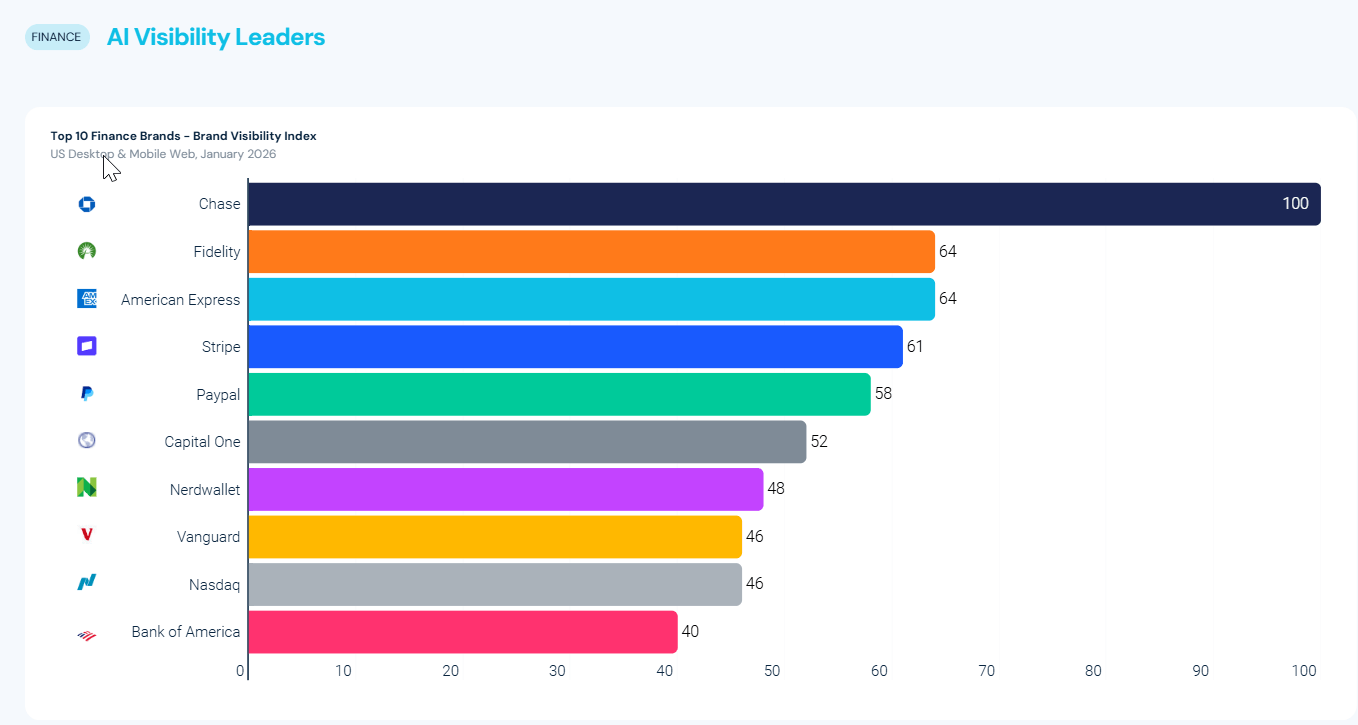
Getting into the top tier matters far more than marginal improvements within it.
Strong brand recognition doesn’t guarantee stable AI visibility. In Travel, Airbnb and TripAdvisor are trending flat or declining in AI mentions despite strong consumer recognition, while Expedia leads at 100, and Delta sits at 88. 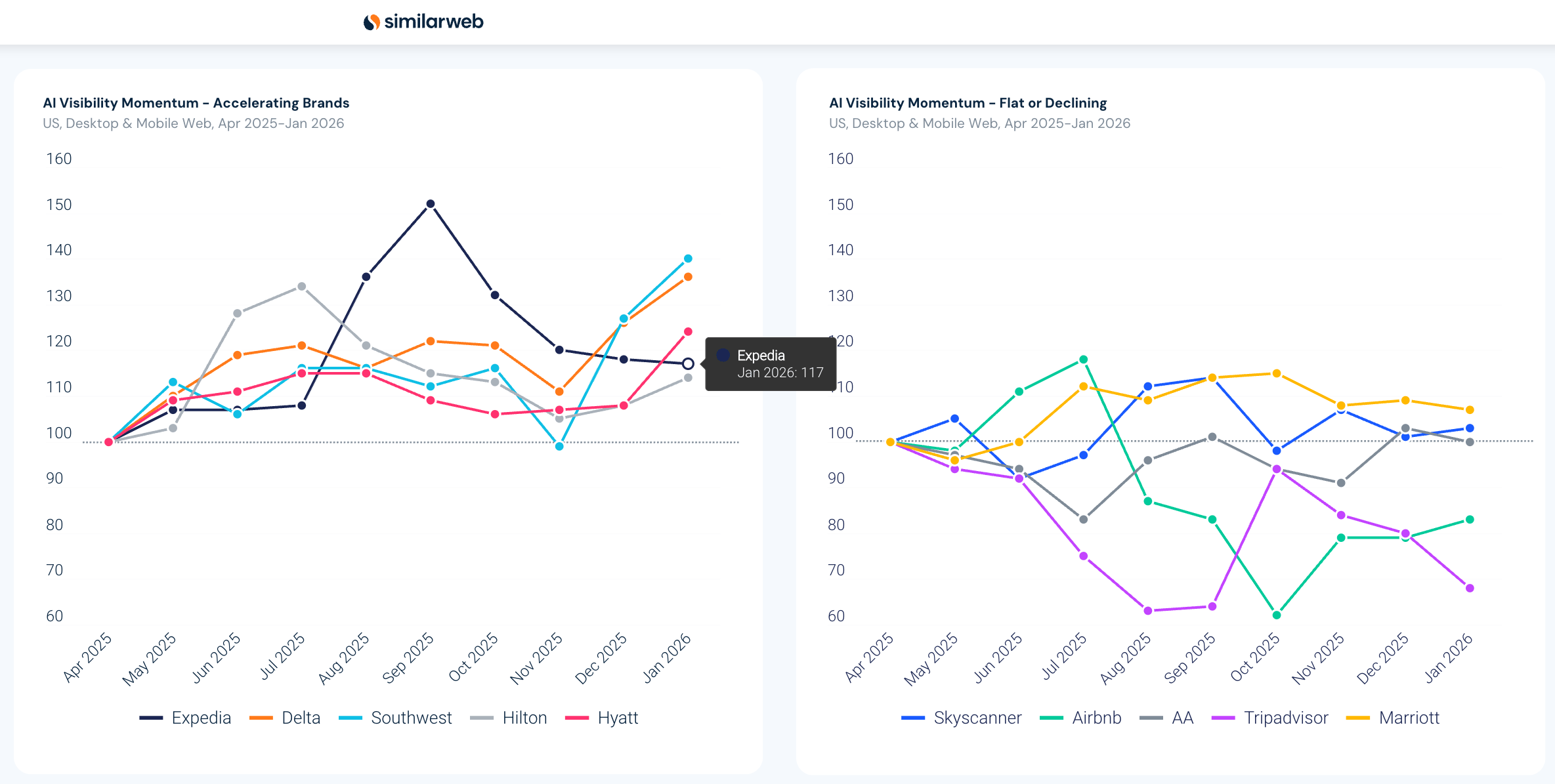
Visibility can shift faster than with traditional SERP ranking, and with less obvious cause. What worked six months ago may not be working now. Watch your visibility momentum, not only your visibility score.
This one I find most interesting. In every sector, the brands that most outperform their branded search demand in AI visibility share one characteristic: they produce structured, reference-led, or education-first content. They are not the biggest brands in their category, but they consistently get mentioned above better-known, better-funded brands.
Travelmath, for example, consistently surfaces alongside Expedia in Travel despite a fraction of the brand recognition.
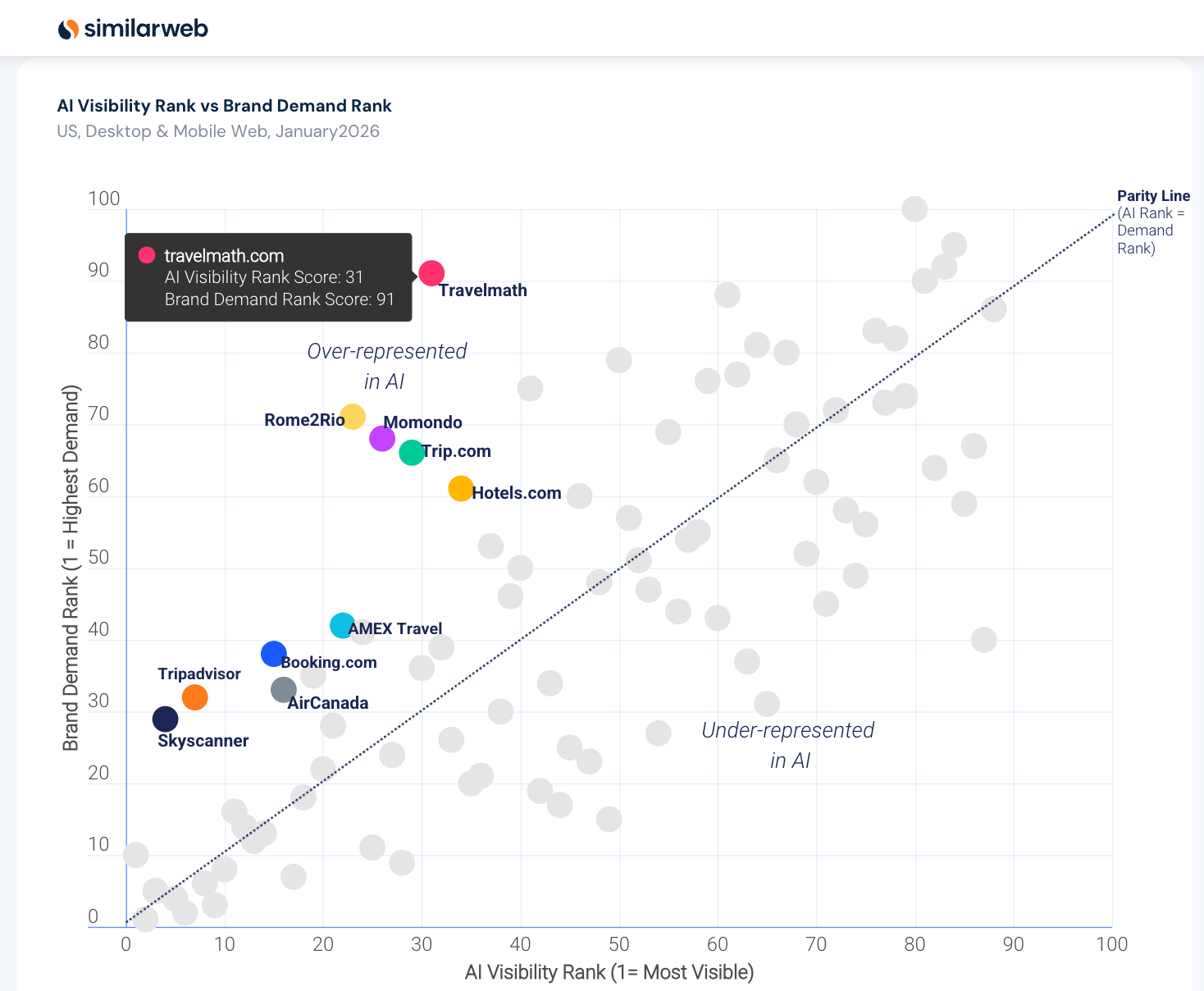
AI engines don’t reward size. They reward content that makes synthesis easy.
The pattern is consistent across sectors: the brands AI cites most are the ones that explain things clearly, structure their content well, and give the AI something concrete to work with. Generic brand content, the kind that describes what a company does without actually teaching the reader anything, rarely makes it into AI answers.
The B2C overachiever model works because B2C AI queries are exploratory. The buyer wants the AI to synthesize a category and surface options. Brands that provide structured, trustworthy category content get cited because they make the AI’s job easier.
B2B overachievers look different. When a buyer’s prompt is a vendor evaluation spec, the sources that get cited aren’t skincare ingredient explainers or destination guides. They’re vendor comparison platforms, analyst reports, peer review aggregators, and technical documentation. The citation pool is structurally different.
The citation source data from both campaigns tells the story directly.
Looking at Nike’s AI citation pool (B2C), the dominant sources are E-commerce Brands at 37.3% and News and Publishers at 24.4%, covering product pages, retailers, and editorial media. Reviews and UGC account for 15.9%. Business Services, the category covering analyst content, software comparison platforms, and integration documentation, accounts for just 7.9%.
For Monday.com (B2B), the picture inverts: Business Services dominates at 52.6%, while E-commerce Brands drop to 3.8%. Same AI engine, same measurement period, completely different source ecosystem.
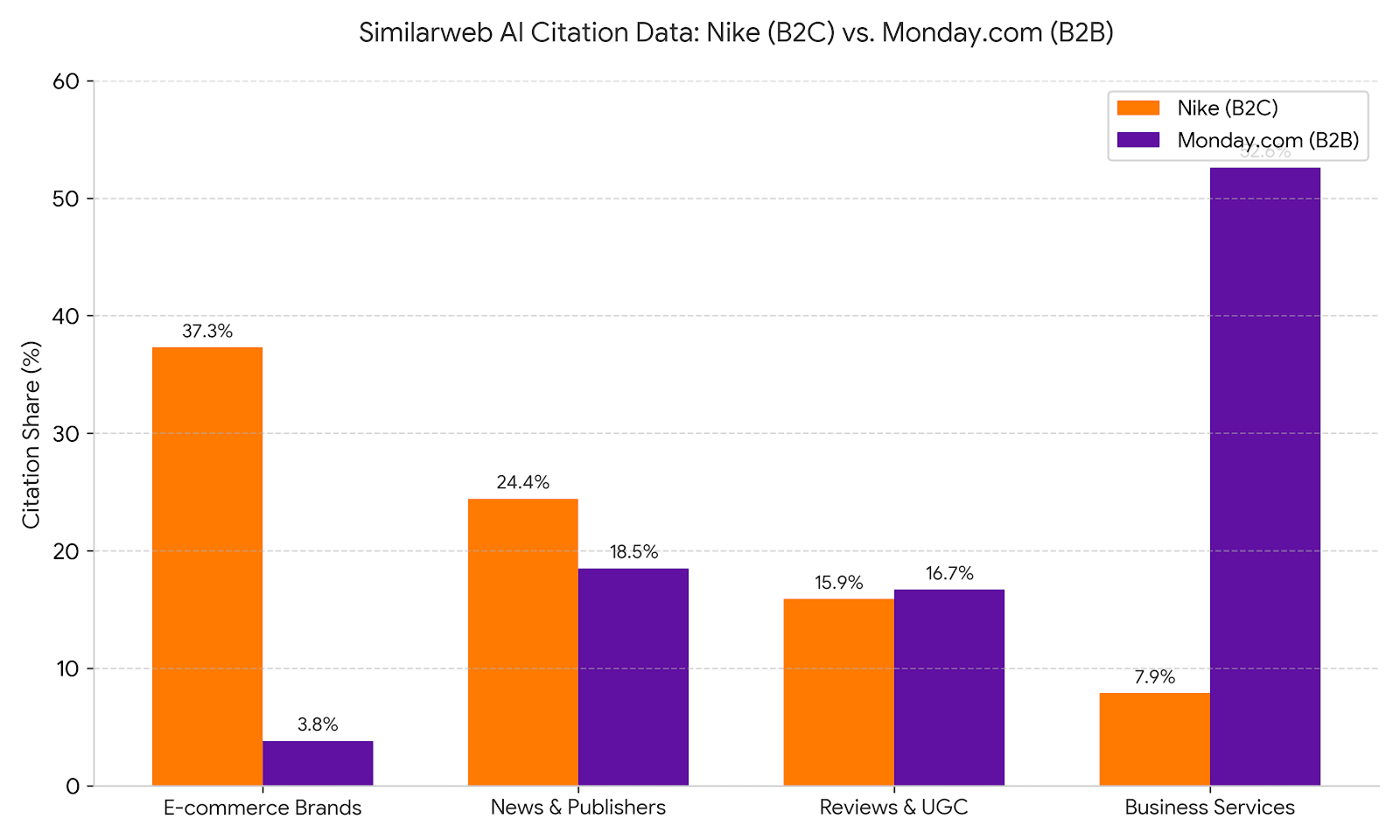
If you’re optimizing for the wrong citation pool, you’re building visibility in a place your buyer’s AI engine isn’t looking.
B2B AI visibility optimization and B2C AI visibility optimization share the same SEO foundation but split at three layers: citation source strategy, content architecture, and the prompt types you’re structuring content to answer.
Here is how those differences map out:
| Dimension | B2C AI visibility | B2B AI visibility |
| Prompt type | Discovery queries: “best,” “affordable,” “for sensitive skin” | Evaluation queries: “integrates with X,” “supports compliance Y,” “implementation timeline” |
| Prompt framework | Transactional Discovery: criteria emerge from response | Consideration Architecture: criteria embedded in the prompt |
| Primary citation pool | E-commerce Brands (37.3%), News & Publishers (24.4%), Reviews & UGC (15.9%) | Business Services (52.6%), News & Publishers (18.5%), Reviews & UGC (16.7%) |
| Content that earns citations | Education-led explainers, editorial “best of,” ingredient/category depth | Technical documentation, vendor comparison, ROI frameworks, integration guides |
| Platform priority | ChatGPT, Google AI Mode, Google AI Overviews | Perplexity (strong for research queries), ChatGPT, Gemini |
| Journey stage tracked | Awareness, consideration, purchase | Awareness, consideration, brand evaluation (skip purchase stage) |
| Success metric | Citation frequency, share of voice in category queries | Citation quality, positioning accuracy, sentiment in evaluation context |
| Overachiever type | Reference/education platforms (NerdWallet, Travelmath, eCosmetics) | Vendor comparison and analyst platforms (G2-style, review aggregators) |
Since 90%+ of prompt phrasing variations produce similar brand mentions, you don’t need to optimize for every way someone might phrase “best CRM for compliance.” You need to own the intent cluster around compliance-aware CRM evaluation. That means creating content that explicitly addresses the technical, regulatory, and implementation criteria your buyers embed in their prompts. The cluster, not the wording, is the unit.
The Monday.com data already shows this in practice: the brand performs on direct-need and evaluation queries, and disappears on generic process questions entirely. B2B brands don’t get purchased through AI chat sessions. They get shortlisted there.
That means prompt tracking coverage should concentrate at the consideration stage, where unbranded, commercial discovery queries determine which vendors make the short list. Peec AI’s analysis of 37,804 AI responses found that middle-of-funnel prompts are where wording variation actually decides winners. TOFU and BOFU queries are relatively stable regardless of phrasing.
For B2B brands, that means MOFU is where content and prompt optimization actually move the needle. Unbranded commercial queries are where small differences in how your brand is covered determine whether you make the short list or not
Statistics and specifics improve LLM citation rates by 30-40%, according to Princeton research. For B2B, this means pricing transparency, integration specifications, implementation timelines, and security compliance documentation. “We’re a leader in CRM” is invisible to AI. “Supports SOC 2 Type II, ISO 27001, and GDPR Article 28 compliance with single-tenant deployment options” is a structured, extractable claim that answers the spec a buyer put in their prompt.
The Monday.com data illustrates both sides of this. On direct need prompts like “what are the best tools for managing complex projects with remote teams,” Monday.com is cited positively in a short list. On generic category prompts, it is listed neutrally among ten or more brands.
The difference is content specificity: structured, specific content earns a recommendation; generic presence earns a listing.
The B2B citation pool is different from the B2C one: analyst platforms, integration documentation, peer review aggregators, and technical publications in your vertical. Every piece of third-party coverage in a trusted B2B source is a potential citation node.
This is the off-site component of B2B AI visibility: not Reddit threads, but industry analyst write-ups, integration partner documentation, and verified review platforms.
Perplexity’s research-mode interface is disproportionately used for multi-source vendor evaluation. B2B buyers conducting serious research often layer prompts and follow up with citation verification. Perplexity’s source transparency makes it a high-stakes surface for B2B brand positioning in a way it simply isn’t for most consumer categories.
The brands that consistently outperform their category in AI visibility are the ones that explain things clearly and give AI engines something concrete to synthesize. That means ingredient explainers, comparison frameworks, “best for” guides with explicit criteria, and editorial “what to consider” content, not generic brand pages.
Structured product attribute content that maps cleanly onto what a buyer asked gets cited. Vague brand content doesn’t.
25% of real B2C LLM prompts include the word “best” (Stella Rising, January 2026). That’s the single highest-frequency intent signal in consumer AI search. If your brand isn’t appearing in “best [category]” AI responses, you’re missing the most common entry point into B2C discovery sessions. This is not optional coverage.
Optimize for personal-context prompts. 32% of B2C prompts include personal attributes: size, health conditions, lifestyle, job type, and skin type. The buyer provides their context and expects the AI to do the matching. Content that explicitly addresses specific user scenarios (“for sensitive skin,” “for wide feet,” “for someone who commutes daily”) gets matched to those prompts. Generic category content doesn’t.
The implication is straightforward. B2C visibility is built across e-commerce, editorial, and consumer review ecosystems. B2B visibility is built in analyst content, integration documentation, and peer review platforms. Optimizing for the wrong ecosystem means building presence in a place your buyer’s AI engine isn’t looking.
Concise, list-style prompts surface up to 20% more brands than open-ended prompts. The content implication: structured, scannable content with clear lists, labeled comparisons, and extractable criteria outperforms dense prose in AI citation pools.
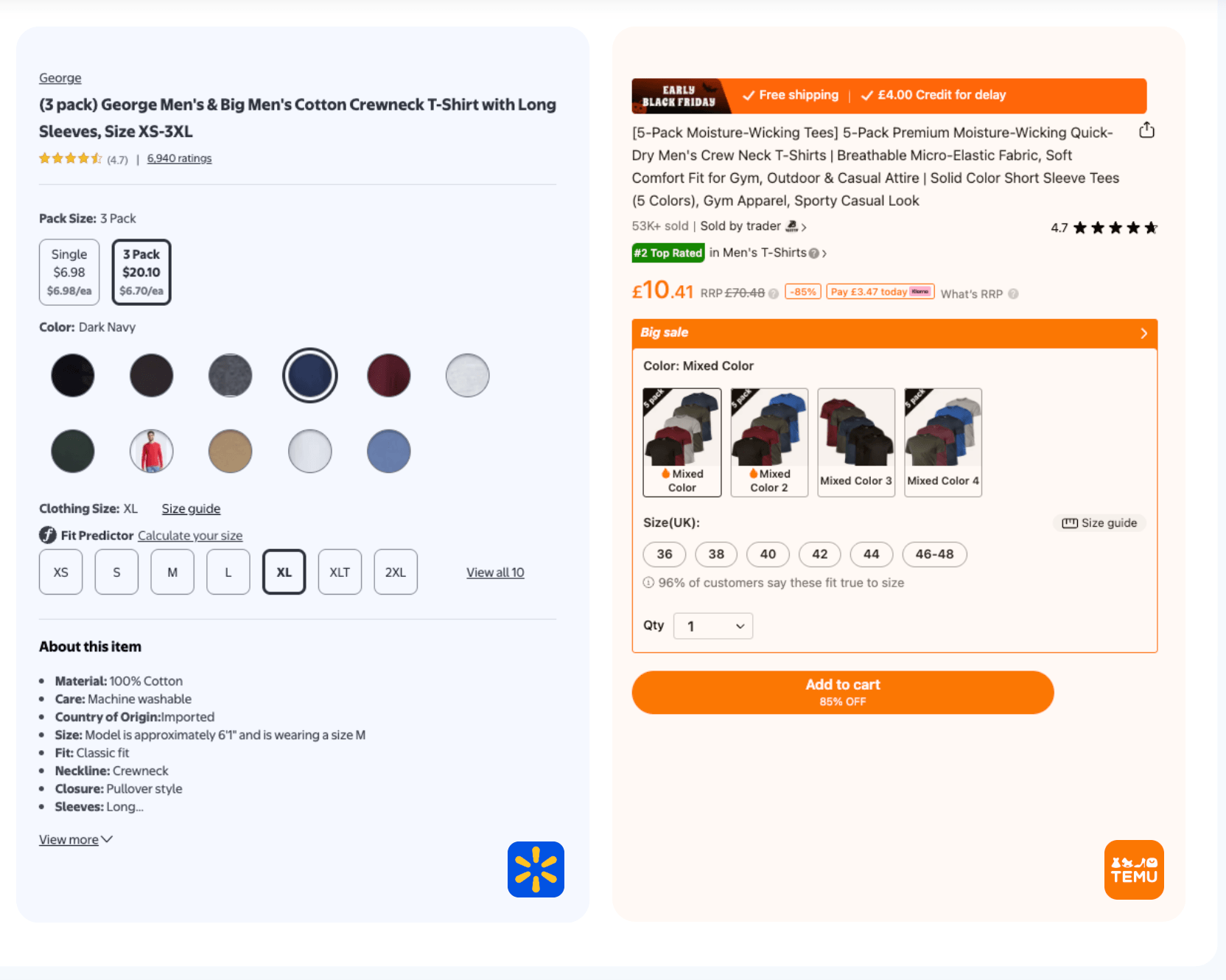
The Walmart vs. Temu PDP comparison in the 2025 Generative AI Landscape report makes the same point: Walmart’s structured “About this item” attribute lists got cited, Temu’s keyword-stuffed titles didn’t.
Neither framework works without the SEO baseline. LLMs retrieve content through the same web infrastructure as search crawlers. Pages that aren’t crawlable, indexed, and ranking for relevant queries aren’t in the retrieval pool, regardless of how well-optimized they are for AI citation.
Traditional SEO is the entry ticket. What I’m describing here is what you do once you’re inside.
Both models also benefit from relevant schema markup, clear entity signals, and explicit definitions. LLMs favor content that defines its own terms rather than assuming shared context. If your page doesn’t say what you do, who you do it for, and what makes you distinct, the AI has nothing to extract. The right AEO tools make both the technical and content layers measurable across platforms.
Measuring B2C AI visibility is fairly straightforward: track citation frequency across product-query clusters, monitor AI share of voice relative to category competitors, and analyze sentiment signals for brand positioning drift.
B2B AI visibility measurement requires one more layer: not just whether the AI mentions your brand, but whether it positions you correctly within a multi-stakeholder evaluation context. A B2B brand cited as “a good option for small teams” in a prompt about enterprise compliance is not a win. The citation is there. The positioning is wrong.
Here is how I think about the six metrics that matter for both models, with different weights depending on context:
| Metric | B2C weight | B2B weight | What to watch |
| Visibility (% of relevant prompts where brand appears) | High | High | Foundation metric: Are you in the conversation? |
| Share of voice (your mentions vs. competitors’) | High | High | Competitive benchmark |
| Domain influence (how often cited as a source) | Medium | High | B2B: Are authoritative sources carrying your brand? |
| Sentiment (positive/neutral/negative positioning) | Medium | Critical | B2B: are you positioned correctly in the evaluation context? |
| Top competitors (who else appears in your prompts) | Medium | High | B2B: Who is the AI shortlisting alongside you? |
| Brand strength (sentiment vs. competitors) | Medium | High | B2B: When you’re mentioned, does the positioning win the comparison? |
The difference in sentiment weighting matters in practice. In the Nike shoe data, nearly every citation carries positive sentiment: the AI is recommending the brand to match a buyer’s stated need.
In the Monday.com data, sentiment splits by prompt type: positive for direct-need queries, neutral for generic category comparisons. The same brand, the same platform, two different signals depending on what the buyer asked.
Same metric, very different signal. For B2B, neutral sentiment at the evaluation stage is a strategic problem that can point to AI misinformation issues, not a visibility win.
The engagement data reinforces why getting this right matters. Visitors referred from ChatGPT to transactional sites spend an average of 15 minutes on the site and convert at 7%, compared to 8 minutes and 5% from Google referrals.
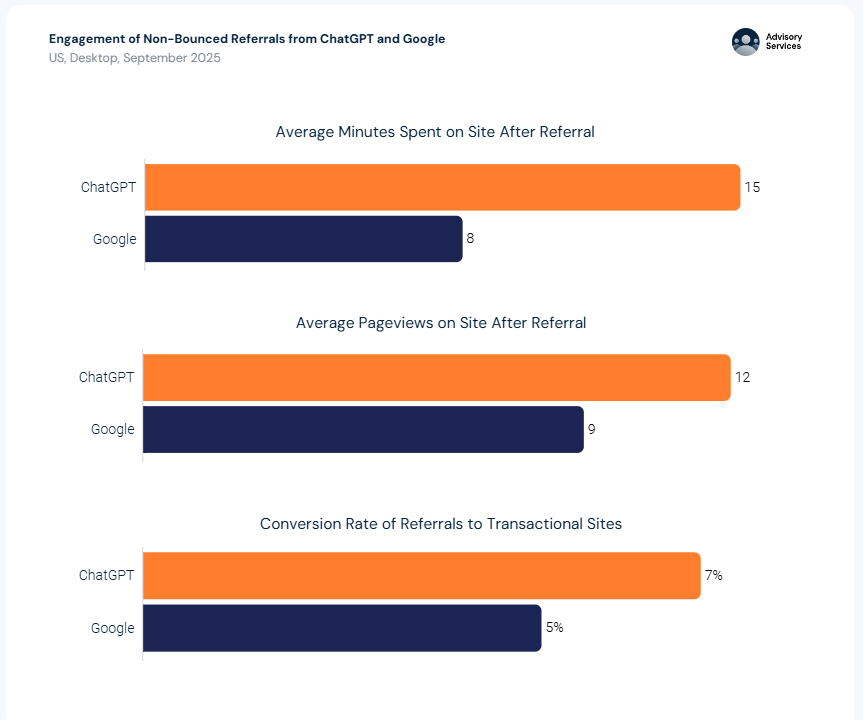
For B2B, where a single converted visitor can represent significant contract value, the ROI on AI search optimization is real. Positioning accuracy matters.
Similarweb’s AI Search Intelligence tracks all six metrics mentioned above across major AI engines. For B2B SEO teams, the prompt-level data, specifically which queries trigger brand mentions and which produce omissions, is where the strategic signal lives. For B2C SEO teams, AI share-of-voice trends and sentiment distribution tell you where the editorial and UGC narrative is ahead of or behind your owned content.
This five-step audit identifies which framework applies to your brand and where your current AI visibility gaps are, before you spend time optimizing for the wrong buyer type.
AI visibility audit: framework selector
Write 10 prompts a real buyer would use when researching your product. Score each:
If 7+ prompts are evaluation-type: use the B2B framework.
If 7+ prompts are discovery-type: use the B2C framework.
If mixed: your product has both buyer types. Build two separate prompt sets and run both frameworks.
Run your top 5 prompts in ChatGPT and Perplexity. For each cited source, categorize it:
For each prompt where you appear, is the positioning accurate for your target buyer’s evaluation criteria? For each prompt where you don’t appear: which competitor does, and what content type earned their citation?
Group your prompts into 3-5 intent clusters. Each cluster should represent a distinct buyer concern or evaluation criterion. Assign a content priority to each: do you have existing content that addresses it? Is it structured for AI extraction?
Track your starting Visibility score and AI Share of Voice across your intent clusters using Similarweb AI Search Intelligence. Mark the date. Revisit in 30 days after initial content changes.
The data in this article points to one consistent conclusion: the same AI engine behaves differently depending on the decision complexity behind the query. B2C buyers get recommendations. B2B buyers get shortlists and evaluations. The content, citation pool, and measurement framework you need are determined by which of those your buyer is doing.
The technical foundation is the same: crawlability, entity clarity, structured content, and traditional SEO as the entry point. But the strategy that sits atop that foundation has to match the buyer’s decision context, not just the platform they use.
If you’re B2C, the opportunity is in the discovery layer. Own the category questions, structure your content for synthesis, and show up in the citation pools where consumer decisions get shaped: publishers, editorial reviews, and UGC.
If you’re B2B, the opportunity is at the consideration layer, before your sales team enters the picture. Build content that answers the evaluation criteria your buyers embed in their prompts. Get into the citation pools that B2B buyers trust: analyst content, integration documentation, and peer review platforms.
Both require measurement. Not just whether you’re mentioned, but how you’re positioned when you are. Tracking visibility without tracking sentiment and positioning accuracy is like tracking impressions without conversion: it tells you something, but not enough.
The frameworks in this article are a starting point. The prompt audit in Step 1 takes less than an hour. Run it before you build anything else.
What is the main difference between B2B and B2C AI search optimization?
Both models share the same technical foundation: crawlability, entity clarity, schema markup, and traditional SEO as the entry requirement. What splits them is the decision context. B2C buyers use AI for Transactional Discovery, with criteria emerging from the response. B2B buyers use Consideration Architecture, with evaluation criteria already embedded in the prompt. That difference determines your content strategy, citation pool, and what counts as a win.
Does B2B AI visibility actually drive pipeline, or is it just a branding metric?
It drives the pipeline. G2’s March 2026 survey found 69% of B2B buyers chose a different vendor than planned based on AI guidance, and one in three purchased from a brand they’d never heard of before. Being cited in AI answers directly shapes which vendors get shortlisted before sales ever enter the picture.
How do B2B buyer prompts differ from B2C consumer queries in AI search engines?
B2C prompts are discovery-first, open to the category, with criteria emerging from the response. B2B prompts arrive pre-loaded with evaluation criteria. A B2B buyer doesn’t ask “what’s the best CRM?” They ask which CRM integrates with Snowflake, supports EU data residency, and can be deployed by two admins in under six months. That’s a vendor filter, not a category exploration.
Which AI search platforms matter most for B2B brands?
Perplexity, ChatGPT, and Gemini. ChatGPT leads adoption among B2B software buyers. Perplexity’s inline citation model makes every appearance a direct referral from an actively researching buyer. Google AI Overviews are especially important for B2B informational queries, appearing on 54% of B2B keywords versus 22% for B2C.
When in the B2B buyer journey does AI visibility matter most?
At the consideration stage, before your sales team enters the picture. B2B buyers now use AI to independently build vendor shortlists, often before making any contact with a vendor. By the time a prospect reaches out, the shortlist is already formed. If you’re not in those early AI-generated answers, you’re not being considered.
What type of content earns the most B2B AI search citations?
Technical specificity. Integration specs, compliance documentation, ROI frameworks, and peer review presence outperform generic brand content. “We’re a project management leader” is invisible to AI. “Supports SOC 2 Type II, ISO 27001, and GDPR Article 28 with single-tenant deployment” is extractable and answerable.
Does B2B AI visibility work for unknown or smaller brands, or only for established market leaders?
It works for unknowns, and sometimes better. G2’s March 2026 survey found that one in three B2B buyers purchased from a vendor they’d never heard of, guided by AI. AI ranks by content relevance to the query, not by budget or brand recognition.
Director of SEO & AI Search at Similarweb
Limor brings 20 years of expertise in SEO and AI Search. She thrives on solving complex problems, creating scalable strategies, and building amazing dashboards.
Give it a try or talk to our insights team — don’t worry, it’s free!