


How to Optimize Your Homepage for AI Traffic
by Limor Barenholtz15 Min.
Aug 09, 2026

Keyword research assumes a query: a specific string of words with a measurable monthly search volume. AI search doesn’t work that way. When someone asks ChatGPT or Google’s AI Mode a question, the system breaks that question apart into a cluster of related sub-queries before it answers. Google’s own AI Mode launch describes this as breaking a question into subtopics and issuing multiple queries simultaneously before generating a response. The unit you’re actually researching isn’t a keyword, it’s a topic, and the specific prompts inside that topic.
This is a six-step process for doing exactly that: start by finding a trending AI topic, narrow it to representative prompts, load those prompts into a prompt tracker, and filter that tracker by competitor citation gaps until you have a ranked list of prompts actually worth writing for. None of the six steps requires guessing, each one hands you a specific number to act on.
Open the AI Research tool within our AI Search Intelligence suite. Start in a Trending Topics report filtered to your category (for example, “Sporting Goods” inside Retail & Consumer Products). Filtering by category before looking at any score matters: the score in step 2 is calculated relative to the top topic within whatever scope you’ve selected, so an unfiltered, all-industries view will bury category-specific opportunities under whatever topic is dominating AI conversation generally that month.
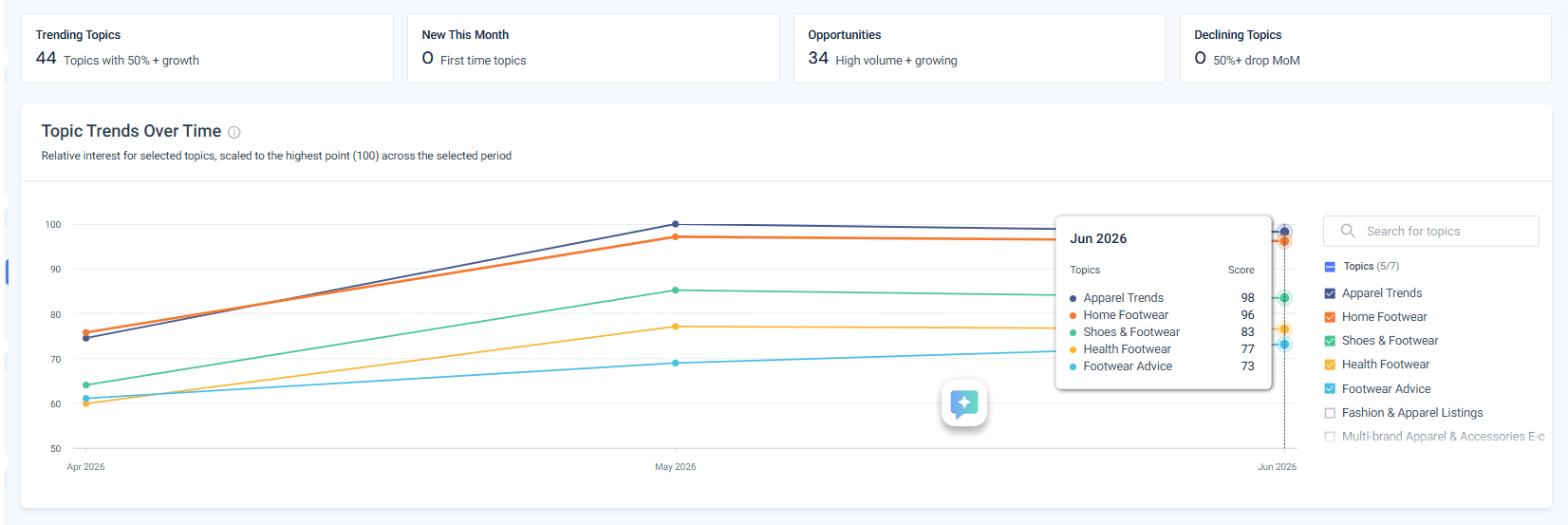
Every topic in the report carries an AI Interest Score, a 0–100 index showing how much attention that topic is getting in AI-generated answers relative to the single most-discussed topic in the category during the selected period. A score of 100 belongs to whichever topic drove the most AI answer volume, and a score of 50 means a topic generated roughly half that volume.
It’s a relative measure, not an absolute one, which is why it should never be read on its own, pair it with the month-over-month (MoM) change and the shape of the trend line before deciding anything.
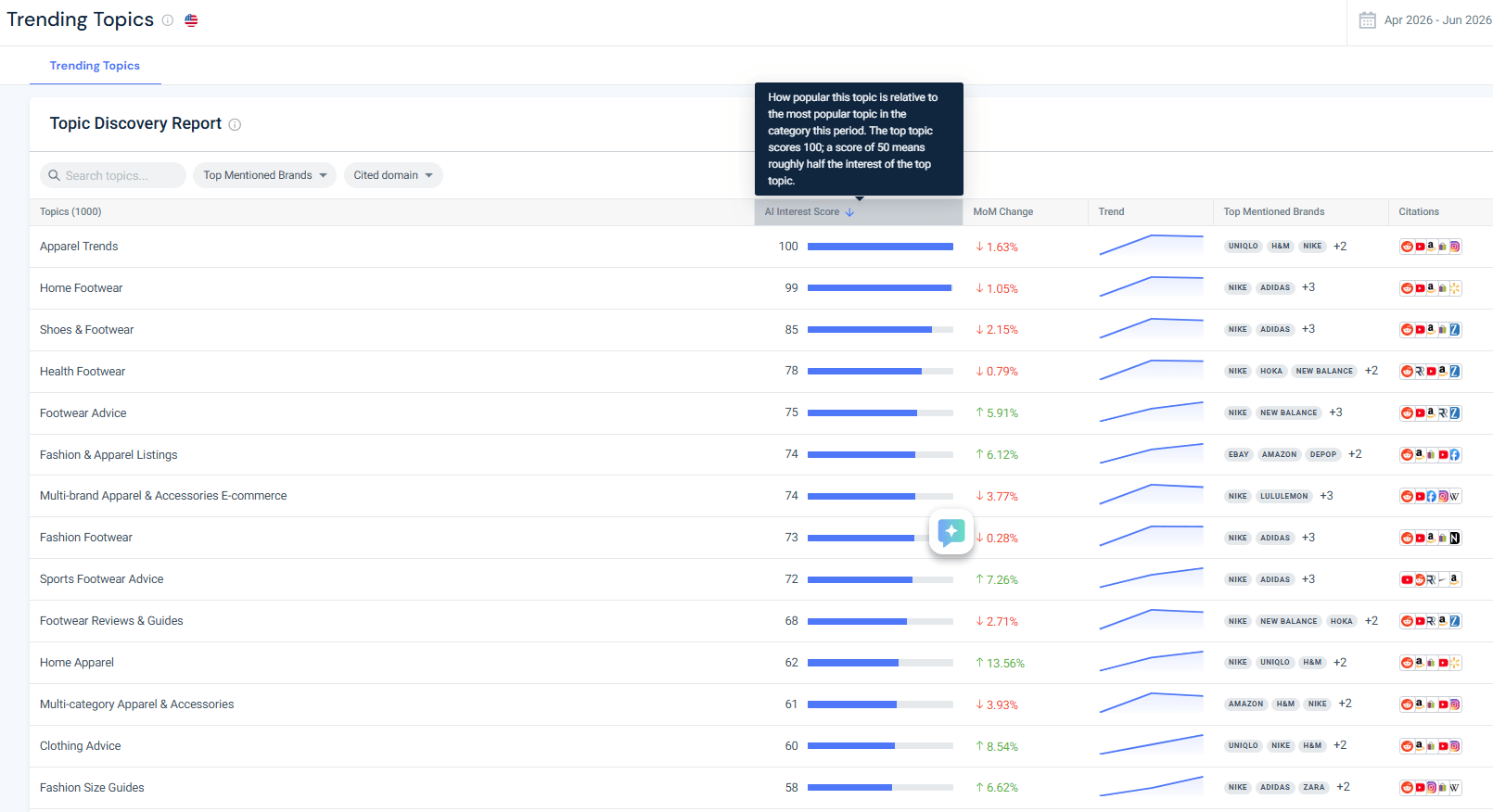
That pairing matters more than the score itself. In a live sporting-goods example, “Apparel Trends” scored 100 and “Home Footwear” scored 99, but both were down slightly month over month (-1.63% and -1.05%). Meanwhile, “Footwear Advice” scored a lower 75, with a 5.91% MoM increase, making it one of the fastest-growing topics in the category even though it didn’t have the highest score.
Read side by side, the picture flips: the two highest-scoring topics are cooling off, and a mid-scoring topic is where new content has the best odds of being noticed while the topic is still forming. The score alone would have pointed at the wrong one.
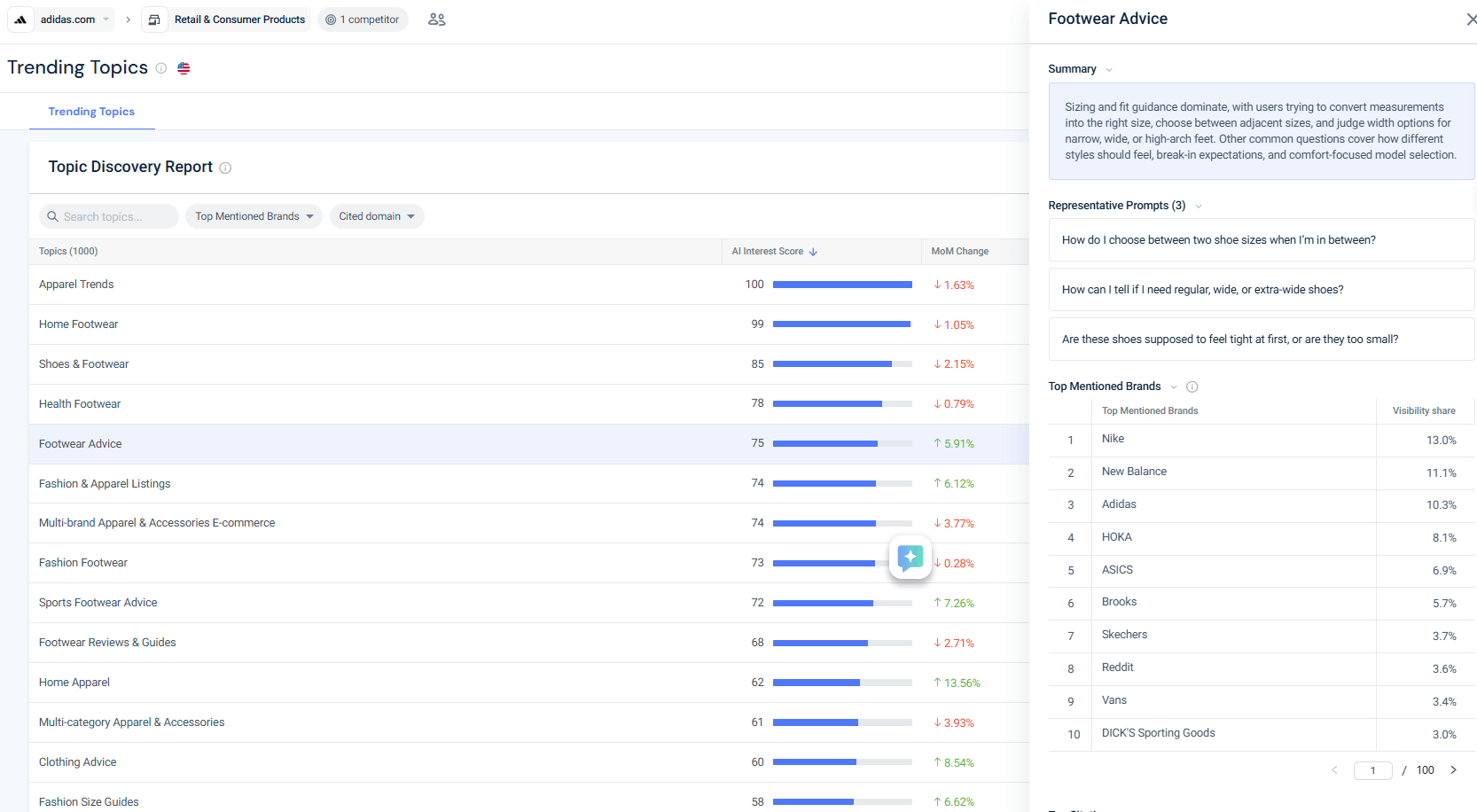
Every topic can be expanded into a detail panel that includes a written summary of what people are actually asking and a short list of representative prompts. For the Footwear Advice topic above, that list includes questions about converting between shoe sizes, telling regular from wide-width models, and whether new shoes are supposed to feel tight at first. These aren’t keywords, they’re the actual phrasing AI systems are fielding, and they’re the input for the next step. This is also where AI Interest Score and traditional search volume genuinely diverge: a topic can carry real AI-answer attention around prompts that have little to no measurable search-engine query volume, because the two are counting different behaviors.
Take the representative prompts and load them into Similarweb’s prompt tracker so they’re monitored for visibility, sentiment, and citations on an ongoing basis, not just captured once. A topic score is a snapshot. A tracked prompt is a time series, you need the second one to know whether anything you publish is actually working.
This is the step that turns a topic score into a prioritized investment decision. Once your prompts are running in a tracker, a prompt-tracking view will typically surface four counts: mention wins, mention gap, citation wins, and citation gap, the number of tracked prompts where your brand is mentioned or cited, and the number where a competitor is mentioned or cited and you are not.
Citation gap is the number to act on first: those are prompts where AI systems are already citing a competitor as the source, and you have zero presence.
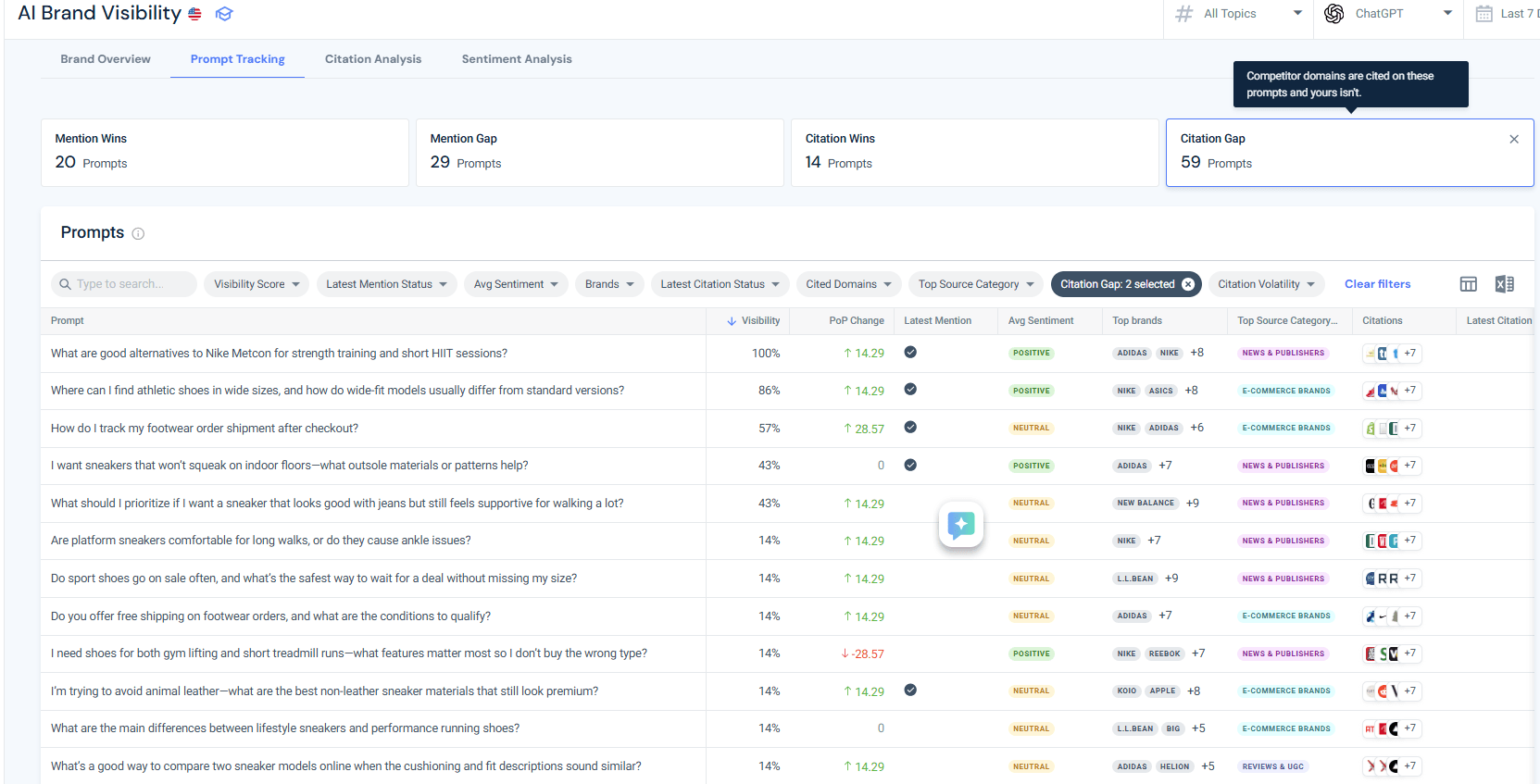
Then filter the mention gap view including two ways at once: “latest mention status: not mentioned” combined with a competitor brand filter.
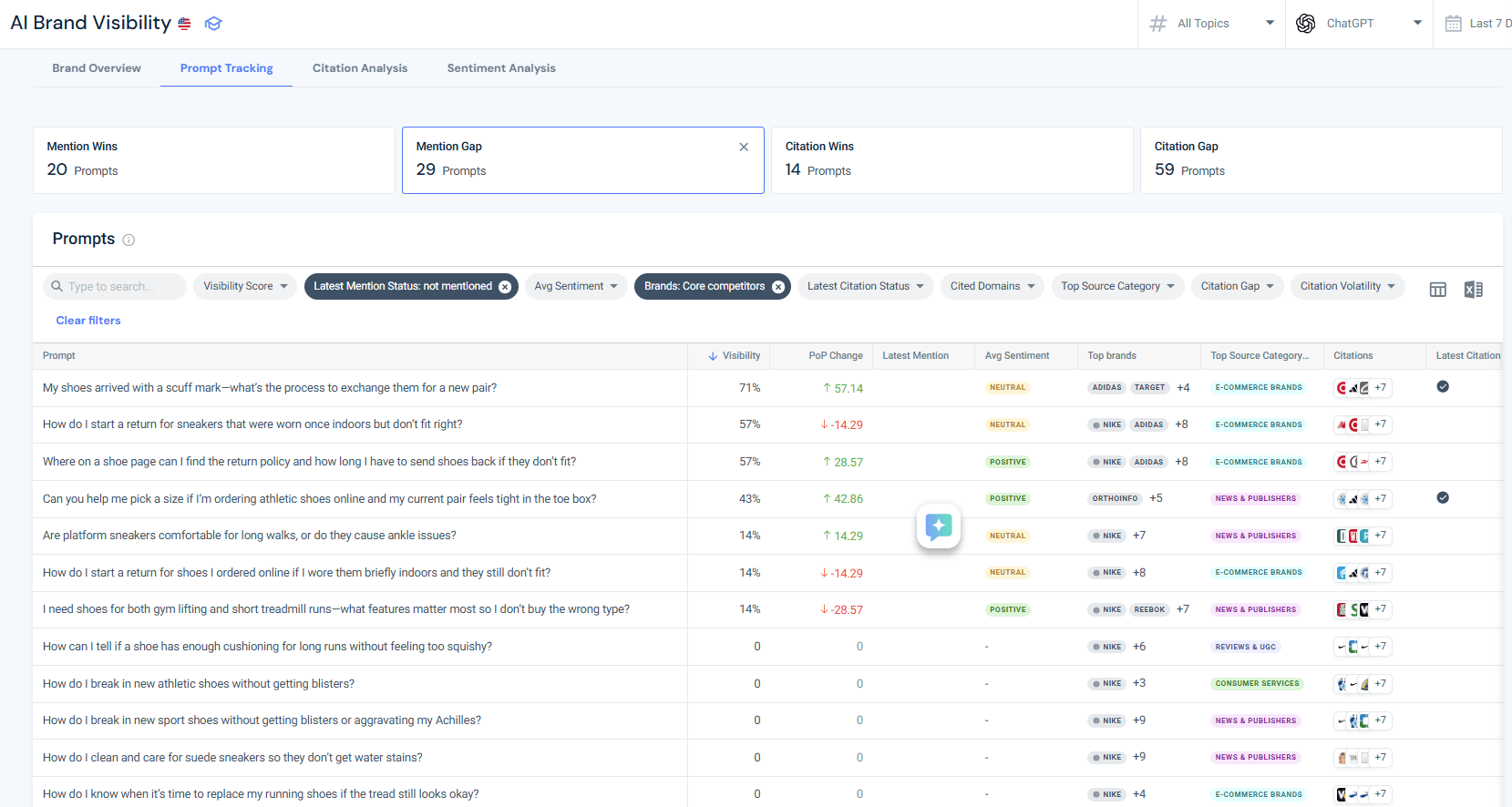
Now that we have these 2 datasets, we can check competitor gaps and decide what to focus on:
The gap concentrates in post-purchase and service prompts, not product recommendation prompts. The three highest-visibility rows in the citation-gap-filtered list are all service questions. Compare that to the unfiltered prompt list, where the highest-visibility prompts are product questions, and adidas already holds a recent mention on both. The gap isn’t in product recommendations, where adidas already shows up, it’s specifically in the service and policy layer.
PoP change inside the gap list moves in both directions, and the direction matters more than the visibility number. The exchange-policy prompt is up +57.14% month over month, a growing gap. But the “return for shoes worn briefly indoors” prompt, sitting at the same visibility score as the return-policy prompt, is down, and “shoes for both gym lifting and treadmill runs” is down more sharply despite carrying positive sentiment. Two prompts can show identical visibility and opposite trajectories, ranked by the PoP column, not the visibility column, when two gap prompts are close.
The single best opportunity in this list isn’t the highest-visibility one. “Can you help me pick a size if I’m ordering athletic shoes online” sits at only 43% visibility, lower than the three service prompts above it, but it’s rising +42.86% month over month and carries positive sentiment. That combination (moderate visibility, steep growth, favorable sentiment) is a stronger signal than a bigger but shrinking gap.
Zero-visibility rows are a different category of opportunity than the rest of the gap list. Five prompts in the filtered view: cushioning without squishiness, breaking in new shoes without blisters, caring for suede, and replacing worn shoes show no measurable presence for any brand at all, no change over the period, and no sentiment recorded, since there isn’t yet an answer pattern for anything to analyze. Even so, Nike still shows up as the top brand on every one of them, with several other brands trailing.
That’s not a competitor beating adidas on those prompts; it’s a prompt where visibility hasn’t consolidated around anyone yet, adidas included. Treat those as open-field opportunities rather than displacement plays, and prioritize them differently from the return/sizing prompts, which show an active, measurable gap against a specific competitor.
An AI Interest Score and a citation gap count are both moving targets. Set a weekly or monthly review of the same topic and prompt list, and track AI visibility momentum, the direction of change, not just the current rank, for both MoM change and citation gap count over time, rather than treating either as a one-time snapshot. A prompt with a shrinking citation gap after you’ve published against it is the closest thing this workflow has to a success metric.
Running the six steps on one topic is a one-off report. Running them as a standing process across every category you track is what actually compounds. Once the workflow is validated on a single topic, scale it two ways.
First, widen the topic net before you widen the prompt list. Pull the top 5–10 topics in each category you cover, sorted by MoM change rather than raw score, and only carry a topic into step 3 once it clears a minimum trend threshold you set for your category (a rising MoM change, not just a high starting score). This keeps the number of prompts entering your tracker proportional to real momentum, not to how many categories you happen to be watching.
Second, if you’re tracking more than one brand or competitor set, a multi-brand portfolio, or a category with a different competitive set per region, run step 5’s citation-gap filter separately for each brand-competitor pairing rather than pooling them into one list. A citation gap against one competitor set can look completely different from the gap against another, even on the identical prompt list, because different competitors are winning different prompts.
Keep the underlying prompt tracker shared across brands where the topics overlap, but keep the competitor filter and the resulting prioritized list separate for each one.
Once several topics are running through the process simultaneously, you’ll have more prompts with a nonzero citation gap than any content team can act on in a given cycle. Rank across topics, not just within one, using three cuts on top of each other: MoM change (is the topic still gaining), citation gap size (how much unclaimed ground exists), and citation-play-versus-click-opportunity from step 6 (whether closing the gap actually matters for your goals this quarter).
A topic with a smaller citation gap but a steep upward MoM trend and a clear citation-play profile will usually outrank a topic with a larger but flat, click-oriented gap, the smaller number is still growing, and closing it pays off in the metric you’re actually trying to move.
Keyword research in AI search starts with a topic score, but it’s decided by a citation gap. The six steps in between, reading the metrics correctly, pulling the real prompts, tracking them over time, and filtering for where competitors are already cited and you aren’t, are what turn a number on a dashboard into a specific, defensible answer to “what should we write this week.” Run it on one topic first, then scale the same process across every category and brand you’re responsible for.
If you’re building this workflow out for your own category, Similarweb’s AI Brand Visibility tools cover both halves, trending topic discovery and prompt-level competitive tracking, in the same place.
What’s the difference between an AI Interest Score and a keyword search volume?
Search volume counts actual queries typed into a search engine. An AI Interest Score measures how much of the AI-generated answer volume in a category a topic occupies, relative to the top topic in that category and period. They’re both demand signals, but they measure different behaviors and often diverge on the same subject.
How many representative prompts should I track per topic?
There’s no fixed number to select prompts you need to track, but starting with the full representative-prompts list a topic surfaces (typically three to a handful) and expanding based on which ones show a citation gap against competitors keeps the tracked list focused on prompts with evidence behind them, rather than every possible phrasing of a topic.
Is a high citation gap always a good reason to write content?
No. Cross-check it against step 6: if the underlying prompt behaves like a pure citation play with very little click behavior, prioritize being the cited source over traffic-focused formatting. If it still carries real click volume, treat it like any other high-intent opportunity.
How often should I re-run this process?
Review the same tracked prompt list on a weekly or monthly cadence rather than treating any single pull as final, both AI Interest Score and citation gap counts move as competitors publish and AI systems re-crawl.
What if a topic has a high AI Interest Score but no representative prompts worth targeting?
That’s a signal to move to the next topic in the category rather than force content around a topic where the underlying prompts don’t map to anything your brand can credibly answer, or where competitors have no measurable presence to catch up to.
Do I need a different prompt tracker for every brand I manage?
Not necessarily, share the underlying topic and prompt research where categories overlap, but keep the competitor citation-gap filter separate per brand, since the competitive set and the resulting gap list are rarely identical across brands.
Senior SEO Specialist at Similarweb
Maayan is a senior SEO specialist with 7+ years of experience in SEO. She loves complex research projects, creating SEO strategies and performing technical audits.
How to Optimize Your Homepage for AI Traffic

Is AI Replacing Search? What The 2026 Numbers Actually Reveal

ChatGPT vs Claude vs Gemini vs Perplexity: what 2026 usage data actually shows
Give it a try or talk to our insights team — don’t worry, it’s free!