


AI Citation Outreach: How to Turn Citation Data Into a Workflow Using Similarweb MCP
by Limor Barenholtz26 Min.
Oct 26, 2026
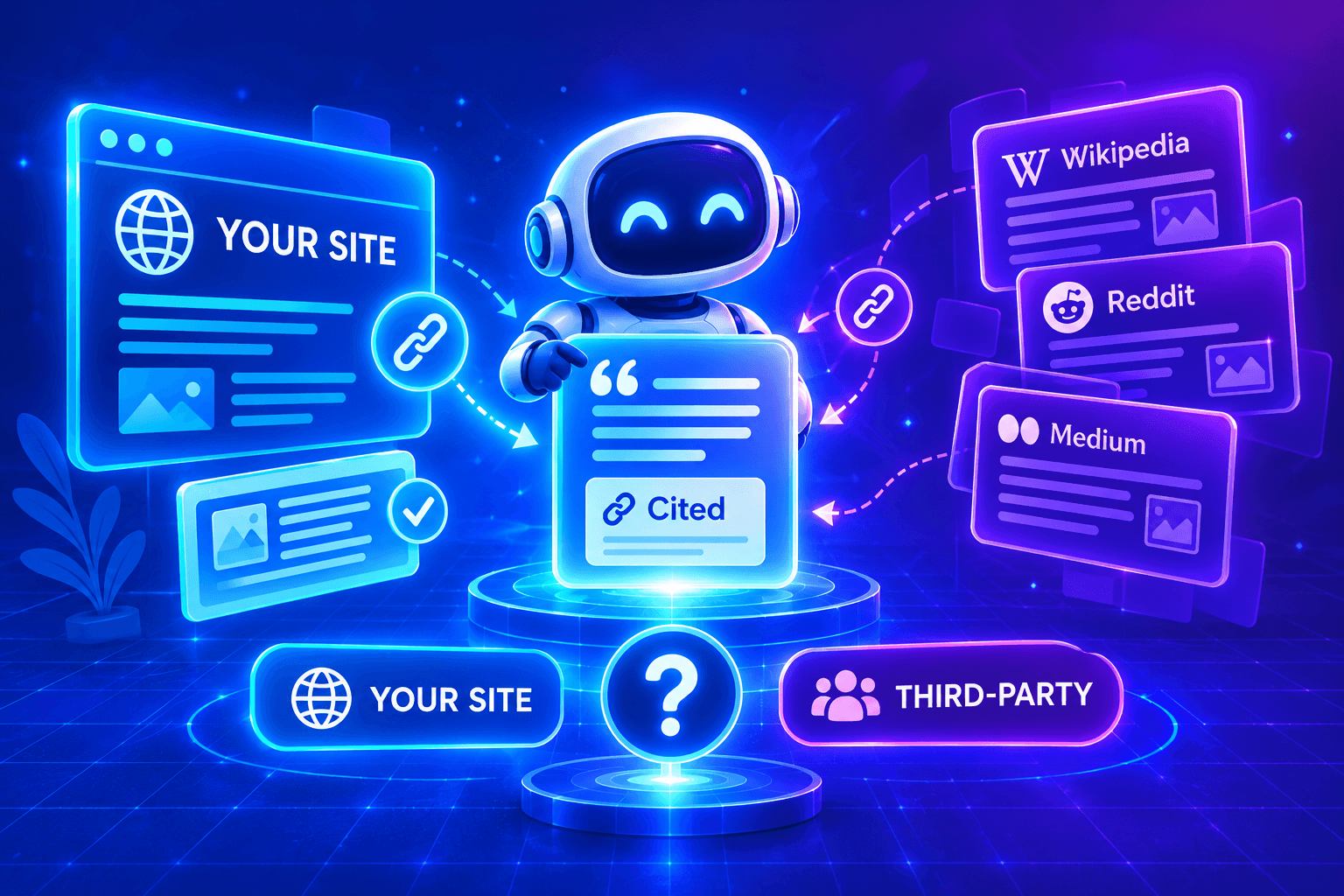
AI search citations look like a simple scoreboard until you compare studies. In a University of Toronto study of 143,249 answers from ChatGPT, Gemini and Perplexity, ChatGPT sent 64.3% of its citations to brand websites. In the same study, the client’s own domain earned just 11.1% across all three engines. Both numbers are real. One counts ChatGPT alone and every brand site, including competitors. The other counts all three engines and only the client’s own domain.
That is the core problem with AI search citations: the own-site versus third-party split is not one number. It moves with the engine, the question, whose site counts as yours and how well the model already knows your brand. This article reconciles the evidence and introduces the WHOSE framework, five checks (Which engine, How well the model knows you, Owner bucket, Subject of the question, Elapsed time) that turn a confusing benchmark into a decision.
By the end you will be able to sort your own citations into three buckets, explain why third-party pages usually win recommendations while your pages win facts, and decide where to spend effort for a brand of your size. We start with the numbers, then explain why they conflict, how retrieval decides eligibility, how brand size changes the answer, what makes your own pages citable, how to measure your split, and where to invest.
Third-party sites collect most AI citations. In a University of Toronto study of 143,249 consumer-market answers collected between June and September 2026, third-party sites earned 75.0% of citations, competitors’ sites 13.8% and the brand’s own site 11.1%. In a niche B2B market, the brand’s own site earned 2.6%.
An AI citation is a link an engine shows in an answer as a source. An own-site citation points to a domain you own. A competitor citation points to a rival brand’s domain. A third-party citation points to any other site: a publisher, review site, community forum, marketplace or encyclopedia. Using three buckets instead of two matters because many studies merge the first two into one “brand-owned” group.
The merge hides the real picture. In the Toronto consumer dataset, brand websites combined (the client plus its competitors) earned 24.9% of citations, but the client’s own domain earned 11.1%. In the niche B2B dataset (proposal software for architecture, engineering and construction firms, 14,850 answers), competitors earned 46.7% of citations and the client 2.6%. Vendor websites took about half of every engine’s citations there, yet the brand in question got a sliver.
The table below places four datasets side by side: two from the 2026 Toronto study, one from Shero Commerce, a Shopify agency whose July 2026 analysis covered 60 buying categories, and one from the Toronto group’s 2025 paper.
| Dataset | Market and method | Own or brand-owned share | Third-party or earned share |
|---|---|---|---|
| Toronto, October 2026 | US home internet, 143,249 answers, ChatGPT, Gemini and Perplexity via API, June to September 2026 | 11.1% own (13.8% competitors reported separately) | 75.0% |
| Toronto, October 2026 | Niche B2B proposal software, 14,850 answers, same engines | 2.6% own (46.7% competitors) | 50.8% |
| Shero Commerce, July 2026 | 60 buying categories, 1,851 cited sources, Google AI Mode, ChatGPT, Perplexity | 2.8% a brand’s own page | 59% publishers (largest category) |
| Toronto, September 2025 | US automotive ranking prompts, GPT with web search, August 2025 collection | 18.1% brand (official brand and retailer sites) | 81.9% earned |
The 2025 Toronto paper found the same direction: AI search engines leaned heavily toward earned media (third-party editorial and review sites) compared with Google’s more balanced mix of 39.5% brand, 15.4% social and 45.1% earned in US automotive queries.
Published numbers conflict because the split depends on the engine, the question, the definition of “own” and the market. In the same Toronto dataset, ChatGPT sent 64.3% of citations to brand websites, Gemini 16.8% and Perplexity 6.8%, so no single share describes AI search as a whole.
Yes, sharply. The table shows the three engines in the same study, using the same 651 questions about a US fiber internet provider.
| AI Engine | Pages cited per answer | Answers with no citation | Citations to brand websites (own plus competitors) |
|---|---|---|---|
| ChatGPT | 2.0 | 30.8% | 64.3% |
| Gemini | 10.1 | 15.6% | 16.8% |
| Perplexity | 0.3 | 95.8% | 6.8% |
The engine ordering also flipped between studies. In the September 2025 Toronto paper, ChatGPT was the most earned-heavy engine for well-known brands (93.5% earned, 6.5% brand) and Gemini the most brand-leaning (25.1% brand). In the 2026 paper, ChatGPT had the highest brand share of the three. Engine behavior changes with the question set and the model version, which is why a benchmark from one study period is a snapshot, not a rule.
It does, and this is the most likely explanation for the ChatGPT gap. The 2025 paper tested ranking-style prompts such as “Top 10 brands” and found that for consideration queries (for example, “Garmin vs Apple Watch”), earned content dominated every system. For transactional queries, brand content rose, and GPT amplified brand content the most. The 2026 paper asked provider-specific questions about pricing, equipment, customer support and reliability, where the natural source is the provider’s own page.
The papers do not test this explanation head to head, but the pattern fits: ranking prompts return editorial sites, and provider-specific questions return provider sites. Similarweb’s data shows the same intent effect. In our most cited domains analysis of nearly 600,000 citation events (US, January to February 2026), opinion and comparison prompts favored community platforms and niche publishers, while decision-focused prompts leaned toward major publishers, aggregators and brand sites.
Ownership is relative. In Similarweb’s January to February 2026 US data, openai.com was the third most cited domain in ChatGPT at 6.21% of citation events, ahead of Reuters, NIH, LinkedIn and every major retailer in the dataset. In Google AI Mode, google.com ranked fifth at 2.85%. For an engine’s publisher, “own site” is a top-five source. For almost every other brand, it is a rounding error.
Definitions differ too. The 2025 Toronto paper counts retailer domains as brand sites, the 2026 paper separates the client from competitors, and Shero counts only a brand’s own pages.
Takeaway: Before comparing any benchmark with your data, match three things: the engine, the question type and the definition of “own.” If any one differs, the numbers are not comparable.
AI engines cite only pages they retrieve first. In the Toronto replay of 22,315 cited URLs, every page ChatGPT cited had been returned by its own search, which consulted about 26 pages and cited 3 per question. Retrieval explained 32% of citation variation within a website, against 2.8% for page features.
This reframes the own-site problem. Much of it is an eligibility problem, not a preference problem. ChatGPT cited 43.8% of the pages it ranked first in its own list, 12.2% of those at ranks 6 to 10 and 3.5% at ranks 11 to 20. A page that never enters the list cannot be cited, however good it is.
That list does not look like a Google results page. For ChatGPT, 97% of the pages retrieved for an answer’s queries were absent from Google’s top 50. The engine also rewrites every question. It splits a question into about four keyword-style queries, adds the current year to 23% of them and adds a brand name the user never typed to 28%. Run the same question twice on the same day and the queries overlap by only 2.7%, while the cited pages overlap by 15%. Gemini behaves differently, writing about three natural-language sub-questions.
Once retrieved, brand pages are not disadvantaged. At equal rank, they were cited at 1.71 times the odds. Reddit threads (0.30 times), comparison pages (0.34) and list pages (0.54) were consulted often but cited rarely. In other words, third-party pages win more citations mainly because there are many more of them in the retrieved set, not because the engine prefers them at the final step.
Takeaway: Treat citation as a two-step funnel. First, get retrieved by matching the sub-queries the engine writes (see query fan-out for how to map them). Then earn the citation with a page that answers the question directly. For the second step, how AI chooses sites to cite covers the selection signals.
For brands the model already knows, 47% of ChatGPT’s citations came from websites its model names unprompted. For niche vendors, being named depended on third-party pages: a cited page that names a vendor raised the odds of the answer naming it 39.7 times in ChatGPT, against 4.2 times for large providers.
The Toronto team probed what each model knows before it searches. For the large providers in the consumer dataset, ChatGPT’s model named them for 61% to 72% of questions without any web search. For the small vendors in the niche dataset, it named them for 2% to 16%. That difference changes what drives visibility.
For known brands, the model’s memory does much of the work. ChatGPT wrote a brand into its searches 67% of the time when the brand was in its prior for the question, against 11% otherwise. In controlled tests with identical product facts, revealing brand names changed rankings 2.1 times as much as repeating the same prompt. One named provider lost 33 points in its top-three rate once its name was shown, while a niche vendor gained 16. The name carries what the model believes about the brand, good or bad.
For niche brands, search evidence does the work. Website authority had no effect in the niche market (a change of 1.3% fewer citations per standard deviation), against a 12.1% gain in the consumer market. A niche vendor is named mainly when a retrieved third-party page names it.
Naming and citing are also separate outcomes. In the consumer dataset, 46% of ChatGPT’s mentions of a brand the question did not name were supported by no cited page that names it. That gap is why AI mentions and AI citations need separate lines in your reporting. The 2025 paper saw the same big-brand pull: in cola prompts, major brands were 56.3% of ChatGPT’s brand mentions and 67.9% of Perplexity’s.
Takeaway: If your brand is niche, find the third-party pages the engines already retrieve for your category and earn a mention there. A citation gap analysis shows which pages cite your competitors but not you.
Open Similarweb AI citation analysis tool for your topic, label every cited domain as yours, a competitor’s or a third party’s, and compare each bucket’s share of citations. In the example below, the largest domains are mostly government and university sites, and epa.gov alone accounts for 112 of 1,360 cited URLs, about 8%.
A split only means something if every domain is labeled the same way each time. The WHOSE framework names the five variables that changed the result in the studies above. The tool supplies the data for each one.
Choose the topic view (S). Start with All Topics for the overview, as in the example, then filter to one topic at a time. Each URL carries topic tags (the example shows Pest control, Rodent management and Bed bugs). If your campaign tracks more than one engine, run the steps once per engine (W).
Read the domain map (O). The map shows the domains cited for the topic. Hover over a block to see its domain influence score, its source category and its number of cited URLs. In the example, epa.gov scores 100 with 112 cited URLs. Its neighbors are cdc.gov, ipm.ucanr.edu, npic.orst.edu, cals.cornell.edu, an NC State extension domain and humanepro.org. None is a company site.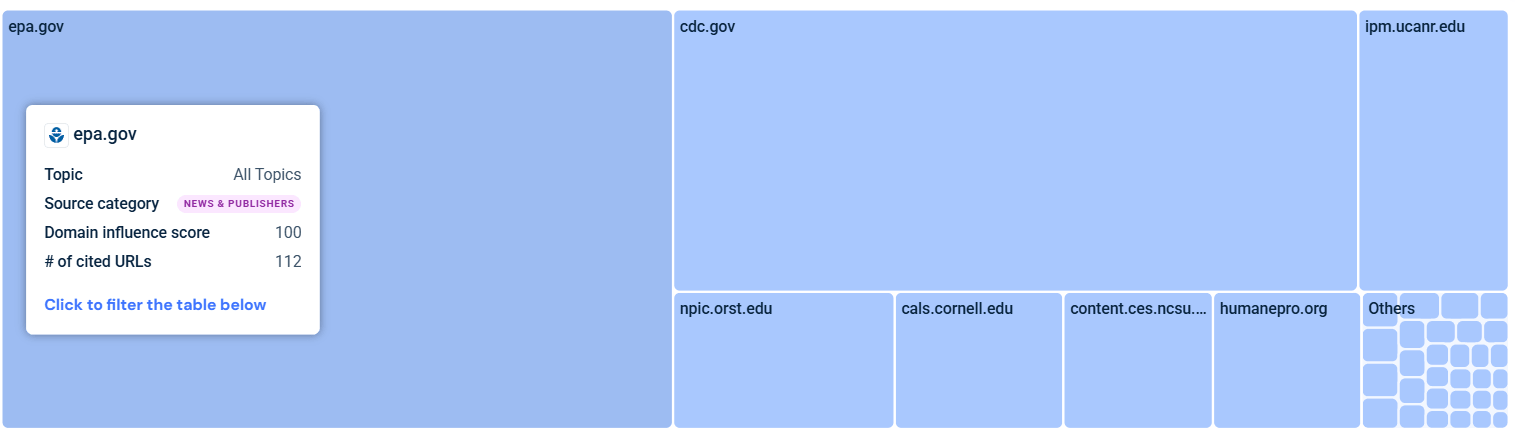
Open the URL table. Click a block to filter the table below it. The table lists every cited URL (1,360 in the example) with its influence score, whether your brand or competitors are mentioned, its source category, its topics and the number of responses that cited it.
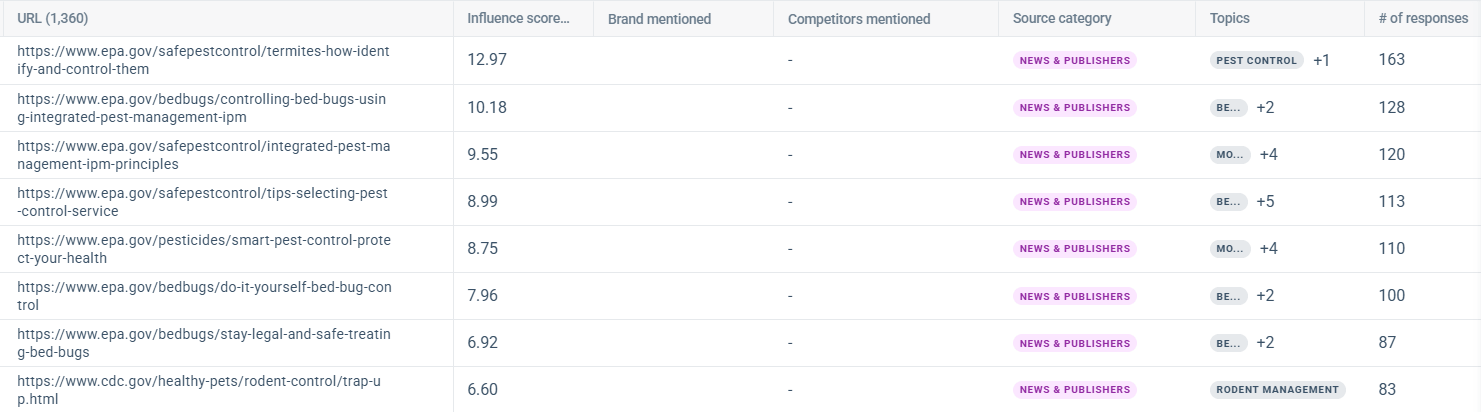
Calculate each bucket’s share. Pick one metric and keep it for every period. Counting cited URLs, epa.gov is 112 of 1,360, about 8%. Summing the responses column per bucket gives a response-weighted share instead. The two measures can rank domains differently, so never mix them in one comparison.
Find your citation gaps (H). Look for rows where competitors are mentioned and your brand is not. Those third-party pages already name your rivals. In the Toronto niche dataset, a cited page that named a vendor raised the odds of the answer naming it 39.7 times in ChatGPT, so these pages are your outreach targets.
Repeat on a schedule (E). The cited set drifts. In the Toronto study, about 40% of the repeatable variation in ChatGPT’s citations was still shared two weeks later and 14% after ten weeks. Re-run the same view monthly and compare it with the last period.
Record the result in a labeling sheet. One row from the example is filled in to show the format:
| Domain | Cited URLs | Influence score | Source category (from the tool) | Owner bucket (your label) | Brand or competitor mentioned? |
| epa.gov | 112 | 100 | News & Publishers | Third-party | No |
Takeaway: Run the seven steps on one topic this week. If your own domain does not appear among the largest blocks and third-party institutions dominate, as in the example, your work is on pages you do not own.
Third-party pages collect most AI search citations, but your own pages win when the question is about you, and your brand’s size decides whether the model remembers you or must find you.
Read together, the studies suggest a simple division of labor. Your own site answers “what is this brand?” Third-party pages answer “which brand should I pick?” A brand that invests only in its own site is missing the second question. A brand that invests only in off-site coverage hands the first question to whoever wrote about it first.
The practical move is to stop optimizing against a single percentage. Sort your citations into three buckets. Cut them by engine and by question type. Re-run the cut every month, because the cited set will drift. Then spend where the gap is: your own pages for facts and purchase questions, third-party coverage for comparison questions, and retrieval-matching titles and paragraphs for both.
Own-site citations are where AI search is easiest to influence, and third-party citations are where it is hardest to ignore. To see your own split, open AI Citation Analysis in Similarweb’s AI Search Intelligence, sort the cited domains into your own, competitor and third-party buckets, and find where your brand sits.
It depends on the question. A 2025 University of Toronto study found 93.5% earned sources for well-known brands on ranking-style prompts, while a 2026 study from the same group found brand websites earned 64.3% of ChatGPT’s citations on provider-specific questions. Once a page is retrieved, brand pages were cited at 1.71 times the odds of other pages at equal rank.
Not reliably. In the Toronto replay, 97% of the pages ChatGPT retrieved for an answer’s queries were absent from Google’s top 50. ChatGPT cites only pages its own search retrieves, and it rewrites each question into about four queries, so write pages that match those sub-queries, not only the head keyword.
Often. In the Toronto study, about 40% of the repeatable variation in ChatGPT’s citations was still shared two weeks later, 47% for Gemini and 22% for Perplexity. After ten weeks, the shared portion was 14%, 29% and 0%. Measure monthly against a fixed prompt set rather than relying on a single snapshot.
It varies widely by engine. In a 2026 University of Toronto study, ChatGPT cited 2.0 pages per answer, Gemini 10.1 and Perplexity 0.3, with Perplexity citing nothing in 95.8% of answers through its API. Fewer cited pages means fewer slots to compete for. The Perplexity figure may differ from the consumer app.
Get named on third-party pages the engines already retrieve. In the Toronto niche B2B dataset, a cited page that named a vendor raised the odds of the answer naming it 39.7 times in ChatGPT and 17.7 times in Gemini. ChatGPT’s model named those vendors unprompted in only 2% to 16% of answers, and website authority had no measurable effect.
Matching the question. Within the same website, pages whose title and best paragraph matched the question were cited 14.1% and 15.5% more per standard deviation of better match. Retrieval rank also matters: ChatGPT cited 43.8% of the pages it ranked first in its own list and 3.5% of those at ranks 11 to 20.
Senior SEO Specialist at Similarweb
Maayan is a senior SEO specialist with 7+ years of experience in SEO. She loves complex research projects, creating SEO strategies and performing technical audits.
AI Citation Outreach: How to Turn Citation Data Into a Workflow Using Similarweb MCP
Does Schema Markup Help You Get Cited By AI?
AI Search Optimization: Tips, Best Practices, and Techniques That Worked in 2026
Give it a try or talk to our insights team — don’t worry, it’s free!